CIN: U74999HR1985PLC034079
ISIN: INE527A01014
Face Value: ₹10 per share
Incorporated: 25 July 1985
Registered Office: Faridabad, Haryana
Listing Status: Unlisted Public Company
Promoter Holding: 97.03%
FY26 Revenue: ₹1,155.24 Cr
FY26 EBITDA: ₹208.99 Cr
FY26 PAT: ₹122.78 Cr
FY26 EPS: ₹96.12
Indicative Unlisted Price: ~₹1,725/share
Indicative Market Capitalisation: ~₹2,203 Cr
Executive Summary
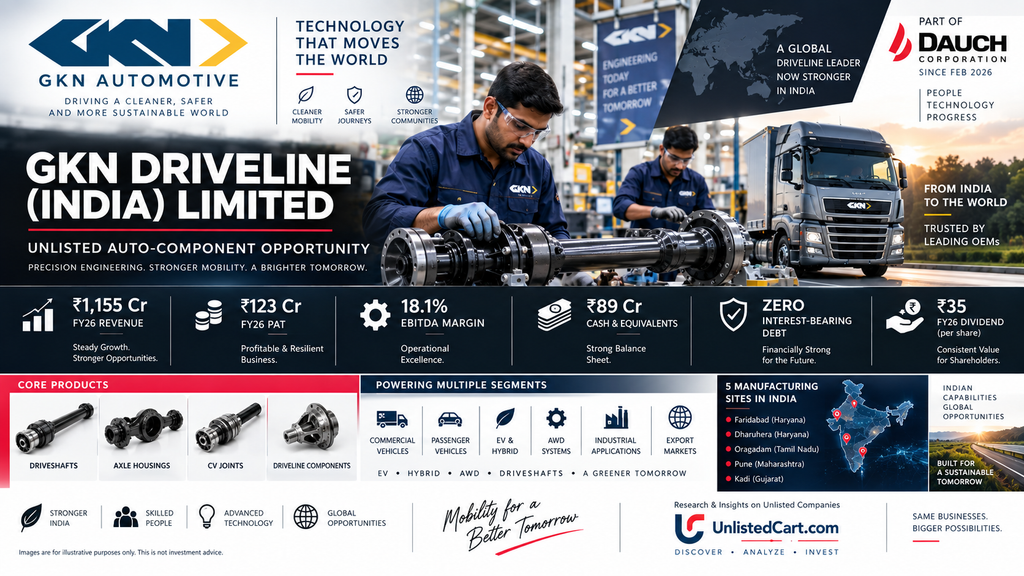
GKN Driveline (India) Limited is a long-established automotive component manufacturer focused primarily on driveshafts and driveline components supplied to automobile OEMs. The company operates five manufacturing locations in India at Faridabad, Dharuhera, Oragadam, Pune and Kadi.
The business has several characteristics that make it interesting in the unlisted market:
- Strong global parentage and technology support
- 97.03% ownership by GKN Driveline International GmbH
- Five manufacturing facilities across major automotive clusters
- Relationships with leading OEMs
- Zero interest-bearing debt at FY26 year-end
- Strong cash generation
- FY26 EBITDA margin expanded to ~18%
- PAT increased by more than 26%
- Significant exposure to new ICE, hybrid and EV programs
- ₹35/share FY26 dividend
- Very high ROE of approximately 30%
The major question is valuation rather than business quality.
At an indicative price of around ₹1,725, the company trades at approximately 17.9x FY26 earnings and around 5.2x book value, according to the latest UnlistedZone reference. Other unlisted-market sources have quoted materially different prices, demonstrating the illiquidity and price-discovery risk inherent in the security.
Our overall view is positive on the business, but valuation-sensitive on the stock.
Company Overview
GKN Driveline (India) Limited was incorporated in 1985 and is engaged primarily in manufacturing and selling driveshafts and related components to automotive OEMs.
The company has five manufacturing locations:
- Faridabad, Haryana
- Dharuhera, Haryana
- Oragadam, Tamil Nadu
- Pune, Maharashtra
- Kadi, Gujarat
The official GKN Automotive location network confirms these Indian manufacturing facilities.
The company operates as part of the global GKN Automotive business.
A significant corporate development occurred in February 2026. Dauch Corporation, formerly American Axle & Manufacturing, completed the acquisition of Dowlais Group and its subsidiaries, including GKN Automotive and GKN Powder Metallurgy. GKN Driveline (India) Limited continues under its existing legal name, while its ultimate group ownership is now under Dauch.
GKN Automotive official website
Business Model
GKN Driveline India’s core business is manufacturing driveline products for vehicle manufacturers.
Its products are critical components that transfer power from the powertrain to the wheels.
The company’s financial statements identify manufacturing of driveshafts as its primary business segment.
The broader GKN Automotive product portfolio includes:
- Sideshafts
- Propshafts
- AWD systems
- Torque management devices
- Constant velocity joints
- Driveline systems for ICE, hybrid and electric vehicles
GKN Automotive positions itself as a global leader in drive systems and serves automotive manufacturers across multiple vehicle architectures.
Manufacturing Footprint
The company’s five-plant network gives it proximity to major automotive manufacturing clusters.
This is strategically important because automotive component suppliers benefit from:
- Lower logistics costs
- Faster OEM response
- Local engineering support
- Just-in-time supply capabilities
- Long-term OEM relationships
The Indian operations therefore have both manufacturing and engineering relevance within the larger GKN/Dauch ecosystem.
Customer & OEM Relationships
The company has demonstrated relationships with several leading automotive manufacturers.
FY26 disclosures highlight quality and customer programs involving:
- Maruti Suzuki
- Toyota
- Tata Motors
- Renault-Nissan
- Mahindra
- MG Motor
- Hyundai
- Bajaj Auto
- Dana
- Fiat
For example, the Oragadam facility received Toyota’s Zero PPM Award for the 10th time, maintained Renault-Nissan Level-1 performance for 11 consecutive years and retained Green Status with Maruti Suzuki. Pune and Kadi also received quality awards from Maruti Suzuki and Bajaj Auto.
These relationships are an important competitive advantage because automotive programs generally require extensive validation and supplier qualification before commercial production.
FY2025–26 Financial Performance
| Particulars | FY23 | FY24 | FY25 | FY26 |
|---|---|---|---|---|
| Revenue | ₹984 Cr | ₹1,052 Cr | ₹1,092 Cr | ₹1,155 Cr |
| EBITDA | ₹140 Cr | ₹151 Cr | ₹175 Cr | ₹209 Cr |
| EBITDA Margin | 14.2% | 14.4% | 16.0% | 18.1% |
| PBT | ₹105 Cr | ₹116 Cr | ₹130 Cr | ₹158 Cr |
| PAT | ₹78 Cr | ₹86 Cr | ₹97 Cr | ₹123 Cr |
| EPS | ₹61.42 | ₹67.72 | ₹76.08 | ₹96.12 |
FY26 revenue increased 5.81%, while EBITDA increased substantially faster at around 19%. PAT increased to ₹122.78 Cr from ₹97.18 Cr.
This is an important feature of the FY26 performance:
Profit growth was significantly stronger than revenue growth.
That indicates meaningful operating leverage and margin improvement.
Revenue Mix
FY26 revenue from operations was ₹1,155.24 Cr.
Sale of goods contributed ₹1,132.26 Cr, while other operating revenue contributed approximately ₹22.79 Cr.
The company generated approximately:
- ₹1,017 Cr domestic goods revenue
- ₹115 Cr overseas goods revenue
Overseas goods revenue more than doubled from ₹53.47 Cr in FY25 to ₹114.91 Cr in FY26.
This export growth is one of the more interesting aspects of the FY26 numbers.
Domestic sales were broadly stable, while exports provided a meaningful incremental growth contribution.
Margin Expansion
FY26 EBITDA increased to ₹208.99 Cr from ₹175.10 Cr.
EBITDA margin therefore expanded from approximately 16.0% to 18.1%.
PAT margin increased from approximately 8.9% to 10.6%.
The improvement is significant because automotive component companies are often exposed to:
- Steel prices
- Labour costs
- Energy costs
- OEM pricing pressure
- Currency movements
- Capacity utilisation
Sustaining an 18%+ EBITDA margin will therefore be an important factor in determining whether the current valuation is justified.
Balance Sheet Strength
The balance sheet is one of GKN Driveline India’s strongest characteristics.
FY26 Balance Sheet
- Total assets: ₹677.12 Cr
- Net worth/equity: ₹412.67 Cr
- Cash & cash equivalents: ₹88.80 Cr
- Inventory: ₹110.23 Cr
- Trade receivables: ₹162.09 Cr
- PPE: ₹256.99 Cr
- CWIP: ₹7.76 Cr
- Interest-bearing borrowings: Nil
The company specifically states that it had no interest-bearing borrowings at March 31, 2026. Its financing obligations primarily consisted of lease liabilities.
This provides substantial financial flexibility.
Cash Flow Analysis
FY26 operating cash flow stood at approximately ₹97.86 Cr.
Cash flow from investing activities was negative ₹33.70 Cr, while financing cash flow was negative ₹41.03 Cr, primarily because of dividend payments and lease-related payments.
Cash and cash equivalents increased from ₹65.68 Cr to ₹88.80 Cr.
The combination of:
High profitability + zero debt + positive operating cash flow
is a major positive for the company.
Working Capital
One area that deserves monitoring is working capital.
Trade receivables increased from ₹136.38 Cr to ₹162.09 Cr, while inventories increased from ₹98.56 Cr to ₹110.23 Cr.
The company reports that its normal credit period for sales is approximately 30–90 days.
Although the majority of receivables are classified as good, the increase in receivables consumed cash during FY26.
For investors, the key monitorable is therefore:
Can revenue growth continue without a disproportionate increase in receivables and inventory?
Parentage & Dauch Advantage
The company is 97.03% owned by GKN Driveline International GmbH.
Following the February 2026 transaction, GKN Automotive became part of Dauch Corporation.
The Indian company continues to receive technology and functional support from the global group.
The FY26 annual report states that the company continuously imports technology from the Dauch Group under its Technical Collaboration Agreement and receives support in areas including:
- Marketing
- Human resources
- Application engineering
- Supply management
- Information technology
This global linkage can help the Indian subsidiary access new products and global vehicle programs.
EV & Hybrid Opportunity
A particularly important part of the investment thesis is that GKN’s technology is not restricted to traditional internal-combustion vehicles.
The FY26 report specifically mentions:
- AWD applications
- Electric vehicle applications
- Hybrid vehicle applications
- Lightweight products
- Hollow shaft technology
- New-generation joints
- ePT solutions
- New business from EV and ICE programs
The company reported winning new business in both ICE and EV segments from local and global OEMs.
This is important because the transition to EVs does not eliminate the requirement for driveline components across all vehicle architectures.
GKN Automotive’s global product portfolio is explicitly designed to support electric, hybrid and ICE vehicles.
R&D Investment
FY26 R&D expenditure was approximately:
- Capital: ₹3.52 Cr
- Recurring: ₹10.26 Cr
- Total: ₹13.78 Cr
The company is investing in new-generation joints, NVH capabilities, lightweight products, testing infrastructure, prototype capabilities and EV/AWD applications.
This is a positive sign because automotive component businesses need continuous engineering investment to remain part of future vehicle platforms.
Dividend Track Record
For FY26, the company declared an interim dividend of:
₹35 per share
This was proposed to be treated as the final dividend for FY2025–26.
With 12.773 million shares outstanding, the total FY26 dividend payout was approximately ₹44.7 Cr.
At an indicative market price of ₹1,725, the dividend yield is approximately 2.0%.
The dividend is therefore an additional positive, although the primary investment thesis remains earnings growth rather than dividend yield.
Related-Party Costs
Investors should also examine the company’s relationship with the global group.
FY26 expenses included:
- Management consultancy/business auxiliary services: ₹112.37 Cr
- Strategic management charges: ₹22.83 Cr
- Trademark fees: ₹138.80 Cr
The annual report identifies these payments to group entities including GKN Automotive Ltd., UK and GKN Investment III GP Ltd.
These payments are part of the group’s operating structure and should not automatically be treated as negative.
However, for valuation purposes, investors should monitor whether the company’s margin expansion remains sustainable after all group-level charges.
Competitive Advantages
1. Strong Global Parentage
97.03% ownership by the global GKN/Dauch group provides access to technology, engineering capabilities and global automotive programs.
2. Established OEM Relationships
The company has demonstrated relationships and quality recognition from major OEMs including Maruti Suzuki, Toyota, Tata Motors, Renault-Nissan and others.
3. High Entry Barriers
Automotive driveline components require:
- Engineering expertise
- Validation
- Quality certifications
- OEM approvals
- Long development cycles
- Manufacturing precision
These factors make replacing an established supplier more difficult than in many generic manufacturing businesses.
4. Debt-Free Balance Sheet
Zero interest-bearing debt significantly reduces financial risk.
5. EV & Hybrid Readiness
The company’s engineering initiatives increasingly cover hybrid and EV applications.
6. Strong Cash Generation
FY26 operating cash flow of nearly ₹98 Cr provides capacity for dividends, capex and future expansion.
Key Growth Drivers
Automotive Volume Growth
India’s FY26 automotive industry recorded strong growth, supporting demand for components. The company’s annual report highlighted 13.3% overall retail growth, with passenger vehicles growing 13% and commercial vehicles 11.74%.
Export Expansion
Overseas goods revenue increased significantly in FY26, providing an additional growth avenue.
EV & Hybrid Programs
New business wins and engineering development for EV, hybrid, AWD and ePT applications could support the next growth cycle.
Global Dauch Integration
The combination of Dauch/AAM and GKN Automotive creates a larger global driveline platform and may provide additional technology and customer opportunities.
Margin Expansion
If the company can sustain EBITDA margins near 18%, earnings could grow faster than revenue.
Key Risks
1. Valuation Risk
At ₹1,725, the company is already valued at around 17.9x FY26 EPS and approximately 5.2x book value.
This leaves less room for disappointment compared with a deep-value unlisted opportunity.
2. Automotive Cyclicality
The company remains dependent on automobile production and OEM demand.
A slowdown in passenger vehicles or commercial vehicles could impact volumes.
3. Customer Concentration
The business is OEM-focused. Although the annual report states that it has many Indian OEM customers, automotive suppliers remain exposed to the production schedules, pricing negotiations and model cycles of their customers.
4. Steel & Commodity Costs
Steel and other raw materials form a significant portion of manufacturing costs. Changes in raw-material prices can affect margins and working capital.
5. Related-Party Charges
Technology, trademark, management and strategic charges to group entities are meaningful and should be monitored.
6. Unlisted Liquidity
There is no continuous NSE/BSE market.
The indicative prices from different unlisted-market platforms can vary materially. Investors should not treat any displayed price as equivalent to an exchange-traded market price.
Current Unlisted Price & Valuation
As of September 2026, the indicative market price references vary:
| Source | Indicative Price |
|---|---|
| UnlistedZone | ₹1,725 |
| Planify | ₹1,695 |
| Chryseum | ₹2,020 |
These are indicative unlisted-market references and not exchange-traded prices.
This price dispersion itself is an important risk factor.
Valuation at ₹1,725
Based on FY26 EPS of approximately ₹96.12:
- P/E: ~17.9x
- P/B: ~5.2x
- Dividend yield: ~2.0%
- Market cap: ~₹2,203 Cr
- EV/EBITDA: approximately 10x, after considering the company’s cash balance
The company therefore cannot be classified as a traditional low-P/E deep-value opportunity.
Earnings-Based Valuation Sensitivity
Using FY26 EPS of ₹96.12:
| P/E Multiple | Indicative Value |
|---|---|
| 12x | ₹1,153 |
| 14x | ₹1,346 |
| 16x | ₹1,538 |
| 18x | ₹1,730 |
| 20x | ₹1,922 |
| 22x | ₹2,115 |
| 25x | ₹2,403 |
This gives an important perspective.
At ₹1,725, the market is effectively assigning approximately an 18x earnings multiple.
Therefore, investors buying around current levels are relying on:
- Continued earnings growth
- Sustainability of 18% EBITDA margins
- EV/hybrid business wins
- Export growth
- Dauch group synergies
- Continued strong cash generation
IPO / Listing Status
GKN Driveline (India) Limited remains an unlisted public company.
There is currently no confirmed IPO date. Current unlisted-market research also indicates that no DRHP has been filed. An eventual IPO should therefore be treated as a possibility rather than a guaranteed catalyst.
Investors should avoid paying an excessive premium solely on the assumption that the company will list.
Investment View
Business Quality: 8.5/10
A high-quality automotive component franchise with strong OEM relationships, global technology, multiple manufacturing facilities and an experienced parent group.
Financial Strength: 9/10
Excellent balance sheet with zero interest-bearing debt, strong cash generation and approximately ₹89 Cr cash at FY26 year-end.
Growth Potential: 8/10
EV/hybrid applications, exports, new OEM programs and Dauch integration provide multiple potential growth avenues.
Valuation: 6.5/10
The company is financially strong, but the current indicative valuation around 18x FY26 earnings already discounts a meaningful portion of the quality.
Liquidity: 4/10
Unlisted shares have limited liquidity and significant price-discovery issues.
Overall Assessment
GKN Driveline (India) Limited is one of the more fundamentally attractive names in India’s unlisted auto-component space.
The investment case is supported by:
Strong parentage + established OEM relationships + debt-free balance sheet + high ROE + strong cash generation + EV readiness + export opportunity.
The biggest concern is not the balance sheet or business quality — it is the price at which the shares are acquired.
At around ₹1,700–₹1,750, the valuation appears broadly reasonable if FY26’s improved profitability can be sustained and earnings continue compounding.
At ₹2,000+, the margin of safety becomes considerably lower because the investor would be paying above 20x current earnings.
For a long-term investor, the most important variables to monitor are:
- FY27 revenue growth
- EBITDA margin sustainability
- Export growth
- New EV/hybrid program wins
- Working-capital intensity
- Group-related charges
- Dividend payout
- Any IPO/strategic corporate action
- Dauch integration benefits
- Sustainability of ~₹96 EPS
Our view: QUALITY BUSINESS — STRONG BALANCE SHEET — ATTRACTIVE LONG-TERM AUTO/EV EXPOSURE — BUT BUYING PRICE MATTERS.
Important Disclaimer
This report is prepared for educational and research purposes based on publicly available company filings, annual reports and unlisted-market information. Unlisted share prices are indicative and may differ materially from the actual transaction price. Unlisted securities carry significant risks including illiquidity, valuation uncertainty, limited price discovery, absence of continuous trading and the possibility of loss of capital.
Past financial performance does not guarantee future returns. An IPO or listing should not be assumed unless officially announced and approved through the applicable regulatory process. Investors should conduct their own due diligence and consult a SEBI-registered investment professional where appropriate.
For more such unlisted stocks visit https://unlistedcart.com/unlisted-shares/