
Sector: Defence & Aerospace / UAV & Drone Technology
Status: Unlisted Public Company
Former Name: Gamma Rotors Private Limited
CIN: U35999DL2018PLC332296
ISIN: INE1VD201014
Face Value: ₹2 per share
Incorporated: 10 April 2018
Registered / Operating Location: Delhi / Noida, Uttar Pradesh
Current Indicative OTC Price: ₹123–₹128/share
FY26 Revenue: ₹28.86 Cr
FY26 PAT: ₹3.39 Cr
Research Date: September 2026
1. Executive Summary
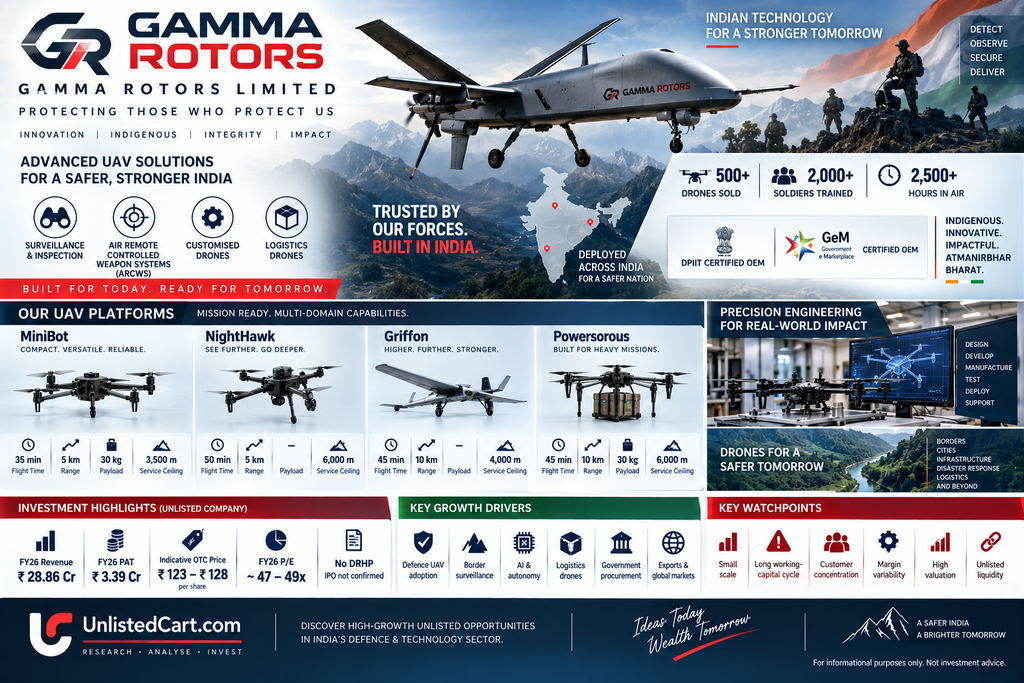
Gamma Rotors Limited is an Indian defence-drone and UAV company focused on designing, manufacturing, assembling and servicing unmanned aerial systems.
The company’s stated focus includes surveillance, inspection, logistics drones, customised UAVs and air remote-controlled weapon systems (ARCWS/RCWS). Its technology stack includes high-resolution imaging, long-range communication, lightweight composite materials, AI-enabled automation, advanced manufacturing and flight-control systems.
The company operates from Noida and describes itself as a DPIIT and GeM-certified OEM. Its official website reports more than 500 drones sold, 2,000+ soldiers trained and 2,500+ hours in air.
The financial trajectory has accelerated sharply:
FY23 revenue: ₹4.15 Cr
FY24 revenue: ₹11.18 Cr
FY25 revenue: ₹12.20 Cr
FY26 revenue: ₹28.86 Cr
FY26 PAT increased to approximately ₹3.39 Cr, up around 125% from FY25.
At an indicative price around ₹123–₹128, the company has an estimated market capitalisation of approximately ₹159–₹165 Cr and trades at roughly 47–48× FY26 earnings, using FY26 PAT and the current share count.
The key investment debate is therefore:
Rapid revenue growth + defence-drone opportunity + improving profitability
versus
small absolute scale + very long working-capital cycle + customer/order concentration + high earnings multiple + unlisted liquidity.
2. Company Overview
Gamma Rotors was incorporated in 2018 and has developed into an indigenous UAV manufacturer.
The company’s official website describes its mission as:
“Protecting Those Who Protect Us.”
Its focus is primarily on mission-oriented UAVs for defence, paramilitary, homeland security and industrial applications.
Official company resources
Official Gamma Rotors website:
Gamma Rotors Official Website
Official product portfolio:
Gamma Rotors Products
Official annual returns / financial filings:
Gamma Rotors Annual Returns
The company has published FY2024-25 and FY2025-26 annual-return documents on its official website.
3. Business Model
Gamma Rotors operates as an integrated UAV OEM.
Its business broadly covers:
Design → Engineering → Prototyping → Assembly → Integration → Testing → Deployment → Maintenance
The company uses in-house manufacturing techniques including:
- 3D printing
- Precision machining
- Composite materials
- Electronics integration
- Flight-control systems
- AI-enabled systems
- Imaging and sensing technology
This allows the company to customise UAV platforms according to customer requirements rather than operating purely as a drone reseller.
4. Core Business Areas
A. Surveillance & Inspection
The company develops drones for:
- Border surveillance
- Security
- Infrastructure inspection
- Mapping
- Industrial inspection
- Intelligence gathering
The official website specifically identifies surveillance and inspection as one of its principal application areas.
B. Air Remote-Controlled Weapon Systems
Gamma Rotors also lists air remote-controlled weapon systems among its core areas.
This positions the company in the specialised defence-UAV segment rather than solely in civilian photography or mapping drones.
C. Customised Drones
The company designs platforms according to:
- Payload requirements
- Endurance
- Range
- Sensors
- Communications
- Operating environment
- Mission requirements
This customisation can create higher-value engineering opportunities but can also increase project complexity.
D. Logistics Drones
The company also develops UAV platforms capable of carrying payloads for logistics and other specialised applications.
5. Technology Platform
Gamma Rotors identifies several technology areas as its competitive capabilities.
High-resolution imaging
Advanced cameras and sensors support aerial surveillance, inspection and data collection.
Long-range communication
Communication systems are designed to maintain connectivity over extended distances.
Lightweight composites
The company uses materials such as carbon fibre and titanium to reduce weight while maintaining strength.
Artificial intelligence
AI is used for applications including:
- Autonomous flight
- Obstacle avoidance
- Route planning
- Object recognition
- Automated decision support
Advanced manufacturing
The company uses:
- Additive manufacturing
- Precision machining
- Rapid prototyping
Advanced flight controls
Algorithms are used for navigation, stability and operation in difficult environments.
6. Product Portfolio
Gamma Rotors currently lists multiple UAV platforms.
MiniBot
The company describes MiniBot as a compact surveillance platform.
Reported specifications include:
- Maximum flight time: 35 minutes
- Maximum range: 5 km
- Service ceiling: 3,500 m
- Payload capacity: 30 kg
- Operating temperature: -20°C to 50°C
NightHawk
NightHawk is positioned as a high-endurance surveillance UAV.
Company-stated specifications include:
- Flight time: 50 minutes
- Service ceiling: 6,000 m
- Range: 5 km
- Operating temperature: -20°C to 50°C
The company highlights day-vision and infrared capabilities for surveillance applications.
Griffon
Griffon is positioned as a high-altitude surveillance platform.
Company-stated specifications include:
- Flight time: 45 minutes
- Range: 10 km
- Service ceiling: 4,000 m
- Payload capacity: 30 kg
- Operating temperature: -20°C to 50°C
Powersorous
Powersorous is designed around heavy-payload applications.
Company-stated specifications include:
- Flight time: 45 minutes
- Range: 10 km
- Service ceiling: 6,000 m
- Payload capacity: 30 kg
The company positions it for applications including heavy-payload operations, surveys and emergency logistics.
7. Customers & Government Exposure
Gamma Rotors’ official website displays organisations including:
- Indian Army
- CISF
- Delhi Police
- Andhra Pradesh Police
- Mumbai Traffic Police
- BSF
- NSG
- RPF
- ITBP
These displayed logos indicate the company’s stated clientele/engagement ecosystem, although the website alone does not provide contract values or revenue contribution by individual customer.
For an investor, the more important issue is to determine:
Which customers have recurring orders versus one-time deployments?
This distinction is particularly important for a small defence company.
8. Government & Defence Opportunity
The Indian UAV industry is benefiting from increasing demand for:
- Border surveillance
- Counter-infiltration
- Intelligence
- Reconnaissance
- Disaster management
- Logistics
- Infrastructure inspection
- Police and homeland security
Gamma Rotors’ DPIIT and GeM certification supports its ability to participate in government procurement channels.
However, government procurement can involve:
- Long tender cycles
- Qualification requirements
- Delayed orders
- Payment cycles
- Working-capital pressure
This is directly relevant to Gamma Rotors’ balance-sheet profile.
9. Industry Opportunity
India’s drone industry is expanding across defence and civilian applications.
For defence-focused companies, the addressable opportunity extends beyond the drone itself into:
Sensors + communication + software + payload + ground control + maintenance + training
This can increase revenue per deployed system.
Gamma Rotors’ integrated model gives it the opportunity to participate in multiple layers of the UAV ecosystem.
However, the industry is competitive and includes both established defence companies and numerous specialised drone startups.
10. Financial Performance
Consolidated/Standalone financial summary
₹ Crore
| Particulars | FY23 | FY24 | FY25 | FY26 |
|---|---|---|---|---|
| Revenue | ₹4.15 | ₹11.18 | ₹12.20 | ₹28.86 |
| EBITDA | ₹1.10 | ₹2.07 | ₹2.68 | ₹4.20 |
| PBT | ₹0.22 | ₹1.22 | ₹2.21 | ₹3.96 |
| PAT | ₹0.15 | ₹0.86 | ₹1.51 | ₹3.39 |
| EBITDA Margin | ~26.5% | ~18.5% | ~22.0% | ~14.6% |
| PAT Margin | ~3.6% | ~7.7% | ~12.4% | ~11.7% |
FY26 revenue increased approximately 136%, while PAT increased approximately 125%.
11. Revenue Growth
Gamma Rotors has grown from a very small base.
Revenue trajectory
FY21: ₹1.63 Cr
FY22: ₹3.38 Cr
FY23: ₹4.15 Cr
FY24: ₹11.18 Cr
FY25: ₹12.20 Cr
FY26: ₹28.86 Cr
From FY21 to FY26, this represents an approximate revenue CAGR of more than 75%, although the calculation is heavily influenced by the very small FY21 base.
The most important recent development is FY26:
₹12.20 Cr → ₹28.86 Cr
or approximately:
136% growth.
12. EBITDA Analysis
EBITDA increased from:
₹2.68 Cr in FY25
to approximately:
₹4.20 Cr in FY26.
However, EBITDA margin declined from approximately:
22.0% → 14.6%.
This is important.
The company achieved very strong revenue growth, but the incremental revenue came at a lower operating margin.
Therefore, future earnings growth will depend not only on revenue growth but also on whether Gamma Rotors can recover operating margins as it scales.
13. PAT Analysis
PAT increased:
₹1.51 Cr → ₹3.39 Cr
between FY25 and FY26.
That represents approximately:
125% growth.
PAT margin remained around:
11.7%.
This is a significant improvement compared with the company’s earlier years, although absolute profit remains small in comparison with listed defence companies.
14. Balance Sheet
FY25 balance-sheet figures provide an important insight into Gamma Rotors’ growth strategy.
| Particular | FY24 | FY25 |
|---|---|---|
| Total Equity | ₹8.26 Cr | ₹36.88 Cr |
| Total Debt | ₹1.21 Cr | ₹1.03 Cr |
| Total Assets | ₹16.29 Cr | ₹41.83 Cr |
| Inventory | ₹0.35 Cr | ₹15.19 Cr |
| Trade Receivables | ₹9.81 Cr | ₹1.53 Cr |
| Cash & Equivalents | ₹0.89 Cr | ₹13.21 Cr |
The sharp increase in equity was associated with a major capital raise, while debt remained relatively low.
15. Capital Raise & Balance-Sheet Transformation
One of the biggest changes occurred in FY25.
Gamma Rotors raised substantial equity capital, which increased total equity from approximately:
₹8.26 Cr → ₹36.88 Cr
while debt declined slightly.
Cash increased to approximately:
₹13.21 Cr
at FY25 year-end.
This gave the company a stronger balance sheet to support:
- Inventory procurement
- Product development
- Manufacturing
- Order execution
- Working capital
- Capacity expansion
16. Inventory Build-Up
One of the biggest FY25 changes was inventory.
Inventory increased from approximately:
₹0.35 Cr → ₹15.19 Cr
in one year.
This is significant because inventory represented a substantial proportion of FY25 revenue.
The increase can be consistent with building stock ahead of expected defence orders, but investors should monitor whether the inventory converts into:
Revenue → Receivables → Cash
within a reasonable period.
A large inventory balance can become a risk if orders are delayed or products become obsolete.
17. Working-Capital Cycle
Working capital is arguably one of the most important risk areas in Gamma Rotors.
Independent reconstruction from the company’s audited financial statements indicates a cash-conversion cycle of approximately:
FY24: ~181 days
FY25: ~550 days
FY26: ~348 days
The FY26 figure improved substantially from FY25 but remained very high.
Why this matters
A company can report:
₹28.86 Cr revenue
and:
₹3.39 Cr profit
but if cash conversion is slow, the company may still need significant working capital to fund growth.
This becomes particularly important when serving government/security customers where procurement and payment cycles can be lengthy.
18. Cash Flow
The working-capital issue means operating cash flow should be monitored carefully.
The company historically experienced negative operating cash flows, and its FY23 audit contained qualifications related to financial-obligation concerns and certain documentation/payment matters. The FY24, FY25 and FY26 audits were reported as clean by the research reviewed for this report.
This represents an important improvement in audit quality, but the cash-conversion cycle remains elevated.
For future quarters, investors should focus on:
PAT vs CFO
rather than PAT alone.
19. FY26 Latest Financial Picture
The latest available FY26 data indicates:
Revenue: ₹28.86 Cr
EBITDA: ₹4.20 Cr
PBT: ₹3.96 Cr
PAT: ₹3.39 Cr
This represents a substantial scale-up from FY25.
The challenge is to determine whether FY26 represents:
A new sustainable revenue run-rate
or:
a project/order-driven spike.
The answer will become clearer through FY27 order wins and quarterly revenue conversion.
20. Current Unlisted Share Price
Current secondary-market references show Gamma Rotors around:
₹123–₹128/share
Recent references include:
- Moneycontrol: approximately ₹123
- Priveq: ₹128
- ShareSaathi: ₹128
- UnlistedZone: current market reference around ₹125
These are indicative OTC prices and not NSE/BSE exchange-traded prices.
Current indicative valuation
At ₹123:
Estimated market capitalisation ≈ ₹158.5 Cr
At ₹128:
Estimated market capitalisation ≈ ₹165.0 Cr
using approximately 12.888 million shares outstanding.
21. Valuation
Using FY26 PAT of approximately:
₹3.39 Cr
and approximately:
1.289 Cr shares
FY26 EPS is approximately:
₹2.63/share
At ₹123
₹123 ÷ ₹2.63 ≈
46.8× FY26 earnings
At ₹128
₹128 ÷ ₹2.63 ≈
48.7× FY26 earnings
Therefore, the current OTC valuation is approximately:
47–49× FY26 earnings
This is materially higher than what the headline FY25 earnings would have suggested.
Some unlisted-market websites display inconsistent P/E figures because of changes in share capital and historical EPS data. For example, Moneycontrol currently displays P/E of 106.84 while not showing current EPS, whereas using the latest FY26 PAT and current share count gives a substantially different figure.
For valuation purposes, the FY26 audited earnings/share count should therefore be used rather than blindly copying a website’s displayed P/E.
22. Valuation Sensitivity
Using FY26 EPS of approximately ₹2.63:
| P/E | Illustrative Value |
|---|---|
| 20× | ₹53 |
| 25× | ₹66 |
| 30× | ₹79 |
| 35× | ₹92 |
| 40× | ₹105 |
| 45× | ₹118 |
| 50× | ₹132 |
| 60× | ₹158 |
At approximately ₹125–₹128, the market is effectively assigning around:
47–49× FY26 earnings.
Therefore, future earnings growth becomes extremely important to valuation.
23. Earnings Growth Scenario
Illustrative scenario analysis, not forecasts:
If FY27 EPS reaches ₹4
At 30× → ₹120
At 40× → ₹160
If FY27 EPS reaches ₹5
At 30× → ₹150
At 40× → ₹200
If FY27 EPS reaches ₹6
At 30× → ₹180
At 40× → ₹240
This demonstrates why the market valuation is effectively dependent on Gamma Rotors continuing to scale its revenue and converting that scale into higher sustainable earnings.
24. Primary Funding Reference
The company completed a funding round in January 2025 at approximately:
₹137.42/share
on a split/bonus-adjusted basis according to current secondary-market research.
The current OTC reference of approximately ₹123–₹128 is therefore below that historical funding-round price.
However, a previous funding-round price should not automatically be treated as fair value, because:
- Capital structure may have changed
- Business scale may have changed
- Investor rights may differ
- Liquidity differs
- Valuation expectations may have changed
25. Shareholding Pattern
Current FY26 references show:
| Shareholder | Approx. Holding |
|---|---|
| Arpan Ghosh | 43.26% |
| Ramchandra Leasing & Finance Ltd | 16.83% |
| Sushmita Ghosh | 6.57% |
| Others | 33.34% |
Total:
100%
The presence of Ramchandra Leasing & Finance as a significant shareholder is notable.
It reportedly acquired an additional 5.55% stake in Gamma Rotors for approximately ₹3.04 Cr in 2025, taking its total holding to around 16.83%.
26. Management
The company is led by:
Arpan Ghosh – CEO / Founder
The founder remains the largest individual shareholder at approximately 43.26%.
Founder ownership provides meaningful alignment, although investors should separately evaluate governance, related-party transactions and capital allocation.
27. IPO / Listing Status
Gamma Rotors is currently:
Unlisted
and there is currently:
No DRHP filed
and therefore:
No confirmed IPO date.
Current unlisted-market sources explicitly report that no DRHP has been found.
Therefore, Gamma Rotors should not be promoted as a confirmed pre-IPO opportunity.
It is better described as:
An unlisted defence-drone company with potential future listing optionality, but no confirmed IPO process.
28. Competitive Advantages
Indigenous UAV development
The company develops and integrates its own UAV platforms rather than simply distributing third-party drones.
Defence orientation
Its products are designed around surveillance, security and specialised defence requirements.
Government ecosystem
DPIIT and GeM certifications support participation in government procurement.
Product diversity
The company has multiple UAV platforms with different endurance, payload and range characteristics.
Engineering capability
3D printing, precision machining, AI, communications and flight-control capabilities provide an integrated technology base.
Small-cap scalability
Because the current revenue base remains only around ₹29 Cr, successful large contracts can materially change the company’s scale.
29. Growth Drivers
1. Defence drone adoption
Increasing use of UAVs for surveillance and reconnaissance can expand the addressable market.
2. Border security
Long-endurance surveillance platforms can support border-monitoring applications.
3. Police & homeland security
Police and paramilitary applications provide a domestic market beyond the armed forces.
4. Logistics drones
Heavy-payload platforms create opportunities in logistics and difficult-terrain applications.
5. AI integration
AI-based navigation, object recognition and autonomous functions can increase product sophistication.
6. Export opportunity
Once products achieve sufficient qualification and reliability, export markets can expand the addressable opportunity.
7. Large-contract scalability
A few meaningful government/OEM contracts could have a disproportionate impact because the existing revenue base remains small.
30. Key Risks
1. Very small revenue base
Even after FY26 growth, revenue is only approximately ₹29 Cr.
This makes the business more vulnerable to individual contract cycles.
2. Working-capital risk
The approximately 348-day FY26 cash-conversion cycle remains high.
3. Customer concentration
Large defence/security contracts can create dependence on a limited number of customers.
4. Order timing
Government procurement can be irregular, producing significant year-to-year volatility.
5. Margin compression
EBITDA margin declined from approximately 22% in FY25 to 14.6% in FY26 despite strong revenue growth.
6. Valuation
At approximately 47–49× FY26 earnings, the OTC price already reflects considerable expectations of future growth.
7. Unlisted liquidity
There is no continuous NSE/BSE market.
Exit depends on finding a willing buyer.
8. Technology competition
The Indian drone ecosystem includes numerous startups and established defence companies.
9. Execution risk
Rapid scaling requires:
- Manufacturing capability
- Procurement
- Working capital
- Quality control
- After-sales support
- Skilled engineering personnel
10. No confirmed IPO
There is no DRHP currently filed, so investors should not build the valuation around a near-term listing assumption.
31. What Investors Should Monitor
Revenue
The most important question:
Can Gamma Rotors sustain ₹25–30+ Cr annual revenue and grow beyond it?
EBITDA margin
Monitor whether margins recover from approximately 14.6%.
PAT
PAT needs to grow faster than revenue for the current valuation to become more supportable.
Cash flow
Compare:
PAT vs Operating Cash Flow
every year.
Inventory
Monitor whether the large inventory build-up converts into sales.
Receivables
Long receivable cycles can create financing pressure.
Order book
The company should ideally disclose more information about:
- Order value
- Order pipeline
- Customer
- Delivery timeline
- Revenue recognition
IPO
Any future DRHP would materially change the investment framework.
32. Research Perspective
Gamma Rotors is a very different proposition from large listed defence companies.
It is a small, specialised UAV company where a few successful programmes can materially change the financial profile.
The FY26 numbers demonstrate this potential:
Revenue +136%
PAT +125%
However, the business is still early in its scale-up phase.
The most encouraging element is the combination of:
Revenue growth + improving profitability + low debt + stronger equity base + defence/UAV exposure.
The biggest concerns are:
Working capital + customer concentration + small scale + margin compression + high valuation.
At ₹123–₹128, the company is valued at approximately 47–49× FY26 earnings based on reconstructed FY26 EPS.
Therefore, the key investment question is not simply whether India’s drone industry will grow.
It is:
Can Gamma Rotors convert industry growth into a much larger and more profitable business while improving cash conversion?
33. Overall Assessment
Gamma Rotors represents an early-stage Indian defence-UAV company with exposure to a strategically important technology segment.
The company has several attributes that make it worth monitoring:
- Indigenous UAV technology
- Defence and security applications
- DPIIT and GeM certification
- Government/security customer ecosystem
- Multiple drone platforms
- AI and advanced manufacturing
- Strong FY26 revenue growth
- Improving profitability
- Relatively low debt
- Founder ownership
The financial trajectory is particularly noteworthy:
₹4.15 Cr revenue in FY23
→ ₹11.18 Cr in FY24
→ ₹12.20 Cr in FY25
→ ₹28.86 Cr in FY26.
At the same time, the business remains small and the cash-conversion cycle is unusually long.
The current valuation around ₹123–₹128 also implies approximately 47–49× FY26 earnings, meaning significant future growth is already reflected in the OTC valuation.
The company therefore needs to be evaluated through three lenses:
Business
Can Gamma Rotors win and execute larger defence/UAV programmes?
Financial
Can revenue growth translate into sustainable EBITDA, PAT and operating cash flow?
Valuation
Can future earnings growth justify the current ~47–49× FY26 earnings multiple?
The absence of a DRHP means there is currently no confirmed IPO catalyst. Any future listing should therefore be treated as optionality rather than the primary investment thesis.
34. Key Numbers at a Glance
| Parameter | Gamma Rotors |
|---|---|
| FY23 Revenue | ₹4.15 Cr |
| FY24 Revenue | ₹11.18 Cr |
| FY25 Revenue | ₹12.20 Cr |
| FY26 Revenue | ₹28.86 Cr |
| FY26 EBITDA | ₹4.20 Cr |
| FY26 EBITDA Margin | ~14.6% |
| FY26 PBT | ₹3.96 Cr |
| FY26 PAT | ₹3.39 Cr |
| FY26 PAT Margin | ~11.7% |
| FY26 EPS – reconstructed | ~₹2.63 |
| Current OTC Price | ₹123–₹128 |
| Implied Market Cap | ~₹159–165 Cr |
| Implied FY26 P/E | ~47–49× |
| FY26 Cash Conversion Cycle | ~348 days |
| Founder Holding | 43.26% |
| RLFL Holding | 16.83% |
| DRHP | Not filed |
| ISIN | INE1VD201014 |
| Face Value | ₹2 |
| Sector | Defence & Aerospace |
35. Important Links
Official Gamma Rotors Website:
Gamma Rotors
Company Products:
Gamma Rotors Product Portfolio
Annual Returns / Company Filings:
Gamma Rotors Annual Returns
Current Unlisted Market Reference:
Gamma Rotors – UnlistedZone
Current Financial Reference:
Gamma Rotors – WWIPL Financials
Current Market Reference:
Gamma Rotors – Moneycontrol
Disclaimer
This report is prepared for research and informational purposes using Gamma Rotors’ official website, company-published annual-return material and publicly available unlisted-market/financial information.
Unlisted share prices are indicative OTC references and are not NSE/BSE exchange-traded prices. Actual transaction prices may differ depending on liquidity, lot size, buyer/seller availability and transaction terms.
Financial ratios have been independently calculated where secondary databases contain inconsistent EPS or P/E data. Investors should verify the latest audited financial statements, capital structure, shareholding, ISIN and transferability before entering into an unlisted-share transaction.
The absence of a DRHP means there is currently no confirmed IPO timetable. Any potential future listing should not be assumed.
Valuation scenarios are illustrative and are not price targets or guaranteed returns.
For more such unlisted stocks visit https://unlistedcart.com/unlisted-shares/