
Unlisted Share Research Report
Company: EPPS Infotech Limited
Former Name: EPPS Infotech Private Limited / POSHS Infotech Private Limited
CIN: U72900MH2008PLC185738
Face Value: ₹10 per share
Incorporated: 12 August 2008
Registered Office: Mumbai, Maharashtra
Corporate Office: Pune, Maharashtra
Industry: Information Technology / Enterprise Software / ERP
Status: Unlisted Public Company
Proposed Exchange: BSE SME
Proposed IPO: Fresh issue of up to 25 lakh equity shares
FY2025 Revenue: ₹34.52 Cr
FY2025 PAT: ₹14.57 Cr
Executive Summary
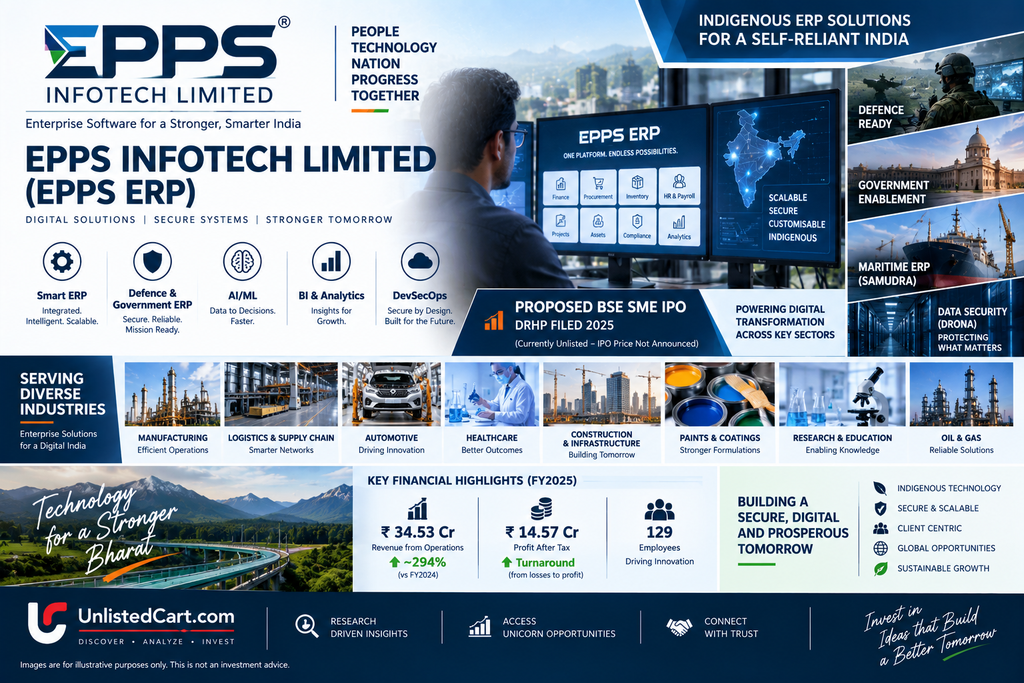
EPPS Infotech Limited is an Indian enterprise-software company focused primarily on ERP, enterprise applications, analytics, automation, cybersecurity and digital transformation solutions.
The company has developed ERP products under the Smart ERP brand and has increasingly focused on specialised solutions for defence, government, manufacturing, logistics, shipyards and other organisations requiring secure and configurable enterprise systems. Its product portfolio also includes SAMUDRA, an ERP platform designed for shipyards, and DRONA, a digital-rights/data-security solution.
The company was incorporated in 2008 and converted from a private company into a public limited company in 2024. It subsequently prepared a DRHP dated 29 September 2025 for a proposed BSE SME IPO involving up to 25 lakh fresh equity shares. The proposed issue did not have a disclosed price at the DRHP stage.
The financial transformation between FY2024 and FY2025 was significant:
| Particular | FY2023 | FY2024 | FY2025 |
|---|---|---|---|
| Revenue from Operations | ₹7.63 Cr | ₹8.76 Cr | ₹34.53 Cr |
| EBITDA | ₹3.73 Cr | ₹3.93 Cr | ₹27.23 Cr |
| PAT | -₹4.26 Cr | -₹4.12 Cr | ₹14.57 Cr |
| Net Worth | -₹4.98 Cr | -₹3.18 Cr | ₹20.46 Cr |
| Total Debt | ₹43.99 Cr | ₹50.34 Cr | ₹49.11 Cr |
| EPS | -₹12.18 | -₹11.75 | ₹28.03 |
The FY2025 revenue growth was approximately 294%, while the company moved from losses to a PAT of ₹14.57 crore.
However, the improvement needs careful due diligence because the FY2025 balance sheet still carried approximately ₹49.11 crore of total borrowings, resulting in a debt/equity ratio of approximately 2.40x.
Therefore, EPPS is best understood as a high-growth, high-margin but high-transition-risk enterprise-software business, rather than a mature IT-services company.
1. Company Overview
EPPS Infotech was originally incorporated as POSHS Infotech Private Limited on 12 August 2008.
It subsequently changed its name to EPPS Infotech Private Limited in 2014 and was converted into a public limited company in 2024. The current CIN is U72900MH2008PLC185738.
The registered office is in Mumbai, while the principal operating/development centre is in Pune.
Official Website:
EPPS Infotech Official Website
Official Contact Page:
EPPS Infotech Contact & Offices
The company’s website describes EPPS as a provider of intelligent ERP solutions aimed at enterprise management.
2. Business Model
EPPS operates primarily as a software-product and enterprise-solutions company.
Its business can broadly be divided into:
Enterprise ERP
The company’s Smart ERP platform covers functions including:
- Finance and accounting
- Procurement
- Inventory
- Manufacturing
- Supply chain
- Human resources
- Payroll
- Project management
- Asset management
- Quality management
- Compliance
- CRM
- Analytics
The DRHP describes the ERP platform as built on an open-source technology stack, with configurable workflows and deployment across cloud, on-premise and air-gapped environments.
Defence ERP
Defence and government organisations are a major focus of the company’s strategy.
The company targets:
- Army
- Navy
- Air Force
- Coast Guard
- Defence PSUs
- Government establishments
The ERP architecture is designed to address manpower, money, machines and materials — the company’s “4M” framework.
Maritime / Shipyard ERP
EPPS has developed SAMUDRA ERP, designed specifically for shipbuilding and ship-repair environments.
The platform covers areas such as:
- Project management
- Inventory
- Dry-dock scheduling
- Defect tracking
- Quality assurance
- Supply chain
- Maintenance
The DRHP states that SAMUDRA has already been deployed in some Indian shipyards serving defence and commercial segments.
Digital Security
The company has developed DRONA, a digital-rights and data-security solution designed to help protect sensitive digital assets and support data-governance requirements.
Analytics & AI
EPPS is integrating:
- Business intelligence
- Data warehousing
- AI/ML forecasting
- Predictive analytics
- Automation
- AI-enabled workflows
into its enterprise-software architecture.
3. Product Portfolio
The DRHP describes EPPS’s technology offering across multiple modules.
Smart ERP
An enterprise-level ERP platform for small, medium and large organisations.
SAMUDRA
Specialised ERP for shipyards and maritime operations.
DRONA
Digital-rights management and data-security platform.
Analytics
Business intelligence dashboards, data lakes and data-warehousing capabilities.
AI/ML
Predictive forecasting and intelligent workflow capabilities.
DevSecOps
Deployment architecture designed for both cloud environments and secure/air-gapped defence networks.
4. Target Industries
EPPS’s target market is broader than conventional ERP for SMEs.
The DRHP identifies:
- Defence
- Government
- Public-sector organisations
- Manufacturing
- Engineering
- Logistics
- Distribution
- Power
- Oil & gas
- Critical infrastructure
- Healthcare
- Education
- Research
- Maritime / shipyards
as target markets.
This vertical approach is important because specialised ERP systems can be more difficult to replace once deeply integrated into an organisation’s processes.
5. Competitive Positioning
The company’s DRHP identifies several qualitative strengths:
Indigenous technology
EPPS describes its solutions as 100% indigenous and built on open-source technology stacks.
Defence-grade deployment
The company says its systems can operate in air-gapped networks, which is particularly relevant to defence and sensitive government environments.
Broad ERP coverage
Its ERP platform covers finance, HR, manufacturing, logistics, procurement, assets, projects, quality and other enterprise functions.
Customisation
Configurable workflows allow solutions to be adapted to individual organisations.
R&D
The company highlights continuous product development and technology innovation.
Client relationships
EPPS describes its approach as client-centric, with dedicated support and tailored solutions.
6. Management
Atul Pimple – Managing Director
The company’s website describes Atul Pimple as a technocrat with more than 25 years of ERP-industry experience and identifies him as a co-founder of EPPS Infotech.
Asheer Kapoor – Promoter
The company describes Asheer Kapoor as having more than 20 years of experience in ERP solutions and business management.
Other Leadership
The company website identifies Archana Shiledar as CFO and Nitiksha Khandelwal as Company Secretary & Compliance Officer.
The DRHP also identifies Ganesh Natarajan as Chairman.
7. Employee Base
As of 31 March 2025, EPPS had 129 permanent employees, according to the DRHP.
This is a relatively small workforce compared with large Indian IT-services companies.
The business model therefore depends significantly on:
Employee productivity + project execution + software/IP reuse + high-value specialised contracts.
8. Government & Defence Exposure
One of the most important characteristics of EPPS is its exposure to government and defence projects.
In FY2025:
| Project Category | Billed Revenue |
|---|---|
| Government Projects | ₹14.61 Cr |
| Other Projects | ₹16.56 Cr |
| Total Billed Revenue | ₹31.17 Cr |
Government projects represented approximately 46.9% of billed revenue in FY2025.
This is both an opportunity and a risk.
Government contracts can provide large project opportunities and credibility, but the company is exposed to:
- Tender competition
- Procurement cycles
- Government budget allocations
- Delayed awards
- Contractual obligations
- Performance guarantees
- Policy changes
The company’s own DRHP identifies these risks.
9. Financial Performance
The restated FY2023-FY2025 financials disclosed in the DRHP show a dramatic turnaround.
Revenue
FY23: ₹7.63 Cr
FY24: ₹8.76 Cr
FY25: ₹34.53 Cr
FY25 growth:
~294%
EBITDA
FY23: ₹3.73 Cr
FY24: ₹3.93 Cr
FY25: ₹27.23 Cr
PAT
FY23: -₹4.26 Cr
FY24: -₹4.12 Cr
FY25: ₹14.57 Cr
This is an extremely significant change in the company’s earnings profile.
10. Margin Analysis
FY2025 EBITDA:
₹27.23 Cr
Revenue:
₹34.53 Cr
Therefore:
EBITDA Margin ≈ 78.9%
FY2025 PAT:
₹14.57 Cr
Therefore:
PAT Margin ≈ 42.2%
These are unusually high margins for an IT/ERP company and deserve detailed scrutiny regarding:
- Revenue mix
- Project accounting
- Software-product contribution
- One-time items
- Capitalisation of development costs
- Employee costs
- Receivable collection
- Sustainability of government-project margins
The DRHP itself reports FY25 EBITDA margin of approximately 78.88% and PAT margin of 42.20%.
11. Balance Sheet
As of 31 March 2025:
| Particular | FY25 |
|---|---|
| Total Assets | ₹85.93 Cr |
| Net Worth | ₹20.46 Cr |
| Total Debt | ₹49.11 Cr |
| Debt / Equity | 2.40x |
| ROE / RONW | 71.21% |
| ROCE | 28.13% |
The balance sheet is therefore substantially different from what the exceptionally high PAT margin alone might suggest.
Key observation
The company has generated substantial profits but still has:
₹49.11 Cr of debt against ₹20.46 Cr of net worth.
This makes deleveraging an important part of the investment thesis.
12. Debt Position
FY2025 total borrowings were approximately:
₹49.11 Cr
comprising approximately:
- Short-term borrowings: ₹17.42 Cr
- Long-term borrowings/current maturities: ₹31.70 Cr
The resulting total debt/equity ratio was:
2.40x
This is one of the biggest areas requiring attention.
The proposed IPO itself was designed partly to address this.
13. Proposed IPO – Important Development
EPPS filed a DRHP dated 29 September 2025 for a BSE SME IPO.
The proposed issue consisted of:
Fresh Issue
Up to 25,00,000 equity shares
Face value:
₹10/share
Offer for sale:
Nil
The proposed shares were intended to be listed on the BSE SME platform.
However, the issue price was not specified in the DRHP; it was left blank pending the book-building process.
14. IPO Proceeds – Intended Use
The proposed IPO proceeds were intended for:
- Repayment of bank borrowings
- Funding incremental working capital
- General corporate purposes
The DRHP specifically disclosed ₹6 crore for incremental working-capital requirements.
This is important because it indicates that the IPO was not primarily designed for aggressive new-capacity expansion.
A meaningful portion was intended to strengthen the balance sheet and working-capital position.
15. IPO Status – Current Position
This requires special attention.
EPPS’s September 2025 DRHP proposed a BSE SME listing, but current IPO databases show the EPPS Infotech DRHP as withdrawn.
Business Standard currently shows the company as an upcoming/proposed BSE SME IPO with:
- Issue price: Not announced
- Issue size: Not announced
- Open date: Not announced
- Listing date: Not announced
Therefore:
EPPS Infotech should currently be treated as an unlisted company.
There is no verified current IPO price or listing date that should be used for valuation.
16. Current Unlisted Share Price
I could not verify a reliable current September 2026 OTC transaction price from a sufficiently credible source.
Therefore, no current unlisted price is quoted in this report.
This is preferable to using an old dealer quote or an unverified online number.
The DRHP’s proposed IPO price was also not available because the document left the price band/issue price blank.
17. Historical Cost Reference
The DRHP provides an interesting reference point.
Following the January 2025 349:1 bonus issue, the weighted average acquisition cost of certain qualifying pre-IPO issuances was approximately:
₹74.11/share
This was based on the company’s capital-structure disclosures and is not a current fair value or market price.
It should therefore not be used as a current valuation benchmark without considering subsequent transactions and the company’s changed capital structure.
18. Share Capital & Bonus Issue
EPPS undertook a very large 349:1 bonus issue in January 2025.
The company allotted:
55,06,871 bonus shares
at a ratio of:
349 bonus shares for every 1 existing share
The post-bonus paid-up capital disclosed in the DRHP was 55,22,650 shares of ₹10 each.
This is important when comparing historical per-share prices or acquisition costs.
Any historical price must be adjusted for the bonus issue before making comparisons.
19. Trade Receivables
Trade receivables deserve significant attention.
As at 31 March 2025:
Gross trade receivables: ₹23.28 Cr
The ageing disclosure showed approximately:
- Unbilled: ₹5.63 Cr
- Less than 6 months: ₹17.56 Cr
- 6–12 months: ₹0.004 Cr
- 1–2 years: ₹0.066 Cr
- 2–3 years: ₹0.019 Cr
The company did not report doubtful receivables in this disclosure.
Receivables therefore represented a substantial proportion of FY25 revenue.
This becomes especially important because the company operates through project-based contracts.
20. Cash Flow
The DRHP reports:
| ₹ Cr | FY23 | FY24 | FY25 |
|---|---|---|---|
| Operating Cash Flow | 6.75 | 0.37 | 16.79 |
FY2025 operating cash flow of ₹16.79 crore was positive and exceeded reported PAT of ₹14.57 crore.
This is an encouraging aspect of the FY25 financial performance.
Nevertheless, future cash conversion should be monitored because large government and enterprise projects can have long billing and collection cycles.
21. Industry Opportunity
EPPS operates in a market supported by several structural technology trends.
Digital Transformation
Businesses and government organisations continue to modernise legacy systems.
Cloud Computing
Cloud-based ERP can reduce infrastructure requirements and allow scalable deployments.
Artificial Intelligence
AI and ML are increasingly being integrated into enterprise software for:
- Forecasting
- Automation
- Decision support
- Analytics
- Predictive maintenance
The company’s DRHP highlights AI and automation as major drivers of enterprise IT spending.
Cybersecurity
Increasing regulatory and cybersecurity requirements can create demand for data-security and digital-rights products such as DRONA.
Defence Digitisation
Defence organisations require specialised systems that can operate in secure environments.
Shipbuilding & Maritime
India’s increasing focus on domestic shipbuilding and ship-repair infrastructure creates a potential market for specialised shipyard ERP systems such as SAMUDRA.
22. Competitive Advantages
1. Specialised Defence ERP
EPPS is not positioning itself simply as a generic ERP vendor.
Its defence focus may create specialised domain expertise.
2. Open-Source Technology
The company states that its platforms use open-source technology stacks, which can potentially reduce software licensing costs and improve flexibility.
3. Air-Gapped Deployment
Ability to deploy in air-gapped environments is relevant for sensitive government and defence applications.
4. Industry-Specific Products
SAMUDRA provides a specialised offering for shipyards.
5. Integrated ERP
The platform covers multiple enterprise functions rather than a single software module.
6. AI/ML Integration
The company is incorporating predictive analytics and AI/ML into its technology roadmap.
7. Experienced Management
The company highlights significant ERP experience among its senior leadership.
23. Major Risks
1. Government Tender Dependence
Government projects represented approximately 46.9% of FY25 billed revenue.
The company itself identifies tender availability and successful bidding as material risks.
2. Defence Concentration
The company has increasingly focused on defence ERP.
The DRHP states that its specialised defence ERP operating history is relatively recent, which creates execution and competitive risks.
3. High Debt
FY25 debt:
₹49.11 Cr
Net worth:
₹20.46 Cr
Debt/equity:
2.40x
This is a major balance-sheet consideration.
4. Customer Concentration
Large government contracts can create significant revenue concentration.
Loss or delay of a major project could affect financial performance.
5. Project Execution
Enterprise and defence ERP projects can involve:
- Long implementation periods
- Complex integrations
- Strict quality standards
- Customer inspections
- Performance guarantees
- Potential liquidated damages
The DRHP explicitly highlights these risks.
6. Cybersecurity Risk
As a software provider handling potentially sensitive enterprise and government data, EPPS faces cybersecurity and data-breach risks.
7. Limited Marketing
The DRHP acknowledges that business development relies significantly on tenders and referrals and that marketing/brand-building activity has historically been limited.
8. Short Defence-ERP Track Record
Although the company has existed since 2008, its specific concentration on defence ERP is relatively recent.
24. Financial Quality – What Stands Out
EPPS presents an unusual combination:
Very high FY25 EBITDA margin: ~79%
Very high PAT margin: ~42%
Very high ROE/RONW: ~71%
High debt/equity: ~2.4x
Large FY25 revenue jump: ~294%
This combination deserves deeper due diligence.
The key question is not simply whether FY25 was profitable.
It is:
How much of the FY25 profitability can be repeated at a larger scale?
Investors should examine:
- FY26 revenue
- FY26 PAT
- New order wins
- Recurring software revenue
- Project revenue versus licence/product revenue
- Employee-cost growth
- Receivables
- Debt reduction
- Cash generation
before assigning a high recurring earnings multiple.
25. Valuation Framework
Because no reliable current OTC price could be verified and the proposed IPO price was never specified in the DRHP, a fixed current P/E cannot responsibly be calculated.
However, using FY25 EPS of ₹28.03 from the DRHP, an illustrative valuation framework is:
| P/E Multiple | Illustrative Value |
|---|---|
| 10x | ₹280 |
| 12x | ₹336 |
| 15x | ₹420 |
| 18x | ₹505 |
| 20x | ₹561 |
| 25x | ₹701 |
| 30x | ₹841 |
These are mathematical sensitivity scenarios only, not price targets.
The FY25 EPS figure is based on the DRHP’s post-bonus capital structure and weighted-average share calculation.
26. What Would Support a Higher Valuation?
A higher sustainable valuation would generally require evidence of:
- Continued revenue growth
- Repeatable high margins
- Strong order inflow
- Increasing recurring software revenue
- Reduction in debt
- Strong operating cash flow
- Lower receivable days
- Expansion beyond government/defence customers
- Successful commercialisation of SAMUDRA and DRONA
- A successful relaunch/listing process, if pursued
These are business drivers to monitor rather than assumptions about future performance.
27. What Could Change the Investment Thesis?
Positive developments to monitor
Debt reduction
If IPO or internal cash generation materially reduces borrowings, financial risk could decline.
Recurring revenue
Higher recurring licence/subscription/maintenance revenue could make earnings more predictable.
Private-sector diversification
Reducing dependence on government tenders could diversify the revenue base.
Defence ERP wins
Large repeat contracts could validate the company’s specialised positioning.
SAMUDRA expansion
Broader adoption among Indian shipyards could create a new vertical.
Successful IPO relaunch
A renewed BSE SME IPO could improve transparency, liquidity and price discovery.
28. IPO / Listing Outlook
As of the latest information reviewed:
Company status: Unlisted
DRHP: Filed September 2025
Proposed exchange: BSE SME
Proposed issue: Up to 25 lakh fresh shares
Issue price: Not disclosed in DRHP
Current IPO status: DRHP shown as withdrawn
Current listing date: Not announced
Current price band: Not announced
Therefore, the IPO should be treated as a corporate development to monitor, not as a confirmed near-term event.
29. Key Numbers at a Glance
| Metric | FY2025 |
|---|---|
| Revenue | ₹34.52 Cr |
| Revenue Growth | ~294% |
| EBITDA | ₹27.23 Cr |
| EBITDA Margin | ~78.9% |
| PAT | ₹14.57 Cr |
| PAT Margin | ~42.2% |
| EPS | ₹28.03 |
| Net Worth | ₹20.46 Cr |
| Total Debt | ₹49.11 Cr |
| Debt/Equity | 2.40x |
| ROE/RONW | 71.21% |
| ROCE | 28.13% |
| Operating Cash Flow | ₹16.79 Cr |
| Trade Receivables | ₹23.28 Cr |
| Government Project Revenue | ₹14.61 Cr |
| Permanent Employees | 129 |
| Proposed IPO | Up to 25 lakh shares |
| Proposed Exchange | BSE SME |
30. Overall Assessment
EPPS Infotech is an interesting but high-due-diligence unlisted technology company.
The company has several distinctive characteristics:
ERP + AI + Analytics
Defence & Government focus
Specialised shipyard ERP
Cybersecurity / digital-rights platform
Indigenous open-source technology
Very strong FY25 earnings turnaround
Positive operating cash flow
The FY2025 numbers show a dramatic transformation from a loss-making business into one reporting ₹14.57 crore of PAT and ₹27.23 crore of EBITDA.
At the same time, the business carries meaningful risks:
2.40x debt/equity
High government/defence exposure
Tender dependence
Recent defence-ERP track record
Project-execution risk
Receivable exposure
Cybersecurity risk
Unlisted liquidity
Uncertain IPO timeline
The most important analytical question is therefore:
Is FY2025 the beginning of a sustainable high-growth ERP/software cycle, or was the exceptional profitability heavily influenced by a small number of large projects?
The answer will depend on FY2026/FY2027 revenue quality, order book, recurring software revenue, debt reduction and cash conversion.
For an unlisted investor, these are more important than simply extrapolating the FY2025 EPS.
31. Important Links
Official Company Website:
EPPS Infotech Limited
Official Contact & Office Information:
EPPS Infotech Contact Page
Company Leadership:
EPPS Infotech Leadership & Philosophy
FY2025 DRHP:
EPPS Infotech Draft Red Herring Prospectus
IPO Status Reference:
EPPS Infotech IPO / DRHP Status
Disclaimer
This report is prepared for research and informational purposes only and does not constitute investment advice, a recommendation, solicitation or offer to buy or sell securities.
EPPS Infotech is currently unlisted. The proposed BSE SME IPO described in the September 2025 DRHP is not a confirmed current listing, and the DRHP is presently shown as withdrawn in current IPO-status databases.
No current OTC/unlisted share price has been included because a reliable September 2026 transaction price could not be independently verified.
Historical financial information is primarily based on the company’s restated financial statements included in the DRHP. Future performance may differ materially from FY2025 results.
Investors should independently verify the latest audited financial statements, capital structure, debt, order book, shareholding, current transaction price and any renewed IPO/listing documents before making an investment decision.
For more such unlisted stocks visit https://unlistedcart.com/unlisted-shares/