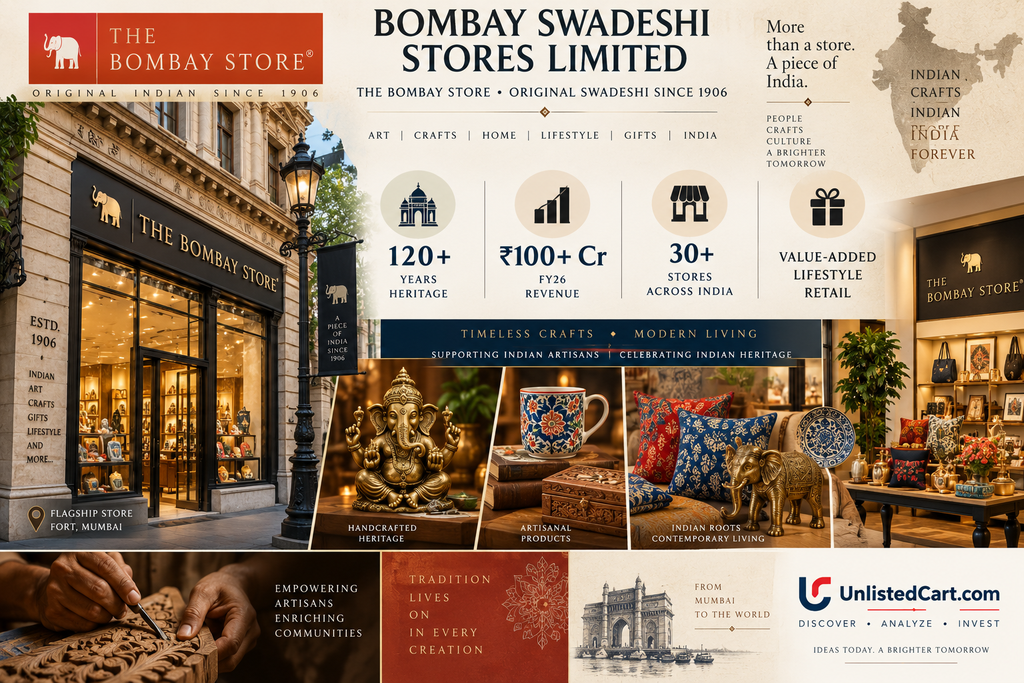
120+ Years of Indian Heritage, Handicrafts & Lifestyle Retail
Company: Bombay Swadeshi Stores Limited
Brand: The Bombay Store
Sector: Retail / Home & Lifestyle / Handicrafts
Headquarters: Mumbai, Maharashtra
CIN: U74999MH1905PLC000223
ISIN: INE595B01027
Incorporation: 11 December 1905
Status: Active, Unlisted Public Company
Business: Retail stores + E-commerce
Flagship Brand: The Bombay Store
Executive Summary
Bombay Swadeshi Stores Limited is the company behind The Bombay Store, one of India’s oldest organised retailers of Indian handicrafts, home décor, gifting products, wellness products, accessories and lifestyle merchandise.
The company traces its roots to 1906, when it was established as The Bombay Swadeshi Co-operative Stores Company during the Swadeshi movement. The company was subsequently renamed Bombay Swadeshi Stores Limited in 1967. Its flagship store at P.M. Road, Fort, Mumbai remains an important part of its heritage.
Unlike conventional retailers focused on mass-market products, The Bombay Store has built its positioning around Indian craftsmanship, cultural products and contemporary interpretations of traditional Indian designs.
The company operates physical stores across multiple Indian cities and an e-commerce platform. Its product categories include handicrafts, home décor, artefacts, gifting, souvenirs, wellness products, accessories, fashion-related products and other lifestyle merchandise.
The business crossed ₹100 Cr of revenue in FY26 for the first time, reaching approximately ₹100.01 Cr. PAT increased to approximately ₹10.31 Cr from ₹8.72 Cr in FY25.
However, the investment case requires careful valuation analysis. The company has a strong heritage and attractive gross margins, but growth over the last two years has been relatively moderate and the business operates predominantly through leased retail stores.
Company Overview
Bombay Swadeshi Stores Limited was incorporated on 11 December 1905 under the name The Bombay Swadeshi Co-operative Stores Company Limited.
The company subsequently changed its name to Bombay Swadeshi Stores Limited effective 3 March 1967. The company operates under its flagship consumer-facing brand, The Bombay Store.
The company’s registered office is located at:
Western India House, Sir P. M. Road, Fort, Mumbai – 400001.
The business has survived for more than a century by adapting its traditional handicraft positioning to modern retail formats.
Today, its product universe includes:
- Home décor
- Indian handicrafts
- Artefacts
- Gifting
- Souvenirs
- Brass products
- Wooden handicrafts
- Marble products
- Pashmina
- Wellness products
- Accessories
- Fashion and lifestyle products
- Tableware
- Stationery
- Toys and games
- Graphic products
The company’s own website describes the business as a platform connecting customers with products inspired by India’s traditional crafts and artisans.
The Bombay Store – Heritage Advantage
The strongest intangible asset of Bombay Swadeshi Stores is its heritage.
The Bombay Store positions itself as a brand that has been associated with Indian craftsmanship since 1906.
Its products draw inspiration from different parts of India, including:
- Jaipur
- Kutch
- Kashmir
- Andhra Pradesh
- Agra
- Rajasthan
- Maharashtra
- South Indian craft traditions
The company says its products are sourced from artisans and villages across India, giving it a differentiated identity compared with generic home décor retailers.
This heritage creates brand differentiation and can support premium pricing in gifting and lifestyle categories.
Business Model
Bombay Swadeshi Stores is fundamentally a retail merchandising business.
The company sources finished products from artisans and suppliers and sells them through:
- Physical retail stores
- E-commerce
- Corporate / gifting opportunities
- Franchise arrangements historically used by the company
The business does not operate like a traditional manufacturing company.
Its economics are therefore driven primarily by:
Product sourcing → Inventory → Retail stores → Customer spending → Gross margin → Store-level profitability
This makes inventory management, store productivity and rental costs particularly important.
Product Portfolio
The Bombay Store operates across multiple categories.
Home Décor
Products include decorative objects, wall décor, tableware, artefacts and other lifestyle products.
Handicrafts
The company offers traditional Indian craftsmanship across metals, wood, marble, textiles and other materials.
Gifting
The brand has strong relevance for:
- Corporate gifting
- Festival gifting
- Wedding gifting
- Tourist purchases
- Premium Indian souvenirs
Wellness
The company also sells wellness-related products and personal-care items.
Souvenirs
The Bombay Store offers products inspired by Indian landmarks and cultural heritage.
Accessories
The portfolio includes wallets, bags, fashion accessories and other lifestyle merchandise.
The company’s website currently showcases products ranging from handcrafted décor to diaries, wallets, tableware and wellness products.
Retail Network
The company has expanded its store footprint beyond Mumbai.
The latest FY26 analysis indicates approximately 30 stores across around 13 cities.
The company’s official store locator shows locations across:
- Mumbai
- Pune
- Hyderabad
- Bengaluru
- Ahmedabad
- Jaipur
- Noida
- Kochi
- Navi Mumbai
- Thane
- Other locations
The company has stores in major malls as well as traditional high-street locations, including its historic Fort Mumbai store.
This provides a combination of:
Heritage stores + mall stores + high-street locations + e-commerce
E-Commerce Opportunity
The company operates an online store through The Bombay Store website.
This gives the business access to customers outside its physical retail footprint.
E-commerce can potentially improve:
- Geographic reach
- Inventory utilisation
- Customer discovery
- Repeat purchases
- Gifting sales
- International demand
The company’s online catalogue includes hundreds of products across home décor, gifting, handicrafts, accessories and souvenirs.
FY26 Financial Performance
The latest FY26 financial data shows that the company crossed ₹100 Cr of annual revenue for the first time.
| Particulars | FY24 | FY25 | FY26 |
|---|---|---|---|
| Revenue | ₹83.10 Cr | ₹88.77 Cr | ₹100.01 Cr |
| PAT | ₹9.92 Cr | ₹8.72 Cr | ₹10.31 Cr |
| EPS | ₹20.08 | ₹17.65 | ₹20.87 |
| Operating Margin | 16.96% | 14.17% | 14.89% |
| Current Ratio | 1.69x | 1.81x | — |
| Debt/Equity | 0.66x | 0.46x | ~0.20x |
FY26 revenue grew approximately 12.7%, while PAT increased approximately 18.3%.
FY26 Profitability
The improvement in FY26 profitability is encouraging.
Revenue increased from:
₹88.77 Cr → ₹100.01 Cr
while PAT increased from:
₹8.72 Cr → ₹10.31 Cr
Therefore, profit grew faster than revenue.
FY26 net margin was approximately:
10.31%
compared with approximately:
9.82% in FY25.
This indicates modest operating leverage during the year.
Historical Growth – Important Observation
The FY26 headline is strong, but investors should also look at the two-year trend.
Revenue:
FY24: ₹83.10 Cr
FY25: ₹88.77 Cr
FY26: ₹100.01 Cr
PAT:
FY24: ₹9.92 Cr
FY25: ₹8.72 Cr
FY26: ₹10.31 Cr
Therefore, revenue has compounded at roughly 9.7% between FY24 and FY26, while PAT growth over the same period has been much more modest.
This is important because FY26’s 18% PAT growth should not automatically be extrapolated as a sustainable long-term earnings CAGR.
Balance Sheet
FY25 balance-sheet data showed:
- Equity: ₹25.34 Cr
- Borrowings: ₹11.71 Cr
- Inventory: ₹19.80 Cr
- Cash & equivalents: ₹2.78 Cr
- Total assets: ₹43.74 Cr
The company’s debt-equity ratio improved from 0.66x in FY24 to 0.46x in FY25.
FY26 analysis indicates further improvement, with debt/equity around 0.20x.
This is a positive development because lower leverage reduces financial risk.
Working Capital & Inventory
Inventory is one of the most important balance-sheet items for Bombay Swadeshi Stores.
FY25 inventory was approximately:
₹19.80 Cr
Against FY25 revenue of approximately ₹88.77 Cr.
FY26 inventory increased to around ₹22.4 Cr, according to the latest annual-report analysis.
This makes inventory turnover an important KPI.
Retail products such as handicrafts and décor can have long shelf lives, but slow-moving inventory can lock up capital and eventually require discounting.
Therefore, investors should monitor:
Inventory turnover → Gross margin → Store productivity → Cash conversion
Gross Margin
The FY26 analysis estimates gross margin at approximately 52%.
This is attractive for a specialised lifestyle retailer.
A high gross margin provides the company with room to absorb:
- Rent
- Employee costs
- Marketing
- Store maintenance
- Logistics
- Technology costs
However, high gross margins do not automatically translate into high shareholder returns because the company has significant store-related operating expenses.
Store Economics
This is an important area that investors should watch.
The company increased store count from approximately 27 to 30 stores during FY26.
Revenue increased approximately 12.7%.
However, a simple revenue-per-store calculation shows only limited movement because new stores were not operational for the full financial year.
The company does not publicly provide sufficient like-for-like store growth data to cleanly separate:
New-store growth
from
Same-store sales growth.
This is a key information gap for investors.
Employee & Rental Costs
FY26 analysis indicates employee expenses increased approximately 18.5%, while rent increased around 12.9%, both faster than revenue growth.
This is important because retail businesses can experience operating leverage only when store revenue grows faster than fixed and semi-fixed costs.
Therefore, future profitability will depend heavily on:
Revenue per store > incremental rental + employee + operating costs
Operating Cash Flow
One of the more encouraging developments in FY26 was operating cash flow.
Operating cash flow reportedly increased from approximately:
₹0.80 Cr in FY25
to:
₹7.07 Cr in FY26.
This is a substantial improvement.
The stronger cash generation enabled the company to reduce promoter borrowing while continuing to invest in the business.
For an unlisted company, improving cash conversion is particularly important because shareholders do not have the same liquidity options as listed investors.
Shareholding
The latest available FY26 shareholding information indicates a highly concentrated ownership structure:
| Shareholder | Approx. Holding |
|---|---|
| Jyoti Varun Kabra | 30.27% |
| Manjri Aditya Chandak | 29.29% |
| Madhu Abhay Chandak | 29.29% |
| Others | 11.15% |
The three major holders therefore collectively control approximately 89% of the company.
This has two implications.
Positive
Strong promoter ownership can align management with long-term business performance.
Negative
The effective public/unlisted float is very limited, making secondary-market liquidity an important risk.
Current Unlisted Share Price
There is currently no exchange-traded market price because Bombay Swadeshi Stores is unlisted.
Different private-market platforms can show substantially different indicative prices.
For example, Moneycontrol’s latest displayed quote was approximately:
₹221.35 per share
with an indicated market capitalisation of approximately ₹109.35 Cr.
UnlistedZone’s latest indicative level was around:
₹470 per share
with an implied market value of approximately ₹232 Cr.
This large difference itself demonstrates an important characteristic of unlisted shares:
There is no single continuously discovered market price.
Therefore, investors should verify the actual executable buy/sell quote before using any platform’s displayed price for valuation.
Indicative Valuation
Using the FY26 earnings of approximately ₹10.31 Cr:
At ₹221.35/share
Implied market capitalisation:
~₹109 Cr
Approximate P/E:
~10.6x
At ₹470/share
Implied market capitalisation:
~₹232 Cr
Approximate P/E:
~22.5x
The difference is substantial.
This is why the purchase price is extremely important for an unlisted business like Bombay Swadeshi Stores.
Book Value
FY26 net worth is approximately ₹35.65 Cr.
With approximately 49.4 lakh shares outstanding, estimated book value is around:
₹72 per share.
Therefore:
At ₹221:
P/B ≈ 3.1x
At ₹470:
P/B ≈ 6.5x
At the higher indicative valuation, the stock is no longer inexpensive on book value.
Valuation Framework
For an appropriate valuation, investors should not rely solely on P/E.
A better framework would combine:
1. Earnings Multiple
Value based on sustainable PAT.
2. Store Productivity
Analyse revenue and EBITDA generated per mature store.
3. Same-Store Growth
This is particularly important for understanding organic growth.
4. Inventory Efficiency
Higher inventory turns generally support better return on capital.
5. Brand Value
The Bombay Store’s 120+ year heritage is a genuine intangible asset.
6. E-Commerce Growth
Online sales could expand geographic reach without proportionately increasing physical store costs.
Competitive Advantages
1. Extraordinary Brand Heritage
The business traces its roots to the Swadeshi movement and has operated for more than 120 years.
2. Distinctive Product Positioning
The company is not simply another general merchandise retailer.
It specialises in Indian-inspired handicrafts, lifestyle products, décor and gifting.
3. Artisan Network
The business provides a retail platform for products sourced from artisans and craft clusters.
4. Premium Gifting Opportunity
Indian handicrafts and cultural products have strong relevance in:
- Corporate gifting
- Weddings
- Festivals
- Tourism
- International gifting
5. Multi-Channel Model
Physical stores are complemented by e-commerce.
6. Strong Brand Recall
The Bombay Store has significant recognition, particularly among consumers seeking Indian cultural and handicraft products.
Industry Opportunity
The broader Indian lifestyle and experiential retail market provides several long-term opportunities.
Consumers are increasingly spending on:
- Home décor
- Personalisation
- Premium gifting
- Wellness
- Travel souvenirs
- Cultural products
- Experiential shopping
India’s expanding middle class and growing consumption economy can support this category.
International demand for Indian handicrafts also creates an opportunity for e-commerce-led exports.
The company’s website already supports online ordering and offers products designed around Indian cultural themes.
Growth Drivers
Pan-India Store Expansion
The company can continue expanding beyond its traditional Mumbai base.
E-Commerce
Online sales can allow the company to reach customers without opening a physical store in every geography.
Premium Gifting
Corporate and festive gifting could become a meaningful growth vertical.
Tourism
The Bombay Store’s product portfolio is naturally aligned with domestic and international tourism.
International Customers
The company’s products have potential appeal among the Indian diaspora and consumers interested in Indian craftsmanship.
Product Innovation
Modern designs inspired by traditional Indian art can expand the addressable market beyond conventional handicraft buyers.
Investment Positives
1. 120+ year heritage
The company possesses an unusually long operating history.
2. Recognisable consumer brand
The Bombay Store has built a differentiated identity around Indian craftsmanship.
3. Strong gross margins
FY26 gross margin is estimated at approximately 52%.
4. Revenue crossed ₹100 Cr
FY26 was the first year the company crossed the ₹100 Cr revenue milestone.
5. Improving profitability
FY26 PAT increased approximately 18%.
6. Lower leverage
Debt/equity has declined significantly from FY24 levels.
7. Improving cash generation
Operating cash flow increased substantially in FY26.
8. E-commerce optionality
The online channel creates an opportunity for national and international reach.
Key Risks
Limited Historical Earnings Growth
The two-year PAT CAGR remains modest despite strong FY26 growth.
Store Productivity
The company needs to demonstrate that new stores can generate attractive returns.
Rental Costs
Retail stores are largely leased, making rent a significant recurring expense.
Inventory Risk
A large portion of capital is tied up in inventory.
Slow-moving products can reduce returns and require discounting.
Limited Liquidity
Approximately 89% ownership by three major shareholders means the effective free float is very small.
No Dividend
The company currently does not provide a dividend yield, according to the latest FY26 analysis.
Therefore, investors primarily depend on future capital appreciation.
No Confirmed Listing Catalyst
There is currently no stated DRHP or confirmed IPO/listing plan identified in the latest research.
Investors should not purchase the stock purely on the assumption that the company will list soon.
Lease Accounting
The company reports under older accounting standards rather than Ind AS.
Consequently, lease commitments are not presented in the same manner as they would be for many listed retail peers.
This can make debt and return ratios appear more favourable than those of an Ind AS reporter.
Key KPIs to Monitor
Investors should track the following every year:
Revenue growth
Same-store sales growth
Revenue per store
Number of stores
Gross margin
EBITDA margin
PAT margin
Inventory turnover
Operating cash flow
Debt/equity
E-commerce growth
Return on capital employed
These KPIs are more useful than simply looking at headline revenue.
Re-Rating Triggers
Potential catalysts include:
- Sustained 15–20%+ revenue growth
- Strong same-store sales growth
- Higher revenue per mature store
- Expansion into new cities
- Strong e-commerce growth
- Better inventory turnover
- EBITDA margin expansion
- Continued debt reduction
- Strong free cash flow
- Strategic investment or corporate restructuring
- Potential future listing, if formally announced
What Could Go Wrong?
The biggest risk is that investors may overvalue the 120-year heritage while underestimating the economics of the underlying retail business.
A great brand does not automatically produce great shareholder returns.
The company needs to demonstrate:
higher store productivity + sustainable margins + better cash conversion + disciplined expansion.
If store count grows but revenue per mature store remains stagnant, capital returns could disappoint.
Similarly, if employee and rental costs continue growing faster than revenue, margin expansion could reverse.
Investment View
Bombay Swadeshi Stores is an interesting heritage consumer-retail business, but it should be analysed differently from a conventional high-growth FMCG company.
The positive case is compelling:
120+ year heritage + differentiated brand + ~52% gross margin + improving cash flow + declining leverage + ₹100 Cr revenue milestone + e-commerce opportunity.
However, the business has also shown that growth is not yet consistently high.
FY24–FY26 revenue CAGR is only around 10%, while FY24–FY26 profit growth has been much slower. FY26 was a strong recovery year, but investors should wait for evidence that the improvement is sustainable.
At ~₹220/share
The valuation appears considerably more comfortable at roughly 10–11x FY26 earnings, subject to verification of the actual executable private-market price.
At ~₹470/share
The investment becomes significantly more demanding at approximately 22.5x FY26 earnings and 6.5x book value.
At that price, investors are effectively paying a premium for:
- Brand heritage
- Future store expansion
- Margin improvement
- E-commerce growth
- Stronger cash generation
- Potential future corporate actions
Overall Assessment
Business Quality: ★★★★
Brand Strength: ★★★★★
Growth Visibility: ★★★
Profitability: ★★★★
Balance Sheet: ★★★★
Cash Flow: ★★★½
Competitive Differentiation: ★★★★½
Liquidity: ★★
Valuation Comfort at ₹220: ★★★★
Valuation Comfort at ₹470: ★★½
Long-Term Opportunity: ★★★½
Overall View: Interesting Heritage Consumer Business — Price Sensitive
Bombay Swadeshi Stores is a unique unlisted opportunity because investors are not merely buying a retail chain; they are buying exposure to a 120+ year-old Indian consumer brand built around handicrafts, culture, gifting and lifestyle products.
The brand itself provides a meaningful competitive advantage.
However, the investment thesis should ultimately be based on future earnings and cash generation rather than heritage alone.
The key question for investors is:
Can The Bombay Store convert its heritage and brand equity into consistently higher store productivity, stronger cash generation and sustainable earnings growth?
FY26 provides encouraging evidence, with revenue crossing ₹100 Cr, PAT rising 18% and operating cash flow improving significantly. But the next two to three years will be crucial in determining whether FY26 represents the beginning of a stronger compounding phase or simply a one-year recovery.
For unlisted investors, entry valuation and liquidity should therefore remain central to the decision.
Disclaimer: This report is for educational and informational purposes only and should not be considered investment advice. Unlisted shares are illiquid, prices are indicative and can vary significantly between platforms. Investors should independently verify financial statements, share availability, transferability, valuation and transaction terms before investing.
For more such unlisted stocks visit https://unlistedcart.com/unlisted-shares/