Company: Nirma Limited
CIN: U24240GJ1980PLC003670
Incorporated: 25 February 1980
Registered Office: Nirma House, Ashram Road, Ahmedabad – 380009, Gujarat
Status: Active, Public Limited, Unlisted Equity
ROC: Ahmedabad
ISIN: INE091A01029
Face Value: ₹5 per equity share
Equity Shares: 14,60,75,130
Promoter / Founder: Dr. Karsanbhai K. Patel
Chairman: Dr. K. K. Patel
Managing Director: Hiren K. Patel
FY2026 Consolidated Revenue: ₹12,005 Cr
FY2026 Consolidated EBITDA: ₹1,842 Cr
FY2026 Consolidated PAT: Loss of ₹274 Cr
FY2026 Consolidated Equity attributable to owners: ₹6,847 Cr
Indicative Unlisted Price: ~₹3,581.55/share as of 14 September 2026
Indicative Market Capitalisation: ~₹52,318 Cr
Executive Summary
Nirma Limited is one of India’s best-known home-grown business groups.
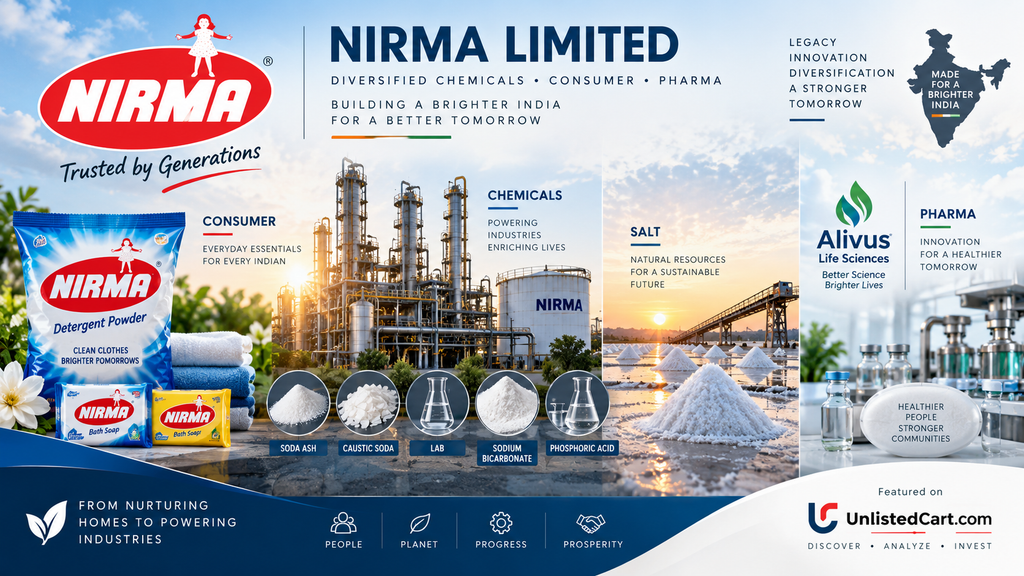
What began with the famous Nirma detergent brand has evolved into a diversified industrial and consumer group with exposure to:
- Soda ash
- Caustic soda
- Linear Alkyl Benzene (LAB)
- Sodium bicarbonate
- Phosphoric acid
- Bromine
- Fertilisers
- Salt
- Soaps
- Detergents
- Pharmaceuticals
- Mining and minerals
The company has also built a significant pharmaceutical presence through Alivus Life Sciences Limited, formerly Glenmark Life Sciences, in which Nirma held 74.87% as of March 2026.
Nirma’s business model is differentiated by a high degree of backward integration. Its captive salt, power and chemical production capabilities provide raw-material advantages to its soda ash, caustic soda, LAB, soap and detergent businesses.
However, the investment story has changed materially in 2026.
The company’s US subsidiary Searles Valley Minerals Inc. (SVM) filed for Chapter 11 bankruptcy in June 2026 after years of operating losses, weak global soda-ash conditions and environmental liabilities. Nirma has provided a $108 million corporate guarantee and injected $20 million to support the bankruptcy process.
At the same time, Nirma’s board decided in 2026 not to proceed with the proposed demerger of its domestic chemical and consumer businesses into Ocular Enterprises Pvt Ltd. The company therefore continues to house its businesses and investments under the existing structure.
This makes Nirma a much more complex investment today:
Strong domestic chemical franchise + consumer business + valuable Alivus stake + significant debt + troubled US operations.
At ~₹3,582/share, the company has an indicative equity value of more than ₹52,000 Cr, while FY2026 consolidated earnings were negative because of exceptional items and overseas losses.
Therefore, Nirma is no longer a simple “cheap unlisted FMCG” story. It is primarily a diversified holding/industrial company where asset value, Alivus ownership, normalised earnings and SVM liabilities all need to be considered.
Company Background
Nirma was established by Dr. Karsanbhai K. Patel and initially built its reputation through low-cost detergents aimed at India’s mass-market consumers.
The company subsequently diversified into industrial chemicals, particularly soda ash, LAB and caustic soda, creating significant backward integration into its consumer businesses.
The company’s official history describes Nirma as a multi-location, multi-product conglomerate with more than 8,000 employees and businesses spanning soaps and detergents, salt, chemicals, fertilisers, mining, printing and packaging.
Today, the business is considerably more diversified than the consumer brand for which it is best known.
Business Structure
Nirma can broadly be divided into four investment buckets:
1. Domestic Chemicals
This is the core operating engine.
Major products include:
- Soda ash
- Caustic soda
- Linear Alkyl Benzene
- Sodium bicarbonate
- Phosphoric acid
- Bromine
- Other chemicals
The company describes itself as one of India’s largest soda-ash producers and a leading producer of caustic soda and LAB.
2. Consumer Products
The consumer business includes:
- Detergent powder
- Detergent cakes
- Soaps
- Scouring products
- Edible salt
Nirma remains particularly strong in the economy segment, where its low-cost positioning and extensive distribution network remain important competitive advantages.
3. Pharmaceuticals – Alivus Life Sciences
Nirma owns 74.87% of Alivus Life Sciences, formerly Glenmark Life Sciences.
Alivus focuses on:
- Active pharmaceutical ingredients
- High-value APIs
- Cardiovascular therapies
- CNS
- Pain management
- Diabetes
- Contract development and manufacturing
This investment materially changes Nirma’s valuation because Alivus is itself a listed company.
4. Overseas Minerals & Chemicals
Nirma’s US operations historically centred around Searles Valley Minerals, which produces soda ash, boron minerals and salts.
This business is currently the most significant source of uncertainty because SVM filed for Chapter 11 bankruptcy in June 2026.
Domestic Chemicals Business
Soda Ash
Soda ash is one of Nirma’s most important businesses.
It is used across industries including:
- Glass
- Detergents
- Chemicals
- Construction
- Sodium silicates
- Other industrial applications
Nirma benefits from captive salt resources, integrated production and captive power.
The company describes its salt works as the largest single-location salt works in India, providing an important raw-material advantage.
Caustic Soda
Caustic soda is another major chemical product.
It is used in:
- Pulp and paper
- Textiles
- Aluminium
- Chemicals
- Water treatment
- Soap and detergent manufacturing
Nirma’s captive integration helps control raw-material and energy costs.
Linear Alkyl Benzene
LAB is an important raw material used in detergent manufacturing.
This is one of Nirma’s most strategically important backward-integrated businesses because the company can use its own LAB in its consumer products while also selling LAB externally.
Nirma states that its LAB facility is the first plant globally to use UOP’s Detal+ technology.
Consumer Business
Nirma’s consumer business remains strategically important even though the company is no longer primarily valued as an FMCG company.
Its major consumer categories are:
- Laundry detergents
- Soaps
- Detergent cakes
- Scouring products
- Edible salt
The company states that it remains one of the leading players in Indian soaps and detergents, particularly in the economy segment.
The integrated business model is an important advantage:
Salt → Soda Ash → LAB → Detergent / Soap
This creates greater control over raw materials and production economics.
Edible Salt
Nirma is the second-largest player in India’s vacuum-evaporated edible salt market, according to its FY2025-26 annual report.
FY2026 salt revenue reached approximately:
₹494 Cr
The company also has very large salt-pan operations in Gujarat, which support both the edible-salt business and the chemical operations.
Pharmaceutical Business – Alivus
The acquisition of a majority stake in Glenmark Life Sciences was one of Nirma’s biggest strategic moves.
The company subsequently became known as Alivus Life Sciences.
Nirma owned:
74.87%
of Alivus as of March 2026.
Alivus itself is now a listed company, creating an important source of transparent market value inside Nirma.
As of 11 September 2026, Alivus traded around ₹1,386.80/share.
With approximately 12.27 Cr Alivus shares outstanding, Nirma’s 74.87% stake represents a substantial publicly quoted asset.
At ₹1,386.80, the approximate market value of Nirma’s Alivus stake is:
~₹12,700 Cr
This is one of the most important components of the Nirma valuation thesis.
FY2025-26 Financial Performance
Consolidated
| ₹ Crore | FY2025 | FY2026 |
|---|---|---|
| Revenue from Operations | 12,206 | 12,005 |
| Other Income | 193 | 185 |
| EBITDA | 2,074 | 1,842 |
| PBT before exceptional items | 598 | 412 |
| Exceptional Items | 2,663 | 274 |
| Profit / Loss Before Tax | -2,065 | 138 |
| PAT | -2,309 | -274 |
| Consolidated Equity | 9,050 | 8,822 |
| Equity attributable to Nirma | 7,158 | 6,847 |
Source: Nirma FY2025-26 Annual Report.
Revenue Performance
Consolidated revenue declined marginally:
₹12,206 Cr → ₹12,005 Cr
This represents a decline of approximately 1.6%.
The lack of top-line growth is not ideal, but the more important issue was the decline in operating profitability.
EBITDA fell:
₹2,074 Cr → ₹1,842 Cr
Operating margin therefore declined from approximately:
17.0% → 15.3%
CRISIL’s adjusted calculation places FY2026 consolidated operating margin at approximately 13.8%, reflecting its analytical adjustments.
Standalone Financial Performance
Nirma’s standalone business performed considerably better than the consolidated group.
| ₹ Crore | FY2025 | FY2026 |
|---|---|---|
| Revenue | 7,073 | 7,091 |
| Other Income | 145 | 161 |
| EBITDA | 1,458 | 1,519 |
| PBT before exceptional items | 722 | 885 |
| Exceptional Item | 2,663 | 537 |
| PAT | -2,096 | 84 |
The standalone EBITDA increased by approximately 4.2%.
Finance cost declined from ₹497 Cr to ₹414 Cr, partly due to repayment associated with the NCD put option.
This is important because it indicates that the core Indian operating business is materially healthier than the headline consolidated PAT suggests.
Why Was FY2026 PAT Negative?
The reported consolidated loss was:
₹274 Cr
However, this should not be interpreted as the normal earning capacity of Nirma’s domestic businesses.
The major factors included:
- Overseas operating losses
- SVM-related problems
- Goodwill impairment
- Higher depreciation
- Finance costs
- Tax expenses
The company recorded ₹274 Cr of exceptional items on the consolidated side, mainly relating to goodwill impairment.
CRISIL similarly reported FY2026 adjusted PAT of approximately -₹273 Cr, versus -₹2,310 Cr in FY2025.
Therefore, the FY2026 loss needs to be analysed rather than simply used to conclude that Nirma is loss-making.
Searles Valley Minerals – Major Risk
This is currently the most important negative factor.
On 15 June 2026, Searles Valley Minerals Inc. and two related entities filed for Chapter 11 bankruptcy in the United States.
The business had been suffering from:
- Low capacity utilisation
- Weak global soda-ash market conditions
- Operating losses
- Environmental liabilities
After the bankruptcy filing, Nirma no longer has operational control over SVM; an independent board governs the business.
Nirma’s Financial Exposure
Nirma has provided:
$108 million corporate guarantee
to SVM lenders.
The guarantee had not been invoked as of CRISIL’s September 2026 assessment.
Nirma also injected:
$20 million
to fund part of the bankruptcy proceedings.
A further $20 million of liquidity from external sources is guaranteed by Nirma.
This is a significant contingent liability and must be considered in any valuation.
CRISIL Rating
Despite the SVM situation, CRISIL reaffirmed Nirma’s:
CRISIL AA / Stable
long-term rating.
Short-term rating:
CRISIL A1+
The rating covers ₹5,350 Cr of bank facilities and ₹1,200 Cr of NCDs, with an additional ₹1,500 Cr commercial-paper programme.
CRISIL considers Nirma’s domestic business profile healthy and expects operating margin to recover toward 16–18% in FY2027.
Debt Position
As of March 2026, consolidated borrowings were approximately:
₹4,705 Cr
including:
- Non-current borrowings: ₹3,384 Cr
- Current borrowings: ₹1,322 Cr
The company had approximately ₹404 Cr of cash and bank balances at the consolidated level.
CRISIL calculates adjusted net debt at approximately:
₹4,783 Cr
with adjusted net debt/equity of approximately 0.70x.
This is manageable, but it is not a debt-free balance sheet.
Deleveraging
One positive factor is Nirma’s historical ability to reduce leverage after acquisitions.
CRISIL notes that net debt/EBITDA declined from:
2.2x → 1.8x
in FY2026.
The rating agency expects leverage to decline further because annual cash accruals of approximately ₹1,600–1,800 Cr should cover debt obligations and part of planned capex.
Future Capex
Nirma plans approximately:
₹1,500–1,700 Cr
of capex over FY2027 and FY2028.
A significant portion is related to expansion at Alivus, along with replacement and maintenance capex.
This could strengthen the pharmaceutical segment but also means capital allocation remains important.
Cancelled Demerger
A potentially important corporate restructuring has now been cancelled.
Nirma’s board decided not to proceed with the proposed scheme of arrangement under which its domestic chemical and consumer businesses were to be transferred to Ocular Enterprises Pvt Ltd.
The company has withdrawn its application submitted to the National Stock Exchange.
Nirma will therefore continue to hold its businesses and investments under the existing structure.
This is important for investors because the earlier investment thesis around a possible demerger/restructuring should no longer be treated as a near-term catalyst.
Nirma’s Historical Delisting
Nirma was previously listed on Indian stock exchanges.
The company completed its delisting in 2012.
The promoters made an exit offer at:
₹260/share
following the reverse-book-building process.
The equity shares were subsequently delisted from the exchanges.
This is relevant because today’s unlisted Nirma shares represent an established company that has already undergone a full public-market listing and delisting cycle.
Current Unlisted Share Price
As of 14 September 2026, Planify reports an indicative unlisted Nirma price of:
₹3,581.55/share
with a 52-week range of approximately ₹3,411–₹3,581.
The reported equity share count is:
14,60,75,130 shares
giving an indicative market capitalisation of approximately:
₹52,318 Cr
This is a private-market indicative quotation, not an NSE/BSE traded price.
Actual transactions can differ depending on quantity, seller, liquidity and negotiation.
Current Valuation
At approximately ₹3,581.55/share:
Market Capitalisation
~₹52,318 Cr
FY2026 Consolidated P/E
Not meaningful because reported consolidated PAT was negative.
FY2026 Standalone P/E
Standalone PAT was only ₹84 Cr after exceptional items, so this also gives a distortedly high multiple.
Therefore, a conventional P/E valuation is not appropriate using FY2026 reported PAT.
Price-to-Book
Consolidated equity attributable to Nirma shareholders was:
₹6,847 Cr
With approximately 14.61 Cr shares outstanding:
Book Value ≈ ₹469/share
At ₹3,582/share:
P/B ≈ 7.6x
This is a high multiple relative to book value.
Therefore, Nirma is not obviously cheap on a simple P/B basis despite its asset base.
Alivus Stake Valuation
The 74.87% stake in Alivus is an important valuation component.
At an Alivus market price around ₹1,386.80 and approximately 12.27 Cr shares outstanding, the implied market capitalisation of Alivus is around:
₹17,000 Cr
Nirma’s 74.87% stake would therefore be worth approximately:
₹12,700 Cr
based purely on the quoted market value.
This does not mean Nirma’s equity value should automatically be increased by ₹12,700 Cr.
An investor needs to account for:
- Holding-company discount
- Nirma’s own debt
- Taxes
- Other liabilities
- Cash
- SVM exposure
- Value of domestic chemical business
- Value of consumer business
- Other assets
But it provides a useful valuation anchor.
Indicative Sum-of-the-Parts Framework
A more appropriate way to analyse Nirma is:
A. Alivus Stake
Approximate market value:
~₹12,700 Cr
B. Domestic Chemicals
Value using normalised EBITDA rather than FY2026 reported PAT.
The business includes:
- Soda ash
- Caustic soda
- LAB
- Sodium bicarbonate
- Phosphoric acid
- Bromine
- Other chemicals
C. Consumer Business
Value separately based on:
- Brand
- Distribution
- Detergent business
- Soap business
- Salt
D. Overseas Assets
The SVM business should be assigned a highly conservative value, given the Chapter 11 proceedings.
E. Less Net Debt
Approximately:
₹4,783 Cr adjusted net debt
before considering other contingent exposures.
This SOTP approach is considerably more informative than applying a P/E to the FY2026 loss.
Industry Opportunity
Soda Ash
Demand is linked to:
- Glass
- Solar glass
- Construction
- Chemicals
- Detergents
India’s industrialisation provides a long-term demand opportunity.
Pharmaceuticals
Alivus provides exposure to higher-value APIs and CDMO opportunities.
This is potentially the fastest-growing and highest-margin component of Nirma’s portfolio.
Consumer Products
Nirma’s mass-market positioning remains relevant in India’s value-conscious consumer segment.
Salt
India’s growing packaged-food market provides a structural opportunity for branded edible salt.
Competitive Advantages
1. Backward Integration
Captive raw materials and power provide cost advantages.
2. Scale
Nirma is one of India’s largest soda-ash producers.
3. Diversification
Exposure to chemicals, consumer products and pharmaceuticals reduces dependence on one industry.
4. Strong Brand
Nirma remains one of India’s most recognised legacy consumer brands.
5. Alivus Ownership
The listed Alivus stake creates an independently observable asset value.
6. Management Track Record
The company has historically demonstrated an ability to execute acquisitions and subsequently deleverage.
7. Strong Credit Profile
CRISIL maintains an AA/Stable long-term rating.
Key Growth Drivers
1. Alivus Expansion
Growth in high-value APIs and CDMO activities can improve the group’s earnings quality.
2. Domestic Chemical Recovery
A recovery in soda-ash and other chemical pricing could materially improve EBITDA.
3. Cost Optimisation
Nirma’s integrated manufacturing model provides scope for margin improvement.
4. Sodium Bicarbonate Expansion
The company doubled its sodium-bicarbonate capacity during FY2026.
5. Renewable Energy
Nirma is increasing its use of solar, wind and other renewable energy sources to optimise power costs.
Key Risks
1. SVM Bankruptcy
This is currently the largest specific risk.
The outcome of the Chapter 11 process, environmental liabilities and corporate guarantee exposure remain important monitorables.
2. Commodity Cyclicality
Soda ash, caustic soda and LAB prices are influenced by global supply-demand dynamics.
3. High Valuation
At approximately ₹52,300 Cr market capitalisation, Nirma is not inexpensive relative to its FY2026 reported earnings.
4. Debt
Adjusted net debt was approximately ₹4,783 Cr.
5. Interest Costs
Although finance cost declined in FY2026, debt remains meaningful.
6. Consumer Competition
The detergent and soap business competes against:
- Hindustan Unilever
- P&G
- Jyothy Labs
- RSPL
- Other regional brands
7. Execution Risk at Alivus
The pharmaceutical business requires continued investment in capacity, compliance and R&D.
8. Corporate Complexity
Nirma’s combination of consumer, chemicals, pharmaceuticals and overseas assets makes valuation more complicated.
Investment Positives vs Concerns
| Investment Positives | Key Concerns |
|---|---|
| Strong domestic chemical franchise | SVM Chapter 11 |
| Significant Alivus stake | ₹4,783 Cr adjusted net debt |
| Backward integration | Commodity-cycle exposure |
| Recognised consumer brand | FY2026 consolidated loss |
| Strong credit rating | High valuation |
| Diversified revenue profile | Complex holding structure |
| Strong domestic assets | SVM guarantee exposure |
| Alivus provides listed-market value discovery | No near-term demerger |
| Long operating history | Unlisted liquidity |
IPO / Relisting Status
Nirma is not currently listed on NSE/BSE.
It was previously listed and was delisted in 2012 following the promoter-led exit process.
The current investment case should therefore not be based on an assumed IPO or relisting.
The more relevant potential catalysts are:
- Recovery in domestic chemical margins
- Alivus growth
- Further deleveraging
- Resolution of SVM bankruptcy
- Monetisation/restructuring of non-core assets
- Improvement in consolidated profitability
- Potential future corporate restructuring
The proposed demerger should not currently be considered a catalyst because the company has decided not to proceed with it.
Investment View
Nirma is a high-quality but complicated unlisted business.
The company still possesses several significant strengths:
Strong domestic chemicals franchise
Backward integration
Recognised consumer brands
Large Alivus stake
Strong credit rating
Long operating history
But the investment thesis has changed following the SVM bankruptcy.
The market is effectively asking investors to pay approximately ₹52,000+ Cr for Nirma’s equity at current indicative unlisted prices.
At the same time, FY2026 consolidated PAT was negative ₹274 Cr and consolidated EBITDA declined to ₹1,842 Cr.
Therefore, Nirma cannot be called cheap merely because the company has a large asset base.
The better question is:
What is the normalised value of the domestic chemical + consumer businesses, what is the market value of the Alivus stake, and how much should be deducted for debt and SVM-related liabilities?
That is the correct investment framework.
Valuation Framework
A sensible investor could use three scenarios.
Conservative Case
- Apply a substantial holding-company discount to Alivus
- Assign low value to SVM
- Use conservative EBITDA multiples for chemicals
- Deduct full net debt and contingent liabilities
Base Case
- Alivus valued at market value with 20–30% holding-company discount
- Domestic chemicals valued on normalised EBITDA
- Consumer business valued separately
- SVM assigned minimal/zero equity value
- Debt deducted
Bull Case
- Domestic chemical margins recover
- Alivus continues strong growth
- SVM liabilities are contained
- Leverage declines
- Market begins valuing Nirma closer to the sum of its underlying businesses
Overall Assessment
Business Quality: ⭐⭐⭐⭐½
Domestic Chemical Franchise: ⭐⭐⭐⭐⭐
Consumer Brand: ⭐⭐⭐⭐
Pharma Exposure: ⭐⭐⭐⭐⭐
Asset Quality: ⭐⭐⭐⭐½
Balance Sheet: ⭐⭐⭐½
Management Track Record: ⭐⭐⭐⭐½
Current Earnings Visibility: ⭐⭐⭐
Valuation: ⭐⭐⭐
Liquidity: ⭐⭐
Overall View: Strong Assets, But Current Valuation Requires Careful SOTP Analysis
Nirma remains one of India’s most interesting legacy unlisted companies.
Its transformation from a detergent company into a diversified chemical, consumer and pharmaceutical group is impressive.
The 74.87% Alivus stake is particularly valuable because it provides investors with an observable listed asset inside the unlisted parent.
However, the Searles Valley Minerals bankruptcy is a material negative development, and investors should not ignore the associated guarantees and funding requirements.
The company’s decision to abandon the proposed demerger also removes a previously discussed restructuring catalyst.
At approximately ₹3,582/share and ₹52,318 Cr market capitalisation, Nirma requires a valuation based on normalised earnings and SOTP, rather than a simple P/E or P/B approach.
Final Investment View
Nirma is a strong business platform with valuable assets, but at the current indicative unlisted valuation, the margin of safety needs to be established through detailed SOTP analysis.
The biggest upside could come from:
Domestic chemical recovery + Alivus compounding + deleveraging + SVM resolution.
The biggest risks are:
SVM liabilities + commodity cyclicality + high valuation + corporate complexity.
For an investor looking at Nirma today, price discipline is more important than the brand name.
Important Company Links
Disclaimer
This report is prepared for informational and research purposes only. Nirma Limited’s equity shares are unlisted and therefore do not have continuous exchange-based price discovery.
The ₹3,581.55/share figure is an indicative private-market quotation reported as of 14 September 2026 and should not be treated as an NSE/BSE traded price. Actual private transactions may differ materially depending on quantity, liquidity, seller and negotiation.
The valuation framework presented above is illustrative and is not a buy/sell recommendation. Investors should independently verify the latest audited financial statements, SVM bankruptcy developments, guarantees, debt, Alivus market value, share-transfer restrictions and actual transaction price before investing.
For more such unlisted stocks visit https://unlistedcart.com/unlisted-shares/