Renewable Energy IPP | Solar Manufacturing | Agri Waste-to-Energy
Company: SAEL Industries Limited
CIN: U40106PB2022PLC055755
Incorporated: 25 April 2022
Registered Office: Firozpur, Punjab
Corporate Office: Aerocity, New Delhi
Business: Renewable Energy & Solar Manufacturing
Status: Unlisted / Pre-IPO
Promoters: Jasbir Singh, Sukhbir Singh & Laxit Awla
Face Value: ₹5 per share
IPO: DRHP filed; SEBI approval received in March 2026; IPO dates not yet announced
1. Company Overview
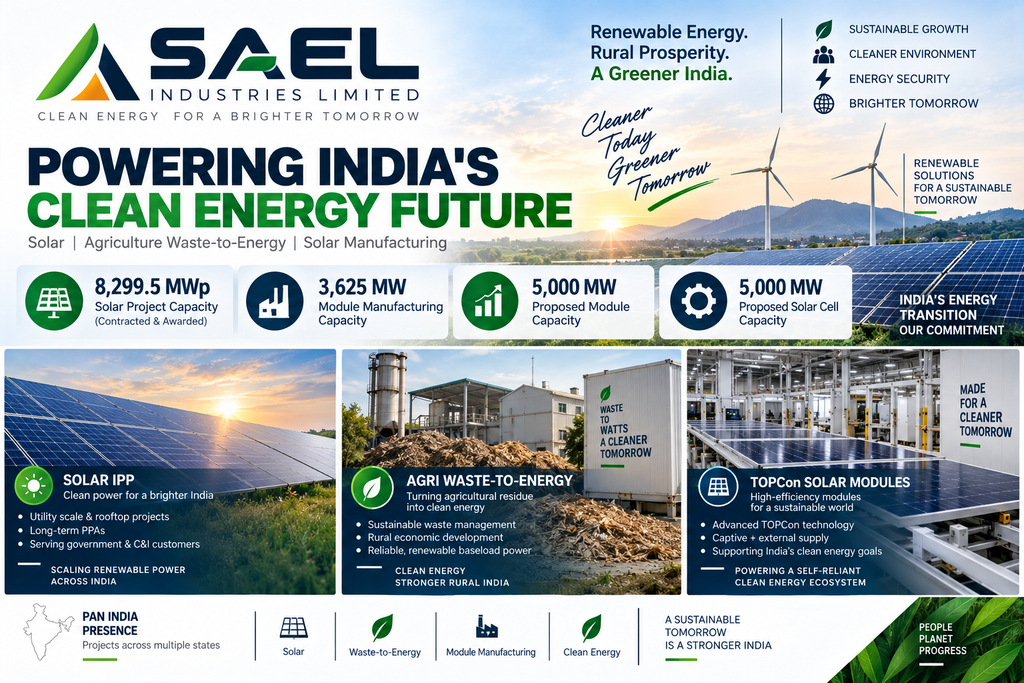
SAEL Industries Limited is a vertically integrated renewable-energy company promoted by the Awla family.
The company operates across three major businesses:
- Utility-scale Solar Power
- Agri Waste-to-Energy
- Solar PV Module Manufacturing
It also has in-house EPC and O&M capabilities, allowing it to develop, construct and operate renewable-energy projects across the value chain.
SAEL has expanded rapidly from an agri-waste power business into a large solar IPP and solar manufacturing platform.
2. Business Model
SAEL’s business can broadly be divided into:
Solar IPP
The company develops and operates utility-scale and rooftop solar projects.
Revenue is generated primarily through long-term Power Purchase Agreements (PPAs) with government agencies, state DISCOMs and other counterparties.
Agri Waste-to-Energy
SAEL uses agricultural residue such as:
- Paddy straw
- Mustard residue
- Cotton stalks
- Other agricultural biomass
to generate electricity.
This gives the company exposure to both renewable energy and agricultural-waste management.
Solar Module Manufacturing
SAEL manufactures TOPCon solar modules, largely for captive consumption as well as external customers.
Its manufacturing capacity had reached approximately 3.625 GW by FY25/FY26.
The vertical integration creates a model of:
Solar project development → Module manufacturing → EPC → Power generation → O&M
3. Current Business Scale
As of September 2025, SAEL reported:
| Business | Capacity |
|---|---|
| Contracted & awarded renewable capacity | 8,299.5 MWp solar + 164.9 MW AgWTE |
| Solar IPP | ~8.30 GWp |
| Agri Waste-to-Energy | 164.9 MW |
| TOPCon module manufacturing | 3.625 GW |
| Planned solar cell manufacturing | 5 GW |
| Planned additional module manufacturing | 5 GW |
The company subsequently commissioned additional projects, including a 1 GWp solar project at Khavda, Gujarat, and a 600 MW solar project in Kurnool, Andhra Pradesh.
4. Solar Power Business
Solar is now the company’s largest business.
As of September 2025, the company had approximately 5,600.7 MW AC / 8,299.5 MWp DC of solar contracted and awarded capacity.
The portfolio includes utility-scale as well as rooftop projects across multiple Indian states.
Major project – Khavda
In January 2026, SAEL commissioned a 1 GWp solar project at Khavda Renewable Energy Park, Gujarat.
The project covers approximately 3,600 acres and is backed by 25-year PPAs with GUVNL.
More than 60% of the modules used were assembled at SAEL’s own manufacturing facilities.
This is an important example of the company’s vertically integrated model.
5. Agri Waste-to-Energy
SAEL is one of India’s largest operators in the agricultural waste-to-energy segment.
Its plants convert agricultural residue into electricity while providing an alternative use for crop residue that might otherwise be burned.
In June 2026, SAEL commissioned its 11th Agri Waste-to-Energy plant, a 14.9 MW facility at Bhadra, Rajasthan.
This took its operational AgWTE capacity to 164.9 MW.
The company’s Rajasthan plants recorded plant-load factors of up to 90.99% in FY25, demonstrating the baseload characteristics of biomass generation.
6. Solar Module Manufacturing
SAEL has rapidly developed an in-house solar manufacturing business.
Existing capacity
~3.625 GW TOPCon module assembly capacity
Planned expansion
The company is setting up an integrated:
5 GW Solar Cell + 5 GW Solar Module manufacturing facility
in Greater Noida/Jewar, Uttar Pradesh.
The planned manufacturing expansion is estimated by CRISIL at approximately ₹5,200 crore of capex, with completion targeted around FY29.
This expansion is intended to strengthen:
- Backward integration
- Domestic manufacturing
- Supply-chain security
- Captive module availability
- Manufacturing margins
7. Recent Module Orders
A major recent development came in September 2026.
SAEL announced that it had secured 1 GWp of solar PV module supply orders over six months, including a 585.8 MWp order from NTPC Renewable Energy’s Chitrakoot project.
This is important because SAEL is gradually moving beyond captive manufacturing towards a larger external module-supply business.
8. Long-Term PPAs
One of SAEL’s key strengths is its contracted revenue model.
Major off-takers include:
- SECI
- NTPC
- SJVN
- NHPC
- GUVNL
- Other state DISCOMs
- Private-sector customers
According to the DRHP-related disclosures, approximately 81.5% of contracted and awarded capacity was backed by off-takers rated AA or above as of September 2025.
The weighted average remaining life of PPAs was approximately 24.64 years as of June 2025.
This provides significant long-term revenue visibility once projects become operational.
9. Geographic Presence
SAEL’s renewable portfolio is spread across multiple Indian states.
Its project footprint includes:
- Rajasthan
- Gujarat
- Punjab
- Uttar Pradesh
- Maharashtra
- Karnataka
- Andhra Pradesh
- Haryana
- Mizoram
- Other locations
CRISIL reported that the company’s operational portfolio was diversified across nine states, while the DRHP describes a broader contracted/awarded portfolio across 10 states and one Union Territory.
10. Financial Performance
There are two financial datasets that should be distinguished.
The DRHP restated consolidated financial statements cover FY23-FY25, while the latest CRISIL rating uses FY26 restricted-group financial information. They should not be mixed without noting the reporting perimeter.
DRHP Restated Consolidated Financials
| ₹ Crore | FY23 | FY24 | FY25 |
|---|---|---|---|
| Revenue from operations | 388.93 | 558.47 | 664.77 |
| EBITDA | 130.22 | 97.08 | 141.92 |
| PAT | -71.07 | -267.14 | -280.95 |
| Total assets | 2,471.17 | 3,852.62 | 10,917.27 |
| Net worth | 134.05 | -131.52 | -281.03 |
The company remained loss-making at the PAT level because of the capital-intensive nature of the business, depreciation and financing costs.
11. Latest FY26 Financial Picture
CRISIL’s August 2026 rating rationale reports FY26 consolidated/restricted-group revenue of approximately ₹1,330.6 crore, compared with ₹672 crore in FY25.
PAT was approximately -₹753.2 crore, while interest coverage was around 1.0x.
| Particular | FY25 | FY26 |
|---|---|---|
| Revenue | ₹672 Cr | ₹1,330.6 Cr |
| PAT | -₹280 Cr | -₹753.2 Cr |
| Interest coverage | 1.31x | 1.00x |
Important: The FY26 figures cited by CRISIL are for its stated consolidated/restricted-group reporting basis and should not be directly compared with every line item in the earlier DRHP financial statements without checking the reporting perimeter.
12. Why PAT Is Currently Negative
SAEL is in an aggressive expansion phase.
Large amounts are being invested in:
- Solar projects
- Transmission infrastructure
- Solar modules
- New manufacturing facilities
- Under-construction renewable assets
The result is high:
Depreciation + interest expense + project-development costs
Therefore, EBITDA can grow while reported PAT remains negative.
For SAEL, investors should therefore closely monitor:
EBITDA → operating cash flow → interest → debt servicing → equity requirement
rather than focusing only on PAT.
13. Debt & Leverage
SAEL is a highly capital-intensive business.
CRISIL expects the operational IPP portfolio’s total debt/EBITDA ratio to remain around 6.5–7.0x in FY27, while the manufacturing arm is expected to remain around 4.0–4.5x over the medium term.
The company’s rapid expansion therefore requires continuous access to:
- Project finance
- Equity capital
- Internal accruals
- Institutional investment
- IPO proceeds
This is one of the most important factors to monitor.
14. Institutional Investors
SAEL has attracted capital from international institutions including:
- Norfund
- US International Development Finance Corporation (DFC)
CRISIL states that Norfund and DFC have collectively infused approximately US$165 million into the group to date.
This provides institutional validation of the company’s renewable-energy platform, while also providing additional funding sources.
15. IPO – Major Development
SAEL filed its Draft Red Herring Prospectus (DRHP) dated 3 November 2025 with SEBI and the stock exchanges.
The proposed IPO comprises:
| Component | Proposed Size |
|---|---|
| Fresh Issue | Up to ₹3,750 Cr |
| Offer for Sale | Up to ₹825 Cr |
| Total | Up to ₹4,575 Cr |
The OFS is proposed to be sold by Norfund.
The shares are proposed to be listed on:
NSE + BSE
16. SEBI Approval
A key update is that CRISIL reported SAEL received final SEBI approval for the IPO on 27 March 2026.
However, as of 21 September 2026, the IPO’s:
- Price band
- Opening date
- Closing date
- Lot size
- Listing date
have not yet been announced in the sources reviewed.
HDFC Securities also currently shows the IPO dates and price range as TBA.
Therefore:
IPO Status
SEBI approved — IPO launch date awaited.
17. IPO Proceeds – Use of Funds
The proposed fresh issue is intended primarily to support investment in subsidiaries and repayment/prepayment of outstanding borrowings associated with solar projects.
This is important because the IPO is not simply an OFS/liquidity event; a substantial fresh-equity component can strengthen the company’s capital structure and fund project expansion.
18. Unlisted Share Price
SAEL remains unlisted as of the latest information reviewed.
Some private-market websites continue to show historical or indicative quotes, but the current quotes are inconsistent and one major unlisted-price source currently displays ₹0, so I would not present a current OTC price as verified market data.
For an UnlistedCart report, the current negotiated seller/buyer price should therefore be separately verified before publishing.
19. Key Growth Drivers
1. Massive renewable-energy pipeline
SAEL has a contracted/awarded solar portfolio of more than 8.2 GWp, providing a large future operating-capacity pipeline.
2. Solar manufacturing
The existing 3.625 GW module capacity plus planned 5 GW cell and 5 GW module facilities create a large manufacturing opportunity.
3. Vertical integration
SAEL can participate across:
Manufacturing → EPC → IPP → O&M
This can potentially improve cost control and supply-chain visibility.
4. Agri Waste-to-Energy
The biomass business provides exposure to a renewable source that can generate relatively stable/baseload power compared with intermittent solar.
5. Strong off-takers
A significant portion of the contracted portfolio is backed by highly rated government and institutional counterparties.
6. Recent commissioning
The company has rapidly increased operating capacity through projects including Khavda and Kurnool.
7. External module orders
The September 2026 announcement of 1 GWp of module orders indicates growing potential for the manufacturing business beyond captive consumption.
20. Key Risks
High leverage
The rapid expansion requires significant debt and equity.
CRISIL expects total debt/EBITDA for the operating IPP portfolio to remain elevated.
Large equity requirement
CRISIL estimates that approximately ₹1,000–1,100 crore of equity may be required in FY27 for projects expected to become operational in FY28, in addition to other commitments.
IPO delay
CRISIL revised SAEL’s long-term rating outlook to Negative in August 2026, citing the delay in raising funds through the IPO and the importance of timely equity funding for under-construction projects.
Project execution
Approximately 2,330 MW was under construction according to CRISIL, with around 600 MW delayed due to pending tariff approvals.
Solar generation risk
Solar projects are exposed to:
- Irradiance
- Weather
- Equipment performance
- Grid evacuation
- Plant-load-factor variation
These factors can directly affect cash flows.
Manufacturing capex
The proposed 5 GW cell + 5 GW module manufacturing expansion requires approximately ₹5,200 crore of capex according to CRISIL.
Negative PAT
Despite revenue and EBITDA expansion, the company remains loss-making at the PAT level because of the capital-intensive expansion model.
21. What Investors Should Track
| Metric | Why it matters |
|---|---|
| Operational MW | Revenue-generating capacity |
| Contracted/awarded MW | Future growth |
| PPA tenor | Revenue visibility |
| Off-taker quality | Collection risk |
| PLF | Generation performance |
| EBITDA | Operating performance |
| Operating cash flow | Cash generation |
| Debt/EBITDA | Leverage |
| Interest coverage | Debt-servicing capacity |
| Equity requirement | Funding risk |
| IPO progress | Capital availability |
| Module utilisation | Manufacturing efficiency |
| Cell/module capex | Expansion risk |
| AgWTE PLF | Biomass efficiency |
| Receivables | Cash-flow quality |
22. SAEL’s Investment Story in One Framework
Renewable Power
↓
8+ GWp contracted/awarded solar portfolio
↓
Long-term PPAs
↓
Predictable project revenue
3.625 GW module manufacturing
↓
5 GW cell + 5 GW module expansion
↓
Vertical integration
164.9 MW Agri Waste-to-Energy
↓
Diversified renewable portfolio
The key challenge is funding this expansion without allowing leverage and interest costs to overwhelm project-level cash generation.
23. Quick Snapshot
| Parameter | SAEL Industries |
|---|---|
| Incorporated | 2022 |
| Promoters | Jasbir Singh, Sukhbir Singh, Laxit Awla |
| Business | Renewable Energy |
| Solar contracted/awarded | ~8.30 GWp |
| AgWTE capacity | 164.9 MW |
| Module manufacturing | 3.625 GW |
| Planned cell capacity | 5 GW |
| Planned module capacity | 5 GW |
| FY26 Revenue* | ₹1,330.6 Cr |
| FY26 PAT* | -₹753.2 Cr |
| IPO proposed size | ₹4,575 Cr |
| Fresh issue | ₹3,750 Cr |
| OFS | ₹825 Cr |
| SEBI approval | 27 Mar 2026 |
| IPO dates | TBA |
| NSE/BSE listing | Proposed |
| Current equity status | Unlisted |
| Recent module orders | 1 GWp |
| Recent Khavda project | 1 GWp |
*FY26 figures are from CRISIL’s reported consolidated/restricted-group financial information and should not be directly mixed with the DRHP’s restated historical financial statements.
24. UnlistedCart Takeaway
SAEL Industries is moving from being primarily a renewable-power developer into a vertically integrated clean-energy platform.
Its story now combines:
Solar IPP + Agri Waste-to-Energy + TOPCon Modules + Solar Cells + EPC + O&M
The company has built a sizeable contracted renewable portfolio, commissioned major solar projects at Khavda and Kurnool, expanded module manufacturing to approximately 3.625 GW and recently announced another 1 GWp of module orders.
The biggest upcoming catalyst is the ₹4,575 crore proposed IPO, for which SEBI approval was received in March 2026. However, the IPO has not yet received a final price band or launch date as of September 2026.
At the same time, this is a high-capex, highly leveraged expansion story. The current negative PAT, substantial equity requirement and dependence on successful IPO/fundraising make capital availability and project execution the most important monitorables. CRISIL’s August 2026 revision of the long-term outlook to Negative specifically highlights these funding and execution considerations.
Key Theme
Solar IPP + TOPCon Manufacturing + Agri Waste-to-Energy + 5 GW Cell/Module Expansion + Upcoming IPO
Official & Research Links
SAEL Industries – Official Website
SAEL – Investor Downloads & Financial Reports
SAEL – Consolidated Financial Statements
SEBI – SAEL Industries DRHP Addendum
CRISIL – SAEL Industries Rating Rationale, August 2026
SAEL – September 2026 Module Order Announcement
SAEL – 1 GWp Khavda Solar Project Announcement
Disclaimer
This report is for informational and research purposes only and should not be considered investment advice, a recommendation, or an offer to buy/sell securities. SAEL Industries’ equity remains unlisted, and private-market transactions may have limited liquidity and price-discovery risks. IPO dates, price band, issue structure and other terms may change until the final offer documents are filed. Investors should verify the latest RHP/prospectus, financial statements, SEBI filings and private-market quotation before making an investment decision.
For more such unlisted stocks visit UnlistedCart – Unlisted Shares