Sector: Capital Goods / Industrial Equipment
Industry: Elevators, Escalators, Modernisation & Vertical Transportation
CIN: U29150MH1953PLC009158
ISIN: INE099A01014
Face Value: ₹10 per share
Incorporated: 30 October 1953
Registered Office: Magnus Towers, 9th Floor, Mindspace, Link Road, Malad West, Mumbai – 400064
Status: Active, Public, Unlisted
Parent: Otis International Asia Pacific Pte. Ltd. / Otis Worldwide Corporation
Current Indicative Unlisted Price: ~₹3,850–₹3,994 per share
FY2025 EPS: ~₹161.78
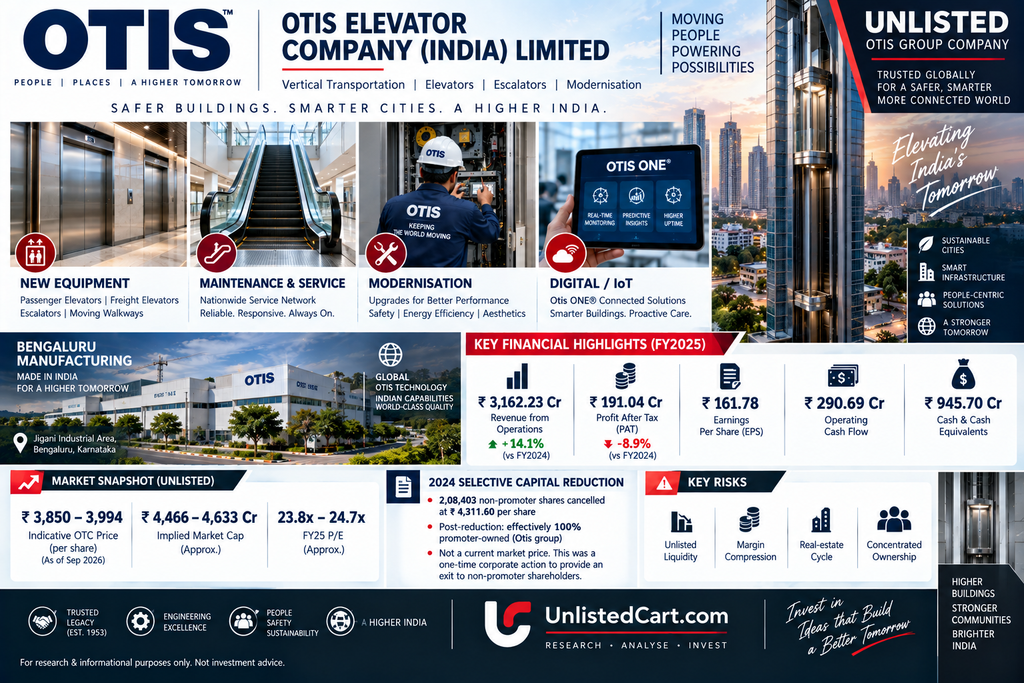
FY2025 Revenue: ₹3,162.23 Cr
FY2025 PAT: ₹191.04 Cr
Official Otis India Website
Official Otis India – About Us
1. Executive Summary
Otis Elevator Company (India) Limited is one of India’s longest-established elevator and escalator businesses, incorporated in 1953. The company is engaged in the manufacture, installation, modernisation and maintenance of elevators, escalators and moving walkways. Its operations are supported by a manufacturing facility in Bengaluru and a nationwide service infrastructure.
The company’s business is particularly attractive from a structural perspective because elevator economics extend beyond the initial sale of equipment. After installation, elevators require recurring maintenance, repair, replacement parts and eventually modernization.
This creates three major revenue engines:
- New Equipment
- Service / Maintenance
- Modernisation
The company’s FY2025 consolidated revenue from operations increased to ₹3,162.23 Cr, compared with ₹2,770.69 Cr in FY2024. However, PAT declined from ₹209.59 Cr to ₹191.04 Cr, while operating margins compressed.
The company also underwent an important corporate action in 2024. Otis proposed and implemented a selective capital reduction under which 2,08,403 non-promoter shares were cancelled at ₹4,311.60 per share, representing 1.76% of the pre-reduction equity. The post-reduction shareholding structure became 100% promoter-owned.
For investors, this makes Otis India a distinctive unlisted company: it has a high-quality global parent and a mature recurring-service business, but liquidity and future exit opportunities for minority shareholders need to be considered very carefully.
2. Company Overview
Otis India operates in the vertical-transportation industry.
Its principal activities include:
- Passenger elevators
- Commercial elevators
- Residential elevators
- High-rise elevators
- Escalators
- Moving walkways
- Elevator installation
- Maintenance contracts
- Repairs
- Modernisation
- Digital/IoT-based monitoring
Otis India also manufactures several products in its Bengaluru facility.
The official Otis India website identifies Bengaluru as its manufacturing location and highlights its products, services and modernization capabilities.
Explore Otis India Products & Services
3. Parent Company
Otis Elevator Company (India) Limited is part of the global Otis group.
The global parent, Otis Worldwide Corporation, became an independent publicly traded company in April 2020 after its separation from United Technologies. Otis Worldwide’s SEC subsidiary listing includes Otis Elevator Company (India) Limited and Otis International Asia Pacific Pte. Ltd.
The parent relationship provides access to:
- Global elevator technology
- Product engineering
- R&D
- Safety standards
- Digital technologies
- International sourcing
- Global manufacturing knowledge
- Brand recognition
Otis Worldwide – Official Website
4. Business Model
Otis India’s business can broadly be divided into three categories.
A. New Equipment
This includes the sale and installation of new elevators and escalators.
Customers include:
- Residential developers
- Commercial buildings
- Offices
- Hotels
- Hospitals
- Shopping centres
- Airports
- Railways
- Metro projects
- Government infrastructure
The company has developed products across low-rise, mid-rise and higher-end applications.
B. Service & Maintenance
This is strategically important because installed elevators require recurring maintenance.
Service activities include:
- Annual maintenance
- Preventive maintenance
- Repairs
- Breakdown services
- Parts replacement
- Remote monitoring
- Technical support
Otis also provides connected solutions through Otis ONE, which uses IoT connectivity and remote monitoring to provide equipment-status information and predictive insights.
Otis ONE – Official IoT Service
C. Modernisation
Older elevators eventually require:
- Control-system upgrades
- Drive upgrades
- Door-system upgrades
- Safety upgrades
- Aesthetic improvements
- Energy-efficiency upgrades
- Digital monitoring
Modernisation can therefore provide an additional revenue opportunity from the existing installed base.
5. Manufacturing Capability
Otis operates a manufacturing facility in Jigani Industrial Area, Bengaluru.
The official Otis website identifies the Bengaluru facility as an ISO-certified manufacturing centre and states that products including Gen2 systems are manufactured there.
The facility also has an R&D centre and testing infrastructure. Otis’s online-booking information states that the Bengaluru R&D centre includes a test tower capable of testing elevators at speeds up to 3 metres per second.
This provides an important combination of:
Manufacturing + Engineering + R&D + Testing
within India.
6. Product Portfolio
Otis India offers products for several building categories.
Residential
- Gen2 Core
- Gen2 Life
- Residential-oriented elevator solutions
Commercial
- Gen2 Prime
- Gen2 Stream
- Gen3 Nova
- Higher-performance commercial systems
Infrastructure
- Heavy-duty elevators
- Transit applications
- Airports
- Metro/rail infrastructure
- Essential infrastructure
Otis has also introduced products designed specifically for demanding data-centre and essential-infrastructure environments.
Explore Otis Elevator Products
7. Digitalisation & IoT
One of the company’s long-term growth areas is the digitalisation of elevator service.
Otis ONE connects elevator equipment to the cloud and enables:
- Real-time equipment information
- Remote monitoring
- Usage information
- Performance dashboards
- Health reports
- Notifications
- Predictive insights
This can potentially improve maintenance efficiency while increasing the value of the company’s service relationships.
This is strategically important because the elevator industry is gradually moving from:
“Equipment supplier” → “Connected equipment + recurring service provider.”
8. FY2025 Financial Performance
Consolidated Financials
| Particular | FY2025 | FY2024 |
|---|---|---|
| Revenue from Operations | ₹3,162.23 Cr | ₹2,770.69 Cr |
| Other Income | ₹98.46 Cr | ₹62.77 Cr |
| Total Income | ₹3,260.69 Cr | ₹2,833.46 Cr |
| PBT | ₹255.97 Cr | ₹285.70 Cr |
| PAT | ₹191.04 Cr | ₹209.59 Cr |
| EPS | ₹161.78 | ₹177.50 |
Source: FY2025 consolidated financial statements.
Revenue Growth
Revenue increased from:
₹2,770.69 Cr → ₹3,162.23 Cr
Growth:
~14.1%
This is a healthy top-line performance.
However, PAT declined by approximately:
8.9%
from ₹209.59 Cr to ₹191.04 Cr.
This divergence between revenue and profit growth deserves attention.
9. EBITDA Analysis
FY2025 approximate EBITDA, excluding other income:
~₹192.9 Cr
Approximate EBITDA margin:
~6.1%
FY2024:
~₹255 Cr EBITDA
Approximate margin:
~9.2%
Therefore, although revenue increased strongly, operating profitability compressed materially in FY2025.
Why is this important?
For a capital-goods company, revenue growth is useful only if it translates into:
- Higher operating profit
- Higher PAT
- Strong cash flow
- Better return on capital
Otis’s FY2025 numbers therefore need to be analysed from a margin and cash-conversion perspective, rather than simply focusing on revenue growth.
10. Cash Flow Analysis
FY2025 operating cash flow:
₹290.69 Cr
FY2024 operating cash flow:
₹264.06 Cr
Operating cash flow therefore increased by approximately 10%.
This is an important positive because cash generation remained strong despite the decline in reported PAT.
Cash Conversion
FY2025:
Operating Cash Flow: ₹290.69 Cr
versus
PAT: ₹191.04 Cr
The company therefore generated operating cash significantly above reported accounting profit.
This indicates relatively healthy cash-generation characteristics.
11. Balance Sheet
Selected FY2025 consolidated figures:
| Particular | FY2025 |
|---|---|
| Total Assets | ~₹2,405.72 Cr |
| Equity Share Capital | ₹11.81 Cr |
| Other Equity | ₹448.78 Cr |
| Cash & Cash Equivalents | ₹945.70 Cr |
| Inventory | ₹259.83 Cr |
| Trade Receivables | ₹554.56 Cr |
| Lease Liabilities | ₹35.45 Cr |
| Total Borrowings | Very low |
| Net Debt | Net cash position |
The company ended FY2025 with approximately ₹945.7 Cr of cash and cash equivalents, giving it substantial financial liquidity.
12. Debt Position
Otis India’s balance sheet is relatively conservative.
The company does not appear to depend materially on conventional interest-bearing debt for its operations.
Finance costs were only approximately:
₹5.51 Cr
in FY2025.
The combination of:
- High cash
- Low debt
- Strong operating cash flow
provides financial flexibility.
13. Working Capital
Trade receivables increased from:
₹458.33 Cr → ₹554.56 Cr
while inventories increased from:
₹227.65 Cr → ₹259.83 Cr.
The increase is partly consistent with the company’s higher revenue scale.
However, investors should continue monitoring:
- Receivable days
- Customer collections
- Inventory turnover
- Contract advances
- Project execution
because elevator installation projects can involve significant working-capital movements.
14. Capital Expenditure
FY2025 capital expenditure on property, plant and equipment was approximately:
₹30.08 Cr
against ₹30.32 Cr in FY2024.
This is relatively modest compared with the company’s cash generation.
The business therefore does not appear to be extremely capital-intensive relative to its operating cash flow.
15. Capital Reduction – Major Development
One of the most important events for unlisted-share investors occurred in 2024.
Otis proposed the selective cancellation of:
2,08,403 equity shares
representing:
1.76% of total equity
held by non-promoter shareholders.
The shares were valued at:
₹4,311.60 per share
based on a valuation report from GT Valuation Advisors.
The post-reduction structure became:
| Shareholder Category | Pre-Reduction | Post-Reduction |
|---|---|---|
| Otis / Promoter | 98.24% | 100% |
| Non-Promoter | 1.76% | Nil |
| Total | 100% | 100% |
The paid-up equity capital reduced from:
₹11.81 Cr → ₹11.60 Cr
and the number of shares reduced from:
1,18,08,222 → 1,15,99,819.
16. What Does the Capital Reduction Mean?
This is a very important consideration for potential buyers of Otis unlisted shares.
The company specifically stated that the capital reduction was intended to provide an exit opportunity to non-promoter shareholders and address liquidity concerns.
Therefore, investors should not assume that historical availability of Otis shares means that a large freely tradeable minority shareholder base still exists.
The company has become effectively 100% promoter-owned after the cancellation.
Due-diligence requirement
Anyone currently offering Otis shares should verify:
- Current shareholder name
- Current share certificate
- ISIN
- Demat status
- Transferability
- Seller’s ownership
- Corporate action history
- Current share count
- Whether the security is actually eligible for transfer
17. Current Indicative Unlisted Price
Current OTC references vary.
As of September 2026:
- One unlisted-market source shows approximately ₹3,850/share.
- Another source reported approximately ₹3,994/share on September 11, 2026.
- Moneycontrol’s unlisted-share page shows approximately ₹3,866/share.
Because these are private OTC references and not exchange-traded prices, the difference between platforms is expected.
Indicative range
₹3,850–₹3,994/share
This should not be interpreted as a firm bid/offer or exchange price.
18. Market Capitalisation
Using the post-reduction share count of:
1,15,99,819 shares
and an indicative price of:
₹3,850
the implied equity value is approximately:
₹4,466 Cr
At ₹3,994:
~₹4,633 Cr
Therefore, a reasonable current OTC valuation range based on these indicative prices is approximately:
₹4,470–₹4,630 Cr
19. Valuation
Using FY2025 EPS:
₹161.78
and indicative price:
₹3,850–₹3,994
the implied FY2025 P/E is approximately:
23.8x–24.7x
This is consistent with current unlisted-market data showing approximately 23.8x P/E around the ₹3,850 reference price.
P/E Sensitivity
| P/E | Illustrative Value |
|---|---|
| 15x | ₹2,427 |
| 18x | ₹2,912 |
| 20x | ₹3,236 |
| 22x | ₹3,559 |
| 24x | ₹3,883 |
| 25x | ₹4,045 |
| 28x | ₹4,530 |
| 30x | ₹4,853 |
| 35x | ₹5,662 |
These are scenario calculations only, not price targets.
20. Book Value
FY2025 equity attributable to shareholders is approximately ₹460 Cr.
Using the post-reduction share count, book value is approximately:
₹397/share
At ₹3,850, the implied P/B is approximately:
9.7x
At ₹3,994:
~10.1x
The relatively high P/B multiple is partly a function of the company’s strong profitability and asset-light characteristics, but it also means the market is assigning a significant premium to the company’s brand, service franchise and future earnings.
21. Return on Equity
Based on FY2025 PAT of approximately ₹191 Cr and shareholders’ equity of approximately ₹460 Cr:
ROE is roughly 41%
This is a strong return on the accounting equity base.
However, the unusually high ROE should not be interpreted in isolation because the company’s balance sheet contains a relatively modest equity base compared with the scale of its business.
22. Dividend History
Otis has historically returned significant amounts of cash to shareholders.
For FY2023-24, the company declared:
- ₹100 per share interim dividend
- ₹35 per share second interim dividend
for a total of:
₹135/share
with no final dividend recommended.
However, FY2025 cash-flow data shows only ₹1.29 Cr of dividend paid, compared with ₹158.90 Cr in FY2024.
This large variation illustrates why investors should examine actual declared and paid dividends rather than assume a fixed payout pattern.
23. Industry Opportunity
India is experiencing structural growth in vertical transportation demand because of:
- Urbanisation
- High-rise residential development
- Commercial real estate
- Hospitals
- Hotels
- Airports
- Metro rail
- Transit infrastructure
- Redevelopment
- Modernisation of old elevator installations
Otis’s FY2023-24 annual report estimated the Indian elevator and escalator market could grow at approximately 6% CAGR over the following five years, driven by urbanisation, infrastructure development and high-speed metro projects.
The broader industry opportunity should be viewed as a long-term structural driver rather than a guaranteed near-term earnings forecast.
24. Why Service & Modernisation Matter
The most interesting feature of the elevator business is the installed base.
A new elevator sale creates:
Initial equipment revenue
followed by:
Maintenance revenue
followed by:
Repair revenue
and eventually:
Modernisation revenue
This creates the potential for a long customer relationship.
Otis’s global business model similarly divides operations into New Equipment and Service, with the Service segment including maintenance, repair and modernization.
For India, the growing installed base can therefore become an increasingly important source of recurring revenue.
25. Competitive Advantages
1. Strong brand
Otis has been operating in India since 1953.
2. Global technology
The Indian business benefits from global Otis technology and engineering capabilities.
3. Manufacturing in India
Bengaluru provides local manufacturing capability.
4. Service network
Otis has historically maintained a broad service network covering more than 300 cities and towns.
5. Installed base
A large installed base can support recurring maintenance and modernization.
6. Digital service
Otis ONE provides connected equipment monitoring and digital service capabilities.
7. Financial strength
FY2025 ended with approximately ₹946 Cr of cash and strong operating cash flow.
26. Key Risks
1. High valuation
At around ₹3,850–₹3,994, the company trades around 24x FY2025 EPS.
2. Margin compression
FY2025 revenue increased 14%, but PAT declined approximately 9%.
EBITDA margin also declined significantly.
3. Real-estate cycle
New elevator installations depend significantly on:
- Residential construction
- Commercial construction
- Infrastructure
- Real-estate activity
4. Unlisted liquidity
There is no NSE/BSE price discovery.
5. Concentrated ownership
After the selective capital reduction, the promoter effectively owns 100% of the equity.
6. Exit uncertainty
An investor buying through the OTC market cannot assume that an IPO or strategic sale will provide an easy exit.
7. Working-capital requirements
Receivables and inventories increased in FY2025 and should be monitored.
8. Competitive intensity
The Indian elevator industry includes global and domestic competitors such as KONE, Schindler, Mitsubishi and Johnson Lifts, alongside regional and unorganised players.
27. Key Financial Snapshot
| Metric | FY2025 |
|---|---|
| Revenue from Operations | ₹3,162.23 Cr |
| Revenue Growth | ~14.1% |
| PAT | ₹191.04 Cr |
| PAT Growth | ~-8.9% |
| EPS | ₹161.78 |
| Approx. EBITDA | ₹192.9 Cr |
| EBITDA Margin | ~6.1% |
| Operating Cash Flow | ₹290.69 Cr |
| Cash & Equivalents | ₹945.70 Cr |
| Indicative Price | ₹3,850–₹3,994 |
| Implied Market Cap | ~₹4,466–₹4,633 Cr |
| FY25 P/E | ~23.8–24.7x |
| Approx. P/B | ~9.7–10.1x |
| Post-reduction Shares | 1,15,99,819 |
| Promoter Ownership | Effectively 100% |
28. Investment Research Perspective
Otis Elevator Company (India) Limited represents a combination of:
Strong brand + installed base + manufacturing + service revenue + modernisation + global technology + strong cash generation.
The business quality is supported by its long operating history and association with the global Otis group.
The FY2025 numbers, however, show an important distinction:
Revenue growth remained strong, but profit growth did not keep pace.
The key questions for investors are therefore:
- Can Otis sustain double-digit revenue growth?
- Can operating margins recover?
- Can service and modernization become a larger proportion of revenue?
- Can digital/IoT services improve customer retention and service economics?
- Can the company continue generating strong operating cash flow?
- Can earnings grow sufficiently to support the current OTC valuation?
- What realistic exit mechanism exists for a minority shareholder?
29. Scenario Analysis
Using FY2025 EPS of ₹161.78:
Scenario A – Earnings remain broadly stable
At 20x P/E:
₹3,236/share
At 25x:
₹4,045/share
Scenario B – Earnings improve
If EPS eventually reaches ₹200:
20x:
₹4,000
25x:
₹5,000
30x:
₹6,000
Scenario C – Earnings decline
If EPS falls to ₹140:
20x:
₹2,800
25x:
₹3,500
These are mathematical scenarios, not forecasts or price targets.
30. What Should an Investor Verify Before Buying?
Given the 2024 capital reduction, this section is particularly important.
Before purchasing Otis unlisted shares, verify:
- ISIN: INE099A01014
- Current share certificate / demat statement
- Seller’s name
- Seller’s beneficial ownership
- Current corporate action status
- Transfer restrictions
- Whether shares are in NSDL/CDSL
- Whether the seller is actually entitled to transfer the shares
- Current RTA records
- Current share count
- Current Articles of Association
- Any applicable transfer approvals
Do not rely solely on a broker or unlisted-share website quotation.
31. Official & Relevant Links
Official Company
About Otis India
Products & Services
Otis India – Products & Services
Customer Service
Otis India – Contact & Service Network
Otis ONE
Otis ONE – Connected Elevator Technology
Global Parent
Otis Worldwide – Official Website
Financial Information
Otis India Financial Statements / Annual Report Research
The FY2025 consolidated financials show revenue of ₹3,162.23 Cr, PAT of ₹191.04 Cr and operating cash flow of ₹290.69 Cr.
Capital Reduction Documents
Otis India Capital Reduction / Postal Ballot Document
The document records the cancellation of 2,08,403 non-promoter shares at ₹4,311.60 per share and the resulting 100% promoter ownership structure.
32. Overall Assessment
Otis Elevator Company (India) Limited has several characteristics that make it structurally interesting within the Indian unlisted market:
Strong brand: more than seven decades of operating history in India.
Recurring business: maintenance and modernization provide revenue opportunities beyond initial equipment sales.
Manufacturing: Bengaluru provides local manufacturing and engineering capabilities.
Technology: Otis ONE and connected-elevator solutions create a digital layer over the traditional service model.
Financial strength: strong operating cash generation and a substantial cash balance.
Global parent: access to the broader Otis technology and engineering ecosystem.
The principal concerns are:
Margin compression, elevated valuation, limited liquidity, concentrated ownership and uncertain exit visibility.
At an indicative price of around ₹3,850–₹3,994, the company is valued at roughly 24x FY2025 earnings. The valuation therefore needs to be evaluated against the company’s ability to restore operating margins and compound earnings rather than against revenue growth alone.
For an investor analysing this company, the most important monitoring metrics should be:
Revenue growth → EBITDA margin → PAT growth → Operating cash flow → Service portfolio → Modernisation revenue → Working capital → Valuation.
Disclaimer
This report is prepared for research and informational purposes only and does not constitute investment advice, an offer, solicitation or recommendation to buy or sell securities.
Otis Elevator Company (India) Limited is an unlisted security. Prices quoted in the report are indicative OTC market references and are not NSE/BSE exchange prices. Different market intermediaries may quote different prices because of limited liquidity and private-market price discovery.
The valuation calculations and P/E scenarios are illustrative and should not be interpreted as price targets or guaranteed future values.
Investors should independently verify the current ISIN, shareholding, transferability, seller ownership, corporate actions, latest financial statements and applicable taxation before entering into any transaction.
For more such unlisted stocks visit UnlistedCart – Unlisted Shares