Strong Laminate Franchise | Panel Business Ramp-Up | High-Capital-Intensity Turnaround Opportunity
Company: Merino Industries Limited
CIN: U51909WB1965PLC026556
ISIN: INE662B01017
Incorporated: 29 July 1965
Registered Office: Kolkata, West Bengal
Face Value: ₹10 per share
Status: Active & Unlisted
Promoter Holding: ~95.22%
Indicative Unlisted Price: ~₹2,575/share
Indicative Equity Value: ~₹2,879 Cr
Sector: Building Materials / Interior Solutions / Food Processing
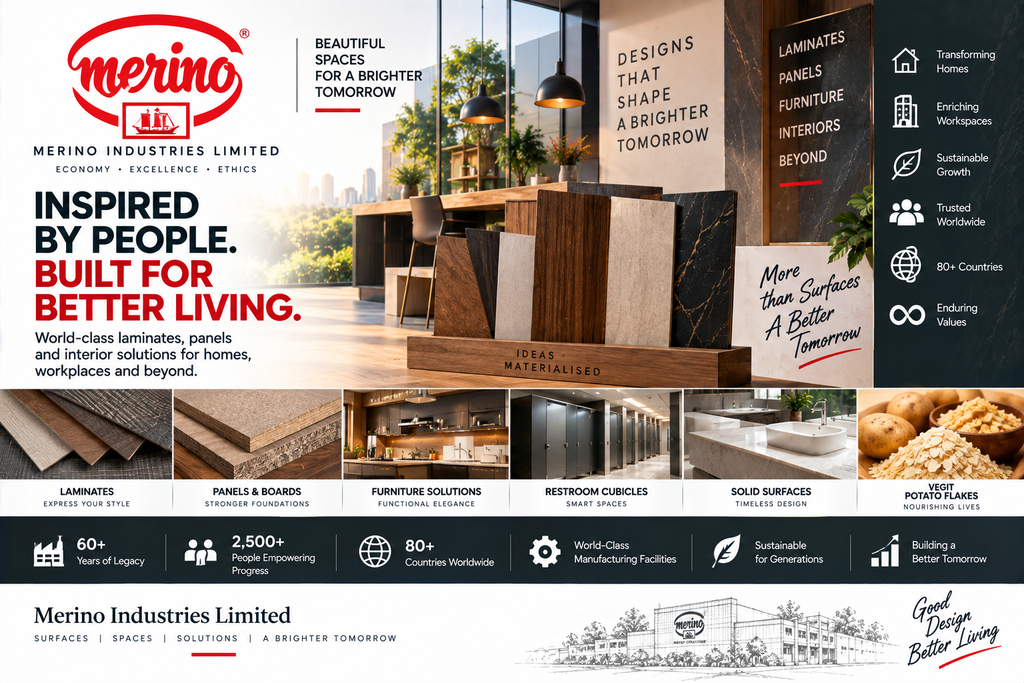
Merino Industries is a 60+ year-old diversified manufacturing company best known for its Merino laminates and interior-surface solutions. The company has built a strong domestic and export franchise and has expanded into panels, chipboards, furniture solutions and potato flakes.
The investment story has, however, changed materially. Merino’s established laminate business remains profitable, while the newer panel products and furniture business is still in the ramp-up phase and currently generating substantial operating losses. FY26 therefore represents more of a business-transition and capacity-utilisation story than a conventional earnings-growth story.
1. About the Company
Merino was established in 1965 by the Lohia family and has grown into one of India’s prominent manufacturers of decorative laminates and interior-surface products.
Its portfolio includes:
- High-pressure decorative laminates
- Compact laminates
- Pre-laminated boards
- Particle boards / chipboards
- Furniture and modular solutions
- Restroom cubicles
- Solid surfaces
- Plywood and related interior products
- Potato flakes under the Vegit brand
- Other interior and agricultural products
The company sells across India and exports to 80+ countries, with exports contributing a significant portion of revenue. Its established distribution network and Merino brand provide a meaningful competitive advantage in the laminate segment.
2. Key Highlights
| Particular | Current Position |
|---|---|
| Operating history | 60+ years |
| FY26 revenue | ~₹2,521 Cr |
| FY26 EBITDA | ~₹184 Cr |
| FY26 PAT | ~₹0.33 Cr |
| FY26 operating cash flow | ~₹237 Cr |
| Net worth | ~₹1,358 Cr |
| Borrowings | ~₹583 Cr |
| Debt / Equity | ~0.45x |
| Promoter holding | ~95.22% |
| Current indicative price | ~₹2,575 |
| Indicative market cap | ~₹2,879 Cr |
| Price / Book | ~2.1x |
| Price / Sales | ~1.14x |
| NSE/BSE listing | No |
FY26 financial data shows a major improvement in cash generation and debt reduction, but profitability remains extremely low because the panel/furniture division is still loss-making.
3. Business Model
A. Laminates — Core Business
Laminates remain Merino’s strongest business.
FY26 laminate revenue was approximately ₹1,859 Cr, generating around ₹219 Cr of operating profit, implying an operating margin of approximately 11.8%.
The laminate business also operated at approximately 83% capacity utilisation, demonstrating that Merino’s established franchise continues to perform relatively well.
B. Panels, Chipboards & Furniture — Growth Engine
Merino has invested heavily in an integrated manufacturing ecosystem at Halol, Gujarat, including chipboard, pre-laminated panels and furniture-related products.
FY26:
- Revenue: ~₹608 Cr
- Operating loss: ~₹120 Cr
- Assets deployed: ~₹1,046 Cr
This is currently the biggest swing factor in the investment thesis. The business has grown revenue significantly, but profitability has not yet followed.
C. Potato Flakes
Merino also operates in the food-processing segment through potato flakes.
FY26 revenue was approximately ₹83 Cr, but the division generated an operating loss of around ₹14 Cr.
This is currently a small but negative contributor to overall profitability.
4. Segment Economics — The Most Important Point
| FY26 Segment | Revenue | Operating Profit / Loss |
|---|---|---|
| Laminates | ~₹1,859 Cr | +₹219 Cr |
| Panel Products & Furniture | ~₹608 Cr | -₹120 Cr |
| Potato Flakes | ~₹83 Cr | -₹14 Cr |
| Other / Unallocable | ~₹77 Cr | -₹29 Cr |
| Total | ~₹2,521 Cr | ~₹57 Cr |
This table explains almost the entire Merino story.
The established laminate business is profitable enough to support the company, but much of that profitability is currently being absorbed by newer businesses.
The critical question for investors is therefore not simply “Will Merino grow revenue?”
It is:
Can Merino convert the new panel capacity into sustainable profitability?
That will determine the company’s future earnings power.
5. Financial Performance
Consolidated / Reported Financial Trend
| ₹ Cr | FY22 | FY23 | FY24 | FY25 | FY26 |
|---|---|---|---|---|---|
| Revenue | 1,792 | 2,205 | 2,309 | 2,355 | ~2,521 |
| EBITDA | 251 | 270 | 264 | 159 | ~184 |
| PAT | ~131 | ~118 | ~122 | -7 | ~0.3 |
| Net Worth | 1,145 | 1,248 | 1,360 | 1,357 | ~1,358 |
| Operating Cash Flow | 79 | 189 | 202 | 93 | ~237 |
FY26 revenue grew approximately 9.5%, while EBITDA increased approximately 16% from FY25.
However, the improvement in EBITDA has not yet translated into meaningful net profit because depreciation and finance costs continue to consume most of operating earnings.
6. FY26 — Revenue Growth But Very Low Profit
FY25 was a particularly weak year, with approximately ₹7.3 Cr of net loss.
FY26 moved back into a marginal profit of roughly ₹0.33 Cr.
At first glance this looks like a turnaround.
However, investors should look deeper.
Merino’s:
- EBITDA: ~₹184 Cr
- Depreciation: ~₹127 Cr
- Finance cost: ~₹55 Cr
Therefore, depreciation + interest consumed almost the entire operating profit.
This explains why a company generating more than ₹2,500 Cr of revenue and ~₹184 Cr of EBITDA ended FY26 with only a few lakh rupees of net profit.
7. Balance Sheet — A Positive Area
The balance sheet is considerably healthier than the income statement suggests.
| Particular | FY25 | FY26 |
|---|---|---|
| Borrowings | ~₹702 Cr | ~₹583 Cr |
| Net Worth | ~₹1,357 Cr | ~₹1,358 Cr |
| Debt/Equity | ~0.53x | ~0.45x |
| Operating Cash Flow | ₹93 Cr | ₹237 Cr |
| Capex | ~₹124 Cr | ~₹55 Cr |
| Current Ratio | ~1.06x | ~1.19x |
Operating cash flow more than doubled to approximately ₹237 Cr, while borrowings declined by roughly ₹119 Cr.
This is one of the strongest positives in the FY26 numbers.
The company appears to have moved past the most aggressive phase of its capex cycle, giving it an opportunity to use future cash generation for debt reduction and operational improvement.
8. Debt Position
CRISIL reaffirmed Merino’s rating at:
Crisil A+ / Stable / Crisil A1
with rated bank facilities of approximately ₹892 Cr as of July 2026.
CRISIL highlighted Merino’s strong market position and improving financial risk profile but also identified competition, raw-material volatility and high working-capital requirements as key concerns.
The company’s debt/equity remains manageable at around 0.45x, but interest coverage remains an important monitorable.
9. Working Capital — Key Risk
Merino remains working-capital intensive.
FY26 inventory days were approximately 181 days.
That represents a substantial amount of capital tied up in inventory.
While receivable days improved to approximately 26 days, inventory remains elevated.
Therefore, future improvement in free cash flow will depend not only on EBITDA growth but also on inventory reduction and working-capital efficiency.
10. Manufacturing & Capacity
Merino operates multiple manufacturing facilities across India.
The company has invested substantially in its Halol, Gujarat facility.
The chipboard plant became operational during FY25, with an investment of approximately ₹800 Cr and installed capacity of around 400 CBM per day according to management commentary.
The company also has installed laminate capacity of approximately 21 million sheets annually.
The key issue now is utilisation rather than further aggressive capacity creation.
11. Competitive Strengths
Strong Merino Brand
The company has spent decades building brand recognition among architects, interior designers, dealers and consumers.
Established Distribution Network
Merino has a large dealer/distributor network across India and a significant international footprint.
Export Presence
Exports provide geographic diversification and reduce complete dependence on the Indian market.
Strong Core Laminate Economics
The laminate business continues to generate healthy operating profitability, with FY26 operating profit of approximately ₹219 Cr.
Large Asset Base
The company has already invested heavily in manufacturing infrastructure.
If utilisation improves, operating leverage could become significant.
Promoter Ownership
Promoters own approximately 95.22%, indicating very high promoter alignment, although it also limits free float and liquidity.
12. Investment Positives vs Concerns
| Investment Positives | Key Concerns |
|---|---|
| 60+ year operating history | FY26 PAT only ~₹0.3 Cr |
| Strong Merino laminate brand | Panel business loss ~₹120 Cr |
| Profitable core laminate business | High depreciation |
| 80+ country export footprint | Interest cost ~₹55 Cr |
| Strong dealer/distributor network | High inventory days |
| Debt reduced in FY26 | Working-capital intensive |
| Operating cash flow improved sharply | New capacity still under-utilised |
| Debt/equity ~0.45x | Commodity/raw-material volatility |
| Large manufacturing base | Intense competition |
| High promoter ownership | Extremely low earnings at current stage |
13. Valuation
At an indicative unlisted price of approximately ₹2,575/share:
Equity Value
Outstanding shares: ~1.118 Cr
₹2,575 × 1.118 Cr ≈ ₹2,879 Cr
Therefore, the indicative market capitalisation is approximately ₹2,880 Cr. Current unlisted-market references around ₹2,575 are being quoted by multiple platforms, although these are indicative OTC/private-market levels rather than exchange prices.
Valuation Snapshot
| Metric | Approx. |
|---|---|
| Price | ₹2,575 |
| Market Cap | ~₹2,879 Cr |
| Book Value/share | ~₹1,223 |
| P/B | ~2.1x |
| P/S | ~1.14x |
| FY26 EPS | ~₹0.29 |
| P/E | Not meaningful |
The headline P/E is extremely high because FY26 earnings were almost zero.
Therefore, Merino should not currently be valued using FY26 P/E.
A more useful framework is:
Normalised earnings + asset value + future profitability of Halol/panel operations.
14. What Could Unlock Value?
1. Halol Capacity Utilisation
This is arguably the biggest trigger.
If panel capacity moves from a loss-making ramp-up phase toward healthy utilisation, a substantial portion of the fixed costs will be absorbed.
2. Panel Business Turning Profitable
The panel business generated approximately ₹608 Cr of revenue but still lost ~₹120 Cr operationally.
Even a gradual reduction in this loss could materially improve consolidated earnings.
3. Debt Reduction
Continued operating cash flow could allow Merino to reduce borrowings and finance costs.
4. Premiumisation
Products such as specialised panels and branded surface solutions could potentially produce better economics than commodity board products.
5. Export Growth
Exports already represent a meaningful component of Merino’s business and provide another growth avenue.
15. IPO / Listing Status
Merino Industries is currently unlisted on NSE/BSE.
The ISIN is INE662B01017, and the security is classified as unlisted.
As of the latest information reviewed, there is no verified DRHP or confirmed IPO/listing date that should be marketed as a certainty.
Therefore, investors should treat Merino as an unlisted investment, not as a confirmed near-term IPO opportunity.
Any potential IPO should be considered an additional possibility rather than the core investment thesis.
16. Shareholding Pattern
| Shareholder Category | Holding |
|---|---|
| Promoters / Promoter Group | ~95.22% |
| Others | ~4.78% |
| Total | 100% |
The extremely high promoter ownership reflects strong control by the Lohia promoter group but also contributes to limited liquidity in the unlisted market.
17. Key Risks
Panel Business Execution Risk
The largest risk is the ability of the Halol panel business to move from revenue growth to profitability.
Low Current Earnings
At the current indicative valuation, FY26 earnings do not support the valuation through a conventional P/E framework.
Raw Material Risk
CRISIL notes that raw materials account for approximately 55–60% of cost of sales, making margins sensitive to design paper, wood, chemicals, freight and other input costs.
Working Capital
High inventory days can absorb significant cash even when EBITDA improves.
Industry Competition
Merino competes with established organised players including Greenlam, Century Plyboards and other domestic and international manufacturers.
Capital Intensity
The company has already deployed substantial capital into its newer manufacturing businesses. Returns on that capital remain the key question.
Unlisted Liquidity
There is no NSE/BSE market. Buying and selling depends on private-market liquidity, negotiated pricing and availability of counterparties.
Valuation Risk
At around ₹2,575/share, the company is valued at roughly 2.1x book value despite extremely low current earnings.
The valuation therefore already assumes meaningful future earnings recovery.
18. Investment View
Merino Industries — Strong Core Franchise, Waiting for the Second Engine to Turn
Merino is an interesting but execution-dependent unlisted opportunity.
The established laminate business is the company’s biggest strength. It has a strong brand, sizeable distribution network, export presence and healthy operating profitability.
The problem is that the company has invested heavily in the next phase of growth — panels, chipboards and furniture — and these businesses have not yet generated acceptable returns.
FY26 provides two contrasting signals:
Positive:
Revenue grew ~9.5%, EBITDA improved, operating cash flow jumped to ~₹237 Cr and debt declined materially.
Negative:
Panel products and furniture generated approximately ₹120 Cr of operating losses, while depreciation and interest consumed almost the entire EBITDA.
Therefore, the investment case should not be based simply on Merino being a leading laminate company.
The real thesis is:
A high-quality laminate franchise + large installed panel capacity + improving utilisation + deleveraging could potentially create a significant earnings recovery over the next few years.
If the panel business reaches profitability, Merino’s earnings power could change materially because much of the manufacturing infrastructure and depreciation is already in place.
However, if the panel business continues to consume cash without achieving adequate returns, the current valuation could remain difficult to justify.
Overall Positioning
Established Brand + Strong Core Laminate Business + High Operating Leverage Potential — but Significant Panel-Ramp-Up Risk
Investment Character: High-Risk / Turnaround & Capacity-Utilisation Opportunity
Key KPI to watch: Panel EBITDA and ROCE
The single most important question for investors:
When does the Halol investment start earning an acceptable return on capital?
19. Share Details
| Particular | Details |
|---|---|
| Company | Merino Industries Limited |
| CIN | U51909WB1965PLC026556 |
| ISIN | INE662B01017 |
| Face Value | ₹10 |
| Shares Outstanding | ~1.118 Cr |
| Current Indicative Price | ~₹2,575 |
| Indicative Market Cap | ~₹2,879 Cr |
| Listing | Unlisted |
| Minimum Lot | Varies by intermediary |
| Demat | NSDL/CDSL |
| IPO | No confirmed IPO/DRHP identified |
Current unlisted prices are indicative OTC/private-market references, not exchange-traded prices. Different intermediaries may quote different prices depending on liquidity, lot size and transaction availability.
20. Disclaimer
This report is prepared for informational and research purposes only and should not be considered investment advice, a recommendation, solicitation or an offer to buy or sell securities.
Merino Industries Limited is an unlisted company. Unlisted share prices are indicative and may vary significantly depending on transaction size, liquidity, availability and counterparty.
Financial data may differ between standalone, provisional and other reporting bases; where such differences exist, the report has attempted to clearly identify them.
Investors should independently verify the latest financial statements, corporate filings, valuation and transaction terms and consult a SEBI-registered investment adviser before making any investment decision.
For more such unlisted stocks visit https://unlistedcart.com/unlisted-shares/