Strong Laminate Franchise | Panel Business Ramp-Up | High-Capital-Intensity Turnaround Opportunity
Company: Merino Industries Limited
CIN: U51909WB1965PLC026556
ISIN: INE662B01017
Incorporated: 29 July 1965
Registered Office: Kolkata, West Bengal
Face Value: ₹10
Status: Active & Unlisted
Promoter Holding: ~95%
Sector: Building Materials / Interior Solutions / Food Processing
Indicative Unlisted Price: ₹2,575/share
Indicative Market Capitalisation: ~₹2,879 crore
1. About the Company
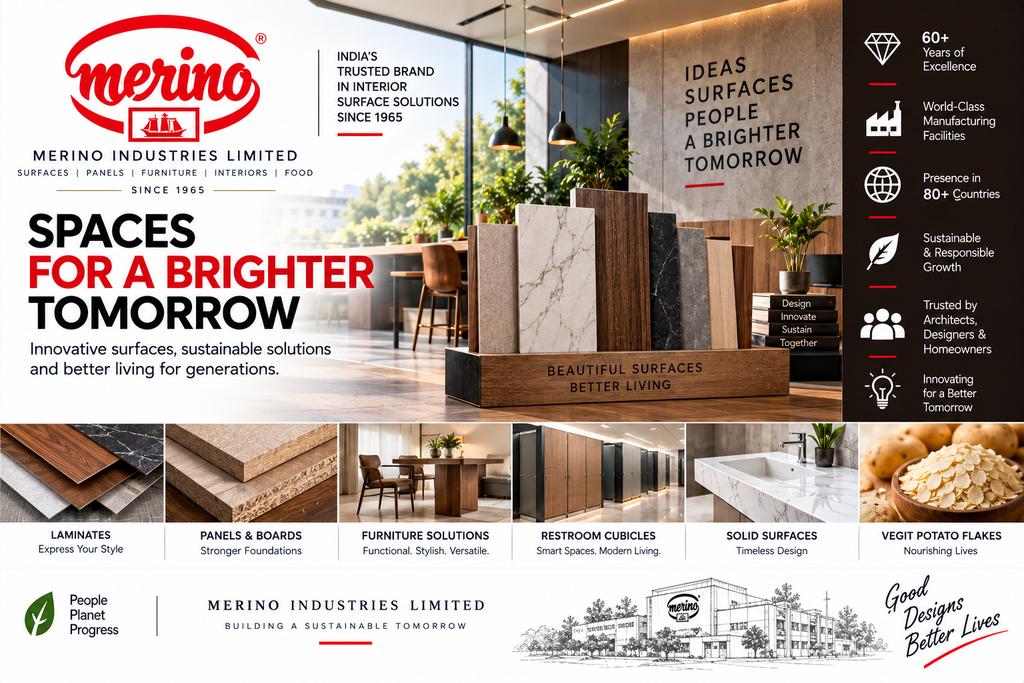
Merino Industries Limited is a diversified manufacturing company with more than six decades of operating history. Established in 1965 by the Lohia family, the company has developed a strong position in decorative laminates and interior-surface solutions.
Its business has gradually expanded beyond laminates into:
- Decorative and high-pressure laminates
- Low-pressure laminates
- Particle boards and panels
- Pre-laminated boards
- Furniture solutions
- Restroom cubicles
- Solid surfaces
- Potato flakes
- Other interior and industrial solutions
Merino has an established domestic distribution network and exports to more than 60–80 countries, depending on the reporting basis. CRISIL describes Merino as one of the larger organised players in India’s domestic laminates industry, with a distribution network of nearly 3,000 dealers.
2. Investment Snapshot
| Particular | FY26 / Current |
|---|---|
| Revenue from operations | ₹2,520.56 Cr |
| Total revenue | ₹2,561.12 Cr |
| EBITDA | ~₹184 Cr |
| PBT | ₹1.72 Cr |
| PAT | ₹0.33 Cr |
| Operating Cash Flow | ₹236.70 Cr |
| Net Worth | ₹1,358.23 Cr |
| Total Assets | ₹2,438.23 Cr |
| Borrowings | ~₹583 Cr |
| Debt / Equity | ~0.43–0.45x |
| Shares Outstanding | 1.118 Cr |
| Indicative Price | ₹2,575 |
| Indicative Market Cap | ~₹2,879 Cr |
| P/B | ~2.1x |
| P/E | Not meaningful |
| NSE/BSE Listing | No |
FY26 revenue grew approximately 9.5%, while operating cash flow improved sharply to ₹236.7 crore from ₹93.3 crore in FY25.
3. The Merino Investment Story in One Sentence
Merino has a profitable and established laminate franchise, but the success of its large panel and furniture expansion will determine whether the company can unlock its next phase of earnings growth.
This distinction is extremely important for investors.
The laminate business is already profitable. The newer panel/furniture business has grown rapidly but is currently loss-making and capital-intensive.
4. Business Model
A. Laminates — Core Cash-Generating Business
Laminates remain Merino’s principal business.
According to FY26 segment information, the laminate business generated approximately:
Revenue: ₹1,859 Cr
Operating Profit: ~₹219 Cr
Operating Margin: ~11.8%
This makes laminates the company’s primary earnings engine.
CRISIL also notes that high-pressure laminates account for more than 70% of turnover and that Merino has strong brand recognition and a sizeable domestic market presence.
B. Panel Products & Furniture
This is the most important emerging business.
Merino has invested heavily in an integrated manufacturing complex at Halol, Gujarat, covering chipboards, pre-laminated panels, furniture and related products.
FY26:
| Metric | Panel Products & Furniture |
|---|---|
| Revenue | ~₹608 Cr |
| Operating Profit/Loss | ~₹120 Cr loss |
| Assets deployed | ~₹1,046 Cr |
This business now represents a substantial portion of Merino’s asset base but has not yet achieved profitability.
C. Potato Flakes
Merino also operates a food-processing business producing potato flakes.
FY26 revenue was approximately ₹83 Cr, with an operating loss of around ₹14 Cr.
5. Segment Economics
| FY26 Segment | Revenue | Operating Profit / Loss | Approx. Assets |
|---|---|---|---|
| Laminates | ₹1,859 Cr | +₹219 Cr | ₹892 Cr |
| Panel Products & Furniture | ₹608 Cr | -₹120 Cr | ₹1,046 Cr |
| Potato Flakes | ₹83 Cr | -₹14 Cr | ₹46 Cr |
| Other / Unallocable | ₹77 Cr | -₹29 Cr | ₹454 Cr |
| Total | ~₹2,521 Cr | ~₹57 Cr | ₹2,438 Cr |
The numbers clearly show why Merino’s consolidated profitability is currently weak.
The laminate business generates substantial operating profit, but a large part of that profit is being absorbed by the newer businesses.
6. Financial Performance
| ₹ Cr | FY22 | FY23 | FY24 | FY25 | FY26 |
|---|---|---|---|---|---|
| Revenue from Operations | 1,744 | 2,176 | 2,252 | 2,301 | 2,521 |
| EBITDA | 251 | 270 | 264 | 159 | 184 |
| PBT | 174 | 174 | 163 | -27 | 1.7 |
| PAT | 131 | 118 | 122 | -7 | 0.3 |
| Net Worth | 1,145 | 1,248 | 1,360 | 1,357 | 1,358 |
| Operating Cash Flow | 79 | 189 | 202 | 93 | 237 |
Source financial data indicates strong revenue growth over the longer term, but earnings have deteriorated significantly since FY24 because of the cost structure associated with the newer businesses.
7. FY26 — The Most Important Financial Takeaway
FY26 revenue increased to approximately ₹2,521 Cr.
EBITDA improved from roughly ₹159 Cr to approximately ₹184 Cr.
However:
- Depreciation: ~₹127 Cr
- Finance cost: ~₹55 Cr
- PBT: only ~₹1.72 Cr
- PAT: only ~₹0.33 Cr
Therefore, the company generated substantial operating cash but almost no accounting profit after depreciation and financing costs.
This means FY26 EPS of approximately ₹0.29 cannot be used as a normalised earnings indicator.
8. Cash Flow — A Major Positive
One of the most encouraging numbers is operating cash flow.
| Year | Operating Cash Flow |
|---|---|
| FY22 | ₹79 Cr |
| FY23 | ₹189 Cr |
| FY24 | ₹202 Cr |
| FY25 | ₹93 Cr |
| FY26 | ₹237 Cr |
FY26 operating cash flow was more than 2.5 times FY25.
This indicates that the company’s underlying cash generation is substantially better than the reported PAT suggests.
However, investors should still monitor working capital closely because the business is inventory-intensive.
9. Balance Sheet
Merino’s balance sheet remains relatively comfortable despite the heavy investment cycle.
| Particular | FY26 |
|---|---|
| Total Assets | ₹2,438 Cr |
| Net Worth | ₹1,358 Cr |
| Total Liabilities | ₹1,080 Cr |
| Borrowings | ~₹583 Cr |
| Debt/Equity | ~0.43–0.45x |
| Operating Cash Flow | ₹237 Cr |
CRISIL reported adjusted debt/net worth of approximately 0.42x and interest coverage of about 3.27x for FY26.
CRISIL reaffirmed Merino’s bank-facility ratings at:
Crisil A+ / Stable / Crisil A1
with rated bank facilities increased to ₹892 Cr.
10. Competitive Strengths
Strong Brand
Merino has built a recognised brand in the laminate and interior-products market over more than six decades.
Distribution Network
The company has a large dealer and distributor network. CRISIL cites nearly 3,000 dealers, while private-market sources report a broader network of more than 4,000 dealers.
Export Franchise
Merino has an established international presence, giving the company geographic diversification beyond India.
Established Laminate Economics
The laminate business remains the company’s strongest operating segment, generating approximately ₹219 Cr of operating profit in FY26.
Integrated Manufacturing
The expansion into panels and furniture gives Merino the opportunity to participate in a larger portion of the interior-products value chain.
Long Operating History
The company has operated since 1965 and has significant manufacturing and distribution experience.
11. The Big Opportunity — Panel Business Turnaround
The biggest potential value creator is the Halol panel ecosystem.
Merino has already invested substantial capital.
The key issue is now:
Capacity utilisation → Revenue growth → EBITDA improvement → ROCE improvement
If the panel business moves from a ₹120 Cr operating loss toward breakeven and subsequently profitability, consolidated earnings could improve dramatically without requiring another major capex cycle.
This is the central investment thesis.
12. Investment Positives vs Concerns
| Positives | Concerns |
|---|---|
| 60+ years of operating history | FY26 PAT only ₹0.33 Cr |
| Strong laminate brand | Panel business currently loss-making |
| Large distribution network | High depreciation |
| International presence | Finance cost ~₹55 Cr |
| Strong core laminate profitability | High capital employed in new business |
| FY26 revenue growth | Working-capital intensity |
| OCF jumped to ₹237 Cr | Commodity/raw-material volatility |
| Debt/equity below 0.5x | Intense competition |
| Large manufacturing base | Low current ROE |
| High promoter ownership | Unlisted-market liquidity |
13. Valuation
The current indicative unlisted-market price is approximately:
₹2,575/share
as of September 10–11, 2026.
With approximately 1.118 crore shares outstanding, this implies:
₹2,575 × 1.118 Cr ≈ ₹2,879 Cr
Valuation Snapshot
| Metric | Approx. |
|---|---|
| Indicative Price | ₹2,575 |
| Market Cap | ~₹2,879 Cr |
| Book Value/Share | ~₹1,224 |
| P/B | ~2.1x |
| FY26 EPS | ~₹0.29 |
| P/E | ~9,000x / Not Meaningful |
| Price/Sales | ~1.14x |
The P/E should not be used for investment decisions at the current stage because FY26 profit is exceptionally low.
The more appropriate approach is to assess:
Normalised earnings + asset utilisation + debt reduction + future ROCE.
14. Why the Current Price Needs Careful Analysis
At ₹2,575, Merino is not cheap on current earnings.
The company is effectively being valued on the assumption that:
- The panel business will eventually become profitable.
- Capacity utilisation will improve.
- EBITDA margins will recover.
- Debt will continue to decline.
- The laminate franchise will remain strong.
If these assumptions play out, today’s valuation could become reasonable on normalised future earnings.
If they do not, the stock could remain expensive despite having valuable assets and a strong brand.
15. Key Risks
1. Panel Business Execution Risk
The biggest risk is that the large panel investment does not generate sufficient returns.
2. Low Current Profitability
Revenue exceeds ₹2,500 Cr, yet FY26 PAT was only ₹0.33 Cr.
3. High Depreciation
The large manufacturing investment has increased depreciation substantially.
4. Interest Cost
Finance costs remain significant at approximately ₹55 Cr.
5. Working Capital
CRISIL specifically identifies large working-capital requirements as a key weakness.
6. Raw Material Volatility
Paper, chemicals, wood and other input costs can materially influence margins.
7. Competition
Merino competes with organised players such as Greenlam Industries and Century Plyboards, alongside international brands and other domestic manufacturers.
8. Unlisted Liquidity
There is no NSE/BSE market. OTC transactions can have wider spreads and limited counterparties.
9. Valuation Risk
The current price already discounts a meaningful future earnings recovery.
16. IPO / Listing Status
Merino Industries is currently unlisted on NSE/BSE. The company is an active public company with ISIN INE662B01017.
As of the latest information reviewed, there is no verified DRHP or confirmed IPO date that should be treated as a certainty.
Therefore:
Merino should currently be evaluated as an unlisted operating company, not as a confirmed pre-IPO opportunity.
Any future IPO should be considered an additional potential catalyst rather than the primary investment thesis.
17. Shareholding
Promoter ownership is approximately 95%, leaving a relatively small public/non-promoter holding.
This provides strong promoter control but also contributes to the limited liquidity of the unlisted security.
18. What Investors Should Track Going Forward
For Merino, investors should focus less on revenue growth alone and more on the following indicators:
Most Important
1. Panel EBITDA
The single most important operating KPI.
2. Panel ROCE
Can the ₹1,000+ Cr asset base generate an acceptable return?
3. Consolidated EBITDA Margin
A sustained move above the current low-single-digit operating margin would be a significant positive.
4. Debt Reduction
Lower debt should gradually reduce finance costs.
5. Operating Cash Flow
FY26’s ₹237 Cr is encouraging; this needs to remain strong.
6. Capacity Utilisation
Higher utilisation should improve fixed-cost absorption.
7. Inventory Days
Working-capital efficiency will determine how much EBITDA converts into free cash flow.
19. Investment View
Merino Industries — Strong Franchise, Weak Current Earnings, Significant Turnaround Potential
Merino is an interesting long-term unlisted manufacturing opportunity, but it is not a straightforward value stock at the current price.
The company has several genuine strengths:
- 60+ years of operating history
- Strong laminate brand
- Large distribution network
- Export presence
- Profitable core laminate business
- Strong FY26 operating cash flow
- Moderate leverage
But the biggest issue is equally clear:
The new panel/furniture business has not yet generated an adequate return on the capital invested.
Therefore, the investment thesis is not:
“Merino is a profitable laminate company.”
It is:
“Merino has a profitable laminate franchise funding a large new panel platform; if the new platform reaches profitability and generates acceptable ROCE, consolidated earnings could potentially recover sharply.”
Overall Positioning
Established Laminate Franchise + Large Panel Opportunity + Strong Cash Flow — but High Execution Risk
Investment Character: High-Risk / Turnaround & Capacity-Utilisation Opportunity
Current Rating: Watchlist / Selective Accumulation Only at Appropriate Valuation
Key Trigger: Panel business moving toward profitability
Key Risk: Continued capital consumption without adequate ROCE
20. Share Details
| Particular | Details |
|---|---|
| Company | Merino Industries Limited |
| CIN | U51909WB1965PLC026556 |
| ISIN | INE662B01017 |
| Face Value | ₹10 |
| Shares Outstanding | ~1.118 Cr |
| Indicative Price | ₹2,575 |
| Indicative Market Cap | ~₹2,879 Cr |
| Listing | Unlisted |
| Exchange | NSE/BSE — Not Listed |
| Demat | NSDL/CDSL |
| IPO | No confirmed DRHP / IPO date identified |
| Minimum Lot | Varies by intermediary |
Unlisted prices are indicative OTC/private-market references, not exchange-traded prices. Actual transaction prices can vary based on lot size, liquidity and counterparty availability.
21. Conclusion
Merino Industries presents a classic “core business + new growth engine” investment case.
The core laminate franchise remains the company’s biggest asset and generates meaningful operating profit. The newer panel and furniture businesses, however, are still in the investment/ramp-up phase and are currently the principal reason consolidated earnings remain depressed.
FY26 gives investors an important positive signal: operating cash flow recovered strongly and debt remains manageable.
But at approximately ₹2,575 per share, investors are paying for future earnings recovery rather than current profitability.
The next 2–3 years will therefore be critical.
If panel utilisation rises, losses narrow, EBITDA margins recover and debt declines, Merino could potentially see a significant improvement in earnings and return ratios.
If the panel business remains loss-making, the company could continue to trade at a premium to its current earnings.
Bottom Line
Merino Industries is a high-quality legacy laminate franchise undergoing a capital-intensive transformation. The opportunity lies in the successful turnaround of its panel/furniture business — not in its current FY26 earnings.
Disclaimer
This report is for informational and research purposes only and does not constitute investment advice, a recommendation, solicitation or an offer to buy or sell securities.
Merino Industries Limited is unlisted. Unlisted share prices are indicative and can differ materially from actual transaction prices because of liquidity, lot size and counterparty availability.
Investors should independently verify the latest financial statements, corporate filings, valuation and transaction terms and consult a SEBI-registered investment adviser before making an investment decision.
For more such unlisted stock visit https://unlistedcart.com/unlisted-shares/