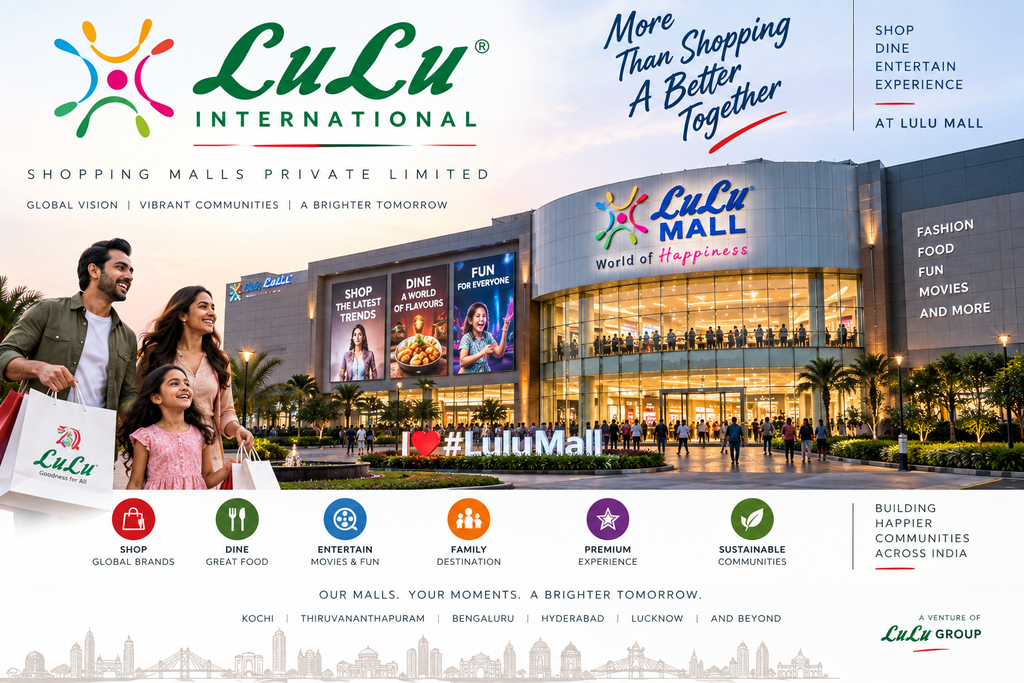
Company: LuLu International Shopping Malls Private Limited
CIN: U52190KL2004PTC017414
Incorporated: 6 September 2004
Registered Office: LuLu Group India Head Office, 37/2907A, NH-66, Edappally, Ernakulam, Kerala – 682024
Status: Active, Private, Unlisted
ROC: Ernakulam
Authorised Capital: ₹1,000 Cr
Paid-up Capital: ₹550 Cr
Industry: Retail / Shopping Malls / Real Estate / Consumer Retail
Promoter Group: LuLu Group International
Key Promoter: M. A. Yusuff Ali
The company is an unlisted private company and is a core Indian vehicle within the broader LuLu Group’s mall and retail operations. Public company databases identify it as an active company with ₹550 Cr of paid-up capital and ₹1,000 Cr of authorised capital.
Executive Summary
LuLu International Shopping Malls Private Limited is one of the most prominent privately held retail and mall businesses operating in India under the LuLu Group umbrella.
The company’s strategy is built around large-format destination malls combining:
- Shopping
- Hypermarkets
- Fashion and lifestyle retail
- Food & beverages
- Entertainment
- Multiplexes
- Family entertainment
- Amusement facilities
- Parking and ancillary services
The business has developed a strong presence in major Indian consumption markets including Kochi, Thiruvananthapuram, Bengaluru, Hyderabad and Lucknow. ICRA has highlighted occupancy levels above 95% across the five-mall portfolio for space leased to non-group retailers, while LuLu’s own retail formats and entertainment businesses occupy a significant portion of mall space.
Financially, the company has been growing rapidly. Public MCA-derived data indicates FY2025 revenue of approximately ₹4,999 Cr, representing around 26% year-on-year growth. However, this growth has come alongside substantial borrowing and debt-funded expansion, making leverage one of the most important factors for investors to evaluate.
ICRA currently maintains a [ICRA]BBB+ (Stable) long-term rating on the company, with [ICRA]A2 for short-term facilities.
The investment case is therefore a combination of high-quality retail assets + strong consumer positioning + large growth runway, balanced against high leverage, large capex requirements, refinancing risk and limited liquidity of unlisted shares.
Company Overview
LuLu International Shopping Malls Private Limited was incorporated in Kerala in 2004 and is currently an active unlisted private company.
The company’s authorised capital stands at ₹1,000 Cr, while paid-up capital is approximately ₹550 Cr.
The company operates within the wider LuLu Group ecosystem, whose founder and chairman is M. A. Yusuff Ali, one of the most prominent Indian-origin entrepreneurs in the Gulf retail sector.
The broader LuLu Group has extensive experience in:
- Hypermarkets
- Shopping malls
- Retail
- Hospitality
- Food processing
- Real estate
- Entertainment
This parentage is strategically important because mall development requires substantial capital, long project cycles and strong relationships with tenants, lenders and suppliers.
ICRA specifically considers the company’s strong parentage and the financial flexibility associated with being part of the LuLu Group as a credit strength.
Business Model
LuLu’s Indian business operates through a combination of mall ownership/development, retail operations and associated consumer services.
1. Shopping Malls
The core business is the development and operation of large destination shopping malls.
These malls typically generate revenue through:
- Rental income
- Common-area maintenance
- Advertising
- Parking
- Retail operations
- Entertainment
- Food & beverage
- Other ancillary services
The destination-mall model creates multiple revenue streams from the same physical asset.
2. Hypermarkets
LuLu operates large-format hypermarkets inside and outside its mall properties.
This creates an important advantage because LuLu is not simply a landlord collecting rent.
It also participates directly in consumer spending.
3. Fashion & Lifestyle
The malls host a wide range of international and domestic brands across:
- Apparel
- Footwear
- Cosmetics
- Jewellery
- Electronics
- Home products
- Lifestyle
This improves the attractiveness of the malls and supports footfall.
4. Entertainment
Entertainment is increasingly important to the LuLu model.
The company has operated attractions such as Funtura, cinemas and family entertainment facilities, allowing the mall to function as an experience destination rather than simply a shopping centre.
A 2025 CESTAT case involving imported trampoline and tag-arena equipment also confirmed that the equipment was intended for the Funtura amusement facility at LuLu Mall Trivandrum. The customs dispute was ultimately decided in LuLu’s favour.
Indian Mall Portfolio
ICRA’s analysis identifies five key operational malls:
- LuLu Kochi
- LuLu Thiruvananthapuram
- LuLu Bengaluru
- LuLu Hyderabad
- LuLu Lucknow
ICRA reported occupancy of more than 95% for leasable areas earmarked for non-group retail operators across these five malls.
LuLu Kochi benefits from its location around Edappally Junction and direct access to the metro network.
LuLu Thiruvananthapuram is strategically positioned near the airport and Technopark.
LuLu Bengaluru is located in Rajajinagar, while the Hyderabad and Lucknow assets provide exposure to two large and rapidly developing consumption markets.
Expansion Strategy
The company is pursuing a significant expansion strategy.
ICRA’s April 2025 assessment estimated approximately ₹2,500–₹3,000 Cr of capex between FY2025 and FY2028, primarily for land acquisition, a proposed Ahmedabad mall and standalone hypermarkets.
Earlier company expansion plans had also identified markets such as:
- Ahmedabad
- Chennai
- Bengaluru
- Hyderabad
- Uttar Pradesh
- Kerala
- NCR
The broader strategy is increasingly moving beyond only very large destination malls toward smaller-format retail properties and hypermarkets.
Industry coverage in 2025 indicated that LuLu was looking at smaller-format opportunities in Tier-II and Tier-III markets as well.
This could become an important long-term growth driver because India’s organised retail penetration remains considerably lower than mature international markets.
Industry Opportunity
India’s retail sector is undergoing a structural transition.
Several factors are supporting organised retail:
Rising disposable income
As household incomes increase, spending is gradually shifting toward:
- Branded products
- Fashion
- Electronics
- Premium food
- Dining
- Entertainment
- Experiences
Urbanisation
Large cities and emerging Tier-II cities are developing increasingly sophisticated consumption ecosystems.
Experience-led consumption
Modern malls are no longer simply shopping destinations.
Consumers increasingly visit malls for:
- Restaurants
- Movies
- Entertainment
- Events
- Family activities
- Social experiences
LuLu’s integrated model is well positioned for this trend.
Organised retail penetration
LuLu management has previously highlighted India’s relatively low organised-retail penetration as a major long-term opportunity.
Financial Performance
FY2025
Public MCA-derived financial data indicates:
| Particulars | FY2025 |
|---|---|
| Revenue | ₹4,999 Cr |
| Revenue Growth | ~26% YoY |
| Paid-up Capital | ₹550 Cr |
| Authorised Capital | ₹1,000 Cr |
| Employees | ~5,599 |
| Status | Active / Unlisted |
The FY2025 revenue figure represents a substantial increase from the previous year.
Another financial database reports FY2025 operating revenue growth of approximately 26.26%, operating profit growth of 68.7% and EBITDA growth of approximately 22%, although exact absolute EBITDA and PAT figures are behind its paid database.
Because publicly accessible databases do not consistently expose the complete audited P&L, investors should obtain the latest MCA financial statements before using PAT, EPS or P/E for a final valuation.
FY2024 Performance – Rating Agency Perspective
ICRA reported consolidated revenue of approximately ₹4,384.8 Cr in FY2024, representing 35% growth year-on-year.
Operating margin was approximately 14.6% at the consolidated level in FY2024.
ICRA expected further revenue growth as the Hyderabad mall and newer hypermarkets ramped up.
The difference between rating-agency consolidated numbers and individual company database numbers is important.
LuLu’s corporate structure contains multiple entities, including LuLu India Shopping Mall Private Limited, which operates specific mall assets. ICRA therefore consolidates the financials of LuLu International and LuLu India for its credit assessment.
This means investors should not simply add the financials of different LuLu subsidiaries, as that could lead to double counting.
LuLu India Shopping Mall Private Limited
A key group entity is LuLu India Shopping Mall Private Limited.
Its FY2025 revenue was approximately ₹619.27 Cr, up about 14% year-on-year according to MCA-derived data.
The company has authorised capital of ₹150 Cr and paid-up capital of ₹137.5 Cr.
Importantly, its reported debt-to-equity ratio is substantially higher than that of a typical consumer company, reflecting the capital-intensive nature of mall development.
This illustrates an important point:
LuLu should be evaluated more like a combination of retail, real estate and infrastructure rather than a conventional FMCG or retail company.
Debt & Capital Structure
Debt is one of the biggest factors in the LuLu investment thesis.
Public MCA-derived data records approximately ₹13,102 Cr of open charges against the company, although registered charges should not be interpreted automatically as equivalent to current outstanding debt.
ICRA’s April 2025 rating rationale provides a more useful picture of the financing structure.
The company had substantial term loans and working-capital facilities, while the rating agency highlighted:
- Large debt-funded capex
- High leverage
- Modest debt coverage
- Bullet repayments
- Refinancing requirements
ICRA specifically noted that bullet repayments were due during FY2026–FY2028 and that refinancing would be an important monitorable.
Credit Rating
As of July 2026, ICRA had reaffirmed:
Long Term: [ICRA]BBB+ (Stable)
Short Term: [ICRA]A2
A BBB+ rating indicates reasonable credit quality but is not comparable with the highest investment-grade ratings.
The rating therefore supports the view that LuLu has access to institutional financing, but its leverage and capital expenditure requirements remain important risks.
CARE Ratings had also previously assigned CARE BBB+; Negative / CARE A2 before withdrawing its ratings at the company’s request in 2025.
Competitive Advantages
1. Strong Brand
LuLu is a recognised retail brand with substantial consumer awareness, particularly in Kerala and the Gulf.
2. Destination-Mall Model
Large malls create a diversified ecosystem involving retail, food, entertainment and services.
3. Strong Occupancy
ICRA reported occupancy above 95% for relevant leasable areas across the five-mall portfolio.
4. Integrated Retail
LuLu is both:
Landlord + Retailer + Hypermarket Operator + Entertainment Operator
This provides greater control over the customer experience.
5. Promoter Strength
The backing of the LuLu Group is a major competitive advantage in capital-intensive projects.
6. Location Quality
The company’s malls are positioned in established and high-consumption urban markets.
7. Expansion Optionality
The company has opportunities to grow through:
- New malls
- Smaller-format malls
- Hypermarkets
- Food processing
- New cities
- Tier-II markets
Key Growth Drivers
Growth Driver 1 – Retail Consumption
India’s rising consumption levels should support long-term mall footfalls and retailer sales.
Growth Driver 2 – New Malls
New properties can materially increase rental and operating revenue once they mature.
Growth Driver 3 – Hypermarkets
Standalone hypermarkets provide another avenue for expansion without requiring the same mall footprint.
Growth Driver 4 – Tier-II & Tier-III Cities
LuLu has increasingly explored smaller cities and smaller-format developments.
Growth Driver 5 – Entertainment
Entertainment increases customer dwell time and can improve the economics of mall properties.
Growth Driver 6 – Premiumisation
Higher-income consumers increasingly seek branded and experiential retail.
Key Risks
1. High Debt
This is the biggest risk.
Mall development requires substantial upfront capital while cash flows take time to mature.
ICRA has specifically highlighted high leverage and modest debt protection metrics.
2. Debt-funded Expansion
Large capex funded primarily through debt could put pressure on future cash flows.
3. Refinancing Risk
Bullet repayments during FY2026–FY2028 make refinancing an important monitorable.
4. New Mall Ramp-up
A new mall can take several years to reach optimal occupancy, tenant mix and profitability.
5. Interest Rates
Higher interest rates can materially affect highly leveraged mall businesses.
6. Retailer Weakness
Mall rental income ultimately depends on the financial health of tenants.
If retailers experience weak sales, occupancy and rental growth can suffer.
7. Real Estate Concentration
Large-format malls involve significant exposure to property markets, construction costs and local economic conditions.
8. Unlisted Liquidity
There is no continuously traded exchange market for these shares.
An investor may have difficulty exiting quickly.
Current Unlisted Share Price
A reliable, publicly verifiable current executable price for LuLu International Shopping Malls Private Limited could not be established from the sources reviewed.
Therefore, an exact current market cap or P/E should not be invented.
This is particularly important for unlisted shares because private transactions can vary considerably depending on:
- Seller
- Buyer
- Quantity
- Share class
- Transfer restrictions
- Transaction structure
- Liquidity
- Latest financial statements
Valuation Approach
LuLu should not be valued purely on a conventional retail P/E multiple.
A better framework would consider:
1. NAV / Asset Value
The underlying value of:
- Mall properties
- Land
- Development rights
- Retail infrastructure
- Other investments
should be considered.
2. EBITDA / EV
An enterprise-value approach is useful because LuLu carries significant debt.
Enterprise Value = Equity Value + Net Debt
This is particularly important because a high revenue number alone does not necessarily translate into high equity value if debt is also high.
3. Sum-of-the-Parts
A sophisticated valuation could separately value:
- Mall rental business
- Hypermarkets
- Entertainment
- New developments
- Land bank
and then deduct net debt.
4. Discount to Listed Peers
Listed Indian mall operators such as Phoenix Mills and Nexus Select Trust can provide valuation benchmarks, but LuLu requires adjustments because its business mix, leverage, ownership structure and retail operations are different.
IPO / Listing Status
LuLu International Shopping Malls Private Limited remains unlisted.
The company should not be marketed as a confirmed upcoming IPO unless a formal IPO filing or company announcement establishes such an event.
The broader LuLu ecosystem also includes LuLu Retail, a separately listed UAE entity. Investors should not confuse LuLu Retail’s listed securities with shares of LuLu International Shopping Malls Private Limited in India.
Investment Positives vs Concerns
| Investment Positives | Key Concerns |
|---|---|
| Strong LuLu brand | High leverage |
| Premium mall portfolio | Debt-funded expansion |
| High occupancy | Refinancing risk |
| Large Indian consumption opportunity | Capital-intensive business |
| Strong promoter backing | New mall ramp-up risk |
| Multiple revenue streams | Interest-rate sensitivity |
| Hypermarket + mall integration | Unlisted liquidity |
| Expansion into new cities | Valuation uncertainty |
Investment View
LuLu International Shopping Malls is an interesting but financially complex unlisted opportunity.
The biggest attraction is not simply the LuLu brand.
The real investment thesis is the combination of:
Premium retail assets + high occupancy + strong consumer positioning + integrated retail + long-term Indian consumption growth.
At the same time, the company should not be treated like a low-debt consumer company.
The business requires substantial capital and currently operates with meaningful leverage.
Therefore, the entry valuation becomes extremely important.
If shares are available at a reasonable valuation relative to the underlying mall assets and future cash flows, the company could offer attractive long-term upside.
However, paying an excessive premium simply because of the LuLu brand could substantially reduce the margin of safety.
What Investors Should Check Before Buying
Before investing in LuLu’s unlisted shares, investors should obtain:
- Latest audited financial statements
- Latest consolidated financial statements
- Current outstanding debt
- Net debt
- Interest cost
- Mall-wise occupancy
- Mall-wise rental income
- Lease expiry profile
- New project capex
- Land bank valuation
- Related-party transactions
- Shareholding pattern
- Current transfer restrictions
- Exact number of outstanding equity shares
- Current transaction price
- Latest valuation / independent valuation report
These details are particularly important because different LuLu entities operate different assets.
Overall Assessment
Business Quality: ⭐⭐⭐⭐⭐
Brand Strength: ⭐⭐⭐⭐⭐
Growth Potential: ⭐⭐⭐⭐½
Asset Quality: ⭐⭐⭐⭐½
Financial Strength: ⭐⭐⭐
Debt Profile: ⭐⭐½
Management/Promoter Strength: ⭐⭐⭐⭐⭐
Liquidity: ⭐⭐
Valuation Visibility: ⭐⭐½
Overall View: High-Quality Business, But Valuation & Leverage Are Critical
LuLu International Shopping Malls represents a differentiated opportunity in India’s private retail and mall ecosystem.
The company has already established a strong presence in major Indian cities and has demonstrated substantial revenue growth. FY2025 revenue of around ₹4,999 Cr and continued expansion demonstrate the scale of the platform.
However, the company is simultaneously pursuing a capital-intensive expansion programme, with rating agencies highlighting debt-funded capex, leverage and refinancing requirements as key risks.
For an unlisted investor, the most important question is therefore not simply:
“Is LuLu a good company?”
The more important question is:
“At what valuation are the shares available, and does that valuation adequately compensate for the company’s leverage and illiquidity?”
At an attractive entry valuation, LuLu could provide exposure to India’s long-term consumption, organised retail and premium shopping-mall opportunity.
At an excessive valuation, however, the high debt and long capital cycle can significantly reduce potential returns.
Important Company Links
LuLu Malls: Official LuLu Malls website
LuLu International Shopping Malls – Company Information: Company information and financial data
ICRA Credit Rating: ICRA rating information
ICRA Rating Rationale: Detailed ICRA analysis
Disclaimer
This report is prepared for informational and research purposes only. LuLu International Shopping Malls Private Limited is an unlisted private company, and publicly available financial information is less comprehensive than that available for listed companies. Certain financial databases provide only partial FY2025 information. Investors should independently verify the latest audited financial statements, shareholding, debt, valuation and transaction price before making any investment decision.
For more such unlisted stocks visit https://unlistedcart.com/unlisted-shares/