Company: Khazana Jewellery Private Limited
Former Name: Khazana Jewellery (Madras) Private Limited
CIN: U36999TN1992PTC022434
Incorporated: 30 March 1992
Registered Office: No. 48, Whites Road, Royapettah, Chennai – 600014, Tamil Nadu
Status: Active, Private, Unlisted
ROC: Chennai
Authorised Capital: ₹102.11 Cr
Paid-up Capital: ₹27.27 Cr
Industry: Jewellery Retail / Consumer Goods
Promoter / Managing Director: Kishorekumar Jain
Brand: Khazana Jewellery
Khazana Jewellery Private Limited is a Chennai-based unlisted jewellery retailer with more than three decades of operating history. The company is primarily engaged in the retailing of gold, diamond, silver and platinum jewellery, with a strong presence in South India.
Executive Summary
Khazana Jewellery is one of the established regional jewellery chains in South India and has built its brand around gold jewellery, handmade designs, wedding jewellery and customer trust.
The company has a particularly strong presence in Andhra Pradesh, Telangana and Tamil Nadu, with additional stores in Karnataka, Puducherry and Odisha. Its official store locator currently displays stores across these markets, while historical CARE Ratings information had identified 41 retail showrooms in the company’s network.
The company has delivered strong financial growth in FY2025.
Revenue from operations increased from approximately ₹8,981 Cr in FY2024 to ₹10,246 Cr in FY2025, while PAT increased from ₹436 Cr to ₹747 Cr. EBITDA/operating profit increased from approximately ₹667 Cr to ₹1,060 Cr.
This represents:
- Revenue growth: ~14.1%
- EBITDA growth: ~58.8%
- PAT growth: ~71.2%
- Net-worth growth: ~31.3%
- Debt reduction: ~24.4%
- ROE: ~23.9%
- ROCE: ~31.7%
- Debt/Equity: ~0.30x
The improvement in profitability is particularly noteworthy because the jewellery industry is typically a high-volume, relatively low-margin business. Khazana’s FY2025 operating margin rose to approximately 10.3%, compared with 7.4% in FY2024.
The key investment question is therefore not whether Khazana has a strong operating business—it clearly does—but what valuation is being demanded for the unlisted shares.
Company Overview
Khazana Jewellery was incorporated on 30 March 1992 as Khazana Jewellery (Madras) Private Limited.
The business was promoted by Kishorekumar Jain, who had already been involved in the gold jewellery business for several years. CARE Ratings noted that Kishore Kumar Jain had been involved in gold jewellery since the 1970s and had more than three decades of experience under the Khazana brand.
The company is currently registered under CIN U36999TN1992PTC022434 and remains an active unlisted private company. Its authorised capital is ₹102.11 Cr and paid-up capital is ₹27.27 Cr.
The company continues to operate under the Khazana Jewellery brand.
Khazana Jewellery – Official Website
Business Model
Khazana follows a predominantly brick-and-mortar jewellery retail model, supported by an online channel.
Its product portfolio includes:
- Gold jewellery
- Diamond jewellery
- Silver jewellery
- Platinum jewellery
- Gemstone jewellery
- Wedding jewellery
- Daily-wear jewellery
- Coins and gifting products
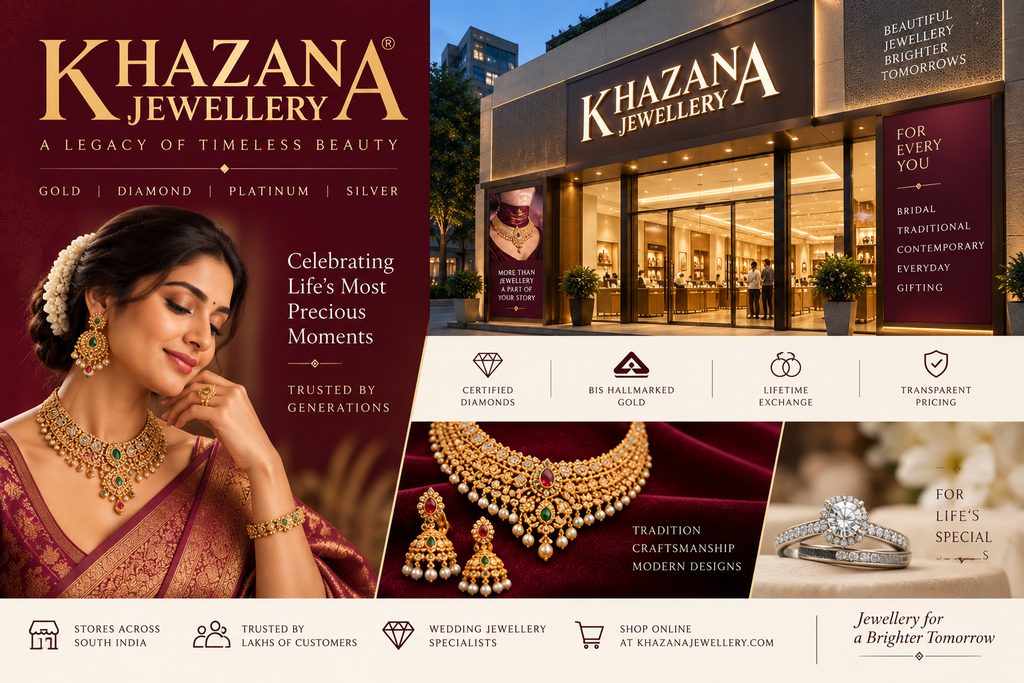
The company has also developed an online shopping platform, allowing customers to browse and purchase jewellery digitally. Its website states that products are BIS hallmarked and that the company offers certified diamond jewellery.
Product Mix
Gold remains the dominant business.
CARE Ratings previously reported that approximately 94% of FY2021 sales came from gold jewellery, with diamonds contributing around 4% and silverware around 2%.
This concentration gives Khazana significant exposure to the Indian gold jewellery market.
At the same time, higher-value diamond, gemstone and value-added jewellery can potentially improve gross margins because the retailer earns more from craftsmanship and design rather than simply the underlying metal value.
Handmade Jewellery – A Key Differentiator
One of Khazana’s important competitive advantages is its emphasis on handmade jewellery.
CARE Ratings highlighted that Khazana provides gold and other raw materials to a network of exclusive artisans who manufacture jewellery on a job-work basis.
This model allows the company to:
- Develop customised designs
- Respond quickly to regional preferences
- Maintain a wide catalogue
- Offer traditional designs
- Reduce dependence on standardised wholesale products
- Create differentiated wedding jewellery
This is particularly important in South India, where regional jewellery designs and wedding-related purchases form a significant portion of the market.
Store Network
Khazana has historically developed its footprint primarily in South India.
CARE Ratings reported 41 retail showrooms across:
- Andhra Pradesh – 20
- Telangana – 6
- Tamil Nadu – 9
- Karnataka – 4
- Puducherry – 1
- Odisha – 1
in its FY2021 assessment.
The company’s current official store locator displays stores in Andhra Pradesh, Karnataka, Odisha, Puducherry, Tamil Nadu and Telangana. The current locator’s listed categories sum to 39 stores, so the exact current operating-store count should be confirmed directly from the company’s latest internal/store database rather than assuming the historical 41-store figure remains unchanged.
Khazana Jewellery Store Locator
Geographic Strength
Khazana’s strongest competitive position is in South India.
The brand has particularly established itself in:
Andhra Pradesh + Telangana + Tamil Nadu
These markets have several attractive characteristics for jewellery retailers:
- Strong gold-buying culture
- High wedding jewellery demand
- Family-led jewellery purchasing
- Preference for physical stores
- High importance of trust and purity
- Large organised-retail opportunity
CARE Ratings specifically highlighted Khazana’s established presence in Andhra Pradesh and Telangana.
The Khazana Customer Proposition
Khazana’s current website highlights several elements of its customer proposition:
- BIS hallmarked gold
- Certified diamonds
- Lifetime exchange and buyback
- Transparent pricing
- Jewellery care
- Craftsmanship
- Competitive making charges
The company’s website also states that every ornament in its showrooms is individually hallmarked.
Khazana Jewellery – Customer Promise
Financial Performance
Khazana has shown significant financial improvement over the last five years.
Revenue & Profit Growth
| ₹ Crore | FY2021 | FY2022 | FY2023 | FY2024 | FY2025 |
|---|---|---|---|---|---|
| Sales | 4,748 | 5,860 | 7,865 | 8,981 | 10,246 |
| Operating Profit | 472 | 405 | 579 | 667 | 1,060 |
| PAT | 287 | 249 | 391 | 436 | 747 |
| Net Worth | 1,305 | 1,554 | 1,944 | 2,380 | 3,125 |
| Borrowings | 935 | 1,200 | 1,277 | 1,100 | 833 |
Source: FY2025 financial data reported by Tofler/SensiBook from company filings.
FY2025 Financial Highlights
FY2025 was a particularly strong year for Khazana.
Revenue from operations: ₹10,245.5 Cr
Other income: ₹27.2 Cr
Total income: ₹10,272.8 Cr
EBITDA / Operating Profit: ₹1,059.9 Cr
PBT: ₹1,000.6 Cr
PAT: ₹746.7 Cr
Net Worth: ₹3,124.9 Cr
Borrowings: ₹832.5 Cr
Total Assets: ₹6,124.9 Cr
The company’s FY2025 PAT increased by approximately 71%, considerably faster than revenue growth of approximately 14%.
This suggests that operating leverage, product mix and margin improvement played a meaningful role during the year.
Margin Expansion
Khazana’s operating margin improved significantly.
| Metric | FY2024 | FY2025 |
|---|---|---|
| Gross Margin | 10.6% | 13.5% |
| Operating Margin | 7.4% | 10.3% |
| Net Margin | 4.8% | 7.3% |
| ROE | 18.3% | 23.9% |
| ROCE | 25.6%* | 31.7% |
*Approximate based on reported figures.
The expansion in operating margin is one of the strongest aspects of the FY2025 financial performance.
However, investors should not automatically assume that the FY2025 margin is a permanent structural level. Jewellery margins can vary based on gold prices, product mix, making charges, inventory gains/losses and competitive intensity.
Balance Sheet
Khazana’s balance sheet improved substantially during FY2025.
Net worth increased from approximately:
₹2,380 Cr → ₹3,125 Cr
while borrowings declined from:
₹1,100 Cr → ₹833 Cr
Debt-to-equity therefore reduced from approximately 0.5x to 0.3x.
This is a positive development because jewellery retail is highly working-capital intensive.
Inventory
Inventory is naturally the largest balance-sheet component for a jewellery company.
FY2025 current assets were approximately ₹5,511 Cr, including inventory of approximately ₹4,935 Cr.
This highlights an important characteristic of the business:
A large amount of capital is continuously tied up in jewellery inventory.
The business therefore requires efficient inventory management and sufficient working-capital financing.
Working Capital
CARE Ratings identifies working-capital intensity as one of the company’s major constraints.
Jewellery retailers must maintain adequate stock across stores because customers expect to see a wide variety of designs.
At the same time, excessive inventory can result in:
- Higher borrowing
- Higher interest expense
- Lower liquidity
- Inventory obsolescence risk
- Higher working-capital requirements
CARE specifically highlighted inventory build-up and working-capital borrowing as important downside factors.
Credit Rating
CARE Ratings reaffirmed Khazana’s bank-facility rating at:
CARE A+; Stable / CARE A1+
for long-term/short-term bank facilities amounting to ₹1,500 Cr in March 2025.
The rating agency cited:
- Strong brand
- Established South Indian presence
- Experienced promoter
- Consistent revenue growth
- Comfortable leverage
as key positives.
The principal constraints were:
- Working-capital intensity
- Competition
- Gold-price volatility
- Regulatory risks
Industry Opportunity
The Indian jewellery market is undergoing a structural shift from fragmented local jewellers toward organised branded retailers.
The major drivers include:
1. Formalisation
Consumers increasingly prefer established brands offering:
- Hallmarked gold
- Transparent billing
- Buyback policies
- Exchange facilities
- Certification
- Consistent quality
2. Rising Disposable Income
Increasing household income supports spending on:
- Weddings
- Gold jewellery
- Diamonds
- Premium jewellery
- Gifting
3. Wedding Demand
India’s large wedding market provides recurring demand for jewellery.
4. Shift Toward Branded Jewellery
Consumers increasingly value brand reputation and purity assurance.
5. Organised Retail Expansion
Regional chains have opportunities to expand into new cities while national players continue to consolidate the industry.
Competitive Landscape
Khazana competes with several established jewellery brands, including:
- Tanishq
- Kalyan Jewellers
- Malabar Gold & Diamonds
- Joyalukkas
- Senco Gold
- GRT Jewellers
- Lalithaa Jewellery
- Jos Alukkas
- Regional independent jewellers
The industry remains highly competitive.
CARE Ratings describes the Indian jewellery retail sector as highly competitive and fragmented.
Competitive Advantages
1. Established Brand
Khazana has operated under its brand for more than three decades.
2. Strong South Indian Presence
Its geographic concentration has allowed it to build deep local brand recognition.
3. Handmade Jewellery
Its artisan network provides access to differentiated designs.
4. Experienced Promoter
The promoter family has decades of experience in the jewellery industry.
5. Large Revenue Base
FY2025 revenue exceeded ₹10,000 Cr.
6. Improving Profitability
FY2025 EBITDA and PAT growth were substantially higher than revenue growth.
7. Lower Leverage
Debt-to-equity declined to approximately 0.3x in FY2025.
8. Strong Capital Efficiency
Khazana was ranked among the top unlisted companies in the JM Financial–Hurun India Unlisted Gems 2026 report, with reported 32% ROCE for 2025.
Key Growth Drivers
Store Expansion
Additional stores can increase revenue while strengthening brand recognition.
South India Expansion
The company still has opportunities to deepen penetration in its strongest markets.
Product Mix
Increasing the contribution from:
- Diamonds
- Gemstones
- Premium jewellery
- Value-added designs
could potentially improve margins.
Digital Commerce
The company’s online platform provides an additional customer acquisition and sales channel.
Gold Exchange
The company’s physical-store exchange programme can encourage customers to recycle existing gold into new purchases.
Organised Retail Shift
The continued movement from independent jewellers toward branded retailers provides a long-term structural opportunity.
Key Risks
1. Gold Price Volatility
Gold-price movements can affect customer affordability, inventory valuation and working capital.
CARE specifically identifies gold-price volatility as a margin risk.
2. Working Capital
Large jewellery inventories require significant capital.
3. Competition
The company competes against both national chains and thousands of local jewellers.
4. Geographic Concentration
The business has historically been concentrated in South India.
5. Margin Sustainability
FY2025’s 10.3% operating margin is significantly above the FY2024 level.
Investors should verify whether this improvement is sustainable rather than simply extrapolating it indefinitely.
6. Regulatory Risk
The jewellery industry is subject to evolving rules concerning:
- Hallmarking
- GST
- Cash transactions
- KYC
- Gold imports
- Consumer protection
7. Inventory Risk
A significant amount of capital remains tied up in inventory.
8. Unlisted Liquidity
There is no continuously traded public market for Khazana shares.
An investor may therefore face difficulty exiting at the desired price.
Current Unlisted Share Price
A reliable current executable market price for Khazana Jewellery’s unlisted shares could not be independently verified from credible public sources.
Accordingly, an artificial “current price” should not be published.
For an unlisted transaction, the actual price can vary depending on:
- Seller
- Quantity
- Buyer demand
- Transfer restrictions
- Latest financials
- Negotiation
- Liquidity
- Valuation expectations
Indicative Valuation Framework
Khazana reported FY2025 PAT of approximately ₹746.7 Cr and net worth of approximately ₹3,124.9 Cr.
A PAT-based valuation can therefore be illustrated as follows:
| P/E Multiple | Indicative Equity Value |
|---|---|
| 15x | ₹11,201 Cr |
| 20x | ₹14,935 Cr |
| 25x | ₹18,668 Cr |
| 30x | ₹22,402 Cr |
These are illustrative valuation scenarios, not a target price or fair-value recommendation.
The appropriate multiple should depend on:
- Sustainable PAT
- Margin sustainability
- Store expansion
- Growth rate
- Debt
- Working-capital efficiency
- Brand strength
- IPO/listing prospects
- Comparable jewellery companies
Book Value Perspective
FY2025 net worth was approximately ₹3,124.9 Cr.
With paid-up capital of ₹27.27 Cr, the implied number of ₹10 face-value shares is approximately 2.73 Cr shares.
This gives an approximate FY2025 book value of:
₹1,145 per share
based on the reported balance sheet and paid-up capital.
Therefore:
| P/B Multiple | Indicative Equity Value |
|---|---|
| 1.0x | ₹3,125 Cr |
| 1.5x | ₹4,687 Cr |
| 2.0x | ₹6,250 Cr |
| 2.5x | ₹7,812 Cr |
| 3.0x | ₹9,375 Cr |
For jewellery retailers, book value is useful but should not be considered in isolation because the economics of the business are driven by inventory turnover, margins, brand strength and return on capital.
Valuation Interpretation
The most interesting feature of Khazana’s FY2025 numbers is the combination of:
₹10,246 Cr revenue + ₹747 Cr PAT + ₹3,125 Cr net worth + 23.9% ROE + 31.7% ROCE + 0.3x debt/equity.
This creates the possibility that Khazana deserves a meaningful premium to book value.
However, the correct valuation depends heavily on whether FY2025’s margin expansion can be maintained.
For example, if PAT normalises closer to ₹500–600 Cr in a weaker operating environment, a 20–25x multiple would produce a very different valuation than using ₹747 Cr of FY2025 PAT.
Therefore, normalised earnings should be used before negotiating an unlisted share purchase.
IPO / Listing Status
Khazana Jewellery remains an unlisted private company.
No reliable formal IPO filing or confirmed IPO timetable was identified in the sources reviewed.
Therefore, investors should not purchase the shares solely on an assumed IPO story.
Any future listing could act as a re-rating catalyst, but it should be treated as optionality rather than the core investment thesis unless management formally announces such a plan.
Legal / Tax Due-Diligence Note
A 2026 Madras High Court matter involving Khazana Jewellery concerned an application for settlement of tax matters relating to assessment years 2011–12 through 2017–18. The Division Bench set aside the earlier rejection and remanded the matter for detailed consideration of the company’s disclosure regarding undisclosed income.
This should not automatically be interpreted as a current operating or solvency issue, but investors purchasing unlisted shares should obtain the latest tax litigation, contingent-liability and settlement disclosures before investing.
Investment Positives vs Concerns
| Investment Positives | Key Concerns |
|---|---|
| ₹10,000+ Cr revenue scale | High inventory requirement |
| 71% FY25 PAT growth | Gold-price volatility |
| Strong South Indian brand | Competitive jewellery market |
| 23.9% ROE | Geographic concentration |
| 31.7% ROCE | Unlisted liquidity |
| Debt/equity only ~0.3x | Margin sustainability |
| Experienced promoter | Regulatory risk |
| Strong artisan network | No confirmed IPO |
| Established retail footprint | Working-capital dependence |
| Improving balance sheet | Valuation uncertainty |
Investment View
Khazana Jewellery stands out among regional unlisted jewellery companies because it combines large revenue scale, strong profitability, an established brand and improving capital efficiency.
The FY2025 performance is particularly encouraging.
Revenue crossed ₹10,000 Cr, PAT reached approximately ₹747 Cr, net worth exceeded ₹3,100 Cr, and borrowings declined substantially.
The company’s reported 31.7% ROCE also places it among the more capital-efficient unlisted businesses highlighted in the JM Financial–Hurun India Unlisted Gems 2026 report.
The main concern is valuation.
A strong company can still be a poor investment if purchased at an excessive price.
For Khazana, the preferred approach would be to assess:
Normalised PAT → Sustainable ROCE → Balance-sheet strength → Store expansion → Comparable-company multiples → Unlisted liquidity discount
rather than simply applying a high P/E to FY2025 earnings.
Overall Assessment
Business Quality: ⭐⭐⭐⭐½
Brand Strength: ⭐⭐⭐⭐
Financial Growth: ⭐⭐⭐⭐⭐
Profitability: ⭐⭐⭐⭐⭐
ROCE: ⭐⭐⭐⭐⭐
Balance Sheet: ⭐⭐⭐⭐
Growth Potential: ⭐⭐⭐⭐½
Management Experience: ⭐⭐⭐⭐⭐
Liquidity: ⭐⭐
Valuation Visibility: ⭐⭐⭐
Overall View: Strong Unlisted Jewellery Business — Entry Valuation Is Critical
Khazana Jewellery has evolved from a regional jewellery retailer into a ₹10,000+ Cr revenue unlisted business with strong profitability and an improving balance sheet.
The company’s biggest strengths are its established brand, South Indian customer base, handmade jewellery capabilities, experienced promoter group and strong return ratios.
The FY2025 numbers make the company particularly interesting from an unlisted-equity perspective.
However, investors should focus on price discipline.
A valuation based on sustainable earnings and a reasonable premium to book value could provide an attractive risk-reward profile. Conversely, an aggressive valuation based entirely on FY2025’s exceptional PAT growth could leave limited margin of safety.
For UnlistedCart investors, Khazana is therefore best viewed as a high-quality regional jewellery franchise with strong financial momentum, but one where the purchase price remains the most important variable.
Relevant Company Links
Khazana Jewellery Official Website
Khazana Jewellery Store Locator
Khazana Jewellery FY2025 Annual Return
CARE Ratings – Khazana Jewellery
Disclaimer
This report is prepared for informational and research purposes only. Khazana Jewellery Private Limited is an unlisted private company and does not provide the same level of continuous market disclosure as a listed company. Financial figures have been sourced from publicly available company filings and financial databases and should be independently verified before any investment decision.
The valuation scenarios presented above are illustrative and are not buy/sell recommendations or target prices. Investors should verify the latest audited financial statements, shareholding, debt, contingent liabilities, tax matters, current unlisted transaction price and transfer restrictions before investing.
For more such unlisted stocks visit https://unlistedcart.com/unlisted-shares/