
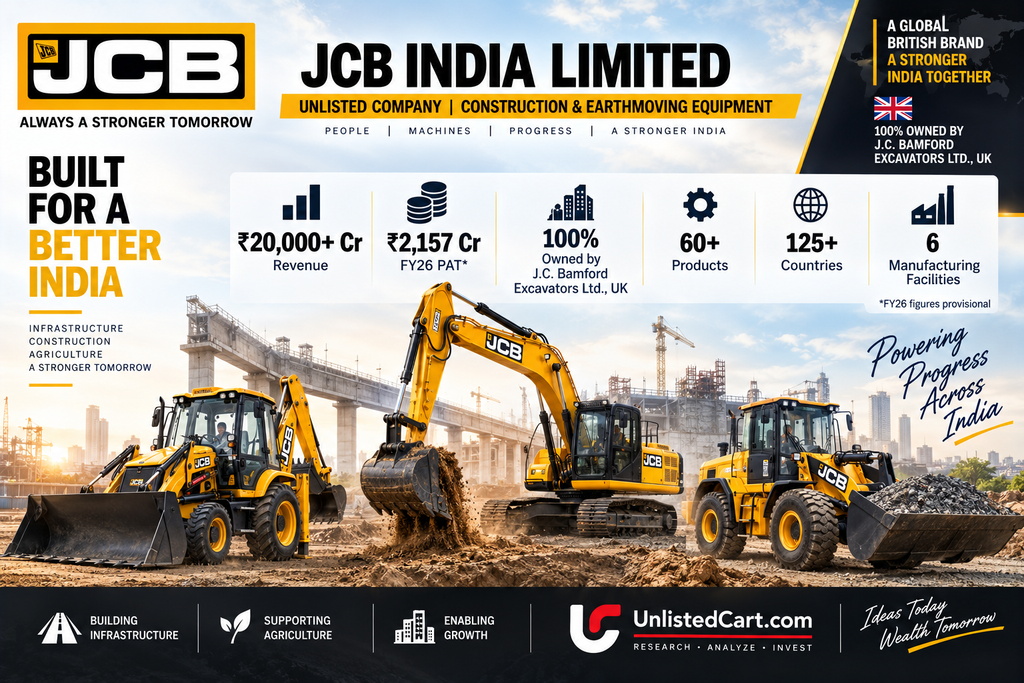
Company: JCB India Limited
CIN: U74899DL1979PLC009431
Incorporated: 1 February 1979
Registered Office: New Delhi, India
Status: Active, Unlisted Public Company
Parent: J.C. Bamford Excavators Limited, UK
Ownership: 100% subsidiary of J.C. Bamford Excavators Limited since 2003
Industry: Construction & Earthmoving Equipment
Managing Director & CEO: Deepak Jagannath Shetty
Official Website: JCB India Official Website
Executive Summary
JCB India Limited is one of the largest construction-equipment manufacturers operating in India. The company began manufacturing in India in 1979 and has developed India into an important manufacturing and export base for the global JCB Group.
JCB India manufactures construction and earthmoving equipment including backhoe loaders, excavators, wheel loaders, compactors, telehandlers, skid-steer loaders, mini excavators and other equipment. The company also manufactures components and engines and supports customers through a large dealer, service and parts network.
A particularly important point for investors is the ownership structure: JCB India is not an independently promoter-owned Indian company. It is a wholly owned subsidiary of J.C. Bamford Excavators Limited, UK. CRISIL states that JCB India became a 100% subsidiary of JC Bamford Excavators in 2003.
Company Overview
JCB entered India in 1979 through a joint venture and subsequently became fully owned by J.C. Bamford Excavators.
The company’s headquarters are at Ballabgarh near New Delhi. JCB describes the Ballabgarh facility as the world’s largest factory for backhoe loaders. The company has manufacturing operations across Delhi-NCR, Pune, Jaipur and Vadodara and also maintains parts warehouses and a nationwide dealer network.
JCB India has manufactured more than 500,000 construction machines in India, with Made-in-India equipment exported to more than 130 countries.
Ownership & Shareholding
JCB India is fundamentally different from a typical Indian family-controlled unlisted company.
Holding company: J.C. Bamford Excavators Limited, United Kingdom
Holding: 100%
Ultimate business group: JCB Group / Bamford family-controlled group
JCB India’s 2024 annual return identifies JC Bamford Excavators Limited as the holding company with 100% shareholding.
CRISIL also confirms that JCB India became a 100% subsidiary of JC Bamford Excavators Ltd in 2003.
Therefore, investors should not confuse JCB India with an Indian promoter-owned unlisted opportunity. Any investment exposure would ultimately be linked to the ownership and transaction structure of the JCB Group.
Business Model
JCB India’s business is primarily based on manufacturing and selling construction and earthmoving equipment.
Its major product categories include:
- Backhoe Loaders
- Excavators
- Mini Excavators
- Wheel Loaders
- Skid Steer Loaders
- Telehandlers
- Compactors
- Agricultural/Material Handling Equipment
- Generators
- Access equipment
- Attachments and parts
JCB’s current Indian product portfolio covers multiple construction, infrastructure, agriculture and material-handling applications.
Backhoe Loaders
Backhoe loaders remain one of JCB’s strongest product categories in India. JCB describes itself as the world’s biggest-selling backhoe-loader manufacturer and has built a particularly strong brand franchise around this product.
Excavators
JCB manufactures excavators at its Pune manufacturing facility. The range is targeted at infrastructure, construction, quarrying, mining and other heavy-duty applications.
Parts & After-Sales
The business is not limited to new-machine sales. JCB has a significant aftermarket ecosystem covering genuine parts, servicing, maintenance, diagnostics and machine monitoring.
JCB India operates more than 60 dealers and 700+ outlets across India, while its warehouse network supports parts availability across major regions.
This creates a recurring aftermarket component alongside equipment sales.
Manufacturing Footprint
JCB has built a significant manufacturing ecosystem in India.
Its Indian operations include facilities in:
Ballabgarh / Delhi-NCR
Major manufacturing base and headquarters, particularly known for backhoe loaders, engines and other equipment.
Pune
Heavyline equipment, excavators, wheel loaders, compactors and engineering/design capabilities.
Jaipur
Manufacturing facility supporting JCB’s access and construction equipment.
Vadodara
Component/fabrication facility supporting both Indian and global JCB production.
JCB has described India as one of its major global manufacturing and market bases.
Product & Technology Advantage
JCB’s competitive positioning is supported by:
- Large installed machine base
- Strong dealer network
- Engineering and R&D capabilities
- In-house engines and components
- Established aftermarket ecosystem
- Global technology transfer
- Brand recognition
- Manufacturing scale
- Export capability
JCB’s Pune operation also houses one of its largest design centres outside the UK, with more than 700 engineers involved in domestic and global projects.
Financial Performance
Standalone Financial Highlights
| ₹ Crore | FY23 | FY24 | FY25 |
|---|---|---|---|
| Revenue from Operations | 15,107.5 | 18,604.7 | 20,039.4 |
| Total Income | 15,299.0 | 18,824.9 | 20,250.5 |
| EBITDA / Operating Profit* | 1,964.4 | 2,817.0 | 2,674.1 |
| PAT | 1,454.7 | 2,074.7 | 1,985.3 |
| Net Worth | 4,265.3 | 4,020.6 | 3,493.6 |
| Borrowings | Nil | Nil | Nil |
| Total Assets | 7,566.8 | 8,074.9 | 8,441.7 |
*Operating-profit/EBITDA presentation can vary by database methodology.
FY25 revenue increased approximately 7.7%, while PAT declined approximately 4.3% from FY24. The FY25 financials show strong profitability despite the moderation in earnings.
FY26 Update
CRISIL’s July 2026 rating rationale provides provisional FY26 figures:
| ₹ Crore | FY25 | FY26* |
|---|---|---|
| Operating Income | 20,201 | 19,710 |
| PAT | 1,985 | 2,157 |
| PAT Margin | 9.8% | 10.9% |
| Adjusted Debt/Net Worth | 0.00x | 0.00x |
*FY26 figures are provisional.
The important observation is that FY26 operating income was slightly lower, but PAT increased to approximately ₹2,157 Cr, resulting in an improvement in PAT margin. CRISIL describes JCB India as a debt-free company.
Balance Sheet Analysis
FY25 total assets stood at approximately ₹8,441.7 Cr, compared with ₹8,074.9 Cr in FY24.
Shareholders’ funds were approximately ₹3,493.6 Cr.
The company reported no long-term or short-term borrowings, which is an important balance-sheet strength.
Key FY25 Assets
- Property, Plant & Equipment: ~₹1,331.9 Cr
- Intangible Assets: ~₹161.2 Cr
- Non-current Investments: ~₹955.0 Cr
- Inventory: ~₹2,004.1 Cr
- Trade Receivables: ~₹2,574.0 Cr
- Cash & Cash Equivalents: ~₹436.7 Cr
The combination of sizeable inventory and receivables means working-capital management remains important even though financial debt is absent.
Working Capital
JCB India’s reported working-capital cycle was approximately 26 days in FY25, according to the financial database reviewed.
Trade payables were approximately ₹3,441 Cr, while inventory was around ₹2,004 Cr and receivables around ₹2,574 Cr.
This indicates that the company uses supplier credit as an important component of its operating cycle.
Industry Opportunity
India’s long-term construction-equipment demand is closely connected with:
- Roads and highways
- Railways
- Urban infrastructure
- Housing and real estate
- Mining
- Ports
- Airports
- Industrial construction
- Agriculture and rural infrastructure
- Government capital expenditure
JCB’s current Indian product portfolio is positioned across construction, agriculture, material handling, mining and infrastructure applications.
The broader opportunity is therefore linked to India’s continued infrastructure investment and construction activity.
Growth Drivers
1. Infrastructure Spending
Large infrastructure projects require excavation, loading, compaction and material-handling equipment.
2. Strong Brand
JCB has exceptionally high brand recognition in India’s construction-equipment market, particularly in backhoe loaders.
3. Export Hub
India is not simply a domestic market for JCB. The company exports Made-in-India equipment to more than 130 countries.
4. Product Expansion
JCB continues to expand beyond traditional backhoe loaders into excavators, telehandlers, compactors, wheel loaders, access equipment, mini excavators and other categories.
5. Technology & Emission Transition
JCB has introduced Stage 5-ready products in India. Its current wheeled-machine portfolio follows the newer Stage 5 emission requirements from January 2025.
6. Aftermarket Revenue
Parts, servicing, maintenance and machine-monitoring solutions provide an additional ecosystem around the installed machine base.
Competitive Position
JCB competes with major construction-equipment manufacturers including:
- Tata Hitachi
- Volvo CE
- Komatsu
- Hyundai Construction Equipment
- CASE Construction Equipment
- SANY
- Caterpillar
- Mahindra Construction Equipment
- Action Construction Equipment
The competitive environment varies considerably by product category.
JCB’s key differentiation is its combination of brand strength, product range, manufacturing scale, dealer network, technology and aftermarket infrastructure.
Key Risks
1. Parent Company Ownership
JCB India is 100% owned by the UK-based J.C. Bamford Excavators group. Therefore, minority investors cannot treat it like an independent Indian promoter-owned business.
2. Cyclicality
Construction equipment demand is linked to infrastructure spending, real estate, mining, agriculture and overall economic activity.
3. Margin Pressure
FY25 operating profit declined despite revenue growth, indicating that cost inflation, product mix or other operating factors can affect profitability.
4. Working Capital
Inventory and receivables are substantial relative to annual operations, making working-capital efficiency an important monitoring factor.
5. Competition
The Indian construction-equipment industry has become increasingly competitive with both domestic and multinational manufacturers.
6. Technology Transition
The industry is moving toward cleaner engines, electrification, telematics and alternative powertrains. Continuous R&D investment will be required.
7. Unlisted Liquidity
JCB India is not exchange listed, meaning there is no NSE/BSE market price or continuous public price discovery.
Current Unlisted Price
No reliable publicly verifiable current OTC price has been identified for JCB India Limited.
Because JCB India is a 100% subsidiary of J.C. Bamford Excavators Limited, its shares are not comparable with freely traded listed-equity securities.
Any quote obtained through a private transaction should be independently verified through the company’s shareholding records, transfer documentation and valuation/transaction documents.
IPO / Listing Status
JCB India is currently an unlisted public company.
I found no confirmed IPO/DRHP announcement that would allow an investor to treat a future listing as a base-case event.
The company’s unlisted status should therefore be considered when assessing liquidity and exit possibilities.
Valuation
A conventional listed-company P/E valuation cannot be directly applied because there is no public market capitalization.
For reference, FY25 net profit was approximately ₹1,985 Cr, while FY26 provisional PAT was approximately ₹2,157 Cr.
The key valuation exercise for a private transaction would require:
- Enterprise/equity value negotiated between buyer and seller
- Number of outstanding shares
- Transfer restrictions
- Dividend history
- Parent-company structure
- Minority rights
- Recent transaction price
- Independent valuation
- Potential liquidity/exit mechanism
Without a verified current transaction price, assigning a P/E or P/B multiple would create false precision.
Investment Due-Diligence View
JCB India represents a large-scale, highly profitable Indian manufacturing operation within the global JCB Group, rather than a small Indian unlisted startup.
The company has several notable characteristics:
Positive factors
- ₹20,000+ Cr annual revenue
- ~₹2,000+ Cr annual PAT
- Debt-free balance sheet according to CRISIL
- Large manufacturing footprint
- Strong domestic brand
- More than 130-country export reach
- Extensive dealer and service ecosystem
- Significant engineering capabilities
- Large installed base
- Strong infrastructure-sector exposure
Points requiring due diligence
- 100% foreign-parent ownership
- No public-market liquidity
- No transparent daily valuation
- Working-capital intensity
- Construction-equipment cyclicality
- Competition
- Technology transition
- Future capital-allocation/dividend policy
Overall Assessment
JCB India is a substantial Indian manufacturing business with global strategic importance to the JCB Group. Its financial profile shows high revenue scale, strong profitability and no reported financial debt.
However, from an unlisted-share investment perspective, the most important issue is ownership: JCB India is 100% owned by J.C. Bamford Excavators Limited, UK, meaning the investment case is fundamentally different from an Indian promoter-owned unlisted company.
The absence of a transparent secondary-market price also makes valuation and exit analysis more difficult. Any private transaction should therefore be evaluated using the latest audited financials, shareholding records and independently verified transaction/valuation information rather than an unverified OTC quote.
Important Links
Official JCB India: JCB India
About JCB India: JCB India – About the Company
JCB India Machines: JCB India Product Range
JCB Backhoe Loaders: JCB Backhoe Loaders
JCB Excavators: JCB Excavators
Corporate Statements & Annual Returns: JCB Corporate Statements & Certifications
Disclaimer
This report is prepared for educational and research purposes only and should not be considered investment advice, a recommendation to buy or sell securities, or a guarantee of future returns. JCB India Limited is an unlisted company and private-market transactions may involve significant liquidity, valuation and transfer risks. Financial figures are based on publicly available filings and third-party financial databases; FY26 figures referenced above are provisional where specifically indicated by CRISIL. Investors should independently verify the latest financial statements, shareholding, valuation, transaction price and legal transferability before making any investment decision.
For more such unlisted stocks visit https://unlistedcart.com/unlisted-shares/