Company: Indian Potash Limited
Former Name: Indian Potash Supply Agency
CIN: U14219TN1955PLC000961
Incorporated: 17 June 1955
Registered Office: 1st Floor, Seethakathi Business Centre, 684–690 Anna Salai, Chennai – 600006, Tamil Nadu
Status: Active, Public Limited, Unlisted
Industry: Fertilisers / Agriculture / Agri-Inputs
ISIN: INE863S01015
Face Value: ₹10
Paid-up Capital: ₹28.60 Cr
Outstanding Equity Shares: 2,85,97,200
Managing Director: Dr. P. S. Gahlaut
Chairman: Pankaj Kumar Bansal
Executive Summary
Indian Potash Limited, popularly known as IPL, is one of India’s most strategically important private-sector participants in the fertiliser supply chain.
The company was established in 1955 with the objective of importing, handling, promoting and distributing potash fertilisers across India. Over the decades, it has evolved from a specialised potash importer into a diversified agri-business group with exposure to:
- Potassic fertilisers
- Phosphatic fertilisers
- Nitrogenous fertilisers
- Cattle feed
- Dairy
- Sugar
- Distillery
- Precious metals
- Fertiliser logistics and infrastructure
- Phosphate mining through its strategic investment in Jordan
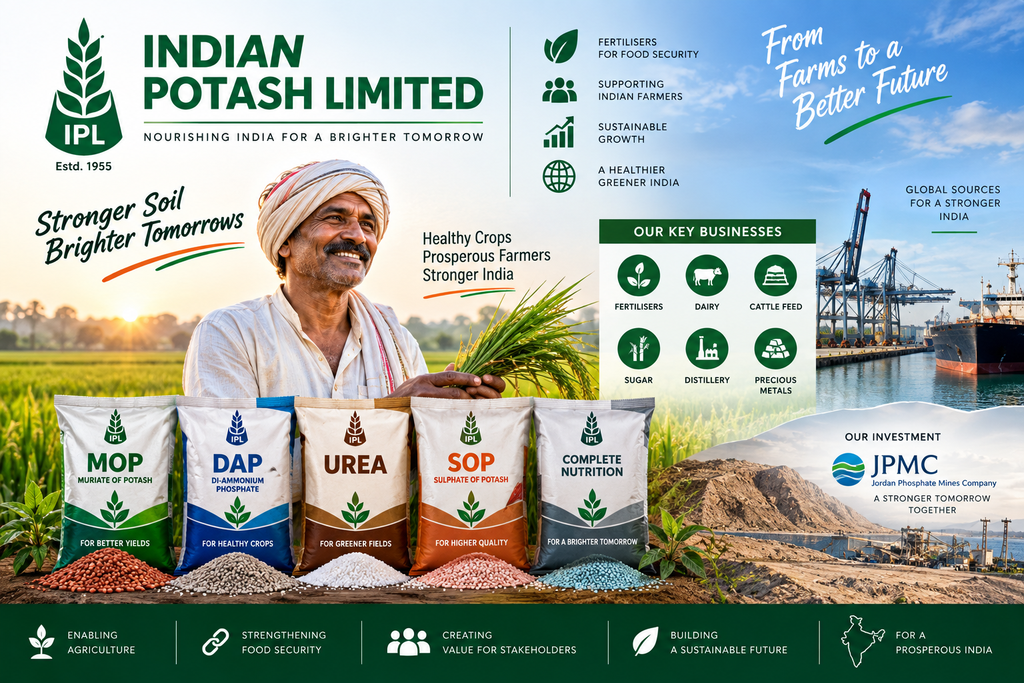
The company’s official website describes IPL as a leading importer and distributor of MOP, DAP, SOP, Urea and other fertilisers, while also highlighting its diversification into dairy, cattle feed, sugar, precious metals and infrastructure.
The most important development for investors is the company’s 27.38% strategic investment in Jordan Phosphate Mines Company (JPMC). JPMC’s contribution has become extremely significant to Indian Potash’s consolidated earnings. In FY2025-26, JPMC contributed approximately ₹1,980 Cr of profit to the consolidated results, representing almost the entire consolidated PAT of IPL.
FY2025-26 snapshot
Consolidated revenue: ₹32,949 Cr
Consolidated PAT: ₹1,981 Cr
Consolidated EPS: ₹692.80
Consolidated net worth: ₹13,663 Cr
Standalone PAT: ₹1,535 Cr
Standalone EPS: ₹536.73
Standalone net worth: ₹8,982 Cr
FY2025-26 consolidated revenue increased approximately 57.6%, while PAT increased around 19.3%. The slower growth in profit compared with revenue reflects higher finance costs and relatively lower margins.
At an indicative unlisted share price of around ₹2,587, the company trades at roughly:
- 3.7x consolidated earnings
- 0.54x consolidated book value
- 4.8x standalone earnings
- Approximately 0.82x standalone book value
Moneycontrol’s current indicative data shows ₹2,587.33 per share and a market capitalisation of approximately ₹7,399 Cr. Unlisted-market dealers show somewhat different indicative prices, illustrating the limited liquidity and price discovery of the security.
This makes Indian Potash one of the more unusual unlisted opportunities: a strategic fertiliser business with a very large listed-equity investment embedded inside it, trading at a relatively low headline valuation multiple.
Company Overview
Indian Potash Limited was incorporated on 17 June 1955 as Indian Potash Supply Agency and subsequently became Indian Potash Limited.
The company’s registered office is located at:
Seethakathi Business Centre
684–690, Anna Salai
Chennai – 600006, Tamil Nadu
The company remains an active unlisted public limited company. MCA-derived records show authorised capital of approximately ₹61.2 Cr and paid-up capital of ₹28.6 Cr.
The company held its 71st Annual General Meeting on 31 August 2026, and the FY2025-26 annual report contains audited standalone and consolidated financial statements.
Indian Potash – Official Website
Business Model
Indian Potash has two broad components:
1. Fertiliser Distribution
This remains the company’s core business.
IPL imports and distributes:
- Muriate of Potash (MOP)
- Di-Ammonium Phosphate (DAP)
- Sulphate of Potash (SOP)
- Urea
- Rock Phosphate
- Gypsum
- Other complex fertilisers
The company distributes fertilisers throughout India, including difficult-to-reach agricultural regions, through its regional network.
IFFCO identifies IPL as a major importer and marketer of potassic, phosphatic and nitrogenous fertilisers and states that IFFCO owns approximately 34% of IPL.
2. Diversified Agri Businesses
Over time IPL has expanded into:
- Dairy
- Milk products
- Cattle feed
- Sugar
- Distillery
- Precious-metal trading
- Rural warehousing
- Port/logistics infrastructure
This diversification provides additional earnings streams beyond fertiliser trading.
Fertiliser Business – The Core Engine
The fertiliser business is strategically important because India has limited domestic availability of certain fertiliser raw materials, particularly potash.
IPL’s long-standing role is to ensure the availability of fertilisers required by Indian farmers.
The company’s official history notes that its original objective was to promote balanced use of potash across the country and that it played a major role in expanding potash usage among Indian farmers.
The company also maintains a large distribution infrastructure and regional presence across India.
Strategic Importance to Indian Agriculture
Indian Potash has a somewhat unique position because fertiliser availability is closely linked with:
- Food security
- Agricultural productivity
- Government subsidy policy
- International commodity markets
- Foreign exchange
- Import logistics
This makes IPL more than a conventional commodity trader.
Its business sits at an important intersection between global fertiliser supply and Indian agricultural demand.
IFFCO describes IPL as strategically important in ensuring timely fertiliser availability in India.
IFFCO Relationship
IFFCO is the largest shareholder of Indian Potash.
Major shareholders
| Shareholder | Approx. Holding |
|---|---|
| Indian Farmers Fertiliser Cooperative Ltd. (IFFCO) | 33.99% |
| Gujarat State Co-operative Marketing Federation | 10.45% |
| Gujarat State Fertilisers & Chemicals | 7.87% |
| Andhra Pradesh State Cooperative Marketing Federation | 6.23% |
| Madras Fertilisers Ltd. | 5.54% |
| Others | 35.92% |
These holdings are based on the company’s reported shareholding structure.
The shareholder structure is strategically relevant.
A large portion of IPL is owned by cooperative and fertiliser-sector institutions, rather than conventional private-equity investors.
Jordan Phosphate Mines Company – The Hidden Asset
This is arguably the most important part of the Indian Potash investment thesis.
Indian Potash owns approximately 27.38% of Jordan Phosphate Mines Company PLC (JPMC).
JPMC is one of Jordan’s major phosphate mining and fertiliser companies.
Indian Potash acquired the stake in 2018, and the investment has become increasingly valuable over time.
Why this matters
The value of this investment is substantial relative to Indian Potash’s own balance sheet.
In FY2025, the reported fair/recoverable value of IPL’s JPMC investment was approximately:
₹14,359 Cr
against a carrying amount of only around:
₹650 Cr
based on the quoted market value in the Amman Stock Exchange.
That creates a very significant embedded value.
JPMC Contribution to FY2026 Profit
The importance of JPMC increased dramatically in FY2025-26.
The consolidated financial statements show:
Share of JPMC profit: approximately ₹1,980 Cr
Indian Potash’s consolidated PAT was:
₹1,981 Cr
In other words, the JPMC investment accounted for almost all of the group’s consolidated profit for FY2026.
This is extremely important when valuing IPL.
An investor should therefore examine Indian Potash using both:
Earnings-based valuation
and
Sum-of-the-parts / investment-value valuation.
FY2025-26 Financial Performance
Consolidated
| ₹ Crore | FY2025 | FY2026 |
|---|---|---|
| Revenue from Operations | 20,689 | 32,535 |
| Other Income | 223 | 415 |
| Total Income | 20,912 | 32,949 |
| EBITDA | 3,254 | 4,523 |
| PBT | 2,687 | 3,221 |
| PAT | 1,661 | 1,981 |
| EPS | ₹580.95 | ₹692.80 |
| Net Worth | 11,321 | 13,663 |
FY2026 consolidated revenue increased approximately 57.6%, while PAT grew approximately 19.3%.
Margin Analysis
Despite the substantial revenue growth, profitability did not increase proportionately.
FY2026
EBITDA margin: ~13.7%
Net profit margin: ~6.0%
compared with approximately:
FY2025 EBITDA margin: ~15.6%
FY2025 net margin: ~7.9%
The margin compression is an important issue.
The reason is that IPL’s business is heavily dependent on trading activity, where a large portion of revenue represents purchases and resale of fertilisers.
In FY2026, purchases of stock-in-trade were approximately ₹25,246 Cr, representing around 77% of total income.
Therefore, the company’s enormous revenue number should not be interpreted like the revenue of a high-margin consumer company.
Finance Cost
One of the biggest changes in FY2026 was the increase in finance costs.
FY2025 finance cost: ₹499 Cr
FY2026 finance cost: ₹1,177 Cr
This represents an increase of more than 135%.
The higher finance cost is a direct reason why PAT growth was substantially lower than revenue growth.
This is an important risk for investors.
The business can generate very large revenue growth, but if working capital requirements rise significantly, the resulting interest expense can absorb a meaningful part of the incremental operating profit.
Balance Sheet
Consolidated balance sheet
| ₹ Crore | FY2025 | FY2026 |
|---|---|---|
| Total Assets | 22,110 | 29,632 |
| Total Equity | 11,321 | 13,663 |
| Total Liabilities | 10,788 | 15,969 |
| Current Assets | 11,237 | 17,336 |
| Current Liabilities | 9,393 | 14,120 |
| Cash & Equivalents | 367 | 2,644 |
The balance sheet expanded considerably during FY2026.
Working Capital
Indian Potash is a highly working-capital-intensive business.
The company must finance:
- Fertiliser inventory
- Imports
- Port logistics
- Receivables
- Dealer network
- Government-linked subsidy cycles
This explains why the company can simultaneously report billions of rupees in revenue and still require substantial short-term borrowing.
The FY2026 cash-flow statement shows negative operating cash flow of approximately ₹2,240 Cr, compared with positive operating cash flow of ₹504 Cr in FY2025.
This is an important point that should not be ignored simply because reported PAT increased.
Cash Flow
FY2026
Operating cash flow: -₹2,240 Cr
Investing cash flow: +₹1,091 Cr
Financing cash flow: +₹3,424 Cr
Closing cash: ₹2,644 Cr
The large negative operating cash flow was accompanied by increased financing inflows, indicating the working-capital intensity of the business.
For investors, this means:
PAT growth ≠ equivalent free-cash-flow growth.
Standalone vs Consolidated Earnings
This distinction is particularly important for Indian Potash.
Standalone FY2026
PAT: ₹1,535 Cr
EPS: ₹536.73
Net worth: ₹8,982 Cr
Consolidated FY2026
PAT: ₹1,981 Cr
EPS: ₹692.80
Net worth: ₹13,663 Cr
The difference is primarily driven by the company’s investments and subsidiaries, especially the JPMC associate.
Therefore, using only standalone financials would understate the economic value of IPL’s investment portfolio.
Other Businesses
Dairy
IPL operates dairy and milk-processing activities and states that its processing capacity is approximately 7 lakh litres of milk per day.
This provides exposure to the growing organised dairy sector.
Cattle Feed
The company has diversified into cattle-feed manufacturing, serving agricultural and dairy ecosystems.
Sugar
IPL has acquired and operates sugar assets.
The company historically acquired five sugar factories with aggregate capacity of approximately 9,700 TCD.
Precious Metals
IPL has also entered precious-metal trading and rural jewellery-related businesses.
The diversification provides additional revenue streams but also makes the overall company more complex to value.
Port & Infrastructure Opportunity
IPL has historically planned a major greenfield port project in southern Gujarat.
The company has discussed investment of up to approximately ₹1,500 Cr in port infrastructure.
The strategic rationale is clear:
Fertiliser imports → port infrastructure → storage → distribution
Greater control over logistics could improve supply-chain efficiency over the long term.
However, investors should treat the project as an execution opportunity rather than guaranteed future value, unless the latest annual report confirms its current status and investment timeline.
Industry Opportunity
1. India’s Agricultural Demand
India’s large agricultural base provides structural demand for fertilisers.
2. Food Security
Government policy continues to prioritise agricultural productivity and fertiliser availability.
3. Potash Usage
Balanced fertilisation requires potassium alongside nitrogen and phosphorus.
4. Import Infrastructure
India depends significantly on international sources for potash and phosphate-based fertiliser inputs.
IPL’s established import and distribution network provides a structural advantage.
5. Global Fertiliser Supply
Long-term supply arrangements can help reduce procurement uncertainty.
IPL has previously signed a five-year MOP supply MoU with Israel Chemicals Ltd. for the 2022–2027 period.
Competitive Advantages
1. Strategic Position
IPL occupies an important position in India’s fertiliser supply chain.
2. IFFCO Backing
IFFCO’s approximately 34% ownership provides institutional strength.
3. Distribution Network
The company serves markets throughout India, including remote agricultural areas.
4. Long Operating History
More than seven decades of operating history create strong institutional relationships.
5. JPMC Investment
The 27.38% stake in JPMC is a major strategic asset.
6. Diversification
Dairy, cattle feed, sugar and other businesses reduce dependence on a single operating segment.
7. Strong Capital Base
Consolidated net worth crossed ₹13,600 Cr in FY2026.
Key Growth Drivers
Fertiliser Volume Growth
Higher agricultural productivity and balanced fertilisation can increase demand.
Potash Penetration
Greater awareness of potassium’s role in crop productivity could support long-term MOP consumption.
JPMC Growth
Higher phosphate production, prices and dividends from JPMC can materially influence IPL’s consolidated earnings.
Dairy Expansion
Organised dairy demand can provide another source of growth.
Sugar
Improved sugar-cycle conditions can benefit the group’s sugar assets.
Logistics
Port and warehousing infrastructure could potentially improve supply-chain efficiency.
Key Risks
1. Government Policy Risk
Fertiliser prices and subsidies are strongly influenced by government policy.
Changes in subsidy structures can affect profitability and working capital.
2. Commodity Price Risk
Potash and phosphate prices can be highly volatile.
3. Working-Capital Risk
Large inventory and receivable requirements can create substantial funding needs.
4. Finance Cost
FY2026 finance costs more than doubled to ₹1,177 Cr.
5. Cash-Flow Risk
Operating cash flow turned negative at approximately ₹2,240 Cr in FY2026.
6. JPMC Concentration
JPMC is a major strength, but it is also a concentration risk.
Almost the entire consolidated FY2026 profit came from the company’s share of JPMC’s profit.
7. Commodity Cyclicality
Profitability can fluctuate with fertiliser and phosphate prices.
8. Complex Corporate Structure
Multiple subsidiaries, associates and operating segments make the company more difficult to analyse than a pure-play fertiliser distributor.
9. Unlisted Liquidity
Indian Potash is not traded on NSE/BSE.
Private-market liquidity can therefore be limited.
Current Unlisted Share Price
As of the latest public data reviewed, Moneycontrol displays an indicative Indian Potash unlisted share price of approximately:
₹2,587 per share
with a 52-week range of approximately ₹2,524–₹3,250 and an indicative market capitalisation of approximately ₹7,399 Cr.
Other unlisted-market platforms show different indicative prices:
- WWIPL: approximately ₹2,550
- Planify: approximately ₹2,462
- Altius Investech: approximately ₹2,750
- Other dealer quotes can be higher
This dispersion demonstrates that there is no exchange-based price discovery for Indian Potash.
Current Valuation
At approximately ₹2,587/share:
Shares outstanding: 2.86 Cr
Approximate equity value:
₹7,400 Cr
Consolidated earnings valuation
FY2026 consolidated EPS = ₹692.80
Therefore:
P/E ≈ 3.7x
Moneycontrol independently reports a P/E of approximately 3.68x.
Standalone earnings valuation
FY2026 standalone EPS = ₹536.73
Therefore:
Standalone P/E ≈ 4.8x
Book Value Valuation
FY2026 consolidated net worth:
₹13,663 Cr
Consolidated book value per share:
~₹4,778
At ₹2,587:
P/B ≈ 0.54x
This is unusually low for a company with a substantial strategic investment portfolio.
However, the low P/B should not automatically be interpreted as a free lunch.
A significant portion of IPL’s book value and earnings depends on investments, associates and working-capital-intensive operations.
JPMC Sum-of-the-Parts Opportunity
The JPMC investment deserves separate attention.
FY2025 fair/recoverable value:
₹14,359 Cr
This was against a carrying value of only approximately ₹650 Cr.
This means the JPMC investment alone had a market value substantially above Indian Potash’s entire unlisted equity valuation at the ₹2,500–₹2,600 range.
However, this comparison requires caution.
The fair value reported in the financial statements is based on the quoted value of JPMC shares and should not be treated as cash that IPL can immediately realise.
There may be:
- Holding-period considerations
- Strategic ownership considerations
- Taxes
- Market volatility
- Currency movements
- Restrictions
- Valuation fluctuations
Nevertheless, the asset is extremely important to the overall investment thesis.
Illustrative SOTP Framework
A conservative investor could analyse Indian Potash through three components:
A. Fertiliser & Operating Businesses
Value using normalised standalone earnings or EBITDA.
B. JPMC Investment
Value the 27.38% listed stake at its current market value and apply an appropriate holding-company discount.
C. Other Investments & Assets
Add:
- Subsidiaries
- Dairy
- Sugar
- Cattle feed
- Other investments
- Cash
and deduct:
- Debt
- Other liabilities
This approach may provide a more meaningful valuation than simply applying a P/E multiple to consolidated PAT.
Dividend
Indian Potash has historically paid dividends.
For FY2025-26, the company proposed a final dividend of:
₹20 per equity share
subject to shareholder approval.
This compares with ₹20 per share in the previous year.
At a share price of ₹2,587, this represents an indicative dividend yield of approximately:
0.77%
Therefore, IPL should primarily be considered a value/asset-growth opportunity rather than a high-dividend stock.
IPO / Listing Status
Indian Potash remains unlisted.
The latest available information does not indicate a filed DRHP or confirmed IPO timetable. Moneycontrol also reports DRHP Status: No.
Therefore, investors should not buy Indian Potash purely on an assumed IPO story.
Any future listing could provide a re-rating catalyst, but there is currently insufficient evidence to make an IPO the base-case investment thesis.
Investment Positives vs Concerns
| Investment Positives | Key Concerns |
|---|---|
| 70+ years of operating history | Government policy dependence |
| Strategic role in fertiliser supply | Commodity price volatility |
| Strong IFFCO backing | High working-capital requirement |
| ₹32,949 Cr FY26 total income | Finance cost increased sharply |
| ₹1,981 Cr consolidated PAT | Negative operating cash flow in FY26 |
| 27.38% JPMC stake | Earnings concentration in JPMC |
| Large hidden/strategic asset value | Complex corporate structure |
| ₹13,663 Cr consolidated net worth | Unlisted liquidity |
| P/E around 3.7x at indicative price | No confirmed IPO |
| P/B around 0.54x | Value realisation may take time |
Investment View
Indian Potash is a very interesting value-oriented unlisted company, but it requires a different analytical approach from a conventional operating business.
The headline numbers are attractive:
₹32,949 Cr revenue
₹1,981 Cr consolidated PAT
₹13,663 Cr net worth
₹692.80 EPS
~3.7x consolidated P/E
~0.54x consolidated P/B
At an indicative market price around ₹2,587, the headline valuation appears inexpensive.
But the real investment thesis is deeper.
Indian Potash owns a 27.38% stake in Jordan Phosphate Mines, which has become a major source of consolidated earnings and represents a substantial investment asset.
The FY2025 fair/recoverable value of the JPMC stake was approximately ₹14,359 Cr, substantially above Indian Potash’s current unlisted equity value at recent private-market prices.
This creates the possibility of a significant holding-company discount / hidden-asset value opportunity.
However, investors should also recognise that the core business has become more leveraged in FY2026, finance costs rose sharply and operating cash flow turned negative.
Therefore, the key question is not simply:
“Is Indian Potash cheap?”
It is:
“How much of the JPMC value, operating business value and future cash generation is already reflected in the unlisted share price?”
What Investors Should Check Before Buying
Before purchasing Indian Potash shares, investors should verify:
- Latest unlisted transaction price
- Exact number of shares being offered
- Seller identity
- Share transfer process
- Latest JPMC market value
- JPMC dividend expectations
- Indian Potash standalone debt
- Consolidated debt
- Working-capital borrowings
- Fertiliser volumes
- Government subsidy receivables
- Inventory levels
- Sugar business performance
- Dairy business performance
- Port project status
- Tax liabilities
- Litigation
- Related-party transactions
- Latest audited annual report
- Potential IPO/listing developments
Overall Assessment
Business Quality: ⭐⭐⭐⭐½
Strategic Importance: ⭐⭐⭐⭐⭐
Asset Value: ⭐⭐⭐⭐⭐
Earnings Growth: ⭐⭐⭐⭐
Balance Sheet: ⭐⭐⭐½
Cash-Flow Quality: ⭐⭐⭐
Management/Institutional Backing: ⭐⭐⭐⭐⭐
Valuation: ⭐⭐⭐⭐⭐
Liquidity: ⭐⭐
IPO Visibility: ⭐⭐
Overall View: Attractive Value Opportunity With Significant Asset Optionality
Indian Potash Limited is one of the more interesting unlisted companies in India’s agricultural ecosystem.
The company combines:
Fertiliser distribution + agricultural infrastructure + diversified agri businesses + a major JPMC investment.
Its most attractive feature today is arguably the mismatch between the market value of the unlisted company and the value of its investment portfolio, particularly the JPMC stake.
At approximately ₹2,500–₹2,600 per share, the stock appears inexpensive on both earnings and book value metrics.
However, investors should not ignore the deterioration in FY2026 operating cash flow and the sharp increase in finance costs.
The best way to approach IPL is therefore through a Sum-of-the-Parts valuation, rather than relying solely on P/E.
Final Investment View
Indian Potash looks fundamentally attractive at a reasonable entry price, particularly for investors seeking value and asset-backed exposure to India’s fertiliser ecosystem.
The JPMC stake provides significant hidden-asset optionality, while the core fertiliser business provides strategic relevance and recurring operating activity.
The primary risks are working-capital intensity, government policy, commodity cycles, finance costs and the concentration of consolidated earnings in JPMC.
For an unlisted investor, the opportunity becomes particularly compelling when the purchase price provides a meaningful discount to the underlying asset value while still allowing a margin of safety against working-capital and commodity-cycle risks.
Relevant Links
Indian Potash Official Website
Indian Potash – About the Company
Indian Potash FY2025-26 Annual Report / AGM Information
Disclaimer
This report is prepared for informational and research purposes only. Indian Potash Limited is an unlisted public company and does not have continuous exchange-based price discovery.
The unlisted share prices mentioned are indicative private-market quotations, not NSE/BSE traded prices. Different intermediaries may quote materially different prices.
Valuation calculations are illustrative and should not be interpreted as a buy/sell recommendation or guaranteed fair value.
Investors should independently verify the latest audited financial statements, current JPMC valuation, debt, working-capital position, tax liabilities, litigation, share-transfer restrictions and actual transaction price before investing.
For more such unlisted stocks visit https://unlistedcart.com/unlisted-shares/