Sector: Retail / Consumer / E-Commerce / Omnichannel
Status: Active & Unlisted
Parent: Reliance Retail Ventures Limited
Ultimate Parent: Reliance Industries Limited
CIN: U01100MH1999PLC120563
ISIN: INE742O01010
Incorporated: 29 June 1999
Registered Office: Mumbai, Maharashtra
Face Value: ₹10 per share
CEO: V. Subramaniam
1. About the Company
Reliance Retail Limited (RRL) is the core operating retail company within the Reliance Group’s consumer ecosystem.
The company operates one of India’s largest integrated retail platforms, combining physical stores, digital commerce, quick commerce, wholesale distribution, private labels and an extensive brand portfolio.
RRL is wholly owned by Reliance Retail Ventures Limited (RRVL), while RRVL is controlled by Reliance Industries. As of March 31, 2026, RRL had approximately 898.70 crore equity shares, all held by RRVL.
The business is therefore different from a conventional retailer: it combines retail stores with digital platforms, supply-chain infrastructure, consumer brands and distribution.
2. Business Model
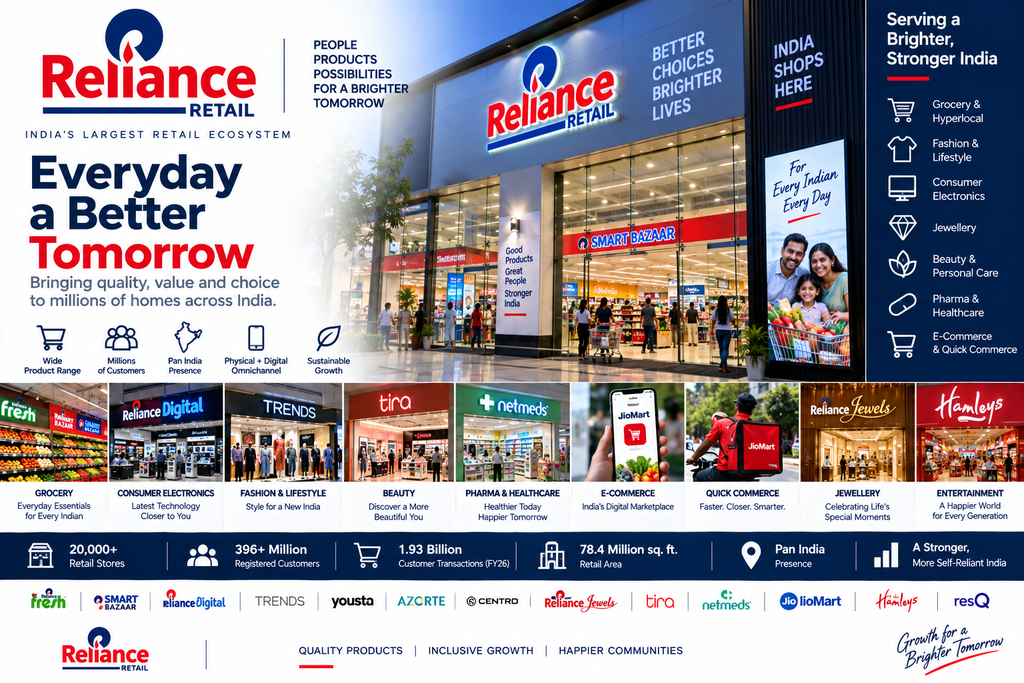
Reliance Retail operates across India’s major consumption categories.
| Segment | Key Brands / Platforms |
|---|---|
| Grocery | Reliance Fresh, Smart, Smart Bazaar, Freshpik, Smart Point |
| Consumer Electronics | Reliance Digital, MyJio Store, resQ |
| Fashion & Lifestyle | Trends, Yousta, Azorte, Centro, Reliance Jewels |
| Premium & Luxury | Armani, Burberry, Diesel, GAP, Marks & Spencer, Superdry and others |
| Beauty | Tira |
| Pharma | Netmeds |
| E-Commerce | JioMart, AJIO |
| Quick Commerce | Hyperlocal JioMart ecosystem |
| Jewellery | Reliance Jewels |
| Entertainment / Toys | Hamleys |
| Distribution | JioMart Digital and merchant network |
Reliance Retail currently operates across grocery, electronics, fashion & lifestyle and pharma, with AJIO and JioMart forming major digital-commerce channels.
3. Scale of the Business
The scale of Reliance Retail is its biggest competitive advantage.
As of June 30, 2026:
- 20,169 retail stores
- 78.4 million sq. ft. retail area
- 396+ million registered customers
- 1.93 billion customer transactions in FY26
- Presence across major consumption categories
- More than 8,000 consumer-electronics stores
- More than 5,000 fashion stores
This creates a powerful physical + digital ecosystem.
The store network can also act as a fulfilment infrastructure for online orders, particularly in hyperlocal commerce.
4. FY26 Financial Performance
FY26 was another year of strong revenue growth.
| ₹ Crore | FY25 | FY26 | Growth |
|---|---|---|---|
| Gross Revenue | 3,30,943 | 3,71,085 | 12.1% |
| Revenue from Operations | 2,91,043 | 3,28,202 | 12.8% |
| EBITDA | 25,094 | 27,034 | 7.7% |
| EBITDA Margin | 8.6% | 8.2% | -40 bps |
The company opened 1,564 new stores during FY26, taking the network to approximately 20,160 stores by March 2026.
5. Profitability
RRL’s standalone audited financial statements show FY26 profit after tax attributable to equity shareholders of approximately:
₹13,476 Cr
versus approximately ₹9,973 Cr in FY25.
That represents approximately 35% year-on-year PAT growth.
Basic EPS increased from ₹11.10 to:
₹14.99
in FY26.
This is particularly important because Reliance Retail’s revenue growth is accompanied by substantial earnings growth.
6. Balance Sheet
As of March 31, 2026:
| Particular | FY26 |
|---|---|
| Total Assets | ₹1,99,778 Cr |
| Total Equity | ₹1,06,769 Cr |
| Non-Current Borrowings | ₹22,521 Cr |
| Current Borrowings | ₹31,738 Cr |
| Total Borrowings | ~₹54,259 Cr |
| Inventory | ₹21,364 Cr |
| Cash & Cash Equivalents | ₹995 Cr |
The company has a substantial asset base, reflecting its large store network, technology infrastructure, inventory and investments required to operate at national scale.
Credit quality remains strong. CRISIL reaffirmed AAA/Stable ratings for RRVL and highlighted strong liquidity, access to capital markets and support from the Reliance ecosystem.
7. Retail + Digital Ecosystem
The biggest strength of Reliance Retail is not simply its number of stores.
It is the integration of:
Stores + JioMart + AJIO + Quick Commerce + Distribution + Private Labels + Consumer Brands + Data
This allows Reliance to potentially acquire a customer through one channel and monetise that customer through multiple categories.
For example:
JioMart → Grocery → Electronics → Fashion → Beauty → Pharma → Payments / Digital Ecosystem
This creates a significantly broader customer relationship than a traditional supermarket chain.
8. Quick Commerce
Quick commerce has become a major strategic focus.
Reliance is using its existing retail-store network as a hyperlocal fulfilment infrastructure for faster deliveries.
FY26 transactions exceeded 1.9 billion, while Q4 hyperlocal-commerce average daily orders increased more than 300% year-on-year.
This is strategically important because Reliance does not have to build the entire quick-commerce network from scratch.
Its existing stores, inventory and supply chain can potentially become fulfilment nodes.
However:
Quick commerce is also margin-intensive.
Aggressive investment by Blinkit, Zepto, Swiggy Instamart and others can pressure:
- Delivery economics
- Discounts
- Store productivity
- EBITDA margins
- Cash requirements
This is one reason FY26 EBITDA growth of 7.7% was below revenue growth of 12.8%.
9. Fashion & Lifestyle Opportunity
Reliance Retail has built one of India’s broadest fashion portfolios.
Its brands cover:
Value → Mass → Premium → Luxury
The portfolio includes Trends, Yousta, Azorte, Centro, Reliance Jewels and more than 50 international marquee brands.
Reliance also continues to add international partnerships and expand its premium positioning.
This is strategically important because higher-value fashion and premium brands can potentially generate better margins than basic grocery retail.
10. Consumer Electronics
Reliance Digital and MyJio Stores give Reliance a dominant physical distribution network in consumer electronics.
The company operates 8,000+ stores in the consumer-electronics ecosystem and has the resQ service network supporting post-sale service.
The business also benefits from:
- Smartphone growth
- Home appliances
- Consumer electronics
- Computing
- Mobility
- Connected devices
- Jio ecosystem cross-selling
11. Private Labels & Consumer Brands
Private-label development is becoming increasingly important.
Reliance can potentially capture more value by controlling:
Product → Brand → Distribution → Retail → Customer
rather than simply acting as a retailer for third-party brands.
The company has been increasing private-label contribution across categories, while the wider Reliance consumer-products ecosystem is also scaling rapidly.
Reliance Consumer Products reported gross revenue of approximately ₹22,000 Cr in FY26, with Campa generating more than ₹4,700 Cr of gross sales.
The FMCG business was separated from the retail structure, allowing Reliance to develop it as a standalone consumer-products growth engine.
12. Competitive Advantages
1. Unmatched Physical Distribution
20,000+ stores provide enormous reach across India.
2. Digital Integration
JioMart and AJIO allow Reliance to compete directly with major e-commerce platforms.
3. Supply-Chain Scale
The company has built extensive logistics and fulfilment infrastructure.
4. Brand Portfolio
Reliance has assembled a broad mix of owned, private-label and international brands.
5. Financial Strength
The Reliance ecosystem gives the business access to substantial capital.
6. Customer Data
396+ million registered customers create a potentially valuable consumer-data and loyalty ecosystem.
7. Jio Synergies
Retail stores also support Jio’s device, connectivity and service distribution.
CRISIL specifically notes that RRL acts as the master distributor for Jio telecom and FTTH services and uses Reliance Digital and Jio Stores as customer touchpoints.
13. Current Unlisted Share Price
As of September 10, 2026, one current private-market reference shows:
₹1,245 per share
for Reliance Retail Limited.
The quoted security carries:
- ISIN: INE742O01010
- Face Value: ₹10
- Shares: ~898.70 crore
Important Warning
This is an OTC/private-market reference price, not an NSE/BSE traded price.
Unlisted Reliance Retail shares can trade at different prices depending on:
- Seller
- Quantity
- Settlement terms
- Demat status
- Buyer demand
- Expected IPO timing
Therefore, ₹1,245 should be treated as an indicative reference, not a guaranteed executable price.
14. Indicative Valuation
At ₹1,245/share and approximately 898.70 crore shares:
Indicative Equity Value ≈ ₹11.19 lakh crore
The same current market source reports approximately:
- P/E: 83x
- P/B: 11.1x
based on FY26 standalone earnings and book value.
Valuation Snapshot
| Parameter | Approx. |
|---|---|
| Indicative OTC Price | ₹1,245 |
| Shares Outstanding | 898.70 Cr |
| Implied Equity Value | ₹11.19 lakh Cr |
| FY26 PAT | ₹13,476 Cr |
| FY26 EPS | ₹14.99 |
| FY26 P/E | ~83x |
| FY26 Book Value/Share | ~₹118.8 |
| P/B | ~10.5–11x |
This is a premium valuation.
At ~83x FY26 earnings, the market is clearly pricing in significant future growth, higher margins, further digital monetisation and a potential IPO/listing premium.
15. Valuation vs Historical Institutional Benchmarks
This is where investors need to be careful.
In 2023, Qatar Investment Authority’s investment in RRVL valued the holding company at approximately ₹8.36 lakh crore equity value.
More recent research cited in 2026 placed Reliance Retail above the $100 billion valuation level, making it one of the world’s most valuable private, venture-backed companies.
The current ₹1,245 unlisted reference implies roughly ₹11.2 lakh crore for RRL itself.
However, RRL and RRVL are not identical securities.
RRVL is the holding company containing RRL plus other retail businesses/assets, while RRL is the operating retail company. Therefore, investors should not directly compare the RRL share price with an RRVL funding-round valuation without making the appropriate corporate-structure adjustments.
This is an important distinction for UnlistedCart.
16. IPO / Listing Status
Reliance Retail is not currently listed.
The company remains one of India’s most closely watched potential IPO candidates.
However, investors should distinguish between:
Confirmed IPO
No current DRHP/listing timetable has been publicly confirmed.
IPO Expectation
Strong.
There have been repeated reports that Reliance Retail could be listed after Jio’s IPO, potentially around 2027, with earlier reports suggesting a valuation of close to $200 billion.
But at the June 2026 AGM, Mukesh Ambani did not provide a specific Reliance Retail IPO timeline.
Therefore:
IPO Catalyst: High Probability / No Confirmed Timeline
It should not be marketed as “IPO launching soon” unless an official filing is made.
17. Why Investors Like the IPO Story
A Reliance Retail IPO could potentially unlock value through:
- Public-market price discovery
- Greater transparency
- Institutional ownership
- Liquidity
- Separate valuation from Reliance Industries
- Potential index inclusion over time
- Clear valuation of India’s largest organised retailer
For existing unlisted shareholders, an IPO could potentially provide a major liquidity event.
18. Investment Positives
1. India’s Largest Retail Platform
20,000+ stores and nearly 400 million registered customers create an enormous competitive advantage.
2. Strong Financial Growth
FY26 gross revenue grew 12.1%, while standalone PAT increased roughly 35%.
3. Multiple Growth Engines
Reliance is not dependent on one retail category.
It operates across:
Grocery + Electronics + Fashion + Beauty + Pharma + Jewellery + Digital Commerce + Quick Commerce.
4. Omnichannel Advantage
The combination of stores and digital platforms can provide better fulfilment economics than a pure online player.
5. Private-Label Opportunity
Higher private-label contribution could gradually support margins.
6. Strong Parentage
Reliance Industries provides significant financial and strategic support.
7. IPO Optionality
A future listing could unlock substantial value if the business is separated and valued independently by public markets.
19. Key Risks
1. High Valuation
At approximately ₹1,245/share, the implied valuation is around ₹11.2 lakh crore and approximately 83x FY26 earnings.
That leaves limited margin of safety.
2. Margin Pressure
FY26 EBITDA grew 7.7%, below revenue growth of 12.1%, and EBITDA margin declined from 8.6% to 8.2%.
3. Quick-Commerce Competition
Blinkit, Zepto and Swiggy Instamart are aggressively investing in quick commerce.
4. Capital Intensity
Retail expansion, inventory, logistics, technology and fulfilment require substantial capital.
5. Execution Complexity
Managing thousands of stores, multiple formats and dozens of brands creates operational complexity.
6. IPO Timing
The IPO is a major potential catalyst, but the exact timing remains unconfirmed.
7. Private-Market Liquidity
Unlike listed shares, unlisted Reliance Retail shares do not have continuous exchange liquidity.
20. Growth Opportunities
The next phase of growth could come from:
Hyperlocal Commerce
Using existing stores for rapid delivery.
Tier-2 & Tier-3 Expansion
Expanding organised retail into underpenetrated markets.
Premiumisation
Higher-income consumers moving toward premium fashion, beauty and electronics.
Private Labels
Increasing share of owned brands.
Digital Commerce
Scaling JioMart and AJIO.
Beauty
Tira remains a significant long-term opportunity.
Pharma
Netmeds provides an integrated online/offline healthcare retail platform.
Consumer Products
The wider Reliance consumer-products ecosystem can strengthen distribution and cross-selling.
21. What Investors Should Track
Before buying unlisted Reliance Retail, investors should monitor:
- Revenue growth
- EBITDA margin
- Same-store sales growth
- Store productivity
- Quick-commerce order economics
- Digital-commerce GMV
- Private-label contribution
- Inventory turnover
- Working-capital intensity
- Debt
- Customer growth
- IPO/DRHP developments
- Institutional valuation benchmarks
- RRL vs RRVL corporate restructuring
Most Important KPI
Revenue growth + EBITDA margin + valuation discipline
Reliance Retail does not need merely to grow.
It needs to grow profitably enough to justify the premium valuation being assigned in the unlisted market.
22. Investment View
India’s Retail Powerhouse — Premium-Valued Unlisted / Potential IPO Opportunity
Reliance Retail is arguably one of the strongest unlisted consumer businesses in India.
Its combination of:
20,000+ stores + 396M+ customers + JioMart + AJIO + Tira + Netmeds + private labels + global brands + massive supply-chain infrastructure
creates a very difficult ecosystem for competitors to replicate.
FY26 financial performance was strong:
- Gross revenue: ₹3.71 lakh crore
- Revenue from operations: ₹3.28 lakh crore
- EBITDA: ₹27,034 Cr
- Standalone PAT: ₹13,476 Cr
- Basic EPS: ₹14.99
The concern is not the quality of the business.
The concern is the price being paid for that quality.
At approximately ₹1,245/share, the implied valuation is around ₹11.2 lakh crore, translating to approximately 83x FY26 earnings.
That means investors are already paying a significant premium for:
- Future growth
- Margin expansion
- Quick-commerce leadership
- Digital-commerce scale
- Consumer-brand optionality
- Potential IPO
Overall Assessment
| Factor | Assessment |
|---|---|
| Business Quality | ⭐⭐⭐⭐⭐ |
| Market Position | ⭐⭐⭐⭐⭐ |
| Growth Potential | ⭐⭐⭐⭐⭐ |
| Financial Strength | ⭐⭐⭐⭐⭐ |
| Consumer Ecosystem | ⭐⭐⭐⭐⭐ |
| IPO Optionality | ⭐⭐⭐⭐ |
| Profitability | ⭐⭐⭐⭐ |
| Margin Expansion Potential | ⭐⭐⭐⭐ |
| Current Valuation | ⭐⭐ |
| Liquidity | ⭐⭐ |
| Overall Risk | Medium |
23. Final Research View
Reliance Retail is one of the highest-quality unlisted consumer businesses available in India, but it is not a cheap stock.
The investment thesis is built around India’s long-term consumption growth and Reliance’s ability to capture that growth across physical retail, digital commerce, quick commerce, consumer brands and premium categories.
The company’s FY26 performance demonstrates that the business continues to scale at enormous levels, with ₹3.71 lakh crore gross revenue, 20,000+ stores and nearly 400 million registered customers.
However, at the current indicative OTC price of approximately ₹1,245, investors are paying a substantial premium.
Our View:
Business Quality: Excellent
Growth: Strong
Competitive Moat: Excellent
Financial Strength: Strong
IPO Potential: High
Valuation: Expensive
Liquidity: Low
Risk: Medium
Long-Term Potential: Strong, but price-sensitive
For UnlistedCart, the correct positioning would be:
“India’s Retail Powerhouse — Premium-Valued Unlisted / Potential IPO Opportunity”
rather than simply marketing it as a “pre-IPO stock.”
The distinction is important because there is currently no confirmed Reliance Retail IPO date or official DRHP, even though the eventual listing remains a major potential value-unlocking event.
Disclaimer
This report is prepared for research and informational purposes only and does not constitute investment advice, an offer to buy or sell securities, or a guarantee of future returns. Reliance Retail shares are unlisted and private-market prices can differ materially from executable transaction prices. Valuation calculations are indicative and depend on the exact security, share class and corporate structure. Investors should independently verify the latest financial statements, share availability, transfer restrictions, taxation, valuation and any future IPO documentation before investing.
For more such unlisited stocks visit https://unlistedcart.com/unlisted-shares/