Digital Healthcare Platform | E-Pharmacy | Diagnostics | Pharma Distribution
Company: API Holdings Limited
Popular Brand: PharmEasy
CIN: U60100MH2019PLC323444
ISIN: INE0DJ201029
Face Value: ₹1
Status: Unlisted Public Company
Registered Office: Navi Mumbai, Maharashtra
Sector: Digital Healthcare / E-Pharmacy / Diagnostics / Healthcare Distribution
1. Company Overview
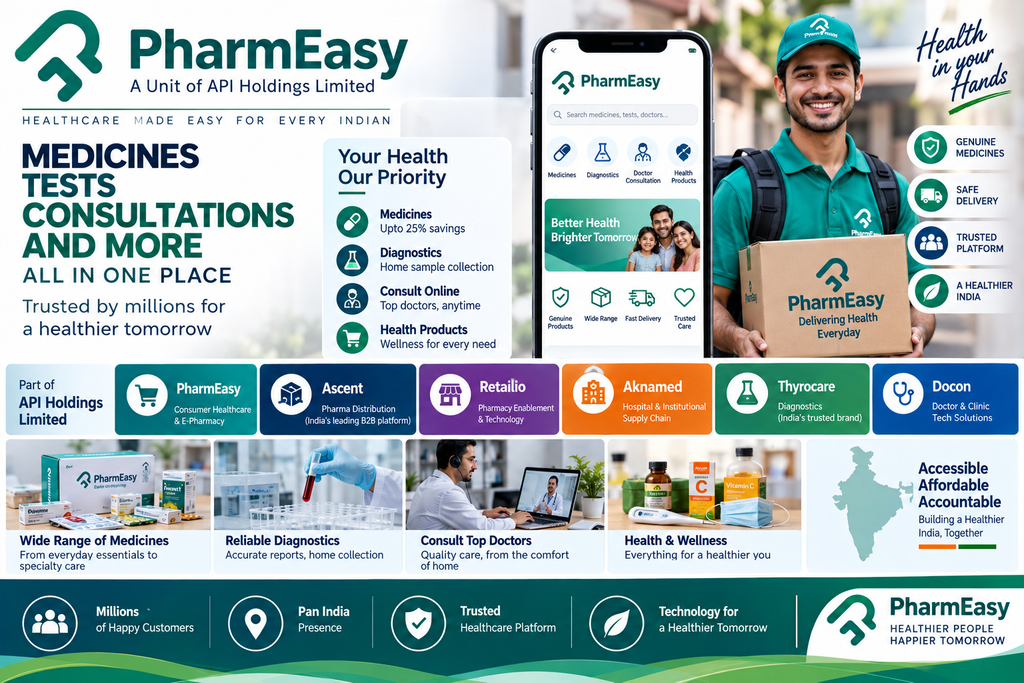
API Holdings Limited is the parent company behind PharmEasy and operates an integrated healthcare ecosystem covering consumers, pharmacies, doctors, hospitals, pharmaceutical distributors and diagnostic laboratories.
The group combines:
- PharmEasy — consumer healthcare/e-pharmacy
- Ascent — pharmaceutical distribution
- Retailio — B2B pharma technology platform
- Aknamed — hospital supply-chain business
- Thyrocare — diagnostics
- Docon — doctor/clinic technology and healthcare services
API Holdings’ strategy is to connect multiple participants across the healthcare value chain rather than operate only as an online pharmacy.
API Holdings – Official Website
API Holdings – Investor Relations
2. What Does PharmEasy Actually Own?
The investment story is much broader than the PharmEasy app.
| Business | Role |
|---|---|
| PharmEasy | Online pharmacy & consumer healthcare |
| Ascent | Pharma distribution |
| Retailio | B2B pharma marketplace/technology |
| Aknamed | Hospital & institutional healthcare supply |
| Thyrocare | Diagnostic testing |
| Docon | Doctor/clinic technology & healthcare services |
API Holdings describes itself as an integrated, end-to-end digital healthcare platform.
3. PharmEasy
PharmEasy is the consumer-facing part of the group.
Its platform provides access to:
- Prescription medicines
- OTC products
- Healthcare products
- Diagnostics
- Healthcare services
The company has increasingly focused on chronic therapies and repeat customers, which can generate higher customer lifetime value than one-time acute-care purchases.
According to the FY26 annual report, PharmEasy’s average active user base increased 14.5% in Q4 FY26 vs Q4 FY25, while loyalty users increased from 32% to 43% of active users.
4. Pharma Distribution – Ascent & Retailio
This is actually one of the largest parts of the API Holdings business.
The company sells pharmaceutical, OTC, surgical and consumable products to:
- Chemists
- Pharmacies
- Hospitals
- Doctors
- Healthcare institutions
The Retailio 1P business generated ₹3,857.9 Cr of FY26 revenue, representing approximately 68% of consolidated product revenue.
Revenue per retailer increased from approximately:
₹54,000 → ₹63,000
between March 2025 and March 2026.
This demonstrates the group’s attempt to increase wallet share from existing pharmacy customers rather than relying purely on customer acquisition.
5. Aknamed – Hospital Supply Chain
Aknamed operates on the institutional side of healthcare.
The business supplies pharmaceutical products, medical devices and other healthcare products to hospitals.
FY26 revenue from the hospital business was approximately:
₹847 Cr
The company has been deliberately reducing low-margin/high-working-capital customers and focusing on more profitable accounts.
6. Thyrocare – The Diagnostics Engine
One of the most valuable assets inside API Holdings is Thyrocare Technologies Limited, which is separately listed on Indian stock exchanges.
Following the September 2026 merger of Docon Technologies into API Holdings, Thyrocare became a direct subsidiary of API Holdings, with API holding approximately 51.02% of Thyrocare.
FY26 Thyrocare highlights:
- 1,275 diagnostic tests
- 41 laboratories
- Around 210 million tests
- 10,800+ active franchisees
- Diagnostic revenue on PharmEasy of approximately ₹158.8 Cr
The group increased NABL-accredited labs from 29 in FY25 to 35 in FY26, excluding specified hybrid/Tanzania labs.
7. Business Model
API Holdings essentially operates a multi-layer healthcare ecosystem.
Consumer
PharmEasy
↓
Distribution
Ascent + Retailio
↓
Hospitals
Aknamed
↓
Diagnostics
Thyrocare
↓
Technology
Docon / Retailio technology
This integrated structure gives API Holdings multiple opportunities to cross-sell services to the same healthcare customer.
For example:
Customer buys medicine → diagnostic test → doctor consultation → recurring chronic medicines
This is an important part of the long-term platform strategy.
8. FY26 Financial Performance
Consolidated – ₹ Crore
| Particular | FY25 | FY26 |
|---|---|---|
| Revenue from Operations | ₹5,872.2 Cr | ₹6,618.5 Cr |
| Other Income | ₹107.9 Cr | ₹70.8 Cr |
| Total Revenue | ₹5,980.0 Cr | ₹6,689.3 Cr |
| Operational Profitability | -₹71.2 Cr | ₹170.7 Cr |
| EBITDA before ESOP & exceptional items | -₹179.1 Cr | ₹99.9 Cr |
| Loss before exceptional items & tax | -₹1,220.4 Cr | -₹456.1 Cr |
| PAT / Loss from continuing operations | -₹1,572.4 Cr | -₹520.3 Cr |
| Operating Cash Flow | -₹210.9 Cr | ₹77.2 Cr |
The FY26 annual report shows revenue growth of approximately 12.7%, while EBITDA before ESOP and exceptional items turned positive at 1.5% of revenue, compared with -3.0% in FY25.
API Holdings – FY26 Annual Report
9. Profitability Turnaround
The most important change in FY26 was not simply revenue growth.
It was the move toward positive operating economics.
Management achieved this through:
- Reducing low-margin business
- Increasing higher-margin products
- Private-label products
- Better procurement
- Workforce rationalisation
- Warehouse optimisation
- Lower credit-loss provisions
- Better working-capital management
- Greater focus on chronic healthcare
- Cross-selling diagnostics
Core working-capital days improved from:
50 days → 42 days
between March 2025 and March 2026.
10. FY26 Revenue Mix
Product Revenue
FY26 product revenue was approximately:
₹5,670 Cr
Break-up:
| Business | FY26 Revenue |
|---|---|
| Retailer Distribution | ₹955 Cr |
| Chemist / Institutional Distribution | ₹3,858 Cr |
| Hospital Distribution | ₹847 Cr |
| Other Products | ₹10 Cr |
Services
Service revenue was approximately:
₹941 Cr
primarily from:
- Diagnostics
- Technology services
- Fulfilment
- Other healthcare services
Thyrocare is the major contributor to the service segment.
11. Q1 FY27 – Latest Performance
The early FY27 numbers indicate that the turnaround continued.
For Q1 FY27:
Revenue
₹1,754 Cr
EBITDA
₹39.3 Cr
Loss
₹29.6 Cr
compared with a loss of ₹145.4 Cr in Q1 FY26.
The company also completed repayment of approximately ₹1,050 Cr of outstanding debt, making API Holdings debt-free at the group level according to the Q1 update.
PharmEasy specifically
Q1 FY27 PharmEasy revenue:
₹348 Cr
up approximately 10% YoY.
Its EBITDA loss narrowed to approximately:
₹17 Cr
from ₹21 Cr a year earlier.
12. Debt Reduction – Major Development
Debt was one of the biggest problems for API Holdings after the acquisition of Thyrocare.
The company had previously accumulated significant debt at relatively high interest costs.
During FY26, the company refinanced debt and replaced earlier lenders with NCDs.
At March 31, 2026, NCDs outstanding were approximately:
₹1,080 Cr
The company subsequently repaid approximately ₹1,050 Cr, becoming debt-free by Q1 FY27.
This is an important change in the financial profile.
13. How Was Debt Repaid?
API Holdings sold a portion of its stake in Thyrocare and used internal accruals to repay the debt.
Following the transaction, API Holdings continued to hold approximately 51.02% of Thyrocare.
This means the company has effectively exchanged part of its ownership in a listed subsidiary for a cleaner balance sheet.
14. Shareholding & Investors
API Holdings has gone through a major capital restructuring since its peak valuation.
The current shareholder base includes several major institutional investors and strategic investors.
As of March 2026, reported major shareholders included:
- MEMG Family Office
- Naspers / Prosus
- Temasek / MacRitchie Investments
- 360 ONE
- CDPQ
- Goldman Sachs
- Other institutional investors
MEMG was reported as the largest shareholder at approximately 10.1% as of March 2026, while founders collectively held approximately 0.8%.
15. Major Funding Round & Valuation Reset
PharmEasy’s valuation story has changed dramatically.
At its peak in 2021, API Holdings was valued at approximately:
US$5.6 billion
A subsequent funding round led by MEMG in 2024 valued the company at approximately:
US$710 million
The round raised approximately:
₹1,804 Cr / US$216 million
with participation from MEMG, Prosus, Temasek, 360 ONE and other investors.
This represents a very substantial reset from the company’s 2021 valuation.
16. Current Unlisted Share Price
API Holdings / PharmEasy remains unlisted.
Recent September 2026 OTC references include:
- Moneycontrol: approximately ₹9.30
- Planify: approximately ₹9.52
- BuyUnlistedShares: approximately ₹9.95
- PreStocks: approximately ₹10.30
These are indicative private-market prices, not NSE/BSE prices.
Current indicative range
₹9–₹10.30/share
The exact executable price can differ significantly between buyers and sellers.
17. Indicative Market Capitalisation
Moneycontrol reports approximately:
₹6,503 Cr
market capitalisation at a share price around ₹9.30 and approximately 7.03 billion outstanding equity shares.
At ₹9.95, another unlisted-market source indicates approximately:
₹9,538 Cr
but the difference demonstrates an important issue with private-market data: different databases can use different capitalisation/share-count assumptions, especially after multiple funding rounds and convertible securities.
Therefore, investors should focus on fully diluted valuation and the latest capitalisation table, rather than comparing only the per-share price.
18. IPO Status
PharmEasy previously had an IPO plan.
API Holdings filed a DRHP with SEBI in 2021 for a proposed IPO.
However, the DRHP was subsequently withdrawn in August 2023 following changes in market conditions and the company’s capital structure.
Current position
As of September 2026:
No active confirmed IPO timetable
The company’s management has instead been focused on:
- Profitability
- Debt elimination
- Operational efficiency
- Balance-sheet restructuring
CEO Rahul Guha stated in 2026 that the company wanted to become profitable and debt-free before seriously considering an IPO, with approximately a year of work remaining at the time of the statement.
19. Possible Future Listing Structure
There has also been market discussion around a possible reverse-merger/listing route involving Thyrocare, rather than simply repeating the old standalone PharmEasy IPO structure.
However, this remains a reported possibility rather than a confirmed transaction.
Investors should therefore not buy API Holdings shares assuming a particular IPO structure or date.
20. Competitive Landscape
PharmEasy operates in a highly competitive digital-healthcare market.
Key competitors and adjacent platforms include:
- Tata 1mg
- Apollo 24|7
- Reliance-owned Netmeds
- Other online pharmacies
- Traditional pharmacy chains
- Offline chemists
- Hospital pharmacies
However, API Holdings differs from a pure e-pharmacy because it also owns substantial B2B distribution and diagnostics businesses.
21. Key Growth Drivers
1. Chronic healthcare
Chronic medicines create recurring demand.
Increasing wallet share from existing users can improve unit economics.
2. Diagnostics cross-selling
PharmEasy customers can also use diagnostic services, creating cross-selling opportunities.
3. B2B distribution
Retailio and Ascent provide a large B2B distribution network beyond the consumer app.
4. Thyrocare
The group’s controlling stake in Thyrocare provides an established diagnostics business and recurring healthcare demand.
5. Private labels
Higher-margin private-label products can improve gross margins.
6. Supply-chain efficiency
Better warehouse utilisation and inventory management can improve operating leverage.
7. Debt-free balance sheet
The repayment of approximately ₹1,050 Cr debt materially reduces finance-cost pressure.
8. Digital healthcare adoption
Online ordering, digital prescriptions, teleconsultation and home diagnostics continue to expand the addressable market.
22. Key Risks
1. Profitability is still developing
Although operating EBITDA turned positive, consolidated FY26 still recorded a ₹520 Cr loss from continuing operations.
2. Low operating margins
FY26 EBITDA before ESOP and exceptional items was only around 1.5% of revenue.
A small deterioration in gross margin or operating expenses can therefore materially affect profitability.
3. Intense competition
E-pharmacy and healthcare delivery remain highly competitive.
4. Previous valuation destruction
The fall from a reported $5.6 billion peak valuation to roughly $710 million in the 2024 funding round demonstrates the volatility associated with private-company valuations.
5. B2B working capital
Pharma distribution can require significant working capital and credit management.
6. Thyrocare concentration
Thyrocare is an important contributor to the group’s profitability, meaning changes in its performance can influence consolidated results.
7. Regulatory risk
Healthcare, pharmacy, diagnostics, data privacy and telemedicine are regulated sectors.
8. Unlisted liquidity
API Holdings shares are not exchange traded. Exit opportunities depend on private-market demand.
23. Investment Snapshot
| Parameter | PharmEasy / API Holdings |
|---|---|
| Company | API Holdings Limited |
| Brand | PharmEasy |
| Sector | Digital Healthcare |
| Status | Unlisted |
| FY26 Revenue | ₹6,618.5 Cr |
| FY26 Total Revenue | ₹6,689.3 Cr |
| FY26 EBITDA before ESOP | ₹99.9 Cr |
| FY26 EBITDA Margin | 1.5% |
| FY26 PAT | -₹520.3 Cr |
| FY26 Operating Cash Flow | ₹77.2 Cr |
| Q1 FY27 Revenue | ₹1,754 Cr |
| Q1 FY27 EBITDA | ₹39.3 Cr |
| Q1 FY27 Loss | ₹29.6 Cr |
| Debt | Repaid / debt-free after Q1 FY27 |
| Thyrocare Holding | ~51.02% |
| Current OTC Reference | ~₹9–₹10.30 |
| Indicative Market Cap | ~₹6,500 Cr+ depending on share-price/share-count basis |
| Old IPO | DRHP withdrawn in 2023 |
| Current IPO | No confirmed timetable |
24. UnlistedCart Takeaway
PharmEasy is no longer just an “online pharmacy story.”
The investment case is now increasingly about an integrated healthcare platform:
PharmEasy
Ascent / Retailio
Aknamed
Thyrocare
Healthcare Technology
The major transformation in FY26–FY27 has been the shift from growth-at-any-cost toward profitability and balance-sheet repair.
FY26 revenue grew to approximately ₹6,619 Cr, operating EBITDA before ESOP and exceptional items turned positive, and operating cash flow became positive. The company then repaid approximately ₹1,050 Cr of debt, becoming debt-free according to its Q1 FY27 update.
The key question for the next phase is whether API Holdings can convert this operational improvement into sustainable consolidated profitability.
What to track
1. PharmEasy EBITDA
2. Consolidated EBITDA margin
3. Thyrocare profitability
4. B2B distribution growth
5. Chronic-care customer growth
6. Private-label contribution
7. Free cash flow
8. Future IPO / listing structure
9. Fully diluted share count
10. Private-market valuation
At the current unlisted valuation, the story is best understood as a turnaround and healthcare-platform restructuring opportunity, rather than simply an e-commerce growth story.
Official & Research Sources
API Holdings – Official Website
API Holdings – Investor Relations
API Holdings – FY26 Annual Report & Financial Reports
API Holdings – Board & Management
Moneycontrol – PharmEasy / API Holdings Unlisted Shares
Planify – PharmEasy Unlisted Share Research
Neoma Capital – PharmEasy Pre-IPO Research
Disclaimer: This report is for informational and educational purposes only and is not investment advice. API Holdings is an unlisted company and its private-market share price is indicative, with potentially limited liquidity and price discovery. Historical private valuations, funding-round valuations and OTC prices should not be treated as guaranteed future valuations or listing prices. Investors should independently verify the latest annual report, capitalisation table, shareholder agreements and regulatory filings before making any investment decision.
For more such unlisted stocks visit UnlistedCart – Unlisted Shares