Unlisted Company | Passenger Vehicles | EV & New Energy Mobility
CIN: U34100HR2017FTC072429
Incorporated: 7 February 2017
Registered Office: Gurugram, Haryana
Status: Active, Private & Unlisted
Industry: Automobile / Passenger Vehicles / Electric Vehicles
Brand: MG Motor India
Promoters / Strategic Partners: JSW Group & SAIC Motor
Executive Summary
JSW MG Motor India Private Limited is the Indian automotive joint venture between JSW Group and SAIC Motor, created to transform MG’s India operations with a stronger focus on localisation, electric vehicles, hybrids and new-energy mobility.
The company has moved beyond being primarily an ICE passenger-vehicle manufacturer and is increasingly positioning itself as a New Energy Vehicle (NEV) company.
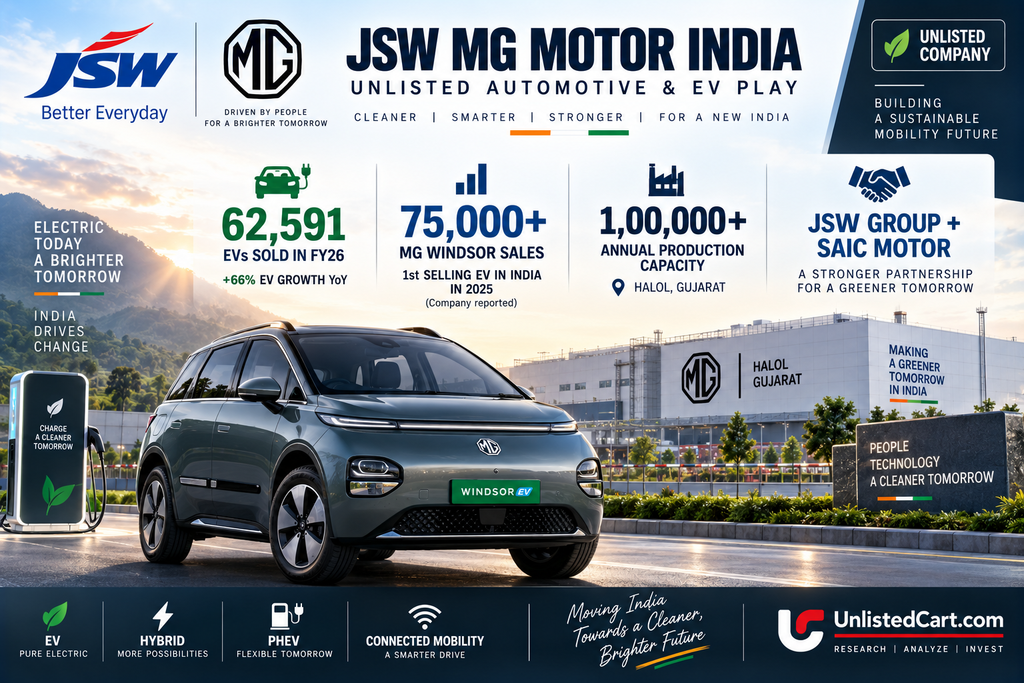
The business has shown particularly strong momentum in EVs. JSW MG Motor India sold 62,591 EVs in FY26, compared with 37,730 EVs in FY25 — a 66% increase. The MG Windsor has been the key growth driver and crossed 75,000 cumulative sales in July 2026.
However, investors should also note that the company remains loss-making. FY25 revenue was approximately ₹8,790.6 crore, while the company reported a net loss of approximately ₹1,096.8 crore.
The investment story therefore revolves around future scale, EV growth, localisation and eventual operating leverage, rather than current earnings.
Company Overview
JSW MG Motor India was formed following the strategic partnership between JSW Group and SAIC Motor.
Official JSW MG Motor India Website
MG has a long automotive heritage and operates in India through its Halol manufacturing facility in Gujarat. Following the JSW-SAIC transaction, the Indian business was restructured under the JSW MG Motor India name.
The company manufactures, markets and distributes passenger vehicles under the MG brand across India.
Its portfolio spans:
- Electric vehicles
- Petrol vehicles
- Diesel SUVs
- Plug-in hybrid vehicles
- Premium vehicles
- Connected vehicles
- New-energy mobility platforms
Ownership & Strategic Partnership
The JSW-SAIC transaction fundamentally changed MG’s India ownership structure.
JSW Group acquired a significant stake in the Indian business, while SAIC retained a controlling strategic interest and continues to provide automotive technology, products and global engineering expertise. CCI approved the acquisition of up to approximately 38% of MG Motor India by JSW Ventures Singapore in January 2024.
The transaction also involved employee benefit trusts and other investors, resulting in a more diversified ownership structure.
Strategic role of each partner
JSW Group
- Indian market knowledge
- Capital allocation
- Manufacturing expertise
- Localisation
- Supply-chain development
- Indian business ecosystem
SAIC Motor
- Global automotive technology
- Vehicle platforms
- Product development
- EV and hybrid technology
- Global engineering capabilities
This combination is intended to give MG access to both Indian manufacturing scale and global automotive technology.
Business Model
JSW MG Motor India’s business model is primarily based on:
- Passenger vehicle sales
- EV sales
- Premium vehicle sales
- After-sales service
- Spare parts
- Accessories
- Connected-car ecosystem
- Future hybrid and PHEV products
The company is simultaneously trying to increase volumes and improve localisation.
Higher localisation is particularly important because locally sourced components can reduce foreign-exchange exposure, logistics costs and imported component dependence.
Management has identified localisation as one of the major levers for improving profitability.
Product Portfolio
MG’s Indian portfolio includes models such as:
- MG Windsor EV
- MG Comet EV
- MG ZS EV
- MG Hector
- MG Astor
- MG Gloster
- MG Majestor
- MG Cyberster
- MG M9
The company has also introduced the MG Select premium channel for higher-end vehicles.
The latest product expansion includes the MG Majestor, which entered production at the Halol facility in May 2026.
MG Windsor – Major EV Growth Driver
The MG Windsor has become one of the company’s most important products.
During CY2025, the Windsor sold more than 46,735 units, making it the highest-selling EV model in India for that year according to the company’s announcement.
By July 2026, cumulative Windsor sales had crossed 75,000 units in less than two years.
The company also reported that more than 19,000 Windsor units were sold during H1 CY2026.
An interesting aspect is its penetration beyond India’s major metros. The company stated that around 70% of Windsor sales came from non-metro cities, indicating that EV demand is expanding beyond the largest urban markets.
EV Growth
The EV business is currently the most important growth component of the JSW MG story.
| Metric | FY25 | FY26 | Change |
|---|---|---|---|
| MG EV sales | 37,730 | 62,591 | +66% |
| March EV sales | — | Strong YoY growth | — |
| Windsor cumulative sales | — | 75,000+ by July 2026 | — |
The company has stated that its EV portfolio grew 66% in FY26 over FY25.
JSW Group also stated in September 2026 that JSW MG Motor India’s EV market share had increased to 35% from 26% in CY2024, although this is a company/group-reported market-share figure and should be interpreted accordingly.
MG ADAPT Platform
One of the most significant technology developments is MG ADAPT.
MG ADAPT – Official Announcement
The platform is designed to support multiple powertrains from a common architecture:
- Pure EV
- Hybrid
- Plug-in Hybrid
- Range-Extended EV
The company announced that an EV and a PHEV based on ADAPT would debut during FY2026–27.
This strategy is important because India’s future electrification pathway may not be limited to pure battery EVs. A multi-powertrain architecture allows the company to address different customer segments and charging-infrastructure conditions.
Manufacturing Capacity
The company’s principal manufacturing facility is located at Halol, Gujarat.
The JSW-SAIC roadmap originally targeted increasing production capacity from more than 1 lakh vehicles annually to up to 3 lakh vehicles annually.
The company subsequently announced a large expansion programme.
Planned investment
JSW MG Motor India has outlined approximately:
₹3,000–₹4,000 crore
of investment over the next phase for:
- New product launches
- Plant expansion
- Localisation
- EV/hybrid development
- Supply-chain development
For FY27 specifically, management indicated an investment of around ₹1,400 crore, with localisation, new products and manufacturing expansion being the three primary priorities.
A first expansion phase is expected to increase Halol capacity from approximately 1.2 lakh units to 1.6 lakh units annually, with further expansion planned toward the longer-term 3-lakh-unit target.
Financial Performance
FY24 vs FY25
| Particulars | FY24 | FY25 |
|---|---|---|
| Revenue from Operations | ₹7,852 Cr | ₹8,648 Cr |
| Total Revenue / Income | ₹7,991 Cr | ₹8,791 Cr |
| EBITDA | ~₹28 Cr | ~₹-431 Cr |
| PAT | -₹586 Cr | -₹1,097 Cr |
| Revenue Growth | — | ~10% |
| Net Margin | ~-7.3% | ~-12.5% |
FY25 revenue increased approximately 10%, but profitability deteriorated sharply. The company moved from a small operating profit in FY24 to an operating loss in FY25, while the net loss expanded to around ₹1,096.8 crore.
This is the most important financial consideration for investors.
Why are losses important?
The company is currently spending heavily on:
- New product development
- EV platforms
- Localisation
- Manufacturing expansion
- Brand development
- Capacity utilisation
- Technology
Therefore, the thesis depends on whether increasing volumes can eventually create sufficient operating leverage to move the company toward profitability.
Balance Sheet
Public financial databases report FY25:
- Paid-up capital: ~₹3,903 Cr
- Total assets: ~₹7,274 Cr
- Borrowings: ~₹3,120 Cr
- Net worth: ~₹6 Cr according to database-derived FY25 figures
The extremely low reported net worth relative to paid-up capital and the large historical accumulated losses make balance-sheet interpretation particularly important.
Investors should therefore examine the latest audited financial statements, subsequent capital infusions and shareholder funding arrangements before relying on book-value-based valuation.
Sales Momentum
The company sold 70,554 vehicles during CY2025, according to industry reporting, representing approximately 19% growth over 2024.
More recently, JSW MG Motor India reported 7,508 wholesale units in August 2026, representing 14% YoY growth.
This suggests that the business is currently in an expansion phase, with volume growth being supported by both ICE and NEV products.
Product Pipeline
The company has been accelerating product launches.
The 2026 roadmap included:
- MG Majestor
- New EV
- Plug-in Hybrid
- Additional new model
- Premium MG Select products
Management has also stated that NEVs are expected to remain a major part of the company’s portfolio.
This could allow the company to participate in multiple parts of India’s evolving electrification market rather than relying solely on battery-electric vehicles.
Competitive Advantages
1. Strong global technology partner
SAIC provides access to global automotive platforms, technology and product development capabilities.
2. JSW Group backing
JSW brings significant experience in Indian manufacturing, infrastructure, industrial operations and capital deployment.
3. Established MG brand
MG entered the Indian market before the current JV and has already developed a national dealer and service ecosystem.
4. EV traction
The company has demonstrated significant growth in EV volumes, led by Windsor.
5. Localisation opportunity
Higher local sourcing could potentially improve margins and reduce dependence on imported components.
6. Multi-powertrain strategy
MG ADAPT allows the company to develop EV, hybrid, PHEV and range-extender products using a common architecture.
Growth Drivers
EV adoption
India’s passenger EV market continues to expand, providing a long-term opportunity for manufacturers with established EV products.
Product expansion
More models allow MG to address a wider range of price points and customer segments.
Premiumisation
The MG Select strategy gives the company exposure to premium vehicles and higher-value customers.
Capacity expansion
Increasing Halol capacity can enable greater volumes if demand continues to grow.
Localisation
Greater localisation could improve gross margins and reduce import dependence.
Hybrid opportunity
The company’s PHEV and hybrid strategy provides an additional route to electrification.
Key Risks
1. Current losses
FY25 net loss was approximately ₹1,097 crore. The company therefore does not currently offer an earnings-based investment story.
2. High capital requirements
The company is planning ₹3,000–₹4,000 crore of investment, with around ₹1,400 crore indicated for FY27.
3. Competitive automobile market
The Indian passenger-vehicle market has intense competition from Tata Motors, Mahindra & Mahindra, Maruti Suzuki, Hyundai, Kia, Toyota and other global manufacturers.
4. EV price competition
EV pricing is becoming increasingly competitive, potentially putting pressure on margins.
5. Technology dependence
SAIC remains an important source of technology and product capability.
6. Execution risk
The company needs to successfully execute:
- New launches
- Capacity expansion
- Localisation
- Supply-chain development
- EV/hybrid technology deployment
7. Unlisted liquidity
There is no regular stock-exchange market for the company’s shares. Any private transaction may involve substantial liquidity constraints and transfer restrictions.
8. Valuation uncertainty
Because the company is loss-making and unlisted, conventional P/E valuation is currently not meaningful.
Valuation
There is no reliable publicly quoted exchange price for JSW MG Motor India shares because the company is privately held and unlisted.
In July 2026, media reports indicated discussions involving KKR for an investment of up to US$400 million, with the transaction reportedly contemplating both primary capital and secondary share sales. The report also stated that the venture’s valuation could reach approximately US$3 billion. This was reported as an ongoing discussion and should not be treated as a completed transaction or confirmed fair value.
Therefore:
Current executable unlisted share price: Not reliably established
P/E: Not meaningful due to losses
Price/Book: Not appropriate without confirming the latest audited net worth and exact share capital structure
Reported potential valuation: ~US$3 billion — subject to transaction confirmation
IPO / Listing Status
JSW MG Motor India is currently an unlisted private company.
No confirmed IPO/DRHP should be assumed merely because the company is expanding or attracting institutional investment.
Any future IPO would depend on shareholder decisions, corporate restructuring, regulatory approvals and market conditions.
Investment Framework
JSW MG Motor India should be viewed primarily as a growth-stage automotive and EV platform, rather than a conventional profitable automobile company.
The key variables to monitor are:
- EV volume growth
- Total vehicle volumes
- Revenue growth
- EBITDA margin
- Reduction in annual losses
- Capacity utilisation at Halol
- Localisation percentage
- New-model acceptance
- Cash burn
- Additional capital requirements
- SAIC-JSW ownership changes
- Potential institutional investment
- Future IPO/listing developments
The central question for valuation is:
Can increasing scale + localisation + product breadth convert the current high-growth but loss-making business into a sustainably profitable automotive franchise?
That is more important than simply looking at current EV sales growth.
Overall Assessment
JSW MG Motor India represents a relatively differentiated unlisted automotive opportunity because it combines:
JSW Group + SAIC technology + established MG brand + EV traction + expanding product portfolio + manufacturing capacity expansion.
The strongest part of the story is the rapid growth in EV volumes and the success of the MG Windsor. FY26 EV sales increased 66% over FY25, while the company is simultaneously expanding into hybrids, PHEVs and premium vehicles.
At the same time, the company remains loss-making, requires significant additional capital and is entering an intensely competitive automotive market.
For an unlisted investor, the most important due-diligence exercise would therefore be to compare the actual private-market acquisition price with a scenario-based valuation based on future revenue, EBITDA margins, production volumes and eventual profitability, rather than valuing the company solely on its brand or EV market position.
Important Disclaimer
This report is prepared for research and educational purposes only and is not investment advice or a recommendation to buy or sell securities.
JSW MG Motor India is an unlisted private company, and private-market transactions can involve limited liquidity, transfer restrictions, incomplete price discovery and significant differences between quoted indicative prices and actual executable transaction prices.
Financial figures sourced from company filings and third-party databases should be independently verified against the latest audited financial statements before making an investment decision. Future investment plans, valuations, IPO possibilities and business projections are subject to execution, regulatory, market and financing risks.
For more such unlisted stocks visit https://unlistedcart.com/unlisted-shares/