Calcined Petroleum Coke (CPC) | Carbon Products | Aluminium & Steel Industry
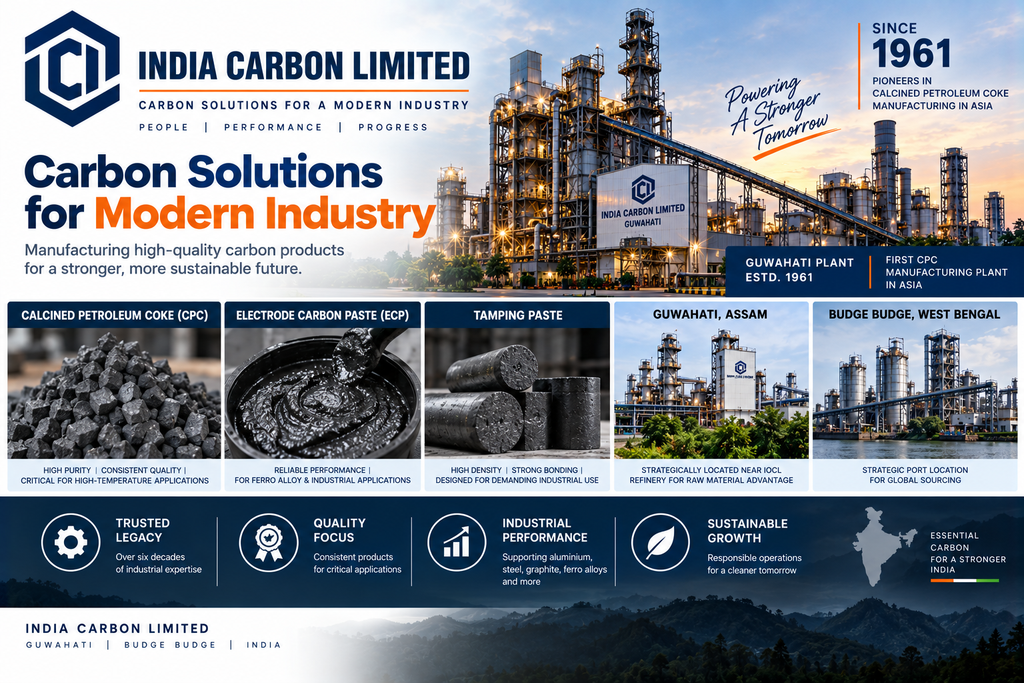
India Carbon Limited (ICL) is a Guwahati-based Indian manufacturer of Calcined Petroleum Coke (CPC), Electrode Carbon Paste (ECP) and Tamping Paste. The company was incorporated on 12 June 1961 and has more than six decades of operating history.
ICL is particularly interesting because it operates in a critical but relatively specialised part of the industrial-materials value chain, supplying carbon products used by aluminium, steel, graphite, ferro-alloy and other industries.
Company Snapshot
| Particular | Details |
|---|---|
| Company | India Carbon Limited |
| CIN | L23101AS1961PLC001173 |
| Incorporated | 12 June 1961 |
| Registered Office | Noonmati, Guwahati, Assam |
| Status | Unlisted Public Company |
| Face Value | ₹10 |
| Paid-up Capital | ~₹2.65 Cr |
| Equity Shares | 26.50 lakh |
| ISIN | INE743B01015 |
| Industry | Industrial Materials / Carbon Products |
| Main Products | CPC, ECP, Tamping Paste |
| Website | India Carbon Limited – Official Website |
The company’s CIN, registered office and paid-up capital are consistent across company records and its own corporate documents.
What Does India Carbon Do?
1. Calcined Petroleum Coke – CPC
Calcined Petroleum Coke is the company’s primary product.
CPC is produced by heating Raw Petroleum Coke (RPC) at high temperatures to remove volatile matter and improve its carbon properties.
It is an important raw material for industries such as:
- Aluminium
- Steel
- Graphite
- Ferro alloys
- Titanium dioxide
- Other carbon-consuming industries
ICL describes itself as a pioneer in India’s CPC industry and states that its Guwahati facility was established in 1961 as the first CPC manufacturing plant in Asia.
2. Electrode Carbon Paste
ICL manufactures Electrode Carbon Paste (ECP) using carbonaceous materials such as CPC and calcined anthracite coal together with soft pitch as a binder.
ECP is primarily used in the ferro-alloy and allied industries.
3. Tamping Paste
The company also manufactures Tamping Paste, another carbon-based product used in industrial furnaces and carbide/ferro-alloy applications.
Together, these products give ICL exposure to several heavy-industry segments rather than a single end market.
Manufacturing Footprint
India Carbon operates manufacturing facilities in:
Guwahati, Assam
and
Budge Budge, West Bengal
The Guwahati plant has a strategic location close to Indian Oil Corporation’s Guwahati refinery, which is an important source of raw petroleum coke. The company has highlighted the resulting freight and lead-time advantage.
The Budge Budge facility is strategically located near the port, which is useful because a portion of its RPC requirement is sourced internationally.
Promoter & Strategic Investor
One of the most interesting aspects of India Carbon is the presence of Oxbow Calcining LLC, a U.S.-based CPC producer.
Oxbow owns approximately:
30.66% of India Carbon
and has board representation.
This provides ICL with exposure to an international player in the CPC industry and is one of the factors highlighted by CARE Ratings in its assessment of the company.
Current unlisted-market shareholding data shows promoters around 49.91%, with the remaining shares distributed among other shareholders.
Customer Base
India Carbon’s products are supplied primarily to large industrial customers.
The company’s disclosed customer ecosystem includes aluminium producers such as:
- NALCO
- Hindalco
- BALCO
- MALCO
and steel/graphite customers including:
- SAIL
- Tata Steel
- Graphite India
- Hindustan Electro Graphite
The company has historically maintained long-standing relationships with major industrial customers.
However, customer concentration remains something investors should monitor: CARE noted that the top five customers represented around 90% of sales in FY23.
Historical Financial Performance
India Carbon’s financial performance is highly sensitive to CPC/RPC pricing and the demand cycle in its end-user industries.
| ₹ Cr | FY23 | FY24 | FY25 | FY26 |
|---|---|---|---|---|
| Revenue from Operations | 565.7 | 420.4 | 174.5 | 168.3 |
| Total Income | 576.3 | 457.8 | 190.9 | 173.4 |
| EBITDA / Operating Profit | 33.0 | ~-4.0 | -6.9 | -18.7 |
| PBT | 34.0 | 27.0 | -11.1 | -20.8 |
| PAT | 24.0 | 30.3 | -12.7 | -20.3 |
| EPS | ₹90.57 | ₹113.21 | -₹48.08 | -₹76.52 |
FY26 revenue from operations was approximately ₹168.30 Cr, while PAT was a loss of approximately ₹20.28 Cr.
The deterioration is significant compared with FY23–FY24.
FY26 Financial Analysis
Revenue
FY26 revenue:
₹168.30 Cr
versus:
₹174.53 Cr in FY25
Revenue therefore declined only around 3.6% YoY, but the much bigger issue was margin compression.
Operating Profit
The company moved from an operating loss of roughly:
₹6.85 Cr in FY25
to:
₹18.7 Cr in FY26
according to third-party compilations of the FY26 financial statements.
This means the company’s current challenge is not simply lack of revenue; it is profitability and cost structure.
PAT
FY26 PAT:
-₹20.28 Cr
FY25 PAT:
-₹12.74 Cr
Thus, the net loss widened despite relatively stable revenue.
Why Did Profitability Fall?
The biggest structural issue for ICL is the relationship between:
Raw Petroleum Coke price
↓
Processing / calcination
↓
CPC selling price
↓
Industrial demand
Margins can get squeezed when raw-material prices move sharply or selling prices do not adjust sufficiently.
CARE Ratings specifically highlighted the company’s vulnerability to volatility in RPC and CPC prices and the relatively weak bargaining power against large raw-material suppliers.
The company also operates in industries such as aluminium, graphite and ferro alloys, which themselves are cyclical.
Balance Sheet – FY26
| Particular | FY26 |
|---|---|
| Total Assets | ₹548.38 Cr |
| Equity | ₹463.34 Cr |
| Investments – Non-current | ₹381.02 Cr |
| Investments – Current | ₹37.98 Cr |
| Inventory | ₹71.69 Cr |
| Trade Receivables | ₹18.96 Cr |
| Cash & Cash Equivalents | ₹3.89 Cr |
| Borrowings | ₹74.00 Cr |
| Net Worth | ₹463.34 Cr |
The balance sheet is particularly interesting because the company has a large investment portfolio relative to its operating revenue.
Non-current investments were approximately ₹381 Cr at March 2026.
That is more than 2.2× FY26 revenue from operations.
This makes India Carbon partly an asset-value story, not purely an operating-company story.
Book Value
FY26 net worth was approximately:
₹463.34 Cr
with approximately:
26.50 lakh shares
outstanding.
This translates into a reported book value of approximately:
₹1,748/share
based on the FY26 financial statements.
Some unlisted-market data providers report a book value in the ₹1,786–₹2,069 range depending on their calculation methodology and reporting period.
For valuation purposes, the audited balance sheet should be treated as the primary reference.
Current Indicative Unlisted Price
As of September 2026, different unlisted-market platforms were quoting India Carbon around:
₹870–₹895 per share
Examples:
- Moneycontrol: approximately ₹870.37
- Planify: ₹869.30 as of 13 September 2026
- UnlistedZone: ₹895
- BuyUnlistedShares: ₹895 as of 15 September 2026
- Neoma Capital: ₹886.05 as of 10 September 2026
These are indicative OTC/reference prices and not NSE/BSE quotes.
Indicative Valuation
At approximately ₹895/share:
26.50 lakh shares × ₹895
≈
₹237 Cr implied equity value
This is consistent with the market-cap figures displayed by several unlisted-share platforms.
Price-to-Book
Using FY26 book value of approximately ₹1,748/share:
₹895 ÷ ₹1,748 ≈ 0.51× P/B
Therefore, the market is valuing India Carbon at roughly half of its reported FY26 book value.
Unlisted-market sources similarly show P/B around 0.50×.
However, a discount to book value does not automatically mean the assets are undervalued. Investors need to understand the nature and market value of the company’s large investment portfolio.
Asset-Value Angle
This is arguably the most important part of the India Carbon story.
The company had:
₹381 Cr non-current investments
₹38 Cr current investments
₹18 Cr receivables
₹4 Cr cash
against:
₹74 Cr borrowings
at March 2026.
Therefore, the company has substantial financial assets compared with its implied unlisted market capitalisation of roughly ₹230–237 Cr.
But investors should not simply subtract debt from the investment figure and call the difference “intrinsic value.”
The key questions are:
- What exactly are the underlying investments?
- At what value are they carried?
- What is their current market value?
- How liquid are they?
- What tax would arise if investments were sold?
- Are there any restrictions on monetisation?
These factors can materially change the true asset value.
Cash Flow – A Warning Sign
FY26 operating cash flow was approximately:
-₹13.90 Cr
versus:
+₹8.78 Cr in FY25
This is an important weakness because the company was loss-making and generated negative operating cash flow during FY26.
Cash and cash equivalents also declined from approximately ₹7.92 Cr to ₹3.89 Cr.
Borrowings increased to approximately ₹74 Cr.
Therefore, the balance-sheet investment cushion needs to be viewed alongside the weaker operating cash generation.
Capacity Utilisation
Historically, ICL has demonstrated relatively high utilisation of its CPC capacity.
CARE reported CPC capacity utilisation of approximately 88% in FY23, up from around 79% in FY22.
This indicates that the company’s historical challenge has not necessarily been a lack of manufacturing infrastructure.
The bigger variable is:
realisation + raw-material cost + product mix + end-market demand.
Key Positives
1. Six-decade operating history
ICL has operated since 1961 and was a pioneer in CPC manufacturing in Asia.
2. Strategic industry
CPC is an important input for aluminium and other carbon-intensive industrial processes.
3. Strong customer relationships
The company has long-standing relationships with major aluminium, steel and graphite companies.
4. Strategic Oxbow investment
Oxbow Calcining LLC owns approximately 30.66% and has board representation, bringing an international CPC-industry participant into the shareholder structure.
5. Large investment portfolio
FY26 non-current investments were approximately ₹381 Cr, which is substantial relative to the company’s market capitalisation.
6. Significant discount to book value
At approximately ₹870–₹895 per share, the company trades at roughly half of its reported FY26 book value.
Key Risks
1. Current losses
FY26 PAT was approximately -₹20.28 Cr.
2. Commodity-price sensitivity
RPC and CPC prices can be volatile, directly affecting margins.
3. Cyclical customers
Aluminium, graphite, steel and ferro-alloy industries are cyclical.
4. Customer concentration
Historically, the top five customers represented approximately 90% of sales.
5. Negative operating cash flow
FY26 operating cash flow was negative approximately ₹13.9 Cr.
6. Unlisted-market liquidity
There is no NSE/BSE order book, and secondary-market prices can differ significantly between intermediaries.
7. Investment valuation risk
The company’s large investment portfolio is an important part of its balance sheet, but investors should independently verify the underlying securities and their current market value.
What Could Change the Story?
For India Carbon, investors should monitor five major variables:
1. Recovery in CPC margins
2. Stabilisation of RPC prices
3. Aluminium and graphite industry demand
4. Monetisation/appreciation of investments
5. Return to positive operating cash flow
A recovery in the CPC business could have a meaningful impact because the company has a relatively small equity base.
Investment Framework
A useful way to analyse ICL is:
Operating Business Value
CPC + ECP + Tamping Paste
PLUS
Investment Portfolio
₹381 Cr+ non-current investments
PLUS
Current Investments
~₹38 Cr
LESS
Debt
~₹74 Cr
LESS
Holding / Liquidity / Tax Discounts
This provides a more appropriate framework than simply looking at the P/E ratio because FY26 earnings are negative.
UnlistedCart Takeaway
India Carbon Limited is a niche industrial-materials company with a very different investment profile from a typical small unlisted manufacturing company.
The company has a strong historical franchise in Calcined Petroleum Coke, long-standing industrial customers, strategic manufacturing locations and a significant investment portfolio. Its association with Oxbow Calcining LLC is another notable feature of the shareholder structure.
However, FY25–FY26 marked a substantial deterioration in operating performance. FY26 revenue was approximately ₹168 Cr, EBITDA was negative, PAT was approximately -₹20 Cr, and operating cash flow was negative.
At indicative unlisted prices around ₹870–₹895, the company is valued at approximately ₹230–237 Cr, versus reported FY26 net worth of approximately ₹463 Cr and book value around ₹1,748/share.
The central question for investors is therefore not simply “Is India Carbon cheap?”
It is:
Can the company restore profitability in its CPC business while preserving the value of its substantial investment portfolio?
That makes ICL a combination of industrial-cycle recovery + asset-value + unlisted-liquidity story.
Disclaimer: India Carbon is an unlisted public company and its secondary-market prices are indicative OTC references rather than NSE/BSE quotes. Prices, availability and lot sizes may vary by intermediary. Unlisted securities can have limited liquidity and significant valuation uncertainty. Financial information should be verified against the latest company filings before making any investment decision. This report is for informational purposes and is not investment advice.
For more such unlisted stocks visit UnlistedCart – Unlisted Shares