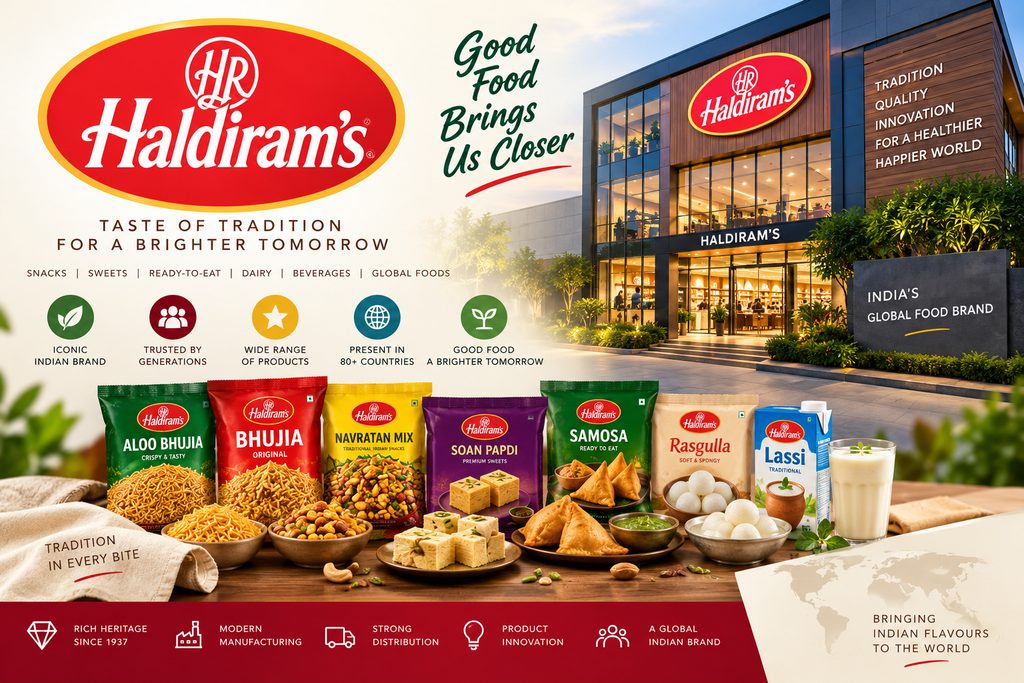
Business: Packaged Foods | Namkeen | Snacks | Sweets | Ready-to-Eat | Dairy | Beverages
Status: Unlisted Private Company
CIN: U15400HR2022PTC108327
Incorporated: 12 December 2022
Registered Office: Haldiram – Village Kherki Daula, Delhi–Jaipur Highway, Gurugram, Haryana – 122001
Paid-up Capital: ~₹1,500 crore
Authorised Capital: ~₹1,500 crore
FY2025 Revenue: ~₹12,977 crore
FY2025 PAT: ~₹1,195 crore
FY2025 PAT Margin: ~9.2%
FY2025 Operating Margin: ~18–19%
Rating: CRISIL AAA / Stable and A1+
Listing Status: Unlisted
Industry: FMCG / Packaged Foods
Executive Summary
Haldiram Snacks Food Private Limited is one of India’s most prominent unlisted consumer businesses and the FMCG entity created by combining the packaged-food operations of the Delhi and Nagpur factions of the Haldiram group.
The company brings together two large businesses that historically operated separately:
- Haldiram Snacks Private Limited — Delhi business
- Haldiram Foods International Private Limited — Nagpur business
The merger became effective from 1 April 2024, with the combined entity beginning operations in FY2025. The Delhi and Nagpur shareholders received approximately 56% and 44%, respectively, in the combined company.
The combination has created a much larger packaged-food platform with approximately ₹12,977 crore of FY2025 revenue and ₹1,195 crore of PAT, according to CRISIL Ratings. The company has also received a CRISIL AAA/Stable/A1+ rating for its bank facilities, reflecting its strong business position, liquidity and financial profile.
The investment story became particularly interesting during 2025 when global investors entered the company.
Temasek acquired a minority stake, followed by Alpha Wave Global and International Holding Company (IHC). Industry estimates valued the business at around $10 billion / ₹85,000–₹90,000+ crore at the time.
In December 2025, L Catterton also announced a strategic investment in Haldiram’s, making it the fourth major external investor to enter the business. The transaction value was not publicly disclosed.
The latest development is important: in February 2026, the Competition Commission of India approved L Catterton’s proposed acquisition of a minority shareholding in Haldiram Snacks Food.
This makes Haldiram Snacks Food one of India’s most closely watched unlisted consumer companies.
Company Overview
Company Name: Haldiram Snacks Food Private Limited
CIN: U15400HR2022PTC108327
Incorporation: 12 December 2022
ROC: Haryana
Company Type: Private Limited Company
Status: Active and Unlisted
Authorised Capital: ~₹1,500 crore
Paid-up Capital: ~₹1,500 crore
The company was incorporated in 2022 specifically to consolidate the FMCG businesses of the Delhi and Nagpur Haldiram groups.
Public corporate records identify Haldiram Snacks Food as an active unlisted private company engaged in food-product manufacturing.
The company’s official website identifies Haldiram Snacks Food Pvt Ltd as its corporate entity and describes the business as a global Indian food brand with products ranging from namkeen and sweets to ready-to-eat meals, frozen foods, bakery and beverages.
Haldiram’s Journey
The Haldiram story dates back to 1937 in Bikaner.
What started as a small namkeen business developed into one of India’s strongest ethnic-food brands.
According to the company’s official history:
1937: Haldiram’s journey begins in Bikaner
1983: Expansion to Delhi and Nagpur with packaged-food manufacturing
1993: Exports begin
2018: First overseas factory in London
2025: International store expansion and global scale-up
Haldiram’s – About Us & Company History
The company’s growth has been built around a combination of:
- Strong Indian taste preferences
- Brand recognition
- Product innovation
- Large distribution network
- Manufacturing scale
- International expansion
- Deep presence in ethnic snacks
The Big Merger
The most important corporate development in Haldiram’s recent history was the merger of the FMCG businesses of the Delhi and Nagpur factions.
Before the transaction, the two businesses operated separately.
Delhi Business
Haldiram Snacks Private Limited was the larger Delhi-based packaged-snacks business.
Its revenue increased from approximately ₹3,100 crore in FY2019 to approximately ₹6,802 crore in FY2024, according to Motilal Oswal’s industry research.
Nagpur Business
Haldiram Foods International represented the Nagpur business.
Its net sales increased from approximately ₹1,419 crore in FY2015 to approximately ₹4,551 crore in FY2024.
Combined Entity
The FMCG operations were brought together into Haldiram Snacks Food.
The merger effectively created a national-scale packaged-food platform rather than two geographically separate Haldiram businesses.
This is strategically important because it allows the combined company to:
- Consolidate manufacturing
- Improve distribution
- Increase purchasing power
- Build a unified national brand
- Expand internationally
- Launch products across a larger distribution network
- Create greater scale in modern trade and general trade
Business Model
Haldiram Snacks Food operates across multiple packaged-food categories.
1. Namkeen
Namkeen remains the company’s core category.
Products include:
- Bhujia
- Sev
- Mixtures
- Aloo Bhujia
- Moong Dal
- Peanuts
- Traditional savoury snacks
Namkeen accounts for more than half of the company’s sales according to CRISIL.
This is one of the company’s strongest competitive positions because Haldiram is deeply associated with the Indian namkeen category.
2. Western Snacks
The company has expanded beyond traditional Indian snacks into:
- Chips
- Extruded snacks
- Western-style packaged snacks
- Other convenience foods
This gives Haldiram exposure to a much larger addressable snack market.
3. Sweets
Haldiram has a strong traditional sweets portfolio.
The category benefits from:
- Festivals
- Weddings
- Gifting
- Religious occasions
- Everyday consumption
4. Ready-to-Eat Foods
The company sells a wide range of ready-to-eat and convenience products.
This category benefits from increasing consumer demand for convenient Indian meals.
5. Frozen Foods
Frozen products provide another growth opportunity and allow the brand to expand into newer consumption occasions.
6. Dairy
Haldiram has expanded into value-added dairy products.
Its subsidiary Vevek Ethnic Foods reported FY2025 revenue of approximately ₹448 crore and PAT of ₹17 crore. It manufactures products including paneer, ghee, milk products, dahi, shrikhand, cheese spreads and beverages.
7. Beverages
The company also operates in non-carbonated ready-to-drink beverages.
8. Bakery and Other Categories
The portfolio is increasingly diversified beyond traditional namkeen and sweets.
Product Portfolio
Motilal Oswal’s industry research estimates Haldiram Snacks Food has more than 410 SKUs.
Approximate category mix:
| Category | Approx. Mix |
|---|---|
| Ethnic Snacks | ~64% |
| Western Snacks | ~14% |
| Sweets | ~8% |
| Ready-to-Eat | ~4% |
| Beverages & Others | ~11% |
The exact mix can change as the company expands newer categories.
The strategic importance of this diversification is that Haldiram is moving from being primarily a namkeen company toward becoming a broader Indian packaged-food company.
Distribution Strength
Distribution is one of Haldiram’s biggest competitive advantages.
The brand has a wide presence across:
- General trade
- Modern trade
- Supermarkets
- Convenience stores
- E-commerce
- Haldiram outlets
- International distributors
- Airport and travel channels
Motilal Oswal estimates Haldiram has approximately 46% retail reach in India.
This distribution footprint creates a significant entry barrier for smaller competitors.
A new snack brand may be able to manufacture a product relatively easily.
The difficult part is getting that product onto millions of shelves and convincing consumers to buy it repeatedly.
International Presence
Haldiram has transformed from an Indian ethnic-snacks brand into a global Indian food brand.
The official website states that Haldiram’s products are exported to 80+ countries across North America, Europe, the Middle East, Asia-Pacific and other markets.
The export portfolio includes:
- Namkeen
- Snacks
- Sweets
- Ready meals
- Frozen products
- Other packaged foods
Haldiram’s International Business
International revenue currently remains relatively modest compared with the overall business. CRISIL estimates exports contribute approximately 8% of overall sales.
This could become an important long-term growth opportunity.
Why the Industry is Attractive
India’s packaged-food industry is benefiting from multiple structural trends.
Rising Disposable Income
As household incomes increase, consumers are spending more on branded packaged foods.
Urbanisation
Urban consumers increasingly prefer convenient packaged and ready-to-eat products.
Premiumisation
Consumers are moving toward:
- Premium snacks
- Branded sweets
- Health-oriented snacks
- Imported flavours
- Convenience foods
Organised Retail
Modern trade and e-commerce provide greater distribution opportunities for national brands.
Food Delivery and Quick Commerce
The growth of quick commerce can increase product discovery and improve access to packaged food.
International Demand
Indian food is increasingly gaining popularity among the Indian diaspora and international consumers.
Haldiram’s brand gives it a natural advantage in this trend.
Financial Performance
The biggest attraction of Haldiram Snacks Food is the scale of the combined business.
CRISIL reports the following FY2025 financials:
| Particulars | FY2025 |
|---|---|
| Revenue | ₹12,977 Cr |
| PAT | ₹1,195 Cr |
| PAT Margin | 9.2% |
| Operating Margin | ~18–19% |
| Adjusted Debt/Net Worth | ~0.12x |
| Interest Coverage | ~63.9x |
The company therefore combines very large revenue with strong profitability and a relatively conservative financial profile.
Revenue Growth
The combined Haldiram Snacks Food business reported net sales of approximately:
FY2021: ₹7,946 crore
FY2022: ₹8,712 crore
FY2023: ₹10,277 crore
FY2024: ₹11,111 crore
FY2025: ₹12,470 crore
This represents a multi-year growth trajectory of approximately 12% CAGR.
CRISIL’s FY2025 revenue figure of ₹12,977 crore differs from the net-sales figure above because of reporting definitions.
For valuation and comparison, investors should therefore use the relevant audited/consolidated financial statement definition consistently.
Profitability
The company’s operating profitability is particularly impressive for a large FMCG business.
CRISIL estimates operating margins of approximately 18–19% in FY2025 and RoCE above 24%.
FY2025 PAT was approximately ₹1,195 crore.
This gives the business a PAT margin of approximately 9.2%.
For a packaged-food company operating at significant scale, this is an attractive profitability profile.
Balance Sheet
The company’s financial position is one of the major reasons for the CRISIL AAA rating.
CRISIL reported:
- Adjusted debt/net worth of approximately 0.12x
- Interest coverage of approximately 63.9x
- Strong cash accrual
- Minimal dependence on external debt
The company also had approximately ₹1,000 crore of cash and liquid investments as of 31 December 2025.
This provides significant financial flexibility.
Liquidity
CRISIL expects cash accruals of approximately ₹1,400–1,500 crore over the medium term.
The company has:
- Strong internal cash generation
- Unencumbered cash and investments
- Significant unused bank limits
- Relatively low debt
- Ability to fund capex internally
CRISIL expects annual capex requirements of approximately ₹500–600 crore.
This is a major positive compared with highly leveraged FMCG expansion models.
Credit Rating
In January 2026, CRISIL assigned:
CRISIL AAA / Stable — Long Term
CRISIL A1+ — Short Term
to Haldiram Snacks Food’s bank facilities.
The rating reflects:
- Leadership in traditional snacks
- Strong brand equity
- Dominant market position
- Geographic reach
- Strong operating efficiency
- Healthy cash generation
- Strong liquidity
An AAA rating is an important indicator of the company’s financial strength, although it does not by itself indicate that the unlisted equity is attractively valued.
Institutional Investors
The entry of major institutional investors is one of the most important developments in Haldiram’s history.
Temasek
In March 2025, Singapore-based Temasek entered into an agreement to acquire a minority stake.
Market reports estimated the transaction at approximately ₹8,000 crore for around 9%, implying a valuation close to ₹89,000 crore.
The exact transaction terms were not publicly disclosed by the company.
Alpha Wave and IHC
Alpha Wave Global and UAE-based International Holding Company subsequently acquired a minority stake.
CCI confirmed that the acquisition involved less than 10% of the company’s issued and paid-up equity capital.
Market estimates put the transaction at around ₹6,000 crore for approximately 6%, implying a valuation of roughly ₹86,000 crore.
L Catterton
L Catterton subsequently became another strategic investor.
The company announced a strategic partnership with Haldiram’s in December 2025.
The transaction value and exact stake were not publicly disclosed.
CCI approved the proposed acquisition in February 2026.
The participation of Temasek, Alpha Wave, IHC and L Catterton provides external validation of the business’s strategic value.
Institutional Investor Significance
The investors entering Haldiram are not merely financial institutions.
They bring:
- Consumer-sector expertise
- International expansion experience
- Capital
- Strategic networks
- Global distribution knowledge
- M&A expertise
- Brand-building capabilities
This could help Haldiram transition from a dominant Indian ethnic-snacks company into a larger global packaged-food brand.
Indicative Valuation
This is the most important section for an unlisted investor.
Unlike listed companies, Haldiram Snacks Food does not have a continuously traded NSE/BSE price.
However, institutional transactions provide useful valuation benchmarks.
Market reports around the Temasek and Alpha Wave/IHC transactions indicated a valuation of approximately:
₹85,000–₹90,000+ crore
Motilal Oswal’s January 2026 research used a valuation of approximately ₹93,300 crore, equivalent to roughly 7.5x FY2025 revenue based on its reported net-sales figure.
These are transaction/market estimates rather than an official daily market valuation.
Revenue Multiple
Using ₹93,300 crore valuation and approximately ₹12,470 crore FY2025 net sales:
EV/Revenue ≈ 7.5x
This is a very substantial multiple for an FMCG company.
P/E Multiple
Using ₹93,300 crore equity value and FY2025 PAT of approximately ₹1,195 crore:
Indicative P/E ≈ 78x
At an ₹86,000 crore valuation:
Indicative P/E ≈ 72x
This indicates that institutional investors have paid a significant premium for Haldiram’s brand, growth potential and scarcity value.
Is the Valuation Expensive?
On conventional valuation metrics, yes, the implied valuation is expensive.
A P/E of approximately 70–80x is significantly above the valuation of many established FMCG companies.
However, there are several reasons why investors may assign Haldiram a premium:
- Exceptional brand recognition
- Category leadership
- High growth
- Large addressable market
- Strong distribution
- International expansion opportunity
- Strong margins
- Low leverage
- Scarcity value of a large unlisted consumer brand
Therefore, the key investment question is not whether Haldiram is a good company.
It is whether future growth can justify the premium valuation.
Growth Opportunity
Management’s growth opportunity remains substantial.
Motilal Oswal estimates management is targeting approximately 15% revenue CAGR, with revenue potentially reaching around ₹25,900 crore by FY2030, while maintaining EBITDA margins around 18%.
If the company achieves this growth while maintaining margins, earnings could compound meaningfully.
However, these are projections/expectations and should not be treated as guaranteed results.
Key Growth Drivers
1. Penetration in Underrepresented States
Haldiram is already strong in several markets but has additional opportunities in states where its distribution penetration remains lower.
2. Western Snacks
Expansion into chips and western snacks increases the addressable market beyond traditional namkeen.
3. Ready-to-Eat
Convenience food is a structural growth category.
4. Frozen Foods
Frozen Indian food provides opportunities both domestically and internationally.
5. International Expansion
Haldiram already exports to 80+ countries.
Increasing international penetration could become a major long-term growth driver.
6. Premiumisation
Premium sweets, nuts, dry fruits and specialty products can increase average selling prices.
7. Quick Commerce
Platforms such as quick-commerce networks can improve product availability and impulse purchases.
8. New Product Categories
The company’s expansion into beverages, dairy, bakery and other packaged-food categories creates additional growth avenues.
Competitive Advantages
Brand Equity
Haldiram is one of India’s strongest food brands.
Category Leadership
The company has a dominant position in traditional Indian snacks.
Product Portfolio
More than 400 SKUs provide significant consumer choice.
Distribution
The company has a broad retail footprint and significant international reach.
Manufacturing Scale
The combined entity benefits from large manufacturing capabilities.
Taste Localisation
Haldiram can adapt products to regional Indian tastes.
International Indian-Food Advantage
The brand has significant recognition among the Indian diaspora.
Strong Financial Position
The company has high profitability, strong cash generation and low adjusted leverage.
Key Risks
1. High Valuation
This is arguably the biggest investment risk.
A valuation of ₹85,000–₹93,000+ crore implies a very high earnings multiple.
If growth slows, valuation compression could materially affect investor returns.
2. Competition
The company competes with:
- PepsiCo
- ITC
- Bikaji Foods
- Balaji Wafers
- Bikanervala
- Other regional namkeen manufacturers
- Numerous private-label and local brands
3. Raw Material Inflation
Key inputs include:
- Edible oils
- Besan
- Potatoes
- Nuts
- Spices
- Dairy products
- Packaging
Commodity inflation can pressure margins.
4. Brand Concentration
Haldiram is heavily dependent on the strength of its flagship brand.
Any major food-safety, quality or reputational issue could have an outsized impact.
5. International Execution
Global expansion introduces:
- Currency risk
- Regulatory risk
- Food standards
- Local competition
- Distribution complexity
6. Family Ownership
The company continues to have substantial promoter/family ownership.
Future capital allocation and governance should be monitored as institutional investors become more involved.
7. Unlisted Liquidity
Even though institutional transactions have created valuation benchmarks, ordinary investors do not have the liquidity of a listed share.
8. IPO Uncertainty
The company’s institutional transactions have increased speculation around a potential IPO.
However, investors should not assume that an IPO will happen at a particular date or valuation.
IPO / Listing Outlook
Haldiram Snacks Food is widely considered a potential future IPO candidate.
The merger of the Delhi and Nagpur FMCG businesses was strategically significant and created a much more unified company.
The entry of large institutional investors further strengthens the possibility of future capital-market activity.
However, there is currently no basis to treat a specific IPO date or issue price as confirmed.
The investment thesis should therefore work even without assuming an IPO.
A future IPO should be considered optionality rather than certainty.
Re-rating Triggers
Potential positive triggers include:
- Revenue growth above 15%
- Sustained 18%+ EBITDA margins
- Successful international expansion
- Increasing export contribution
- Strong western-snacks growth
- Successful dairy expansion
- Improved retail penetration
- Higher cash generation
- Continued institutional investor participation
- Formal IPO announcement
- Stronger corporate governance and disclosure
Key KPIs to Monitor
Investors should closely monitor:
Revenue growth
EBITDA margin
PAT growth
Same-store growth
Distribution reach
Retail penetration
Export contribution
Western-snacks contribution
Namkeen market share
Inventory days
Working-capital cycle
Debt/equity
Cash generation
ROCE
New product contribution
Investment Positives
1. Iconic Indian brand
Haldiram has built decades of consumer trust.
2. Category leadership
The company has a dominant position in traditional Indian snacks.
3. Large scale
FY2025 revenue was approximately ₹12,977 crore.
4. Strong profitability
FY2025 PAT was approximately ₹1,195 crore with an estimated 9.2% PAT margin.
5. Strong balance sheet
Adjusted debt/net worth was only around 0.12x.
6. AAA credit rating
CRISIL assigned AAA/Stable and A1+ ratings to its bank facilities.
7. Global opportunity
The brand already exports to more than 80 countries.
8. Institutional validation
Temasek, Alpha Wave, IHC and L Catterton have invested or entered strategic transactions with the company.
Investment Concerns
High valuation: Institutional transactions imply a very high valuation relative to current earnings.
Unlisted liquidity: Exit opportunities can be limited.
Commodity risk: Raw-material inflation can affect margins.
Competition: Large FMCG companies are entering the Indian snack market aggressively.
Execution risk: Maintaining 15%+ growth at a ₹12,000+ crore revenue base is more difficult than growing a smaller company.
IPO uncertainty: Investors should not depend on an IPO for their return.
Investment View
Haldiram Snacks Food is one of the highest-quality consumer franchises in India’s unlisted market.
The business has several characteristics that make it unusually attractive:
Iconic brand + category leadership + high margins + strong distribution + international opportunity + low leverage + strong cash generation.
The merger between the Delhi and Nagpur businesses has materially strengthened the company by creating one large FMCG platform.
The entry of global investors such as Temasek, Alpha Wave, IHC and L Catterton is another important validation of Haldiram’s long-term potential.
However, the biggest issue is valuation.
At estimated transaction valuations of ₹85,000–₹93,000+ crore, the company is already being valued as a premium consumer franchise.
Therefore, investors should not simply ask:
“Is Haldiram a good company?”
The more important question is:
“At what valuation am I buying Haldiram?”
At a reasonable entry valuation, Haldiram could offer exposure to one of India’s strongest branded-food businesses.
At an excessive valuation, even strong earnings growth may not generate attractive investor returns.
Overall Assessment
| Parameter | Assessment |
|---|---|
| Brand Strength | ⭐⭐⭐⭐⭐ |
| Market Position | ⭐⭐⭐⭐⭐ |
| Product Portfolio | ⭐⭐⭐⭐⭐ |
| Distribution | ⭐⭐⭐⭐⭐ |
| Revenue Growth | ⭐⭐⭐⭐⭐ |
| Profitability | ⭐⭐⭐⭐⭐ |
| Balance Sheet | ⭐⭐⭐⭐⭐ |
| International Opportunity | ⭐⭐⭐⭐⭐ |
| Management/Execution | ⭐⭐⭐⭐ |
| Industry Opportunity | ⭐⭐⭐⭐⭐ |
| Cash Flow | ⭐⭐⭐⭐⭐ |
| Valuation | ⭐⭐ |
| Unlisted Liquidity | ⭐⭐ |
| IPO Visibility | ⭐⭐⭐ |
| Overall Business Quality | ⭐⭐⭐⭐⭐ |
| Overall Investment Risk | Medium–High |
Conclusion
Haldiram Snacks Food Private Limited has emerged as one of India’s most important unlisted FMCG businesses following the consolidation of the Delhi and Nagpur Haldiram operations.
The combined company generated approximately ₹12,977 crore of revenue and ₹1,195 crore of PAT in FY2025, with operating margins of approximately 18–19%.
Its competitive advantages include:
A powerful brand
Strong category leadership
Large distribution network
More than 400 products
80+ country export presence
Strong profitability
Low leverage
Significant cash generation
Large institutional investor interest
The biggest concern is valuation.
Recent institutional transactions have indicated valuations in the region of ₹85,000–₹93,000+ crore, making the company one of India’s most valuable unlisted consumer businesses.
This creates both an opportunity and a risk.
The opportunity is that Haldiram could continue compounding earnings as it expands into newer categories, underpenetrated Indian markets and international markets.
The risk is that investors buying at a very high valuation may receive lower future returns if growth or margins disappoint.
Our view: Haldiram Snacks Food is a high-quality, high-growth, strategically important unlisted FMCG business, but investors should focus heavily on the entry valuation. The business quality is exceptional; the investment attractiveness ultimately depends on the price paid.
Disclaimer: This report is for educational and informational purposes only and should not be considered investment advice or a recommendation to buy or sell securities. Unlisted share prices and private transaction valuations can vary materially. Institutional transaction valuations cited above are based on publicly reported estimates where the exact consideration was not disclosed by the company. Investors should independently verify the latest audited financial statements, shareholding, corporate actions, valuation and transaction terms before making any investment decision.
For more such unlisted stocks visit https://unlistedcart.com/unlisted-shares/