India’s Full-Stack Agritech Platform | Seeds to Market | Unlisted
Legal Entity: Green Agrevolution Private Limited
Brand: DeHaat
CIN: U01122BR2012PTC018117
Founded: 2012
Headquarters: Patna, Bihar / Corporate Office in Gurugram
Founders: Shashank Kumar, Amrendra Singh, Shyam Sundar Singh, Adarsh Srivastava & Abhishek Dokania
Business: Agritech / Agri-Commerce / Supply Chain / Farm Advisory
Status: Active, Unlisted Private Company
IPO Status: Long-term possibility; no confirmed near-term IPO
About the Company
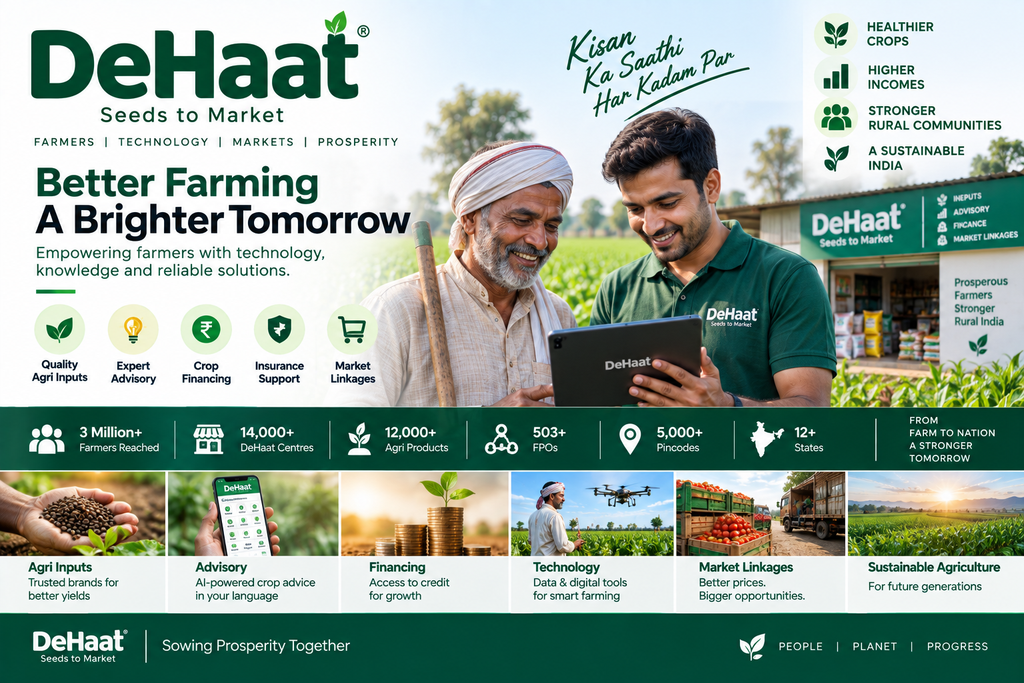
DeHaat is one of India’s largest full-stack agritech platforms, connecting farmers with agricultural inputs, crop advisory, farm intelligence, financing, insurance and market linkages.
The company follows a “Seeds to Market” model—rather than solving only one part of farming, DeHaat attempts to participate across the agricultural value chain.
Its technology platform is combined with a large physical rural network, allowing the company to reach farmers who may not be adequately served by purely digital platforms.
Key Highlights
| Particular | Details |
|---|---|
| Founded | 2012 |
| Legal Entity | Green Agrevolution Pvt. Ltd. |
| CIN | U01122BR2012PTC018117 |
| Headquarters | Patna / Gurugram |
| Business | Full-stack Agritech |
| Operating States | 12+ |
| DeHaat Centres | 14,000+ |
| FPOs | 503+ |
| Farmers | 3 Mn+ according to current DeHaat platform |
| Products | 12,000+ |
| Brands | 150+ |
| Pincodes | 5,000+ |
| FY25 Operating Revenue | ~₹3,010 Cr |
| FY25 Reported PAT | ~₹369 Cr |
| FY25 Adjusted Profitability | Loss of ~₹207 Cr excluding one-time gain |
| FY25 Revenue Growth | ~12% |
| FY26 Revenue Run Rate | ~₹4,000 Cr |
| Latest Funding | ~$3.6 Mn, Aug 2026 |
| Last Widely Reported Valuation | ~$700–800 Mn |
| Status | Unlisted |
| IPO | No near-term confirmed plan |
The company’s current consumer platform reports 14,000+ centres and 3 million+ farmers, while its LinkedIn profile reports a larger 15,000+ centre and 12.8 million+ farmer reach; these figures appear to use different definitions of farmers/reach, so they should not be treated as directly comparable.
Business Model
DeHaat’s model can be simplified as:
Farm Inputs → Advisory → Farm Management → Financing → Harvest → Market Linkage → Processing/Exports
1. Agri Inputs
Farmers can purchase:
- Seeds
- Fertilisers
- Crop-protection products
- Pesticides
- Equipment
- Animal nutrition products
- Other agricultural inputs
The DeHaat platform currently lists 12,000+ products from 150+ brands.
2. Farm Advisory
DeHaat provides crop-specific advice covering:
- Crop planning
- Disease identification
- Pest management
- Fertiliser dosage
- Harvesting
- Weather
- Soil
- Crop health
Its AI/ML systems are designed to provide personalised recommendations based on crop and farm conditions.
3. Market Linkages
After cultivation, DeHaat helps farmers sell agricultural produce to:
- Institutional buyers
- Traders
- Exporters
- Food processors
- Other downstream businesses
This is an important part of its “Seeds to Market” model.
4. Agri-Finance & Insurance
DeHaat partners with financial institutions to provide access to financing and crop-insurance products.
The objective is to embed financial services into the farmer relationship rather than operating only as an agricultural marketplace.
5. Food Processing & Exports
DeHaat has increasingly focused on:
- Export commodities
- Storage
- Processing
- Private-label products
- Branded agricultural products
Management said exports were targeted to reach approximately ₹800 Cr in FY26, compared with around ₹430 Cr in FY25.
DeHaat Centres — The Physical Moat
One of DeHaat’s biggest competitive advantages is its phygital model.
A DeHaat Centre acts as a local one-stop agricultural service point where farmers can access:
Inputs + Advisory + Market Access + Other Financial/Agri Services
Many centres are operated through local franchise entrepreneurs/DeHaat micro-entrepreneurs.
This creates a human distribution network in rural India that is difficult for a purely digital competitor to replicate.
Technology & AI
Technology is at the centre of DeHaat’s strategy.
Its AI/ML capabilities are used for:
- Personalised crop advisory
- Pest and disease warnings
- Weather alerts
- Farm intelligence
- Crop monitoring
- Risk assessment
- Yield-related analytics
The company is effectively trying to create a digital operating layer for Indian agriculture.
Scale of Operations
DeHaat currently operates across 12+ major agrarian states.
Its platform includes:
- 14,000+ DeHaat Centres
- 503+ FPOs
- 3 Mn+ farmers according to its current website
- 12,000+ products
- 150+ brands
- 5,000+ pincodes
The company has also expanded its digital reach through acquisitions.
AgriCentral Acquisition
In January 2025, DeHaat acquired AgriCentral, a farm-advisory platform from Olam Agri.
The acquisition strengthened DeHaat’s digital advisory capabilities and expanded its potential reach among farmers.
The acquisition is consistent with DeHaat’s strategy of combining:
Physical Rural Distribution + Digital Advisory + Supply Chain
FY25 Financial Performance
DeHaat’s FY25 financials require an important qualification.
Operating Performance
| Particular | FY24 | FY25 | Growth |
|---|---|---|---|
| Operating Revenue | ~₹2,675 Cr | ~₹3,010 Cr | ~12% |
| Reported PAT | ~₹(1,133) Cr | ~₹369 Cr | Turnaround |
| Total Expenses | ~₹3,853 Cr | ~₹2,671 Cr | Significant reduction |
But There Is a Major Catch
The ₹369 Cr FY25 profit does not represent clean recurring operating profitability.
Approximately ₹576 Cr came from a non-cash fair-value adjustment related to CCPS.
Excluding this one-time accounting gain, DeHaat would have reported a loss of approximately ₹207 Cr.
Therefore:
Reported PAT: ₹369 Cr
Adjusted/underlying result: ~₹207 Cr loss
This distinction is extremely important when valuing the company.
FY26 Progress
The company showed signs of improving operating economics during FY26.
Management said DeHaat became profitable in Q1 FY26, supported by:
- Higher-margin private-label products
- Exclusive agri-input distribution
- Exports
- Storage
- Food processing
The company was operating at approximately ₹4,000 Cr annualised revenue run rate in FY26 according to management commentary.
The sustainability of this profitability is the key issue investors need to monitor.
Revenue Mix
DeHaat has two broad economic engines:
Input & Services
Revenue comes from selling agricultural inputs and related services to farmers.
Output / Market Linkage
DeHaat aggregates produce from farmers and connects it with institutional buyers, traders, exporters and processors.
An FY25 analysis reported approximately:
- ₹606.7 Cr from input/service sales
- ₹2,392.7 Cr from output linkages
This indicates that a substantial portion of DeHaat’s revenue still comes from agricultural commodity trading/market linkage, rather than high-margin software or SaaS.
Why This Matters
The company has a large technology layer, but its economics are still substantially influenced by:
Commodity prices + trading margins + working capital + supply-chain efficiency.
Therefore, investors should not value DeHaat like a pure SaaS company.
Funding History
DeHaat has attracted substantial institutional capital.
Major investors include:
- Peak XV Partners
- Prosus Ventures
- RTP Global
- Temasek
- Sofina
- Lightrock
- Omnivore
- FMO
- AgFunder
- Trifecta Capital
DeHaat has raised more than $250 Mn across disclosed funding rounds according to current funding databases.
Latest Funding — 2026
In August 2026, DeHaat raised approximately $3.6 Mn in a new funding round involving OTP Ventures and other investors, taking reported cumulative funding to approximately $251 Mn according to Inc42’s current database.
This is important because the company continues to raise capital even while moving toward profitability.
Valuation
The last widely reported institutional valuation was approximately:
$700–800 Million
This valuation was reported around the 2022/2024 financing period.
Financial Express reported a valuation of approximately ₹5,690 Cr in July 2025.
However, there is no reliable public evidence of a fresh 2026 equity valuation that should be treated as the company’s current market valuation.
Therefore:
Do not publish a current ₹/share valuation without verifying the latest transaction and fully diluted cap table.
IPO Status
This is an important area where DeHaat should be positioned carefully.
DeHaat’s management has historically indicated that it eventually wants to list in India and potentially become the country’s largest agritech IPO.
However, in 2025 CEO Shashank Kumar stated that there were no plans to IPO within the following two years, with profitability being an important prerequisite.
The company’s longer-term vision has included a potential IPO after achieving sufficient scale and profitability.
Current Position
No verified DRHP
No SEBI approval
No confirmed IPO date
No confirmed IPO valuation
Therefore, DeHaat should currently be classified as:
Unlisted Agritech Opportunity — Long-Term IPO Optionality
and not as a near-term pre-IPO stock.
Investment Thesis
1. Massive Agricultural Market
India has one of the world’s largest agricultural ecosystems with millions of small and fragmented farmers.
Digitising this ecosystem presents a very large opportunity.
2. Full-Stack Model
DeHaat covers much more than agricultural inputs:
Input → Advisory → Finance → Harvest → Market → Export
3. Physical + Digital Network
Its rural centres provide a distribution advantage that purely digital agritech companies may struggle to replicate.
4. Strong Institutional Backing
Peak XV, Prosus, Temasek, RTP Global, Sofina and other investors have backed the company.
5. Export Opportunity
DeHaat is increasingly expanding into agricultural exports and expects exports to become a larger revenue contributor.
6. Private-Label Opportunity
Private-label agricultural products can potentially generate better margins than pure commodity distribution.
7. AI & Data
The company has years of agricultural data that can potentially improve:
- Advisory
- Crop planning
- Risk assessment
- Input recommendations
- Insurance
- Yield prediction
8. Improving Operating Economics
The reduction in losses and reported Q1 FY26 profitability are encouraging, although investors need multiple periods of sustainable profitability to confirm the turnaround.
Key Risks
| Risk | Concern |
|---|---|
| Underlying Losses | FY25 reported PAT was boosted by a ₹576 Cr non-cash fair-value gain |
| Low-Margin Business | Significant revenue comes from agricultural output trading |
| Commodity Risk | Prices and volumes can fluctuate significantly |
| Working Capital | Procurement and output aggregation require capital |
| Farmer Economics | Rural customers are price-sensitive |
| Execution | Managing thousands of rural centres is complex |
| Funding Dependence | Business has historically relied heavily on external capital |
| Governance | Historical reports raised concerns around internal controls and inventory management |
| IPO Uncertainty | No near-term DRHP or confirmed listing |
| Valuation | Previous private valuation may not reflect current fundamentals |
| Seasonality | Agriculture is inherently seasonal and weather-dependent |
| Climate Risk | Droughts, floods and extreme weather can affect supply |
Historical reporting has also highlighted concerns around inventory controls and internal processes, although the company has subsequently worked on strengthening operations.
Competitive Landscape
DeHaat competes across different parts of its ecosystem with companies such as:
- AgroStar
- Ninjacart
- WayCool
- Samunnati
- Arya.ag
- BigHaat
- Various regional agri-input distributors
However, DeHaat’s combination of rural distribution + technology + inputs + advisory + market linkage gives it a differentiated positioning.
DeHaat vs Traditional Agri Distributor
| Factor | Traditional Distributor | DeHaat |
|---|---|---|
| Physical Network | High | High |
| Digital Platform | Low | High |
| AI Advisory | Low | High |
| Input Sales | Yes | Yes |
| Market Linkage | Limited | Yes |
| Data Analytics | Low | High |
| Financing/Insurance | Limited | Integrated |
| Export Capability | Limited | Growing |
| Farmer Relationship | Local | Local + Digital |
Investment Positives vs Concerns
| Positives | Concerns |
|---|---|
| Large agricultural opportunity | Underlying FY25 loss |
| 14,000+ centres | Commodity-linked economics |
| 3M+ farmers on current platform | Working-capital intensity |
| Full-stack ecosystem | Funding requirements |
| Strong institutional investors | IPO not near-term |
| AI-driven advisory | Execution complexity |
| Growing exports | Weather/climate risk |
| Private-label products | Valuation uncertainty |
| Q1 FY26 profitability | Need to prove sustainable margins |
| ₹4,000 Cr revenue run rate | High operational complexity |
Investment View
Business Quality: ⭐⭐⭐⭐☆
Growth Potential: ⭐⭐⭐⭐⭐
Market Opportunity: ⭐⭐⭐⭐⭐
Technology Moat: ⭐⭐⭐⭐☆
Profitability: ⭐⭐⭐☆☆
IPO Visibility: ⭐⭐☆☆☆
Valuation Visibility: ⭐⭐⭐☆☆
Liquidity: ⭐⭐☆☆☆
Overall Risk: High
Our View
DeHaat is one of India’s most interesting agritech businesses, but the investment thesis needs to be understood correctly.
This is not simply an agricultural app.
It is attempting to build a technology-enabled agricultural supply chain connecting farmers with:
Inputs → Knowledge → Finance → Production → Buyers → Processing → Exports
Its physical distribution network is perhaps its strongest competitive advantage.
The company has also demonstrated significant scale, reaching thousands of rural centres and millions of farmers.
But Profitability Needs a Closer Look
The headline FY25 PAT of ₹369 Cr looks impressive.
However:
₹369 Cr reported PAT
minus
₹576 Cr non-cash fair-value gain
= approximately
₹207 Cr underlying loss
Therefore, investors should not value DeHaat using the ₹369 Cr PAT as if it were recurring earnings.
The real investment question is whether DeHaat can convert its ₹3,000–4,000 Cr revenue base into sustainable operating profitability and free cash flow.
UnlistedCart Investment View
“India’s Full-Stack Agritech Platform | Seeds to Market | 14,000+ Centres | Millions of Farmers | Long-Term IPO Optionality.”
Investment Category: High-Growth Agritech / Unlisted Opportunity
Business: Strong
Market Opportunity: Very Large
Growth: High
Profitability: Improving but not yet fully proven
IPO Catalyst: Long-term only
Risk: High
Share Details
| Particular | Details |
|---|---|
| Company | Green Agrevolution Private Limited |
| Brand | DeHaat |
| CIN | U01122BR2012PTC018117 |
| Founded | 2012 |
| Status | Active & Unlisted |
| Face Value | Verify current share class |
| FY25 Revenue | ~₹3,010 Cr |
| FY25 Reported PAT | ~₹369 Cr |
| FY25 Adjusted Result | ~₹207 Cr Loss |
| FY26 Revenue Run Rate | ~₹4,000 Cr |
| Last Widely Reported Valuation | ~$700–800 Mn |
| Latest Funding | ~$3.6 Mn, Aug 2026 |
| IPO | No confirmed near-term IPO |
| Current OTC Price | No reliable public reference verified |
Corporate records identify Green Agrevolution Private Limited as an active, unlisted private company incorporated in February 2012.
Final Verdict
DeHaat is a strong business story but not yet a clean earnings story.
The biggest attraction is the combination of:
India Agriculture + Millions of Farmers + Rural Distribution + AI + Agri Inputs + Market Linkages + Exports
The biggest concern is:
Can DeHaat generate sustainable profits without depending on accounting gains or continual external capital?
If FY26 and FY27 demonstrate consistent EBITDA profitability, positive operating cash flow and stronger margins, the investment case could become significantly stronger.
Overall
Business ⭐⭐⭐⭐☆
Growth ⭐⭐⭐⭐⭐
Market Opportunity ⭐⭐⭐⭐⭐
Technology ⭐⭐⭐⭐☆
Profitability ⭐⭐⭐☆☆
IPO Visibility ⭐⭐☆☆☆
Risk ⭐⭐⭐⭐☆
Investment Category
High-Growth Agritech / Long-Term Unlisted Opportunity
Best suited for investors willing to take high private-market risk and wait for the business to demonstrate sustainable profitability.
Disclaimer
This report is for informational and educational purposes only and should not be considered investment advice, an offer to buy or sell securities, or a guarantee of future returns. DeHaat is an unlisted private company and its shares may have limited liquidity and significant valuation/transfer risks. Financial databases can differ in accounting definitions; reported FY25 profit includes a substantial non-cash fair-value gain. Investors should independently verify the latest audited financial statements, cap table, share class, ISIN, valuation and transaction price before investing.
For more such unlisited stocks visit https://unlistedcart.com/unlisted-shares/