Company: Airtel Payments Bank Limited
CIN: U65100DL2010PLC201058
Founded: 2010; payments-bank operations launched in 2016/17
Headquarters: New Delhi / Gurugram
Parent Group: Bharti / Airtel
MD & CEO: Anubrata Biswas
Business: Digital banking, payments, remittances and financial services
Status: Active, Unlisted Public Company
Face Value: ₹10
ISIN: INE360U01018
Airtel Payments Bank Official Website
About the Company
Airtel Payments Bank is one of India’s leading digital payments banks and is part of the Bharti Airtel ecosystem. It was created to provide digital banking, payments and financial-services access through Airtel’s large telecom and retail distribution network.
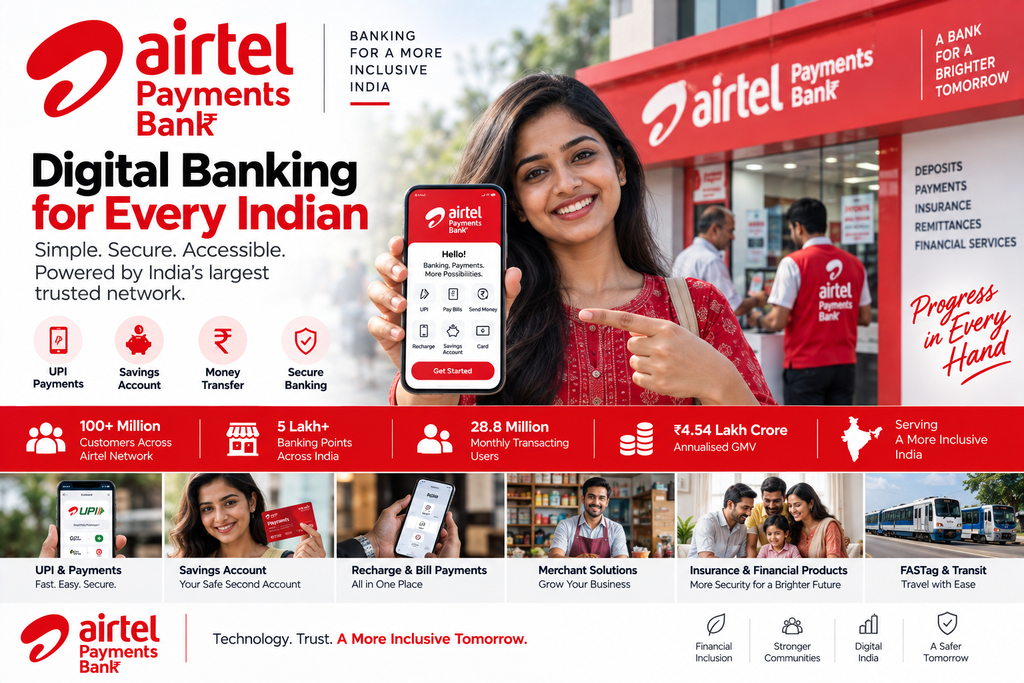
The bank offers savings and current accounts, UPI, money transfers, bill payments, FASTag, RuPay/NCMC cards, merchant services, insurance and financial-product distribution.
Airtel Payments Bank is particularly differentiated by its combination of a mobile-first digital platform + large physical distribution network, allowing it to serve both urban digital customers and underbanked/rural customers.
The bank’s own investor-relations page now publishes its FY26 annual financial statements and Pillar 3 disclosures.
Key Highlights
| Particular | Details |
|---|---|
| FY26 Revenue | ₹3,207 Cr |
| FY26 Net Profit | ₹109 Cr |
| FY26 Revenue Growth | 18.4% |
| FY26 Profit Growth | 73% |
| Customer Balances | ₹4,612 Cr |
| Customer Balance Growth | 26% YoY |
| Savings Account Monthly Transacting Users | 28.8 Mn |
| Annualised GMV | ₹4.54 Lakh Cr |
| Monthly Users Across Businesses | 100 Mn+ |
| Banking Points | 5 Lakh+ |
| IPO Target | By September 2027 |
| Current Status | Unlisted |
FY26 was another strong year for Airtel Payments Bank, with revenue rising 18.4% to ₹3,207 crore and net profit increasing 73% to ₹109 crore. Customer balances grew 26% to ₹4,612 crore.
Business Model
Airtel Payments Bank operates across several financial-services categories.
1. Digital Banking
The bank offers:
- Savings accounts
- Current accounts
- UPI
- Money transfers
- Debit cards
- Digital banking services
- Safe Second Account
Its Safe Second Account proposition has become an important growth driver, particularly among urban customers who want a separate account for digital transactions.
2. Payments
The platform facilitates:
- UPI payments
- Bill payments
- Recharge
- FASTag
- Bharat BillPay
- Merchant payments
- UPI AutoPay
- NCMC/transit payments
The bank has also expanded its presence in urban transit through RuPay On-the-Go/NCMC cards.
3. Cash & Assisted Banking
One of Airtel Payments Bank’s biggest advantages is its extensive physical distribution network.
The bank has 5 lakh+ banking points, allowing customers in smaller towns and rural areas to access assisted digital financial services.
4. Financial-Product Distribution
Airtel Payments Bank distributes or facilitates products such as:
- Insurance
- Loans through partner/lending arrangements
- Fixed deposits
- Digital gold
- Other financial products
Important: As a Payments Bank, Airtel Payments Bank itself cannot undertake conventional lending. Lending activities are therefore structurally different from those of a traditional bank.
RBI’s Payments Bank framework restricts these banks from undertaking lending activities.
Regulatory Structure
This is extremely important for investors.
Airtel Payments Bank is not a full-service commercial bank.
Under the Payments Bank framework:
- It can accept deposits.
- It can provide payment/remittance services.
- It can issue debit/ATM cards.
- It can distribute certain financial products.
- It cannot undertake lending activities.
The maximum end-of-day balance permitted for a customer account is currently ₹2 lakh. Airtel Payments Bank’s own May 2026 deposit policy confirms this limit.
This creates both a competitive advantage and a structural limitation.
FY26 Financial Performance
| ₹ Crore | FY24 | FY25 | FY26 |
|---|---|---|---|
| Revenue | 1,836 | 2,709 | 3,207 |
| Net Profit | 34.5 | 63 | 109 |
| Revenue Growth | — | 47.5% | 18.4% |
| Profit Growth | — | 82.5% | 73% |
| Customer Balances | — | 3,659 | 4,612 |
Airtel Payments Bank has now reported three consecutive years of profitability, according to management, with FY26 profit reaching ₹109 crore.
Profitability Trend
The improvement is significant:
FY24: ₹34.5 Cr
↓
FY25: ₹63 Cr
↓
FY26: ₹109 Cr
That represents roughly 3.2x growth in profit in two years.
Customer & Transaction Scale
Airtel Payments Bank has built substantial transaction scale.
FY26
- 28.8 million savings-account monthly transacting users
- ₹4,612 Cr customer balances
- ₹4.54 lakh crore annualised GMV
- 100 million+ monthly users across all businesses
- 5 lakh+ banking points
Management has described Airtel Payments Bank as the third-largest mobile bank in India by user base based on savings-account monthly transacting users.
Revenue Mix
One of the most interesting changes is the evolution of the revenue mix.
Management said that roughly four years ago around 90% of revenue came from payments.
By FY25:
- ~60% from transactions
- ~30–33% from banking-account business
- Remaining revenue from net interest income and other sources
This diversification is important because it reduces dependence on pure payment transactions.
Shareholding Pattern
Airtel Payments Bank is effectively controlled by the Bharti Group.
In March 2025, Bharti Airtel transferred its 69.94% stake in Airtel Payments Bank to its wholly owned subsidiary Airtel Limited as an internal group restructuring. The transaction did not change the ultimate ownership of the bank.
Current Group Structure
Bharti Airtel → Airtel Limited → Airtel Payments Bank
The remaining ownership is also within the Bharti promoter ecosystem.
Therefore, investors should look at Airtel Payments Bank as a Bharti Group financial-services asset, rather than an independently promoted fintech.
IPO Status
This is one of the biggest attractions of Airtel Payments Bank as an unlisted investment.
IPO is expected by September 2027.
The bank crossed the ₹500 crore net-worth threshold in September 2024.
According to MD & CEO Anubrata Biswas, the applicable regulatory framework requires listing within three years of crossing that threshold, making September 2027 the outer deadline communicated by management.
Current IPO Position
| IPO Parameter | Status |
|---|---|
| IPO Intent | Yes |
| Target | By September 2027 |
| DRHP | Not filed |
| Price Band | Not announced |
| Issue Size | Not announced |
| Merchant Bankers | Not officially announced |
| Listing Exchange | Not announced |
Importantly, the CEO said in 2025 that the bank had not yet begun the full IPO process and that the timing would be decided by the board.
Therefore, this is an IPO-mandated/IPO-targeted opportunity, but not yet a DRHP-filed pre-IPO.
Current Unlisted Share Price
There is currently extreme variation between private-market price sources, so this deserves special attention.
Recent references include:
- ₹114.64/share on Moneycontrol
- ₹14.70/share on Planify
- ₹215/share on another unlisted-share platform
Moneycontrol itself identifies the prices as partner-derived and indicative, while its page currently shows a ₹99.50–₹200 52-week range and ₹215 all-time high.
Another platform currently quotes ₹215 and an implied market capitalisation of approximately ₹50,159 crore.
Planify, meanwhile, shows ₹14.70/share.
Therefore:
I would NOT publish a single “current price” for Airtel Payments Bank on UnlistedCart without independently confirming an executable seller quote.
The dispersion itself is a major warning that private-market liquidity and/or corporate-action/share-count data may be creating inconsistencies across platforms.
Indicative Valuation
Using the reported 2.465 billion shares and different market references:
| Indicative Price | Implied Equity Value |
|---|---|
| ₹14.70 | ~₹3,624 Cr |
| ₹114.64 | ~₹28,259 Cr |
| ₹215 | ~₹52,998 Cr |
This produces an enormous valuation range.
Against FY26 PAT of ₹109 crore, the implied P/E would range from approximately:
| Price | Approx. P/E* |
|---|---|
| ₹14.70 | ~33x |
| ₹114.64 | ~259x |
| ₹215 | ~486x |
*Indicative calculation using the cited share count and FY26 profit; private-company capital structures and transaction prices may differ.
This is the biggest investment issue.
At ₹14–15, the valuation could look relatively interesting for a profitable, fast-growing financial-services platform.
At ₹100+, the valuation becomes much more demanding.
At ₹200+, investors would be paying an extremely high multiple of current earnings and would be relying heavily on future growth and IPO re-rating.
Why Airtel Payments Bank Could Be Attractive
1. Strong Parentage
The bank benefits from the Bharti Airtel ecosystem, giving it access to a massive telecom customer base and distribution network.
Management has highlighted access to around 350 million customers on the parent side as a major strategic advantage.
2. Strong Profit Growth
FY26 PAT reached ₹109 crore, up 73% YoY.
3. Large User Base
The bank has:
28.8 Mn SBA MTUs + 100 Mn+ monthly users across businesses
which provides significant cross-selling potential.
4. Huge Transaction Ecosystem
Annualised GMV has reached approximately ₹4.54 lakh crore.
5. Physical + Digital Distribution
Few fintechs can combine:
Telecom ecosystem + digital app + 5 lakh+ banking points + banking licence
at Airtel’s scale.
6. IPO Catalyst
The requirement/target to list by September 2027 provides a potentially significant liquidity event for existing unlisted shareholders.
Major Risks
| Risk | Investor Concern |
|---|---|
| Payments Bank Restrictions | Cannot lend directly |
| High Valuation at Some Quotes | ₹100–₹200+ prices imply very high earnings multiples |
| Private-Market Liquidity | No NSE/BSE price discovery today |
| Regulatory Risk | Banking/payments businesses are heavily regulated |
| Competition | UPI, banks, fintechs and wallets compete aggressively |
| Deposit Cap | ₹2 lakh per customer limits balance accumulation |
| Margin Pressure | Payment businesses are generally low-margin |
| IPO Execution | September 2027 is an outer target, not a guaranteed listing date |
| Compliance | RBI imposed a ₹31.8 lakh penalty in March 2026 |
| Technology/Cyber Risk | Large digital transaction volumes create operational and fraud risks |
Regulatory Concern
The RBI imposed a ₹31.80 lakh monetary penalty on Airtel Payments Bank on March 30, 2026 for non-compliance with disclosure requirements relating to financial statements.
The issue concerned non-disclosure of certain complaints in the FY25 annual financial statements. RBI specifically stated that the penalty related to regulatory compliance deficiencies and was not a finding on the validity of customer transactions or agreements.
The bank also reported 194,338 complaints received during FY26, with 3,758 pending at year-end. The bank said its complaint reporting methodology had been revised retrospectively following RBI expectations and a show-cause notice.
This does not necessarily change the investment thesis, but regulatory compliance should remain an important monitoring point.
Positives vs Concerns
| Positives | Concerns |
|---|---|
| Bharti Airtel ecosystem | Payments Bank cannot lend |
| FY26 PAT ₹109 Cr | Valuation varies wildly |
| 73% profit growth | Low-margin payments business |
| ₹3,207 Cr revenue | ₹2 lakh customer balance cap |
| 100 Mn+ monthly users | Strong fintech competition |
| 5 lakh+ banking points | Regulatory scrutiny |
| ₹4.54 lakh Cr annualised GMV | RBI penalty in 2026 |
| Strong customer balance growth | IPO process not yet formally filed |
| IPO expected by 2027 | Private-market liquidity |
| Profitable for 3 years | High valuation at ₹100–₹200+ |
Investment View
Airtel Payments Bank is an interesting financial-services unlisted opportunity, particularly because it combines:
Bharti Airtel backing + banking licence + massive distribution + strong user base + profitability + mandatory/targeted IPO timeline.
The business itself is becoming stronger.
However, valuation is everything in this story.
At a low private-market entry price, the risk-reward could be attractive.
At ₹100–₹200+ per share, the investment becomes substantially more speculative because current earnings do not yet justify such multiples without strong future growth.
Investment Scorecard
| Factor | View |
|---|---|
| Parent Strength | ⭐⭐⭐⭐⭐ |
| Business Scale | ⭐⭐⭐⭐⭐ |
| Revenue Growth | ⭐⭐⭐⭐ |
| Profitability Trend | ⭐⭐⭐⭐½ |
| Customer Growth | ⭐⭐⭐⭐½ |
| Competitive Moat | ⭐⭐⭐⭐ |
| Regulatory Risk | ⭐⭐⭐ |
| IPO Visibility | ⭐⭐⭐⭐½ |
| Valuation Comfort | ⭐⭐–⭐⭐⭐⭐* |
| Overall Opportunity | High-Quality Business / Price Sensitive |
*Depends heavily on the actual executable unlisted-market price.
Final Takeaway
Airtel Payments Bank has moved from a loss-making payments-bank experiment into a profitable digital financial-services platform.
FY26 numbers are encouraging:
₹3,207 Cr Revenue
₹109 Cr Profit
73% Profit Growth
₹4,612 Cr Customer Balances
28.8 Mn Savings MTUs
₹4.54 Lakh Cr Annualised GMV
The next major catalyst is the IPO, with management targeting listing by September 2027.
But investors should be particularly careful about the unlisted share price, because currently available private-market quotes are extraordinarily inconsistent.
Investment Category
Profitable Fintech / Digital Banking / IPO-Mandated Unlisted Opportunity
Overall View: Attractive business, but valuation must be checked transaction-by-transaction.
Share Details
| Particular | Details |
|---|---|
| Company | Airtel Payments Bank Limited |
| CIN | U65100DL2010PLC201058 |
| ISIN | INE360U01018 |
| Face Value | ₹10 |
| Status | Active & Unlisted |
| FY26 Revenue | ₹3,207 Cr |
| FY26 PAT | ₹109 Cr |
| Customer Balances | ₹4,612 Cr |
| IPO Target | By September 2027 |
| DRHP | Not filed |
| Current Unlisted Price | Highly inconsistent across platforms |
| Primary Parent Group | Bharti / Airtel |
How to Invest
Airtel Payments Bank shares are currently not traded on NSE/BSE.
Unlisted shares can be acquired through private-market transactions with existing shareholders or specialised intermediaries.
Before buying, investors should verify:
- Exact ISIN
- Number of equity shares
- Seller’s ownership
- Demat status
- Executable transaction price
- Latest capital structure
- Any corporate actions
- Tax implications
- IPO-related lock-in
- Whether the quoted price is actually executable
Disclaimer
This report is for informational and educational purposes only and should not be considered investment advice, a recommendation, or an offer to buy or sell securities. Unlisted-share prices are indicative private-market references and can differ materially between intermediaries and actual executable transactions. Unlisted investments carry liquidity, valuation, regulatory, business and capital-loss risks. Investors should conduct independent due diligence and consult a SEBI-registered investment professional before investing.
For more such unlisited stocks visit https://unlistedcart.com/unlisted-shares/