1. Company Overview
Carlsberg India Limited is the Indian business of Denmark-based Carlsberg Group, one of the world’s major international brewing companies.
Carlsberg entered India in 2006 and commenced commercial operations in 2007 with its brewery at Paonta Sahib, Himachal Pradesh. Over the years, the company has established a strong presence in India’s beer market, particularly in the premium and strong-beer segments.
Carlsberg India is currently an unlisted public company and has taken a significant step toward a potential Indian IPO by confidentially pre-filing its draft red herring prospectus with SEBI in July 2026.
The proposed transaction is expected to be primarily an Offer for Sale (OFS) by the parent, rather than a fresh capital raise by Carlsberg India.
2. Company Details
| Particular | Details |
|---|---|
| Company | Carlsberg India Limited |
| Former Name | Carlsberg India Private Limited |
| Earlier Name | South Asia Breweries Private Limited |
| Incorporated | May 3, 2006 |
| CIN | U15111DL2006PLC148579 |
| Registered Office | New Delhi |
| Corporate Office | Gurugram, Haryana |
| Industry | Alcoholic Beverages / Beer |
| Status | Unlisted Public Company |
| Parent | Carlsberg Group |
| Ownership | 100% owned by Carlsberg Group |
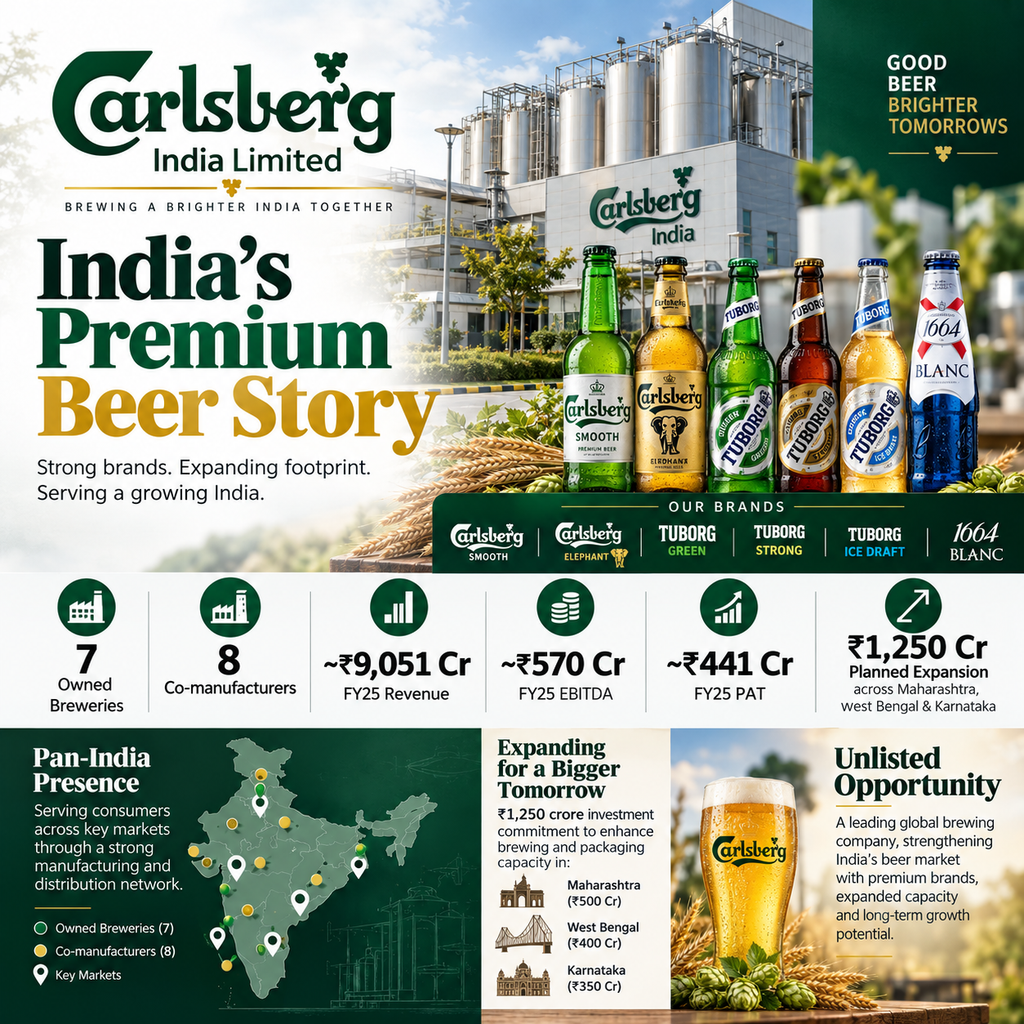
| Owned Breweries | 7 |
| Co-manufacturers | 8 |
| Proposed IPO | Confidentially pre-filed |
| Proposed IPO Structure | Primarily OFS |
| Proposed Exchanges | Expected BSE & NSE |
| Current Status | Unlisted |
The company was converted from Carlsberg India Private Limited to Carlsberg India Limited in 2026. MCA-linked company records show the latest balance sheet filing date as March 31, 2026.
3. Carlsberg Group Ownership
In August 2024, Carlsberg announced an agreement to acquire the remaining 33.33% stake in Carlsberg South Asia Pte. Ltd.
The transaction was completed in November 2024, giving Carlsberg 100% ownership of the existing India business. The total purchase price for the broader South Asia transaction was approximately US$744 million, subject to the transaction adjustments.
This is important for the IPO because the Indian listing is effectively a monetisation opportunity for the global parent.
4. Business Model
Carlsberg India’s business is built around the production, marketing and distribution of beer brands across India’s states and union territories.
The company operates through:
- Owned breweries
- Contract manufacturing / co-manufacturing
- Distribution partners
- Retail channels
- On-premise consumption
- Off-premise retail
- Premium beer positioning
- Strong beer segment
Carlsberg India currently operates through seven owned breweries and eight co-manufacturers.
5. Product Portfolio
Carlsberg India has a diversified portfolio spanning premium, mainstream and strong-beer categories.
Major Brands
- Carlsberg Green
- Carlsberg Smooth
- Carlsberg Elephant
- Tuborg Green
- Tuborg Strong
- Tuborg Classic
- 1664 Blanc
- Other international and local portfolio brands
The company has increasingly focused on premiumisation while maintaining a significant presence in India’s strong-beer market.
6. Market Position
Carlsberg India is one of India’s largest beer companies.
Industry research cited by JM Financial estimated Carlsberg India’s FY2025 market share at approximately 16–17% of India’s beer market, with United Breweries substantially larger and AB InBev another major competitor.
Carlsberg’s own 2025 India presentation highlights a particularly strong position in the premium strong-beer segment, where its share was approximately 31% and its position was #2 in that segment.
Major Competitors
Carlsberg India competes primarily with:
- United Breweries / Heineken
- AB InBev
- Other regional and state-level breweries
The competitive landscape varies significantly by state because alcohol distribution and taxation in India are highly regulated at the state level.
7. Manufacturing Footprint
Carlsberg India currently operates:
7 owned breweries + 8 co-manufacturers
Its owned brewery network includes facilities in locations such as:
- Paonta Sahib, Himachal Pradesh
- Alwar, Rajasthan
- Aurangabad, Maharashtra
- Mysuru, Karnataka
- Other strategically located production facilities
The company states that its seven breweries use standardized systems for raw-material handling, brewing, packaging and quality control.
8. Mysuru Expansion
Mysuru has become an important part of Carlsberg India’s capacity-expansion strategy.
In February 2025, Carlsberg announced a ₹350 crore investment for expansion of its Mysuru brewery.
The expansion includes:
- New can line
- Glass line
- Keg line
- Additional production capacity
The investment takes Carlsberg India’s cumulative investment commitment in Karnataka to approximately ₹600 crore.
In January 2026, the company inaugurated a new can line at Mysuru with an investment of approximately ₹100 crore.
The new line has a production capacity of approximately 22,000 cans per hour.
9. Large Expansion Plan – ₹1,250 Crore
In September 2025, Carlsberg India signed an MoU with the Ministry of Food Processing Industries for proposed investments of approximately ₹1,250 crore across Maharashtra, West Bengal and Karnataka.
The proposed allocation included:
| Location | Proposed Investment |
|---|---|
| Ahilyanagar, Maharashtra – Greenfield | ₹500 Cr |
| Hooghly, West Bengal – Brownfield | ₹400 Cr |
| Mysuru, Karnataka – Brownfield | ₹350 Cr |
| Total | ₹1,250 Cr |
The company expects these projects to increase brewing and packaging capacity and support long-term growth in India.
10. FY2025 Financial Performance
The latest detailed financial information publicly available from secondary company-data sources is for FY2025.
| ₹ Crore | FY2024 | FY2025 |
|---|---|---|
| Total Revenue | ~₹8,065 Cr | ₹9,050.6 Cr |
| EBITDA | ~₹416 Cr | ₹569.9 Cr |
| Net Profit | ~₹325 Cr | ₹441.4 Cr |
| Net Worth | ~₹1,843 Cr | ₹2,284 Cr |
| Borrowings | — | ₹33.4 Cr |
| ROE | — | 19.3% |
| ROCE | — | 22.3% |
FY2025 revenue increased approximately 12.5%, while EBITDA increased approximately 36.6% and net profit increased approximately 36.6%.
Important Note on Financial Data
Because the 2026 IPO filing was made through the confidential pre-filing route, detailed IPO financial disclosures are not yet publicly available.
Therefore, the FY2025 numbers above should be treated as the latest publicly accessible detailed financial snapshot rather than FY2026 audited IPO numbers.
11. Revenue & Profitability Trend
The company’s financial trajectory has improved considerably over recent years.
Secondary financial data indicates:
FY2023
- Revenue: ~₹6,937 Cr
- EBITDA: ~₹286 Cr
- PAT: ~₹203 Cr
FY2024
- Revenue: ~₹7,965 Cr
- EBITDA: ~₹417 Cr
- PAT: ~₹325 Cr
FY2025
- Revenue: ~₹8,939–9,051 Cr depending on revenue presentation
- EBITDA: ~₹570 Cr
- PAT: ~₹443–441 Cr
The difference in reported revenue between databases can arise from presentation and accounting classifications, so investors should rely on the audited financial statements for final valuation work.
12. Premiumisation Opportunity
One of the key structural opportunities for Carlsberg India is the continued premiumisation of India’s beer market.
The company’s own India presentation shows that:
- Premium beer represents approximately 20% of the market.
- Strong beer represents approximately 80% of the market.
- Carlsberg has a meaningful presence in both segments.
- Its premium strong-beer portfolio has a particularly strong market position.
Brands such as Carlsberg, Tuborg and 1664 Blanc give the company exposure to consumers trading up toward premium products.
13. Industry Opportunity
India has a relatively young population, increasing urbanisation and rising disposable incomes.
Long-term industry drivers include:
- Premiumisation
- Urban consumption
- Rising disposable income
- Growth in organised retail and hospitality
- Increasing penetration of premium beer
- Expansion of modern trade
- Growth of bars, restaurants and hotels
- Increasing brand experimentation among younger legal-age consumers
However, alcohol is one of India’s most heavily regulated consumer categories, with state governments playing a major role in taxation, pricing and distribution.
14. State-Level Regulation
A major characteristic of India’s alcoholic-beverage industry is that there is no single national alcohol market.
Different states can have different:
- Excise duties
- Retail structures
- Distribution systems
- Pricing mechanisms
- Licensing requirements
- Advertising restrictions
- Dry-day rules
This creates both complexity and competitive barriers for companies with established distribution infrastructure.
Carlsberg’s large national footprint can help it navigate this fragmented market, but changes in state taxation or regulations can materially affect volumes and profitability.
15. Growth Drivers
1. Capacity Expansion
The planned ₹1,250 crore investment programme can materially increase production capacity across key states.
2. Premiumisation
Growth in premium beer consumption can support higher realisations and potentially better margins.
3. Strong Brand Portfolio
Carlsberg and Tuborg provide established international brands with significant recognition in India.
4. Distribution Scale
Seven owned breweries and eight co-manufacturers provide a broad production and distribution footprint.
5. 100% Parent Ownership
Full ownership by Carlsberg Group gives the Indian business direct alignment with a global brewing major.
6. Market Growth
India remains a strategically important growth market for Carlsberg Group.
7. Operating Leverage
Higher capacity utilisation can potentially improve fixed-cost absorption as volumes grow.
16. Carlsberg Group’s Strategic Focus on India
Carlsberg Group has repeatedly identified India as an important growth market.
The company has continued investing in:
- Brewing capacity
- Packaging
- Premium brands
- Digital capabilities
- Sustainability
- Supply-chain infrastructure
The global parent completed its move to full ownership of the India business in 2024, highlighting the strategic importance it places on the market.
17. IPO Development
Carlsberg India made a significant announcement in July 2026.
The company confidentially pre-filed its DRHP with SEBI for a potential IPO.
The confidential route means that detailed IPO documents and the final issue structure are not yet publicly available.
Reported IPO Structure
Based on company statements and reliable media reports:
| Parameter | Current Information |
|---|---|
| Company | Carlsberg India Limited |
| IPO Filing | Confidential DRHP |
| Filing Date | July 2026 |
| Fresh Issue | None reported |
| OFS | Expected |
| Indicative Issue Size | Up to ~$700 million reported |
| Indicative INR Size | ~₹6,700 Cr reported |
| Indicative Valuation | Up to ~$4 billion reported |
| Proposed Listing | Indian exchanges |
| Lead Managers | Citi, JPMorgan, Kotak Mahindra Capital |
| IPO Date | Not announced |
| Price Band | Not announced |
Reuters reported that the planned IPO would not involve fresh capital raising and would instead allow Carlsberg Group to sell part of its stake in the Indian business. The reported potential size was up to approximately US$700 million, subject to regulatory approvals and market conditions.
The reported ₹6,700 crore size and approximately $4 billion valuation are media estimates, not final IPO terms.
18. Why the IPO Could Be Important
If completed, the IPO would create a listed Indian pure-play exposure to a major global beer company.
Potential implications include:
- Public-market price discovery
- Greater visibility for the India business
- Potential monetisation for Carlsberg Group
- Increased transparency through public disclosures
- Potential access to domestic capital markets in the future
- Greater investor focus on India’s beer-consumption opportunity
However, because the proposed issue is primarily an OFS, the IPO itself may not directly add significant fresh capital to Carlsberg India’s balance sheet.
19. Key Risks
1. Regulatory Risk
Alcohol taxation and distribution are controlled heavily at the state level.
Changes in excise duties, licensing or retail structures can affect profitability.
2. Taxation
Beer prices are significantly influenced by state taxes and levies.
3. Competition
Carlsberg competes against very large players such as United Breweries/Heineken and AB InBev.
4. Weather & Seasonality
Beer demand can be affected by weather, monsoon patterns and seasonal consumption.
5. Raw Material Costs
Key inputs include:
- Malt
- Barley
- Glass
- Aluminium cans
- Packaging materials
- Energy
- Logistics
Commodity inflation can pressure margins.
6. Foreign Exchange
Although the business generates revenue in India, certain imported inputs and group-related transactions may expose the business to currency movements.
7. Advertising Restrictions
Alcohol advertising in India is highly regulated, which can limit traditional marketing channels.
8. IPO Valuation Risk
The reported ~$4 billion valuation is not a confirmed IPO valuation.
The final valuation will depend on the eventual price band, share count and market conditions.
9. OFS Structure
Since the proposed IPO is expected to be primarily an OFS, investors should understand that the proceeds mainly go to selling shareholders rather than directly funding the company’s expansion.
20. Unlisted Investment Perspective
Carlsberg India is a relatively distinctive unlisted opportunity because it combines:
- A globally recognised parent
- Strong Indian beer brands
- Large manufacturing footprint
- Significant market presence
- Growing premiumisation
- Major planned capacity expansion
- Improving profitability
- Potential 2026 IPO catalyst
The proposed IPO is the most important near-term event to monitor.
For an unlisted investor, the critical variables are:
- Current unlisted entry price
- Final IPO valuation
- FY2026 audited financial performance
- Actual IPO OFS size
- Post-IPO promoter holding
- Volume growth
- EBITDA margin
- State-wise regulatory environment
- Capacity utilisation
- Premiumisation-led realisation growth
An unlisted purchase should therefore not be evaluated only on the basis of the reported $4 billion potential valuation. The final IPO documents will provide much better visibility into the company’s earnings, capital structure, share count and valuation.
21. IPO Status – September 2026
| Parameter | Status |
|---|---|
| Current Status | Unlisted |
| Parent | Carlsberg Group |
| Parent Ownership | 100% |
| Confidential DRHP | Filed |
| Filing | July 2026 |
| IPO Type | Primarily OFS |
| Fresh Issue | Not reported |
| Reported Potential Size | Up to ~$700 million |
| Reported Potential Valuation | Up to ~$4 billion |
| Price Band | Not announced |
| IPO Dates | Not announced |
| Listing Date | Not announced |
| Lead Managers | Citi, JPMorgan, Kotak Mahindra Capital |
| Final IPO Terms | Awaited |
The company itself has stated that the timing of the proposed share sale depends on regulatory approvals and prevailing market conditions.
22. Company Snapshot
| Parameter | Carlsberg India Limited |
|---|---|
| Sector | Alcoholic Beverages / Beer |
| Established in India | 2007 |
| Parent | Carlsberg Group |
| Ownership | 100% |
| Status | Unlisted |
| Owned Breweries | 7 |
| Co-manufacturers | 8 |
| FY25 Revenue | ~₹9,051 Cr |
| FY25 EBITDA | ~₹570 Cr |
| FY25 PAT | ~₹441 Cr |
| FY25 Net Worth | ~₹2,284 Cr |
| FY25 ROE | ~19.3% |
| Market Position | Major #2 player |
| Key Brands | Carlsberg, Tuborg, 1664 Blanc, Elephant |
| Proposed Investment Programme | ₹1,250 Cr |
| Potential IPO | Up to ~$700 Mn reported |
| Proposed IPO Structure | Primarily OFS |
| Current IPO Status | Confidential DRHP |
| Proposed Listing | Indian exchanges |
| Price Band | Not announced |
23. Important Links
Official Carlsberg India Website:
Carlsberg India – Official Website
Carlsberg India – Breweries:
Carlsberg India Breweries
Carlsberg India – ₹1,250 Crore Expansion Announcement:
Carlsberg India Expansion Announcement
Carlsberg India – Mysuru Investment:
Mysuru Brewery Expansion
Carlsberg Group – India Business:
Carlsberg Group – India
Carlsberg Group – 100% India Ownership:
Carlsberg Group Acquisition Announcement
Carlsberg India – UnlistedCart:
Carlsberg India Limited – UnlistedCart
24. Disclaimer
This report is prepared for informational and educational purposes only and should not be construed as investment advice, an offer to buy or sell securities, or a guarantee of future returns.
Carlsberg India Limited is currently unlisted. Its proposed IPO has been confidentially pre-filed and the final issue size, structure, price band, valuation, IPO dates and other terms may change before the public launch.
The reported potential IPO size and valuation are based on media reports and should not be treated as final IPO terms.
Financial information has been compiled from company disclosures, Carlsberg Group materials, publicly available company records and reputable secondary sources. Investors should independently verify the latest audited financial statements, regulatory filings and final IPO documents before making any investment decision.
Unlisted and pre-IPO investments involve liquidity risk, valuation risk, regulatory risk and limited price discovery. Past financial performance does not guarantee future performance.
For more such unlisted stocks visit:
UnlistedCart – Unlisted Shares