
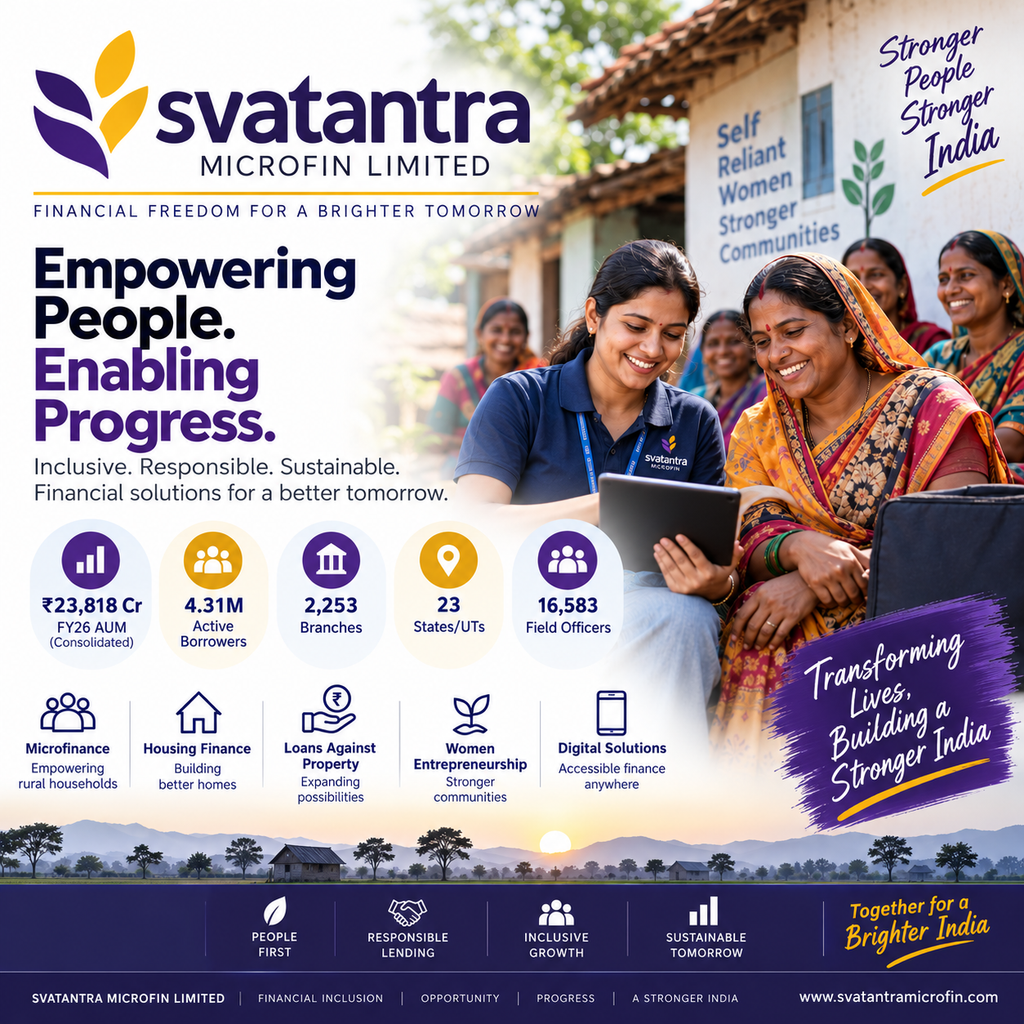
Company Overview
Svatantra Microfin Limited is an India-focused NBFC-MFI (Non-Banking Financial Company – Microfinance Institution) providing financial services primarily to economically underserved households, small entrepreneurs and rural women.
The company was founded by Ananya Birla in 2012 and commenced microfinance operations in 2013. Svatantra was the first institution to receive an NBFC-MFI licence after the RBI introduced the category in 2011.
The company’s core business is microfinance lending, complemented by affordable housing finance and loans against property through Svatantra Micro Housing Finance Corporation Limited.
A major transformation occurred in March 2026 when Chaitanya India Fin Credit Private Limited (CIFCPL) and Svatantra Holding Private Limited were amalgamated into Svatantra. The merger substantially expanded its geographic footprint and scale, making Svatantra the second-largest NBFC-MFI in India by microfinance AUM as of March 31, 2026.
Official Website:
Svatantra Microfin
Company Details
| Particular | Details |
|---|---|
| Company | Svatantra Microfin Limited |
| Former Name | Svatantra Microfin Private Limited |
| CIN | U74120MH2012PLC227069 |
| Incorporated | 17 February 2012 |
| Microfinance Operations Started | March 2013 |
| Industry | NBFC-MFI / Financial Services |
| Status | Unlisted Public Company |
| Registered Office | Mumbai, Maharashtra |
| Corporate Office | Bengaluru, Karnataka |
| Promoters | Ananyashree Birla & Antimatter Media Private Limited |
| Face Value | ₹10 per equity share |
| Major Business | Microfinance |
| IPO Status | DRHP filed |
| Proposed Listing | NSE & BSE |
The company was converted from a private limited company into a public limited company in April 2026, and the RBI issued a fresh NBFC-MFI registration certificate in May 2026 reflecting the new name.
Business Model
Svatantra primarily follows the Joint Liability Group (JLG) model.
Under this model, groups of borrowers—predominantly women in rural and semi-urban areas—come together to access credit.
The loans are generally used for:
- Agriculture and allied activities
- Small businesses
- Kirana stores
- Livestock-related activities
- Trading
- Manufacturing
- Service businesses
- Micro-enterprises
- Household income-generating activities
The company focuses on responsible lending and financial inclusion rather than traditional urban consumer lending.
Major Business Segments
1. Microfinance
Microfinance remains the company’s dominant business.
The company provides loans primarily to women borrowers and small entrepreneurs who may have limited access to formal banking credit.
As of March 2026, microfinance represented approximately 88.56% of consolidated AUM.
2. Housing Finance
Through Svatantra Micro Housing Finance Corporation Limited, the group provides:
- Affordable housing loans
- Home improvement loans
- Housing-related financing
- Loans against property
Housing finance AUM was approximately ₹2,724.56 Cr as of March 2026.
3. Loans Against Property
The housing-finance subsidiary also provides secured loans against property, primarily targeting low- and middle-income borrowers and small entrepreneurs.
This provides Svatantra with an opportunity to gradually diversify beyond pure microfinance.
Scale of Operations
The merger with Chaitanya India Fin Credit significantly increased Svatantra’s operating scale.
As of 31 March 2026, the consolidated company had:
- 2,253 branches
- 23 states and Union Territories
- 446 districts
- 4.31 million active borrowers
- 16,583 field officers
- 15,575 MFI field officers
- ₹23,817.78 Cr consolidated AUM
The standalone microfinance business had 2,123 MFI branches and ₹21,093.22 Cr MFI AUM.
Geographic Presence
Svatantra has developed a pan-India presence.
The merger with Chaitanya was strategically significant because it strengthened Svatantra’s presence in southern India, complementing its existing strong presence in central and northern India.
The company is particularly significant in:
- Bihar
- Uttar Pradesh
- Maharashtra
- Karnataka
- Tamil Nadu
- Madhya Pradesh
- Rajasthan
- Odisha
- Andhra Pradesh
- Telangana
- Other rural and semi-urban markets
As of March 2026, Svatantra was reported as the largest NBFC-MFI in Bihar and Uttar Pradesh by MFI AUM.
FY2026 Financial Performance
Svatantra delivered strong growth in FY2026.
Consolidated Financial Performance
| Particulars | FY2024 | FY2025 | FY2026 |
|---|---|---|---|
| Revenue from Operations | ₹2,429 Cr | ₹3,441 Cr | ₹4,121 Cr |
| EBITDA | ₹1,436 Cr | ₹1,853 Cr | ₹2,133 Cr |
| PAT | ₹345 Cr | ₹445 Cr | ₹649 Cr |
| AUM | ₹16,472 Cr | ₹17,174 Cr | ₹23,818 Cr |
| Net Worth | ₹2,370 Cr | ₹3,570 Cr | ₹4,738 Cr |
Source: Svatantra DRHP / restated consolidated financial statements.
Revenue Growth
Revenue from operations increased from approximately:
₹2,429 Cr → ₹3,441 Cr → ₹4,121 Cr
between FY2024 and FY2026.
FY2026 revenue increased approximately 19.8% YoY.
Profit Growth
PAT increased from:
₹345 Cr in FY2024
to ₹445 Cr in FY2025
to ₹649 Cr in FY2026.
FY2026 PAT growth was approximately 45.8% YoY.
The improvement was supported by:
- AUM growth
- Better collection efficiency
- Improved asset quality
- Lower cost of borrowings
- Operating scale
- Merger-related expansion
AUM Growth
AUM increased substantially after the Chaitanya combination.
| Year | Consolidated AUM |
|---|---|
| FY2024 | ₹16,472 Cr |
| FY2025 | ₹17,174 Cr |
| FY2026 | ₹23,818 Cr |
FY2026 AUM growth was approximately 38.7%.
Standalone MFI AUM increased from ₹14,902 Cr in FY2025 to ₹21,093 Cr in FY2026, representing approximately 41.5% growth according to CRISIL.
Disbursements
Total FY2026 disbursements were approximately:
₹20,242 Cr
compared with approximately ₹13,192 Cr in FY2025.
This represents growth of approximately 53.4%.
Strong disbursement growth indicates continued demand for formal credit among Svatantra’s target customer base.
Asset Quality
Asset quality is one of the most important parameters for evaluating a microfinance institution.
Svatantra’s asset quality improved significantly during FY2026.
| Asset Quality Metric | FY2024 | FY2025 | FY2026 |
|---|---|---|---|
| Gross Stage 3 – Consolidated | 2.00% | 2.34% | 1.37% |
| Gross Stage 3 – MFI | 1.99% | 2.24% | 1.19% |
| Net Stage 3 – Consolidated | 0.42% | 0.67% | 0.48% |
| Net Stage 3 – MFI | 0.22% | 0.41% | 0.28% |
CRISIL separately reported standalone gross NPA of approximately 1.2% and net NPA of 0.3% at March 2026.
Collection Efficiency
Collection efficiency improved materially.
According to CRISIL:
- Collection efficiency had fallen to around 95% in May 2025
- It improved to approximately 98% by March 2026
- X-bucket collection efficiency remained above 99% during FY2026
The improvement indicates better portfolio performance following tighter underwriting and collection measures.
Guardrail-Based Underwriting
An important development in the microfinance sector has been the introduction of stricter borrower-level guardrails.
Svatantra has increased the proportion of its portfolio originated after implementation of Guardrail 1.0.
As of March 2026:
- Approximately 94% of AUM was from the post-guardrail portfolio
- 90+ DPD for this portfolio was approximately 0.5%
CRISIL noted that this newer portfolio was performing better than the older portfolio originated before August 2024.
This is an important metric to monitor because sustainable asset-quality improvement is critical for microfinance lenders.
Capital Adequacy
Svatantra maintains a relatively strong capital position.
As of March 2026:
- MFI Tier-I CRAR: 22.83%
- MFI Total CRAR: 23.12%
- Housing Finance Tier-I CRAR: 28.20%
- Housing Finance Total CRAR: 29.11%
Debt-to-equity ratio was approximately 3.93x.
The proposed IPO is expected to further strengthen the company’s Tier-I capital.
Credit Ratings
Svatantra has a CRISIL AA/Stable long-term rating and CRISIL A1+ short-term rating.
CRISIL reaffirmed the AA/Stable rating in July 2026.
The rating reflects:
- Strong scale
- Growing AUM
- Improving asset quality
- Adequate capitalisation
- Diversified geographic presence
- Strong promoter support
- Established microfinance franchise
Promoters & Ownership
The DRHP identifies the company’s promoters as:
Ananyashree Birla
Ananya Birla is the founder of Svatantra Microfin and serves as Chairperson and Non-Executive Director.
Antimatter Media Private Limited
Antimatter Media is associated with Ananya Birla and is also identified as a promoter.
The DRHP states that Ananya Birla held approximately 26.48% directly, while Antimatter Media held approximately 33.49% before the IPO. Together, these holdings represented approximately 59.97%.
Other significant investors include institutional/private-equity investors such as:
- Advent International / Violicina Limited
- Multiples Private Equity
Advent & Multiples Investment
Svatantra has attracted significant institutional capital.
In 2024, Advent International and Multiples announced an investment of approximately ₹1,930 Cr in Svatantra.
Following the subsequent Chaitanya acquisition and merger, the institutional investors became significant shareholders.
The proposed IPO includes an OFS from:
- Multiples Private Equity Fund III
- Multiples Private Equity Fund IV
- Multiples Private Equity Gift Fund IV
- Violicina Limited
Why the Chaitanya Merger Matters
The merger with Chaitanya India Fin Credit was one of the most significant developments in Svatantra’s history.
The transaction was completed following NCLT approval in March 2026.
It provided Svatantra with:
- Greater southern India presence
- Additional branches
- Larger borrower base
- Increased AUM
- Expanded field-force network
- Greater geographic diversification
Following the merger, Svatantra became India’s second-largest NBFC-MFI by MFI AUM as of March 31, 2026.
Industry Opportunity
India’s microfinance sector serves a large population that remains underserved by traditional financial institutions.
Key growth drivers include:
Financial Inclusion
Millions of households and micro-entrepreneurs require small-ticket formal credit.
Rural Entrepreneurship
Microfinance loans can support:
- Kirana stores
- Agriculture
- Dairy
- Livestock
- Small manufacturing
- Trading
- Local services
Women Entrepreneurship
A significant portion of Svatantra’s borrower base consists of women.
The company focuses on enabling women borrowers to establish and expand income-generating businesses.
Formalisation of Credit
Migration from informal lenders towards regulated NBFC-MFIs can support long-term industry growth.
The company’s DRHP cites industry research projecting continued growth in India’s microfinance sector through FY2029.
Technology & Digital Transformation
Svatantra has increasingly integrated technology into its lending and collection processes.
The company has focused on:
- Cashless disbursements
- Digital customer journeys
- Automated underwriting
- Collection technology
- Data analytics
- Customer-facing digital tools
The company states that all disbursals have been cashless since commencement of operations in 2013.
Technology can potentially improve:
- Cost efficiency
- Credit underwriting
- Collection efficiency
- Fraud detection
- Customer servicing
Competitive Advantages
1. Large Scale
₹23,818 Cr consolidated AUM gives Svatantra significant scale within India’s MFI sector.
2. Strong Geographic Diversification
The Chaitanya merger expanded its presence across northern, central and southern India.
3. Large Borrower Base
More than 4.3 million active borrowers provide a substantial customer base.
4. Strong Capitalisation
Tier-I CRAR of approximately 22.83% provides a capital cushion for future growth.
5. Institutional Investors
Advent and Multiples bring institutional capital and financial-services experience.
6. Improving Asset Quality
The decline in Stage 3 ratios and improvement in collections are important indicators of portfolio stabilisation.
Growth Drivers
AUM Expansion
The company has demonstrated strong AUM growth and has considerable room to expand its customer base.
Cross-Selling
Existing microfinance customers could potentially be offered:
- Housing finance
- Loans against property
- Insurance
- Other financial products
Geographic Expansion
The Chaitanya merger has strengthened the southern India franchise.
Rural Consumption
Increasing formalisation of rural financial services could support credit demand.
Women-Led Entrepreneurship
Svatantra’s focus on women entrepreneurs provides exposure to the growing formalisation of women-led micro-enterprises.
Key Risks
1. Microfinance Asset Quality
Microfinance remains inherently exposed to borrower-level credit risk.
Economic stress, crop failures, unemployment or local disruptions can affect repayment capacity.
2. Local Socio-Political Risk
Microfinance operations can be affected by:
- State-level regulations
- Political intervention
- Borrower protests
- Local collection restrictions
- Changes in lending norms
CRISIL specifically identifies local socio-political issues as a potential risk for the sector.
3. Multiple Borrowing
Customers may borrow from multiple lenders.
This can increase household leverage and create repayment stress.
4. Interest Rate & Funding Cost
NBFC-MFIs depend on external funding.
Higher borrowing costs can pressure net interest margins and profitability.
5. Regulatory Risk
The RBI and self-regulatory organisations can change:
- Lending limits
- Pricing requirements
- Borrower-level exposure
- Capital requirements
- Collection practices
6. Integration Risk
The Chaitanya merger significantly increased the company’s scale.
Successful integration of systems, employees, processes and risk-management practices remains important.
7. Concentration in Microfinance
Although Svatantra has housing finance exposure, approximately 89% of consolidated AUM remains linked to microfinance.
Therefore, the company remains materially exposed to the performance of India’s microfinance sector.
IPO Status
Svatantra Microfin filed its Draft Red Herring Prospectus (DRHP) on 13 August 2026.
The proposed IPO consists of:
Fresh Issue
Up to ₹1,500 Cr
Offer for Sale
Up to ₹1,500 Cr
Total Proposed IPO
Up to ₹3,000 Cr
The proposed shares are intended to be listed on:
- BSE
- NSE
IPO – Offer for Sale Details
The proposed ₹1,500 Cr OFS includes:
| Selling Shareholder | Proposed OFS |
|---|---|
| Multiples Private Equity Fund III | ₹230 Cr |
| Multiples Private Equity Fund IV | ₹99.2 Cr |
| Multiples Private Equity Gift Fund IV | ₹106 Cr |
| Violicina Limited | ₹1,064.8 Cr |
| Total | ₹1,500 Cr |
Use of IPO Proceeds
The fresh issue proceeds are proposed primarily for augmenting Tier-I capital.
The additional capital is intended to support:
- Future lending
- Growth in AUM
- Regulatory capital requirements
- Expansion of the business
- General corporate purposes
Importantly, the fresh issue proceeds are not being raised primarily to repay existing debt; the stated purpose is strengthening the company’s capital base for future growth.
IPO Timeline
As of 23 September 2026:
- DRHP: Filed
- Proposed issue: ₹3,000 Cr
- Fresh issue: ₹1,500 Cr
- OFS: ₹1,500 Cr
- Proposed exchanges: NSE & BSE
- Price band: Not announced
- IPO opening date: Not announced
- IPO closing date: Not announced
- Listing date: Not announced
The DRHP specifically states that the price band and minimum bid lot will be decided closer to the IPO.
Unlisted Investment Perspective
Svatantra represents exposure to India’s microfinance + financial inclusion + rural entrepreneurship theme.
The business has undergone a major transformation following the Chaitanya merger.
Key operating numbers now include:
₹23,818 Cr consolidated AUM
₹21,093 Cr MFI AUM
₹649 Cr FY2026 PAT
4.31 million active borrowers
2,253 branches
23 states/UTs
₹20,242 Cr FY2026 disbursements
22.83% MFI Tier-I CRAR
CRISIL AA/Stable rating
The proposed IPO adds another potential liquidity event for existing shareholders, while the ₹1,500 Cr fresh issue can provide additional capital to support future AUM growth.
However, the most important factors for an unlisted investor remain:
Entry valuation + future IPO valuation + asset quality + collection efficiency + regulatory environment + AUM growth + funding costs.
The IPO filing itself should not be interpreted as a guarantee of listing at a particular valuation or within a particular timeframe.
Company Snapshot
| Particular | Details |
|---|---|
| Company | Svatantra Microfin Limited |
| Former Name | Svatantra Microfin Private Limited |
| CIN | U74120MH2012PLC227069 |
| Founded | 2012 |
| Operations Started | 2013 |
| Industry | NBFC-MFI |
| Status | Unlisted Public Company |
| Promoters | Ananyashree Birla & Antimatter Media |
| FY2026 Revenue | ₹4,120.91 Cr |
| FY2026 PAT | ₹649.40 Cr |
| FY2026 Consolidated AUM | ₹23,817.78 Cr |
| FY2026 MFI AUM | ₹21,093.22 Cr |
| Active Borrowers | 4.31 Mn |
| Branches | 2,253 |
| MFI Branches | 2,123 |
| States/UTs | 23 |
| Districts | 446 |
| FY2026 Disbursement | ₹20,241.99 Cr |
| Gross Stage 3 | 1.37% |
| MFI Gross Stage 3 | 1.19% |
| Net Stage 3 | 0.48% |
| MFI Tier-I CRAR | 22.83% |
| Total MFI CRAR | 23.12% |
| FY2026 ROE | 15.63% |
| Credit Rating | CRISIL AA/Stable |
| IPO Size | Up to ₹3,000 Cr |
| Fresh Issue | ₹1,500 Cr |
| OFS | ₹1,500 Cr |
| Proposed Listing | NSE & BSE |
| IPO Status | DRHP Filed |
Important Links
Svatantra Official Website
Svatantra Microfin
Investor Relations
Svatantra Investor Relations
IPO / DRHP Documents
Svatantra IPO & DRHP Documents
DRHP – August 2026
Svatantra Microfin DRHP
Reports & Financial Statements
Svatantra Reports & Statements
CRISIL Rating Rationale
CRISIL – Svatantra Microfin
CRISIL Company Factsheet
CRISIL Company Factsheet – Svatantra Microfin
Disclaimer
This report is for informational and educational purposes only and should not be considered investment advice, an offer to buy or sell securities, or a guarantee of returns.
Unlisted securities involve higher risks including limited liquidity, limited price discovery, valuation uncertainty, transfer restrictions, lack of an established public market and uncertainty regarding IPO/listing timelines.
Financial figures and company information have been compiled from the company’s DRHP, audited financial statements, CRISIL rating reports and other publicly available sources. IPO size, valuation, price band, timing and listing plans may change. The DRHP is a draft document and should not be treated as confirmation of the final IPO terms.
Investors should independently verify the latest company and regulatory disclosures before making any investment decision.
For more such unlisted stocks visit