Kaolin Clay | Specialty Minerals | Industrial Applications | Karan Thapar Group
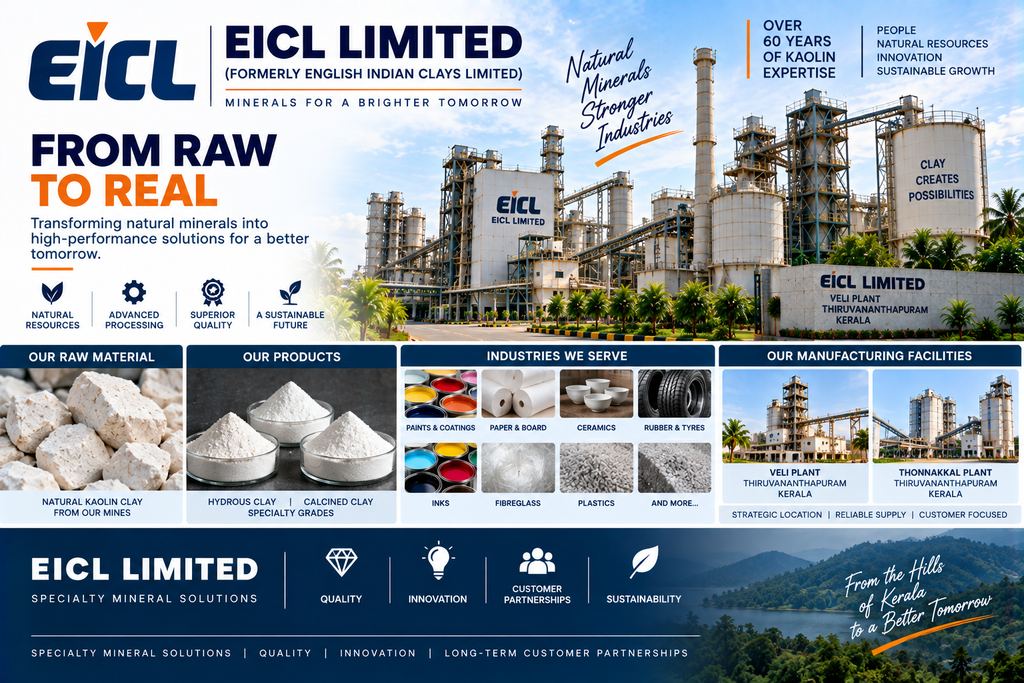
EICL Limited, formerly known as English Indian Clays Limited, is an Indian specialty-minerals company focused primarily on the mining, processing and development of kaolin/clay-based products.
The company was incorporated in 1963 and has more than six decades of operating history. It supplies processed clay solutions to industries including paints, paper, rubber, tyres, ceramics, ink and other industrial applications. EICL is an unlisted public company.
The company is part of the Karan Thapar Group, and its largest shareholder is DBH Investment Capital India Private Limited, which held 91.65% as of the latest disclosed shareholding.
Company Snapshot
| Particular | Details |
|---|---|
| Company | EICL Limited |
| Former Name | English Indian Clays Limited |
| CIN | U26939KL1963PLC002039 |
| Incorporated | 18 November 1963 |
| Status | Unlisted Public Company |
| Registered Office | TC-79/4, Veli, Thiruvananthapuram, Kerala |
| Corporate Office | Gurugram, Haryana |
| Face Value | ₹2 |
| Paid-up Capital | ~₹10.06 Cr |
| Equity Shares | ~5.03 Cr |
| ISIN | INE267F01024 |
| Promoter Holding | ~91.65% |
| Industry | Specialty Minerals / Kaolin / Clay |
| Group | Karan Thapar Group |
| Website | EICL Limited – Official Website |
The company’s official FY26 annual report confirms the CIN, registered office, management and financial statements.
What Does EICL Do?
EICL’s core business is kaolin/clay processing.
Kaolin, also known as China Clay, is a naturally occurring mineral used as a functional raw material in several industries.
The company’s products are used in:
- Paints
- Paper
- Rubber
- Tyres
- Ceramics
- Inks
- Fibreglass
- Other industrial applications
EICL describes its business as converting natural raw resources into application-specific solutions and has more than 700 customers worldwide according to its website.
Why Kaolin Is Important
Kaolin is used because it can provide properties such as:
- Whiteness
- Opacity
- Smoothness
- Reinforcement
- Absorption
- Surface modification
- Improved processing characteristics
This makes EICL an industrial-input company, rather than a commodity miner selling only raw clay.
The higher-value opportunity comes from processing the mineral into specialised grades suitable for particular customer applications.
Major Applications
1. Paint Industry
Kaolin can be used as a functional extender and performance-enhancing mineral in paints and coatings.
Paints are one of EICL’s important end markets.
2. Paper
Kaolin is used in paper coating and filling applications to improve properties such as brightness, opacity and surface finish.
3. Rubber & Tyres
Specialty clay can be used as a functional filler in rubber applications.
EICL has historically supplied the tyre and rubber industries.
4. Ceramics
Kaolin is an important raw material in ceramics because of its mineral composition and processing characteristics.
5. Industrial Specialty Applications
EICL also serves customers across other applications where customised mineral solutions are required.
Manufacturing Footprint
EICL’s major operating facilities are located in Kerala, with the company’s historical operations centred around its Veli/Thonnakkal facilities.
The FY26 annual report states that the Veli unit resumed partial operations in September 2024 after being suspended since August 2020 because of raw-material shortages. The company invested approximately ₹10 Cr in refurbishment and incremental working capital to restart the facility.
The Thonnakkal unit continued to operate at partial scale because of restrictions on the availability of clay from captive mines.
The Biggest Issue: Mining Approvals
This is the most important part of the EICL investment story.
EICL has captive mining resources in Kerala, but several larger mining blocks remain subject to statutory/environmental approvals.
The FY26 annual report states that:
- Two smaller Thonnakkal mining blocks currently have necessary approvals.
- Larger blocks in Veiloor and Mullassery remain pending.
- Raw-material availability has therefore remained constrained.
- The company has had to purchase more expensive raw materials from the open market.
- This has affected capacity utilisation, product mix and profitability.
This creates a clear operating leverage opportunity if the pending approvals are secured.
Capacity Utilisation Opportunity
The company currently operates below optimal capacity because of raw-material constraints.
Management states that once the required mining approvals are obtained, it expects to:
Increase raw-material availability
↓
Increase plant utilisation
↓
Improve product mix
↓
Reduce dependence on expensive external clay
↓
Improve profitability
The company’s FY26 annual report explicitly states that long-term growth of its Kerala manufacturing operations is contingent upon obtaining environmental and mining clearances for the larger leasehold areas.
FY26 Financial Performance
FY26 was a significant improvement over FY25.
Consolidated Financials
| ₹ Cr | FY25 | FY26 |
|---|---|---|
| Revenue from Operations | 169.45 | 191.33 |
| Other Income | 1.52 | 2.59 |
| Total Revenue | 170.97 | 193.92 |
| EBITDA / PBDIT | ~19.92 | 25.69 |
| PBT before exceptional items | 7.70 | 13.38 |
| PBT | 4.28 | 15.76 |
| PAT | 5.39 | 10.97 |
| EPS | ₹1.07 | ₹2.18 |
The FY26 audited consolidated accounts report revenue from operations of ₹191.33 Cr, total income of ₹193.92 Cr, profit before exceptional items and tax of ₹13.38 Cr, and PAT of ₹10.97 Cr.
Revenue Growth
Revenue increased from:
₹169.45 Cr → ₹191.33 Cr
representing growth of approximately:
12.9% YoY
Third-party FY26 analysis also reports revenue of approximately ₹191.32 Cr and PAT of ₹10.96 Cr.
Profitability Improvement
The operating improvement is more important than the revenue growth.
ICRA noted that EICL recorded operating profit of approximately ₹18.7 Cr in FY25 and ₹12.2 Cr in H1 FY26, compared with losses in FY23, citing improved realisations and cost-efficiency measures.
The full-year FY26 audited numbers subsequently show:
PBDIT: ₹25.69 Cr
This indicates a meaningful recovery in operating profitability.
FY26 Exceptional Items
FY26 PAT needs to be interpreted carefully.
The consolidated accounts include several exceptional items:
| Exceptional Item | FY26 |
|---|---|
| Labour Code impact | -₹1.30 Cr |
| Write-down of assets held for sale | -₹0.28 Cr |
| Profit on slump sale of subsidiary | +₹3.96 Cr |
| Net exceptional impact | +₹2.37 Cr |
Therefore, the reported FY26 PAT of ₹10.97 Cr includes a ₹3.96 Cr profit from the slump sale of the subsidiary, which is not recurring operating profit.
This distinction is important when valuing EICL.
Kaolin India Private Limited – Divestment
EICL’s wholly owned subsidiary Kaolin India Private Limited (KIPL) operated a kaolin manufacturing facility at Bhuj, Gujarat.
FY26 sales were approximately:
₹19.09 Cr
but the subsidiary recorded an operating loss of approximately:
₹0.87 Cr
The company subsequently sold KIPL’s business as a going concern on a slump-sale basis effective 31 March 2026, generating a reported profit of approximately ₹3.09 Cr at the subsidiary level / ₹3.96 Cr in the consolidated exceptional item presentation.
This simplifies EICL’s structure and reduces exposure to a business that was facing raw-material and scale-related challenges.
Balance Sheet
FY26 consolidated balance sheet:
| Particular | FY26 |
|---|---|
| Total Assets | ₹252.88 Cr |
| Total Equity | ₹158.45 Cr |
| PPE | ₹122.85 Cr |
| Inventory | ₹38.07 Cr |
| Trade Receivables | ₹42.67 Cr |
| Cash & Equivalents | ₹1.25 Cr |
| Other Financial Assets | ₹13.24 Cr |
| Borrowings | ₹40.91 Cr |
| Total Liabilities | ₹94.43 Cr |
The FY26 audited balance sheet shows consolidated equity of approximately ₹158.45 Cr and current borrowings of approximately ₹40.91 Cr, with no non-current borrowings reported at year-end.
Debt Position
One of the positive developments is the reduction in debt.
ICRA noted that improved profitability and proceeds from monetisation of land parcels helped EICL repay a healthy portion of its debt. As of February 2026, ICRA rated EICL’s facilities at [ICRA]BBB+(Stable)/[ICRA]A2, with total rated facilities of ₹52.5 Cr.
This compares with the company’s FY26 consolidated current borrowings of approximately ₹40.9 Cr.
Book Value
FY26 consolidated equity:
₹158.45 Cr
Equity shares:
~5.03 Cr
Approximate book value:
₹31.5/share
This is consistent with FY26 third-party financial databases, which report book value around ₹31.51/share.
Current Unlisted Share Price
EICL’s unlisted-market price varies significantly between intermediaries.
Recent September 2026 references include:
- Planify: ₹70.79/share as of 15 September 2026
- Moneycontrol: approximately ₹88.87/share
- Other unlisted platforms show different indicative levels.
These are OTC/indicative prices and not NSE/BSE exchange quotes.
This price dispersion is normal in unlisted securities because there is no central exchange order book.
Indicative Valuation
Using approximately 5.03 Cr shares:
At ₹70.79/share
Implied market capitalisation:
~₹356 Cr
At ₹88.87/share
Implied market capitalisation:
~₹447 Cr
At ₹88.87:
| Valuation Metric | Approx. |
|---|---|
| Market Cap | ~₹447 Cr |
| FY26 EPS | ₹2.18 |
| P/E | ~40.8x |
| Book Value | ~₹31.5 |
| P/B | ~2.82x |
| Debt/Equity | ~0.26x |
The P/E and P/B are based on FY26 reported numbers and should be treated as indicative because the shares are unlisted. FY26 financial-ratio data from Precize similarly shows P/E around 43x and debt/equity around 0.26x.
Promoter Holding
The latest disclosed shareholding shows:
| Shareholder Category | Holding |
|---|---|
| DBH Investment Capital India Pvt. Ltd. | 91.65% |
| Others/Public | 8.35% |
| Total | 100% |
DBH Investment Capital India Private Limited holds approximately 4.61 Cr shares.
The very high promoter holding also means the free float available for secondary transactions is limited.
Dividend History
EICL has historically paid dividends.
For FY25, the company declared a final dividend of:
₹0.50/share
For FY26, the Board recommended:
₹1.50/share
equivalent to 75% of the ₹2 face value.
At an indicative ₹88.87 share price, ₹1.50 dividend would represent a gross dividend yield of approximately 1.7%, subject to shareholder approval and applicable taxation.
Strategic Strengths
1. Captive mineral resources
EICL’s captive mining resources can provide a raw-material advantage when the required approvals are available.
ICRA specifically highlights captive mines as supporting quality and cost competitiveness.
2. Established customer relationships
The company serves customers across multiple industries including paper, paint, rubber and tyres.
ICRA noted that the top eight customers accounted for approximately 60% of revenue in H1 FY26, but many are market leaders in their respective sectors.
3. Product diversification
EICL is not dependent on a single application. Its products serve paper, paint, rubber, tyre, ceramic and other industrial applications.
4. FY26 turnaround
Revenue increased approximately 13% and PAT approximately doubled from FY25.
5. Debt reduction
The company has reduced debt through improved operations and asset monetisation.
6. Karan Thapar Group ecosystem
EICL is part of the broader Karan Thapar Group, providing access to group-level relationships and financial flexibility.
Key Risks
1. Mining approval risk
This is the biggest operational risk.
The company’s ability to reach full capacity depends substantially on obtaining environmental and mining approvals for larger blocks.
2. Raw-material shortage
The company has been forced to purchase expensive clay from the open market because of restricted captive-mining availability.
This can directly reduce margins.
3. Capacity under-utilisation
Both the Thonnakkal and Veli operations have been operating below optimal capacity because of raw-material constraints.
4. Customer concentration
Although the customer base is diversified by industry, ICRA notes that approximately 60% of revenue was generated by the top eight customers in H1 FY26.
5. Low free float
With promoter ownership of approximately 91.65%, only a small proportion of shares are available outside the promoter group.
6. Unlisted liquidity
There is no NSE/BSE trading order book, so buying and selling can involve:
- Limited counterparties
- Large bid/ask spreads
- Negotiated prices
- Longer exit periods
7. Valuation
At some recent indicative prices, EICL trades at more than 2.5–2.8x book value and around 40x FY26 earnings.
Therefore, the market is already assigning value to a future recovery in operations.
The Key Investment Trigger
For EICL, the most important potential operational catalyst is:
Mining approvals
If the larger mining blocks receive the required approvals, the potential chain is:
More captive clay
↓
Higher capacity utilisation
↓
Lower dependence on expensive external raw material
↓
Better product mix
↓
Improved margins
↓
Higher operating profit
The FY26 annual report itself states that obtaining these clearances is critical to increasing capacity utilisation and improving financial performance.
What Investors Should Track
For EICL, I would closely monitor:
- Mining approvals for Veiloor and Mullassery
- Capacity utilisation at Veli and Thonnakkal
- Captive vs externally purchased clay
- EBITDA margin
- Revenue growth
- Customer retention
- Debt reduction
- Cash-flow generation
- Remaining land monetisation
- Dividend payout
Valuation Framework
EICL should not be valued only on current P/E.
A more useful framework is:
Current Earnings
FY26 PAT ≈ ₹11 Cr
PLUS
Operating Recovery Potential
Higher capacity utilisation following mining approvals
PLUS
Asset Value
Land + manufacturing facilities + mining rights/resources
LESS
Debt
~₹41 Cr current borrowings
LESS
Liquidity / Unlisted Discount
This provides a better framework for understanding the company’s potential valuation.
UnlistedCart Takeaway
EICL is essentially a specialty-minerals turnaround story built around kaolin/clay.
The company has a long operating history, established industrial customers, captive mineral resources and a strong promoter group. FY26 showed a meaningful improvement: consolidated revenue reached approximately ₹191 Cr, while PAT increased to approximately ₹11 Cr from ₹5.4 Cr in FY25.
The most important issue, however, remains raw-material availability.
EICL currently has only limited access to its captive mining blocks, forcing it to procure expensive raw material externally. The company’s future earnings potential is therefore closely linked to the approval and reopening of larger mining areas.
At recent indicative unlisted prices of roughly ₹71–₹89/share, the company has an implied market capitalisation of approximately ₹356–447 Cr. Against FY26 book value of roughly ₹31.5/share, the stock is trading above book value, while FY26 P/E is around 32–41x, depending on the transaction price.
The key question for investors is therefore:
Can EICL convert its captive-resource advantage into higher capacity utilisation and sustainably higher margins once the mining constraints ease?
That is the central variable to monitor rather than simply looking at the current year’s EPS.
Disclaimer: EICL is an unlisted public company. Prices quoted by unlisted-share platforms are indicative and can differ materially between intermediaries. There is no NSE/BSE order book, and liquidity can be limited. Valuation depends on the negotiated transaction price, share availability, financial performance and future mining approvals. This report is for informational purposes only and is not investment advice.
For more such unlisted stocks visit UnlistedCart – Unlisted Shares