
Renewable IPP | Wind-Solar Hybrid | C&I Green Power | Energy Storage
Company: Continuum Green Energy Limited (CGELI)
CIN: U40102TZ2007PLC038605
Incorporated: 15 May 2007
Registered Office: Tirupur District, Tamil Nadu
Corporate Office: Mumbai, Maharashtra
Business: Renewable power generation & sale
Status: Unlisted public company
Business Model: Independent Power Producer (IPP)
Focus: Commercial & Industrial (C&I) renewable power
CEO: Arvind Bansal
COO: Nandiwada Venkatesan Venkataramanan
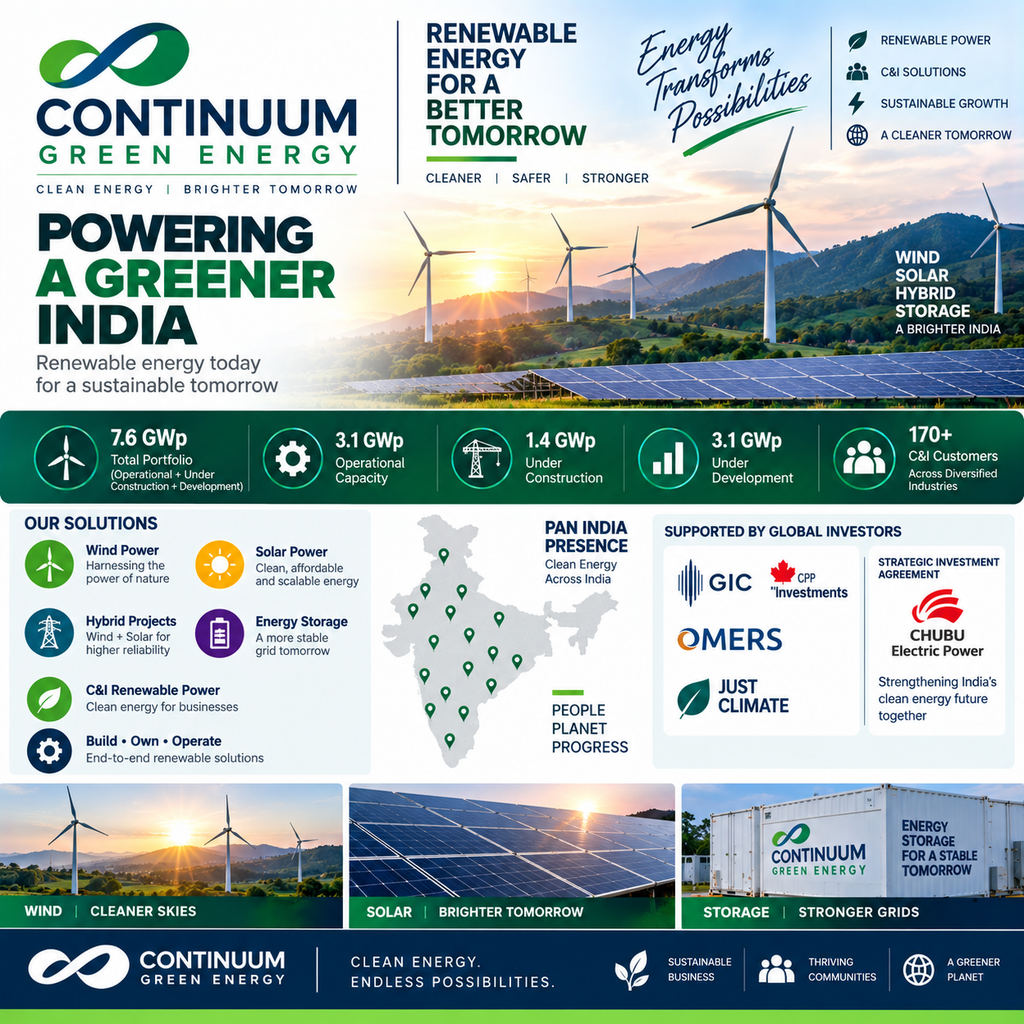
Current Portfolio: ~7.6 GWp
Operational: ~3.1 GWp
Under Construction: ~1.4 GWp
Under Development: ~3.1 GWp
1. Company Overview
Continuum Green Energy is an India-focused renewable-energy independent power producer that develops, owns and operates renewable power assets.
Unlike many renewable developers that primarily sell power to government distribution companies, Continuum has a strong focus on commercial and industrial consumers (C&I) through corporate power-purchase arrangements.
Its portfolio consists primarily of:
- Wind power
- Solar power
- Wind-solar hybrid projects
- Wind-solar-storage projects
- Battery energy storage
- Open-access renewable power
- Renewable power supplied to state/central utilities
- Power exchange sales
The company says its portfolio is approximately 7.6 GWp, comprising around 3.1 GWp operational, 1.4 GWp under construction and 3.1 GWp under development.
Continuum Green Energy – Official Website
2. Business Model
Continuum’s core model is:
Develop renewable project → Build generation capacity → Sign long-term power contracts → Generate electricity → Sell power → Earn recurring cash flows
The company primarily targets C&I customers that want to procure renewable electricity for:
- Lower carbon emissions
- Renewable-energy compliance
- Long-term power-cost visibility
- Sustainability commitments
- Reduced dependence on conventional electricity
Continuum states that more than 170 diversified C&I customers are part of its portfolio and that no single industry represents more than 25% of its contracted C&I capacity.
This customer diversification is relevant because the company is not dependent on a single industrial sector.
3. Portfolio
Current Portfolio
| Category | Capacity |
|---|---|
| Total portfolio | ~7.6 GWp |
| Operational | ~3.1 GWp |
| Under construction | ~1.4 GWp |
| Under development | ~3.1 GWp |
The portfolio includes projects such as:
- Bothe – 199.7 MW wind
- Ratlam-1 – 170 MW wind
- Perriyapatti – 256.8 MW wind-solar hybrid
- Rajkot – 394.3 MW wind-solar hybrid
- Ratlam-2 – 250 MW wind-solar hybrid
- Dalavaipuram – 372.75 MW wind-solar hybrid
- Bhavnagar – 300.8 MW wind-solar hybrid
- Dangri – 375 MW wind-solar hybrid + 90 MWh storage
- Morjar-3 – 60 MW solar + 360 MWh storage
- Latur – 256.2 MW wind-solar hybrid
Continuum Green Energy – Project Portfolio
4. Wind-Solar Hybrid Strategy
One of Continuum’s important differentiators is its focus on wind-solar hybrid projects.
Wind and solar generation patterns complement each other to some extent.
A hybrid project can potentially:
Improve utilisation of transmission infrastructure → generate power across more hours → improve overall project economics.
Continuum has also been developing projects that combine:
Wind + Solar + Battery Storage
This becomes increasingly relevant as C&I consumers demand renewable power with better reliability and more predictable generation.
5. Commercial & Industrial Opportunity
India’s C&I electricity market represents a major opportunity for renewable-energy developers.
Large companies increasingly want:
- Renewable electricity
- Long-term PPAs
- Open-access power
- Captive/group-captive structures
- Lower carbon intensity
- ESG compliance
Continuum’s portfolio has historically been heavily oriented towards C&I customers.
In one company operational presentation, C&I customers represented approximately 72.9% of the 2.9 GW portfolio at that reporting date.
The company’s current website continues to describe C&I as the majority of its operational and under-construction capacity.
6. Major Investors
Continuum has attracted capital from several global institutional investors.
The company identifies support from institutions including:
- GIC
- CPPIB
- OMERS
- Just Climate
- Domestic banks and financial institutions
The company also raised US$150 million of new equity from Just Climate in 2024 to support deployment of wind-solar-hybrid and storage projects.
Just Climate
Just Climate is an investment platform focused on climate solutions.
The 2024 investment increased Just Climate’s exposure to Continuum’s India renewable platform.
As of 31 March 2025, the Indian operating company reported:
| Shareholder | Holding |
|---|---|
| Continuum Green Energy Holdings Ltd | 85.35% |
| JC Infinity (B) Ltd | 14.65% |
| Others / nominee holdings | ~0% |
Continuum – Shareholding Pattern
7. Recent Strategic Investor – Chubu Electric Power
One of the most important recent developments is the proposed investment by Chubu Electric Power, a major Japanese utility.
On 11 June 2026, Chubu announced agreements to invest approximately:
₹1,350 crore
in Continuum Green Energy.
The investment is through a combination of primary subscription and secondary acquisition, subject to regulatory approvals.
Chubu specifically cited India’s renewable-energy expansion and the growth of C&I renewable demand as strategic reasons for the investment.
It also intends to leverage its customer network to help Japanese companies operating in India procure renewable electricity.
Chubu Electric Power – Continuum Investment Announcement
8. What Does the Chubu Investment Indicate?
The transaction is strategically relevant because Continuum gains a major international utility as a strategic partner.
Potential strategic benefits include:
- Access to Japanese corporate customers
- International renewable-energy expertise
- Additional equity capital
- Support for future project development
- Greater C&I customer diversification
- Potential financing flexibility
However, the transaction is subject to regulatory approvals, so it should not be treated as completed until the relevant conditions are satisfied.
9. Financial Performance
FY25 Standalone
The FY2024-25 standalone financial statements reported:
| Particular | FY25 |
|---|---|
| Revenue from operations | ₹193.63 Cr |
| Other income | ₹517.45 Cr |
| Total income | ₹711.08 Cr |
| Profit before tax | ₹3.80 Cr |
| PAT | ~₹(130) Cr |
| Total assets | ₹6,496.71 Cr |
| Net worth | ₹1,901.81 Cr |
| Borrowings | ₹4,076.02 Cr |
| Operating cash flow | ₹30.8 Cr |
The standalone numbers need to be interpreted carefully because the Indian parent company holds investments in project subsidiaries. A significant part of the standalone income is therefore from items such as interest, deemed dividend and fair-value movements rather than electricity sales alone.
Important
For evaluating Continuum’s underlying renewable-generation business, consolidated project-level financials and cash flows are more meaningful than standalone PAT.
The company provides its FY2024-25 consolidated financial statements through its investor-relations portal.
Continuum – Financial Statements & Annual Reports
10. Historical IPO Financials
The company’s 2024 DRHP provides useful historical consolidated financial information.
Restated Consolidated Financials
| ₹ Cr | FY22 | FY23 | FY24 |
|---|---|---|---|
| Revenue from operations | 901.15 | 970.30 | 1,294.84 |
| EBITDA | 755.65 | 837.31 | 1,011.31 |
| EBITDA Margin | 78.39% | 75.26% | 73.34% |
| PAT | -75.08 | -367.15 | -597.98 |
| Borrowings | 6,195.57 | 10,479.12 | 12,369.51 |
| Net worth | 705.62 | 330.21 | -184.32 |
These were the restated figures disclosed in the IPO documentation and therefore represent the financial position at that stage of the company’s growth cycle.
The negative PAT during these years was heavily influenced by depreciation, finance costs and the capital-intensive nature of the renewable project portfolio.
11. Why EBITDA Is Important
Renewable IPPs are capital-intensive businesses.
A typical project requires:
Land + turbines/solar modules + transmission + evacuation + construction financing
Once commissioned, operating costs can be relatively low compared with the initial capital investment.
Therefore:
High EBITDA → depreciation + interest → lower accounting PAT
This means EBITDA, project-level cash generation, debt service coverage and contracted cash flows are particularly important when analysing renewable IPPs.
12. Debt & Capital Intensity
Continuum has historically used substantial project and corporate debt to finance its expansion.
Its FY24 restated consolidated borrowings were approximately ₹12,370 crore.
This is not unusual for renewable infrastructure, but it creates important risks:
- Interest-rate movements
- Refinancing requirements
- Construction delays
- Lower-than-expected generation
- PPA delays
- Transmission delays
- Currency exposure for foreign-currency debt
S&P Global Ratings highlighted the company’s high leverage while also noting improving cash-flow coverage as commissioned capacity increased.
13. Capacity Expansion
The company has been rapidly increasing operational capacity.
At the end of March 2024, operating capacity was approximately 1,592 MW.
By October 2024, it had increased to approximately 2,128 MW.
S&P subsequently reported approximately 2.24 GW of operating capacity by early December 2024, following commissioning of nearly 936 MW of additional capacity.
The company’s current portfolio is substantially larger at approximately 3.1 GW operational, according to its current website.
This growth is important because newly commissioned projects contribute additional revenue once they enter commercial operations.
14. IPO History
Continuum filed a Draft Red Herring Prospectus (DRHP) with SEBI in December 2024.
The proposed IPO structure included:
- Fresh issue: up to ₹1,250 crore
- Offer for sale: up to ₹2,400 crore
- Possible pre-IPO placement: ₹250 crore
- Indicative total issue size: approximately ₹3,650 crore
The proposed fresh issue was primarily intended to support repayment/prepayment of borrowings at subsidiaries.
The company’s website still hosts the historical IPO/DRHP section.
15. IPO Status – Important Update
The IPO should not be treated as currently active.
Continuum’s later investor disclosures indicate that the company decided to withdraw the DRHP amid prevailing market conditions.
The December 2025 interim financial disclosure specifically states that Continuum decided to withdraw the DRHP filed with SEBI.
Therefore:
Current equity status: Unlisted
Historical IPO: DRHP filed and SEBI approval was reported in 2025.
Current IPO: No active confirmed IPO timetable identified.
This is an important distinction for unlisted-share investors.
16. Current Unlisted Share Price
There is no transparent NSE/BSE market price for Continuum Green Energy equity.
I could not identify a reliable current September 2026 OTC transaction quote that can be presented as an official market price.
Therefore, an UnlistedCart report should not invent a current share price.
Any private transaction price should be independently verified based on:
- Seller quote
- Buyer quote
- Recent transaction
- Share class
- Latest capitalisation
- Chubu transaction valuation
- Any subsequent equity issuance
17. Strategic Valuation Reference
Bloomberg reported in February 2026 that Chubu Electric was considering a roughly 15% investment at a valuation of at least US$1 billion.
The subsequent official Chubu announcement confirmed the investment agreement at approximately ₹1,350 crore, subject to approvals.
This transaction can provide a useful institutional valuation reference, but it should not automatically be treated as the current value of every unlisted share transaction because the final transaction structure includes both primary and secondary components.
18. Key Growth Drivers
1. India’s renewable-energy expansion
India’s policy target of expanding renewable capacity creates a large structural market for renewable IPPs.
2. C&I renewable demand
Companies are increasingly seeking renewable power through corporate PPAs and open-access structures.
Continuum is specifically positioned around this market.
3. Wind-solar hybrid
Hybrid projects can improve generation utilisation and make better use of transmission infrastructure.
4. Battery storage
The addition of BESS can help address intermittency and improve the value of renewable electricity.
Continuum already has projects combining renewable generation with storage.
5. International strategic investors
Just Climate and Chubu Electric provide access to international capital and strategic expertise.
6. Scale
Moving from approximately 1.6 GW operating capacity in FY24 to approximately 3.1 GW currently represents substantial expansion in the operating asset base.
19. Key Risks
High leverage
Renewable IPPs require large amounts of debt, making interest costs and refinancing important risks.
Project execution
Delays in:
- Land acquisition
- Transmission
- Equipment
- Grid connectivity
- Construction
can postpone revenue generation.
Generation risk
Wind and solar generation depends on natural resource availability.
PPA risk
Long-term contracts provide revenue visibility, but delays, renegotiations or counterparty issues can affect cash flows.
Regulatory risk
Open-access renewable power depends on state-level regulations, wheeling charges, banking rules and other regulatory frameworks.
Interest-rate risk
Higher borrowing costs can materially affect project economics.
IPO uncertainty
The previous IPO process was withdrawn, meaning unlisted investors should not assume that an IPO is an imminent liquidity event.
Valuation risk
Institutional transactions at a strategic valuation should not automatically be extrapolated to every private-market share transaction.
20. What Investors Should Track
| Metric | Why it matters |
|---|---|
| Operational MW/GW | Revenue-generating capacity |
| Under-construction capacity | Near-term growth |
| PPA coverage | Revenue visibility |
| C&I customer concentration | Counterparty risk |
| Plant availability | Asset efficiency |
| PLF | Generation performance |
| EBITDA | Operating profitability |
| Operating cash flow | Debt-servicing ability |
| Net debt/EBITDA | Leverage |
| Interest coverage | Financial stress |
| Capex/MW | Project economics |
| Storage capacity | Future grid flexibility |
| PPA tariff | Project returns |
| IPO developments | Potential liquidity |
21. Investment Framework
Continuum should primarily be analysed as an infrastructure cash-flow business, rather than simply on P/E.
A useful framework is:
Installed capacity
↓
Generation
↓
PPA / C&I sales
↓
Revenue
↓
EBITDA
↓
Interest + depreciation
↓
Cash available for debt servicing
The key question is therefore:
Can Continuum continue adding renewable capacity while maintaining adequate cash-flow coverage and controlling leverage?
22. Quick Snapshot
| Parameter | Continuum Green Energy |
|---|---|
| Incorporated | 2007 |
| Business | Renewable Energy IPP |
| Primary market | C&I consumers |
| Portfolio | ~7.6 GWp |
| Operational | ~3.1 GWp |
| Under construction | ~1.4 GWp |
| Under development | ~3.1 GWp |
| C&I customers | 170+ |
| CEO | Arvind Bansal |
| Major investor | Continuum Green Energy Holdings |
| Just Climate holding | ~14.65% as of Mar-25* |
| Recent strategic investor | Chubu Electric Power |
| Chubu investment | ₹1,350 Cr |
| Equity listed | No |
| Historical DRHP | Filed Dec-2024 |
| IPO status | DRHP subsequently withdrawn |
| Current exchange price | Not available |
| Business focus | Wind + Solar + Hybrid + Storage |
*Based on the 31 March 2025 shareholder list; subsequent transactions may have changed the ownership structure.
23. UnlistedCart Takeaway
Continuum Green Energy is a large-scale renewable IPP focused heavily on India’s C&I power market.
Its biggest strategic strengths are its ~7.6 GW portfolio, rapidly increasing operating capacity, wind-solar hybrid expertise, C&I customer base, storage pipeline and access to institutional capital.
The ₹1,350 crore strategic investment agreement with Japan’s Chubu Electric Power is an important recent development and adds another international utility partner to the platform.
At the same time, this remains a capital-intensive and highly leveraged infrastructure business. Investors should therefore focus on project-level cash generation, debt servicing, commissioning timelines, PPA quality and leverage rather than looking only at reported PAT.
The earlier IPO provides an important reference point, but the DRHP was subsequently withdrawn, so the equity remains unlisted and investors should not assume an immediate IPO exit.
Key Theme
C&I Renewable Power + Wind-Solar Hybrid + Storage + Institutional Capital + India’s Energy Transition
Official & Research Links
Continuum Green Energy – Official Website
Continuum – Financial Statements
Continuum – Company Details & Shareholding
Continuum – Investor Resources
Chubu Electric Power – ₹1,350 Crore Investment Announcement
Continuum – Investor Announcements
Continuum Holdings – Investor Information
Disclaimer
This report is prepared for informational and research purposes only and should not be considered investment advice, a recommendation, or an offer to buy or sell securities. Continuum Green Energy’s equity is unlisted and therefore has limited liquidity and less transparent price discovery than listed securities. Historical IPO information, institutional transaction valuations and private-market prices should not be assumed to represent the current fair value of the equity. Investors should independently verify the latest financial statements, shareholding, transaction documents, regulatory approvals and any private-market quotation before making an investment decision.
For more such unlisted stocks visit UnlistedCart – Unlisted Shares