Sector: Renewable Energy / Solar EPC / Green Hydrogen
Status: Unlisted Public Company
Headquarters: New Delhi / Noida, Uttar Pradesh
Incorporated: 2013
Business Model: Solar EPC + Solar Projects + Green Hydrogen + Electrolyser Manufacturing + BESS
Promoters: Anurag Jain and Aditi Jain
1. Company Overview
GH2 Solar Limited is an Indian renewable-energy company that has evolved from a solar EPC and project-development business into an integrated solar-to-hydrogen clean-energy platform.
The company was incorporated in 2013 and was subsequently converted from a private limited company into a public limited company in 2025. It was formerly known as GH2 Solar Pvt. Ltd.
The company currently describes its strategy as building an integrated green-hydrogen ecosystem covering:
- Solar generation
- Battery Energy Storage Systems (BESS)
- Green hydrogen production
- Alkaline electrolyser manufacturing
- Hydrogen refuelling infrastructure
- Fuel-cell systems
- Green ammonia and other green molecules
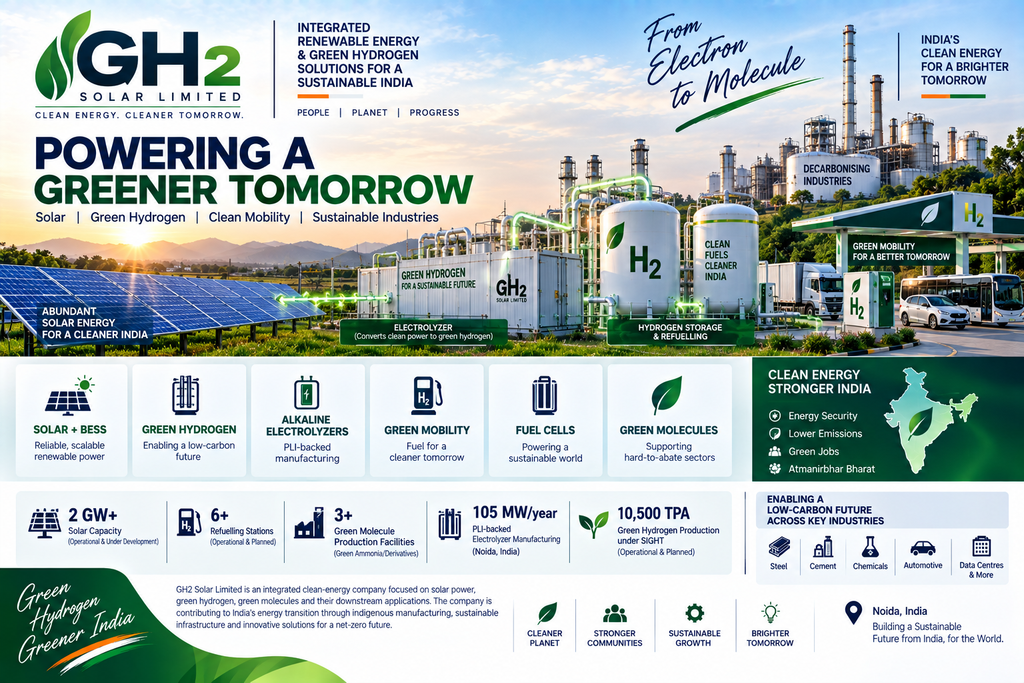
Its official website states that the company has more than 2 GW of solar capacity associated with its platform and is developing projects across solar, hydrogen and energy-storage applications.
2. Business Model
GH2 Solar can broadly be divided into two stages.
A. Existing Renewable-Energy Business
The company’s established business is solar EPC and renewable-energy project development.
It provides engineering, procurement and construction services for solar projects and has developed open-access solar assets.
The company’s current project portfolio includes:
- Maharashtra – 20 MW open-access solar park
- Karnataka – 14 MW open-access solar project
- Rajasthan – 80 MW open-access solar project
The company states that its solar platform has crossed 2 GW of capacity.
B. Green Hydrogen Platform
The newer and potentially more transformational part of the business is green hydrogen.
GH2 Solar is attempting to integrate:
Renewable electricity → Electrolyser → Green hydrogen → Industrial/Mobility applications
This gives the company exposure to a much larger clean-energy value chain than conventional solar EPC.
3. Electrolyser Manufacturing
One of GH2 Solar’s most important projects is its alkaline electrolyser manufacturing facility in Morena, Madhya Pradesh.
The facility is being developed in partnership with South Korean technology company AHES.
The company states that the initial manufacturing capacity is:
105 MW per year
with potential expansion to:
500 MW per year
The facility received a groundbreaking ceremony in August 2025 and is being developed under India’s National Green Hydrogen Mission.
The strategic significance is important.
Instead of only building hydrogen plants using equipment purchased from third parties, GH2 Solar intends to manufacture the core electrolyser systems itself.
This could potentially provide:
- Higher value addition
- Better control over technology
- Equipment-sales revenue
- Lower dependence on imports
- Export opportunities
- Recurring aftermarket/service opportunities
4. South Korean Technology Partnership
GH2 Solar has partnered with AHES Co. Ltd. of South Korea for alkaline electrolyser technology.
According to the company, the partnership combines South Korean electrolyser technology with Indian manufacturing and project execution.
The company describes the technology as advanced alkaline stack technology with applications across industrial hydrogen production and infrastructure.
This partnership is particularly relevant because electrolyser technology is still developing rapidly and technological efficiency can materially affect the economics of green hydrogen.
5. Green Hydrogen Production
GH2 Solar is also developing green-hydrogen production capabilities.
Its official website states that it has received PLI-related support for:
Green hydrogen production – 10,500 tonnes per annum
and:
Electrolyser manufacturing – 105 MW per annum
under India’s National Green Hydrogen Mission framework.
The company has also announced a proposed green-hydrogen facility in Andhra Pradesh.
The MoU involves:
Capacity: 10,500 tonnes per year
Proposed investment: approximately ₹1,300 crore
The company expects the project to create more than 500 direct and 1,500 indirect employment opportunities.
Important Data Note
Some secondary sources and rating documents use a figure of 105,000 MT/year for green-hydrogen production capacity, whereas GH2 Solar’s current official website and its Andhra Pradesh announcement refer to 10,500 TPA.
For this report, the more conservative 10,500 TPA figure is used because it is consistent with the company’s current official materials.
6. Major Hydrogen Projects
GH2 Solar’s website currently identifies several hydrogen-related projects and opportunities.
V.O. Chidambaranar Port, Tamil Nadu
Green Hydrogen Demonstration Project awarded under a Government of India programme.
NHPC – Leh
Hydrogen fuel-cell microgrid project.
KP Group
Green hydrogen and hydrogen-refuelling infrastructure.
Green Ammonia
GH2 Solar, AHES and KP Group are working on a green-ammonia project.
Hydrogen Refuelling
The company currently reports more than 6 refuelling stations on its website.
These projects are strategically important because they demonstrate that the company is trying to develop hydrogen applications beyond simply manufacturing electrolysers.
7. Financial Performance
Consolidated Financial Snapshot
| ₹ Crore | FY22 | FY23 | FY24 | FY25 |
|---|---|---|---|---|
| Revenue | 17.31 | 61.72 | 64.77 | 214.61 |
| PAT | 0.59 | 0.93 | 3.46 | 19.56 |
| PAT Margin | ~3% | ~2% | ~5% | ~9% |
| EPS | — | — | — | ₹10.04 |
FY25 marked a significant acceleration in the company’s scale.
According to CRISIL, consolidated operating income increased to approximately ₹214.8 crore in FY25, compared with ₹64.77 crore in FY24.
PAT increased from ₹3.46 crore to approximately ₹19.56 crore.
The financial statements available through an unlisted-share database report revenue from operations of ₹214.61 crore and PAT of ₹19.56 crore for FY25.
8. FY25 Profitability
The FY25 numbers show a substantial improvement in profitability.
FY24
Revenue: ₹64.77 Cr
PAT: ₹3.46 Cr
PAT Margin: ~5.3%
FY25
Revenue: ₹214.61 Cr
PAT: ₹19.56 Cr
PAT Margin: ~9.1%
This represents approximately:
Revenue growth: ~231%
PAT growth: ~465%
The improvement was supported by increased scale and healthy operating margins.
CRISIL reported that the company maintained operating margins in the broad 13–14% range, while interest coverage was approximately 17.6x in FY25.
9. Balance Sheet
FY25 consolidated balance-sheet figures were approximately:
| Particular | FY25 |
|---|---|
| Equity Share Capital | ₹4.29 Cr |
| Reserves & Surplus | ₹54.71 Cr |
| Long-Term Borrowings | ₹0.12 Cr |
| Short-Term Borrowings | ₹46.41 Cr |
| Trade Receivables | ₹56.86 Cr |
| Cash & Cash Equivalents | ₹5.66 Cr |
| Total Assets | ₹129.96 Cr |
The company therefore had relatively modest long-term debt but meaningful short-term borrowings.
The large trade-receivables balance is an important working-capital consideration for an EPC business.
10. Cash Flow
This is one of the most important areas to monitor.
FY25 operating cash flow was approximately:
₹(22.19) crore
despite PAT of approximately ₹19.56 crore.
The main reasons included:
- Increase in trade receivables
- Increase in short-term advances
- Increase in other current assets
- Reduction in trade payables
Trade receivables increased substantially, absorbing cash from the business.
Cash Flow Structure
| FY25 | ₹ Cr |
|---|---|
| Operating Cash Flow | -22.19 |
| Investing Cash Flow | -41.52 |
| Financing Cash Flow | +66.52 |
| Net Change in Cash | +2.81 |
This means the company’s positive year-end cash movement was supported substantially by financing rather than operating cash generation.
For an EPC company growing rapidly, this isn’t automatically a negative signal, but it becomes important if negative cash conversion continues for several years.
11. Credit Rating
GH2 Solar received a CRISIL BBB-/Stable long-term rating and CRISIL A3 short-term rating in November 2025.
CRISIL rated ₹100 crore of bank facilities.
CRISIL highlighted:
- Favourable solar-industry demand
- Promoter experience
- Strong revenue growth
- Healthy interest coverage
- Relatively healthy capital structure
At the same time, CRISIL identified risks from:
- Increasing competition
- Raw-material price volatility
- Regulatory changes
- Execution of the ongoing project
- Potential working-capital pressure
- Large debt-funded capex
The rating is therefore useful evidence that the company had a reasonably established financial profile by FY25, while its new hydrogen investments remain a key execution variable.
12. Capital Structure
CRISIL reported FY25 adjusted gearing of approximately:
0.79x
and total outside liabilities to adjusted net worth of approximately:
1.20x
Interest coverage stood at approximately:
17.6x
These numbers indicate that the company entered its hydrogen expansion phase from a relatively manageable leverage position.
However, this could change if the company funds large electrolyser and hydrogen projects primarily through debt.
13. Current Unlisted Share Price
GH2 Solar remains unlisted.
A current unlisted-market source reports an indicative price of approximately:
₹274 per share as of 18 September 2026
with an indicative market capitalization of approximately:
₹534 crore.
Another unlisted-share platform currently displays:
₹252 per share
indicating that OTC quotations differ between intermediaries.
Therefore, a reasonable current indicative range based on the sources checked is approximately:
₹250–₹275 per share
This is not an NSE/BSE market price. GH2 Solar is an unlisted company and these are indicative OTC quotations.
14. Indicative Valuation
The current indicative share count reported by an unlisted-market source is approximately:
1.948 crore shares
At ₹274 per share:
Indicative equity value ≈ ₹534 crore
FY25 EPS was approximately:
₹10.04
Therefore:
Indicative P/E at ₹274 ≈ 27.3x
At ₹252:
Indicative P/E ≈ 25.1x
This means the current valuation is materially above the company’s FY25 earnings base, but it is not at the extremely high earnings multiples seen in some early-stage hydrogen businesses.
The market appears to be assigning value to both:
- The existing profitable solar EPC business
- The potential future hydrogen/electrolyser business
15. Valuation Framework
For GH2 Solar, using only a conventional P/E approach is not sufficient.
A more appropriate framework would separate the business into:
Existing Solar EPC
Value based on:
- Revenue
- EBITDA
- PAT
- Working capital
- Order book
- ROCE
Electrolyser Manufacturing
Potential value based on:
- MW manufacturing capacity
- Utilisation
- Electrolyser selling price
- EBITDA margin
- Technology competitiveness
Green Hydrogen Production
Potential value based on:
- Hydrogen production capacity
- PPA/offtake agreements
- Renewable electricity cost
- Electrolyser efficiency
- Hydrogen selling price
- Plant utilisation
- Project IRR
BESS / Fuel Cells / Green Molecules
These should be valued based on actual commercialisation rather than headline project announcements.
16. Key Growth Drivers
1. India’s Green Hydrogen Mission
India’s push toward domestic green hydrogen production creates a new market for electrolysers, hydrogen production, storage and distribution infrastructure.
GH2 Solar is directly targeting several of these segments.
2. Electrolyser Manufacturing
The planned 105 MW/year manufacturing facility could provide an additional revenue stream beyond EPC.
The company’s stated expansion potential to 500 MW could become significant if utilisation rises.
3. Green Hydrogen Production
The proposed 10,500 TPA production project in Andhra Pradesh has an estimated investment of approximately ₹1,300 crore.
If executed successfully, this would substantially increase the scale of the company’s hydrogen business.
4. Solar + Hydrogen Integration
One of GH2 Solar’s strongest strategic features is the ability to combine renewable electricity generation with hydrogen production.
The basic model is:
Solar → Electricity → Electrolyser → Hydrogen
This potentially allows the company to participate in several layers of the clean-energy value chain.
5. Hydrogen Mobility
Hydrogen refuelling stations and fuel-cell systems give GH2 Solar exposure to heavy transport and long-distance mobility applications.
The company currently reports more than six refuelling stations.
6. Green Ammonia
Green hydrogen can be converted into green ammonia, creating potential applications in:
- Fertiliser
- Shipping
- Industrial chemicals
- Energy transportation
GH2 Solar is developing a green-ammonia project with AHES and KP Group.
17. Major Risks
Hydrogen Economics
Green hydrogen remains more expensive than conventional grey hydrogen in many applications.
The economics depend heavily on:
- Renewable electricity costs
- Electrolyser costs
- Utilisation
- Financing costs
- Hydrogen offtake prices
Project Execution
GH2 Solar is moving from an established solar EPC business into much larger hydrogen manufacturing and production projects.
Execution risk therefore increases significantly.
Working Capital
FY25 operating cash flow was negative ₹22.19 crore despite strong reported profit.
A sustained deterioration in working-capital cycles could increase dependence on debt.
Capital Expenditure
The proposed hydrogen projects require substantial capital.
The Andhra Pradesh project alone has been described as approximately ₹1,300 crore.
Technology Risk
Electrolyser technology is evolving quickly.
GH2 Solar’s partnership with AHES provides technology access, but the company will still need to demonstrate competitive efficiency, reliability and cost.
Competition
The company faces competition from:
- Established renewable EPC companies
- Large industrial groups
- Global electrolyser manufacturers
- Indian electrolyser manufacturers
- Large hydrogen developers
Regulatory Risk
Green hydrogen economics are influenced by government incentives, renewable-energy regulations, certification standards and offtake policies.
Changes in these frameworks could affect project returns.
18. Solar EPC vs Hydrogen Opportunity
| Factor | Solar EPC | Green Hydrogen |
|---|---|---|
| Current maturity | Established | Emerging |
| GH2 experience | Strong | Developing |
| Revenue visibility | Existing projects | Project-dependent |
| Capital requirement | Moderate | High |
| Technology risk | Lower | Higher |
| Growth potential | High | Potentially very high |
| Cash-flow predictability | Moderate | Yet to be demonstrated |
| Competition | High | Increasing |
| Valuation contribution | Current earnings | Future expectations |
This distinction is important.
The solar EPC business is the current earnings engine.
Hydrogen is the future growth option.
19. What to Monitor
For an investor evaluating GH2 Solar, the following numbers are particularly important:
| Metric | Why It Matters |
|---|---|
| Solar EPC revenue | Existing business scale |
| EBITDA margin | Operating profitability |
| Operating cash flow | Quality of earnings |
| Trade receivables | Working-capital risk |
| Net debt | Financial leverage |
| Electrolyser capacity | New-business scale |
| Electrolyser utilisation | Manufacturing economics |
| Hydrogen production capacity | Future revenue |
| Hydrogen offtake agreements | Revenue visibility |
| Hydrogen production cost | Competitiveness |
| BESS capacity | Additional growth |
| ROCE | Capital efficiency |
| IPO/listing plans | Future liquidity |
20. Investment Perspective
GH2 Solar is more interesting than a conventional solar EPC company because it is attempting to build an integrated renewable-energy and green-hydrogen platform.
The existing business provides a financial base:
FY25 revenue: ~₹215 crore
FY25 PAT: ~₹19.6 crore
The company is then using this base to expand into:
Solar → BESS → Electrolysers → Green Hydrogen → Fuel Cells → Green Molecules
The FY25 financial performance was strong, with revenue growing more than threefold and PAT increasing substantially. CRISIL also reported strong interest coverage and a BBB-/Stable rating.
However, the next phase is much more capital intensive.
The most important question is whether GH2 Solar can convert its hydrogen ambitions into commercial projects, manufacturing revenue and cash-generating assets.
At an indicative unlisted price of around ₹250–₹275, the market is already assigning a valuation significantly above the FY25 earnings base.
Therefore, the investment thesis increasingly depends on successful execution of the hydrogen strategy rather than simply continued growth in solar EPC.
21. Overall Company Snapshot
| Parameter | GH2 Solar |
|---|---|
| Company | GH2 Solar Limited |
| Sector | Renewable Energy / Green Hydrogen |
| Status | Unlisted |
| Incorporated | 2013 |
| FY25 Revenue | ~₹214.6 Cr |
| FY25 PAT | ~₹19.6 Cr |
| FY25 EPS | ~₹10.04 |
| FY25 Operating Cash Flow | ~₹-22.2 Cr |
| Electrolyser Capacity | 105 MW/year initially |
| Potential Electrolyser Capacity | Up to 500 MW |
| Green Hydrogen Capacity | 10,500 TPA stated by company |
| Solar Platform | 2 GW+ |
| Credit Rating | CRISIL BBB-/Stable; A3 |
| Indicative Unlisted Price | ~₹250–₹275 |
| Indicative Market Cap | ~₹500–₹535 Cr |
| Indicative FY25 P/E | ~25–27x |
22. Corporate Details
Company: GH2 Solar Limited
CIN: U35105DL2013PLC249995
Registered Office: Unit No. 1, Plot No. 2, DDA Building, District Centre, Nehru Place, New Delhi – 110019
Corporate/Business Office: Q Tower, A-8, Block A, Sector 68, Noida, Uttar Pradesh – 201301
Website: GH2 Solar – Official Website
Company Downloads: GH2 Solar Downloads
Credit Rating: CRISIL GH2 Solar Rating Rationale
23. Conclusion
GH2 Solar Limited represents a transition from a conventional solar EPC company toward an integrated clean-energy platform.
Its FY25 performance demonstrates that the existing solar business has achieved meaningful scale, with approximately ₹215 crore of revenue and ₹19.6 crore of consolidated PAT.
The company’s future story, however, is increasingly linked to green hydrogen.
The combination of:
Solar + Electrolyser Manufacturing + Green Hydrogen + BESS + Fuel Cells + Green Ammonia
could create a much larger addressable market than the company’s historical solar EPC business.
At the same time, hydrogen projects require significant capital, have technology and execution risks, and have not yet demonstrated the same earnings and cash-flow maturity as the existing solar business.
The most important metrics to watch over the next 2–3 years are therefore electrolyser utilisation, hydrogen project commissioning, offtake agreements, operating cash flow, debt levels and ROCE.
At the current indicative unlisted valuation, the investment case is increasingly dependent on GH2 Solar successfully converting its hydrogen expansion plans into profitable, cash-generating operations.
Disclaimer
This report is for educational and informational purposes only and does not constitute investment advice or a recommendation to buy, sell or hold GH2 Solar Limited shares.
GH2 Solar Limited is currently unlisted. Unlisted-share prices are indicative OTC quotations and may differ materially between intermediaries. They are not equivalent to NSE/BSE market prices and may have limited liquidity.
Financial information should be cross-checked with the company’s latest audited financial statements, MCA filings, credit-rating reports and other official disclosures before making any investment decision.
For more such unlisted stocks visit UnlistedCart – Unlisted Shares