Company Overview
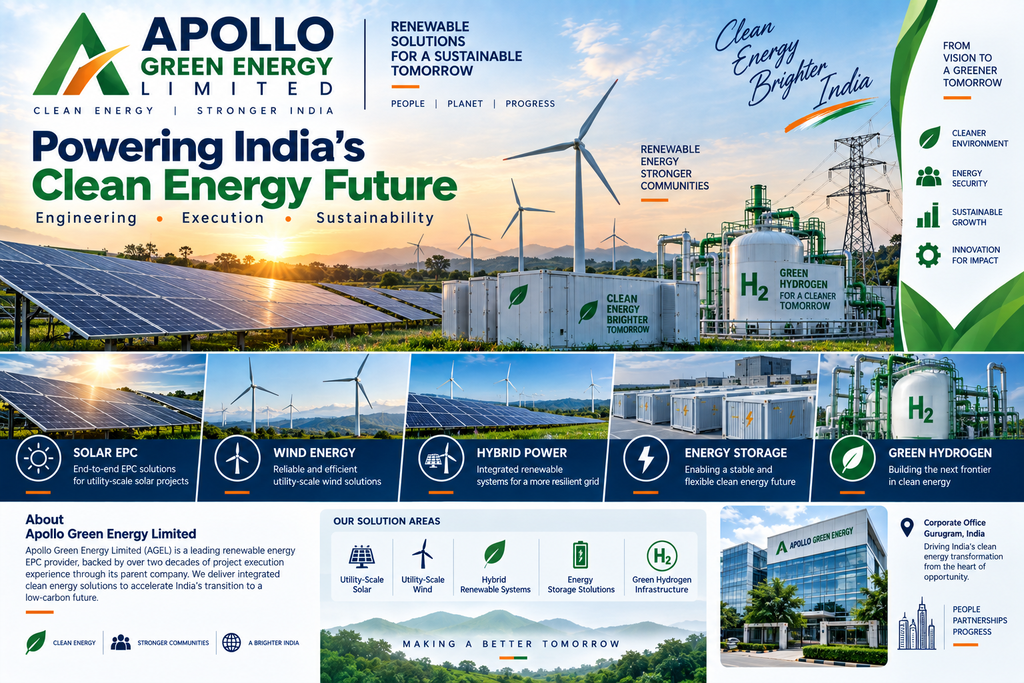
Apollo Green Energy Limited (AGEL) is an unlisted public company operating in the renewable energy and infrastructure space. The company was incorporated in 1994 and was formerly known as Apollo International Limited. It subsequently repositioned itself toward green energy, renewable EPC and sustainable infrastructure projects.
The company is part of the broader Apollo Group and is headquartered in Gurugram, Haryana, with its registered office in New Delhi.
AGEL’s business has evolved from a diversified trading and infrastructure background toward a more focused green-energy platform covering solar EPC, renewable power projects, battery energy storage systems (BESS), green hydrogen, transmission infrastructure and other sustainable-energy solutions.
Company Name: Apollo Green Energy Limited
Former Name: Apollo International Limited
Incorporated: 25 August 1994
CIN: U74899DL1994PLC061080
ISIN: INE838A01015
Face Value: ₹10 per share
Listing Status: Unlisted
Depository: NSDL & CDSL
Registered Office: DLF Courtyard, Saket, New Delhi
Corporate Office: Apollo Towers, Sector 44, Gurugram
Business Model
Apollo Green Energy operates primarily around renewable-energy EPC and green-infrastructure opportunities.
1. Renewable Energy EPC
The company provides engineering, procurement and construction services for renewable-energy projects, particularly solar projects.
Its EPC activities involve project development, engineering, procurement of equipment, construction, commissioning and related infrastructure.
The company has previously disclosed a portfolio of solar projects across multiple states and has targeted significant expansion in its renewable EPC order book.
2. Solar Power
Solar power is a key part of AGEL’s transition toward a pure-play green-energy business.
The company has worked on utility-scale solar projects and has indicated plans to expand its presence in solar generation and EPC.
3. Battery Energy Storage Systems
Energy storage is becoming increasingly important as India’s renewable-energy capacity expands.
AGEL has entered the BESS segment, offering battery-based storage solutions designed to store surplus renewable power and provide electricity when demand or grid requirements increase.
4. Green Hydrogen
The company has identified green hydrogen as another potential growth vertical.
Management has previously discussed working with international technology partners to develop capabilities in the green-hydrogen ecosystem, including areas involving electrolyser and fuel-cell technologies.
5. Transmission & Infrastructure
AGEL also participates in EPC and infrastructure projects beyond solar, including transmission-related work and other power-sector infrastructure.
This gives the company an opportunity to participate in the broader expansion of India’s electricity infrastructure.
Strategic Transformation
Apollo Green Energy’s key strategic change has been its transition from a diversified business model toward renewable and sustainable infrastructure.
The company’s earlier operations included trading, international business and other non-core activities. Management has subsequently focused on renewable energy and EPC.
The FY25 annual report states that the decline in revenue was primarily influenced by the disposal of non-core verticals, while standalone profitability improved.
This means the decline in reported revenue should not be viewed in isolation. Part of the reduction reflects business restructuring and disposal of non-core activities.
Renewable Energy Opportunity
India’s energy transition creates a large addressable market for companies operating in solar EPC, energy storage, transmission and green hydrogen.
Apollo Green Energy has previously targeted a ₹10,000 crore project portfolio, with a significant portion intended for renewable-energy projects. In 2024, the company had indicated an order book of approximately ₹3,500 crore and active solar projects worth around ₹2,500 crore.
In January 2025, management also indicated that approximately 90% of its targeted project portfolio would be focused on renewable energy, with the remainder in conventional EPC.
Financial Performance
Consolidated Financials
| Particulars | FY22 | FY23 | FY24 | FY25 |
|---|---|---|---|---|
| Revenue from Operations | ₹810 Cr | ₹753 Cr | ₹1,234 Cr | ₹806 Cr |
| EBITDA | ₹59 Cr | ₹22 Cr | ₹71 Cr | ₹23 Cr |
| PBT | ₹78 Cr | ₹32 Cr | ₹41 Cr | ₹43 Cr |
| PAT | ₹41 Cr | ₹25 Cr | ₹39 Cr | ₹34 Cr |
| EPS | ₹21.58 | ₹13.16 | ₹20.26 | ₹10.62 |
FY25 consolidated revenue from operations stood at approximately ₹806.48 crore, compared with ₹1,234.27 crore in FY24.
However, consolidated PBT increased to approximately ₹42.58 crore from ₹41.17 crore, while PAT was approximately ₹33.66 crore versus ₹38.59 crore in FY24.
The revenue decline was therefore accompanied by comparatively stable pre-tax profitability, partly reflecting the company’s restructuring and exit from non-core activities.
Profitability
FY24 was a stronger year in terms of operating revenue and EBITDA.
However, FY25 saw a substantial reduction in revenue and EBITDA:
- FY24 Revenue: ~₹1,234 Cr
- FY25 Revenue: ~₹806 Cr
- FY24 EBITDA: ~₹71 Cr
- FY25 EBITDA: ~₹23 Cr
- FY24 PAT: ~₹39 Cr
- FY25 PAT: ~₹34 Cr
The reported EBITDA margin declined from approximately 5.8% in FY24 to around 2.9% in FY25 based on the commonly reported financial data.
This indicates that the company is still operating on relatively thin EPC margins and that execution, project mix and working-capital efficiency will be important determinants of future profitability.
Balance Sheet
Selected FY25 figures:
| Particulars | FY25 |
|---|---|
| Shareholders’ Funds | ~₹665 Cr |
| Total Debt | ~₹493 Cr |
| Current Liabilities | ~₹631 Cr |
| Non-Current Liabilities | ~₹284 Cr |
| Total Assets | ~₹1,581 Cr |
| Current Assets | ~₹711 Cr |
Shareholders’ funds increased substantially over the FY22–FY25 period, while debt also increased in FY25 after declining during FY23–FY24.
Share Capital & Promoter Holding
The FY25 annual report records 4,06,10,287 equity shares outstanding at March 31, 2025.
During FY25, the company issued:
- 1,06,10,287 fully paid equity shares
- 1,10,00,000 partly paid equity shares
This resulted in a significant expansion of the company’s equity base.
Promoter Shareholding – March 2025
| Promoter | Shares | Holding |
|---|---|---|
| RK Eternanova Pvt. Ltd. | 79,40,812 | 19.55% |
| Raaja Kanwar | 68,43,733 | 16.85% |
| OSK Holdings (AIL) Pvt. Ltd. | 57,00,500 | 14.04% |
| AIL Consultants Pvt. Ltd. | 28,50,000 | 7.02% |
| Others/Public | 1,72,75,242 | 42.54% |
| Total | 4,06,10,287 | 100% |
The promoter group held approximately 57.46% of the company at March 31, 2025.
Cash Flow
Cash generation remains an important area to monitor.
| Particulars | FY22 | FY23 | FY24 | FY25 |
|---|---|---|---|---|
| CFO | ₹32.8 Cr | -₹79.6 Cr | ₹14.2 Cr | ₹2 Cr |
| CFI | ₹50.5 Cr | ₹381 Cr | -₹35.1 Cr | -₹179.7 Cr |
| CFF | -₹69.5 Cr | -₹304.6 Cr | ₹5.6 Cr | ₹182.9 Cr |
| Free Cash Flow | -₹49.4 Cr | -₹563.2 Cr | ₹10.3 Cr | -₹1.1 Cr |
FY25 operating cash flow was only around ₹2 crore despite the company reporting a profit.
This highlights the importance of working-capital management in the EPC business. Cash can remain tied up in receivables, project execution and advances even when accounting profits are positive.
Order Book & Project Pipeline
Apollo Green Energy has historically communicated an ambitious renewable-energy project pipeline.
In 2024, the company announced a project portfolio target of approximately ₹10,000 crore, with an order book of around ₹3,500 crore and approximately ₹2,500 crore of solar projects under development.
In 2025, Moneycontrol reported that the company had more than 400 MW of solar capacity in its portfolio and an order book of approximately ₹3,000 crore, with a target of reaching a 1 GW EPC order book by 2026.
For investors, the important distinction is between a pipeline, awarded order book and executable revenue. A large announced pipeline does not automatically translate into revenue or cash flow.
IPO Plans
Apollo Green Energy has discussed a potential public listing for several years.
Management indicated in January 2025 that it was targeting an IPO by the fourth quarter of calendar year 2025.
Earlier reports had also indicated plans to use IPO proceeds to fund green projects, particularly solar power, with additional investments in battery storage, green hydrogen and EV charging infrastructure.
However, as of September 2026, there is no confirmed IPO date or publicly established IPO price band that can be treated as final.
Therefore, investors should not value the shares assuming a particular future listing price.
Credit Rating & Debt Risk
This is one of the most important sections of the Apollo Green Energy investment case.
In April 2024, CRISIL had reaffirmed AGEL’s bank-facility ratings at CRISIL BBB/Stable and CRISIL A3+, citing factors including a diversified revenue profile, geographical presence, financial risk profile and EPC order book.
However, the rating situation subsequently deteriorated.
In September 2025, CRISIL downgraded AGEL’s ₹330 crore of rated bank facilities to CRISIL D / Issuer Not Cooperating, stating that the company had not provided required information and that there were irregularities in account conduct.
Infomerics also continued AGEL’s ratings in the Issuer Not Cooperating category and reported that it had not received the required No Default Statement since May 2025.
A December 2025 Infomerics disclosure also stated that information regarding payment of interest and principal on a particular NCD had not been received.
These developments make the company’s financing position and debt servicing an important due-diligence issue.
Capital Raising
The company has also pursued equity capital raising.
Moneycontrol reported in September 2025 that AGEL had announced a proposed private placement involving approximately ₹4,110 crore, although only around ₹78 crore had reportedly been raised as of July 2025.
For an unlisted shareholder, future capital raising is important because additional equity issuance can lead to share dilution, while successful capital infusion can strengthen the balance sheet and fund expansion.
The effect therefore depends on the issue price, amount raised and how the proceeds are deployed.
Current Unlisted Share Price
Unlisted-market prices vary considerably because Apollo Green Energy does not trade on NSE or BSE.
Recent September 2026 references include:
- Around ₹66 on September 10–14, 2026 from UnlistedZone/BuyUnlistedShares.
- Around ₹67.46 on Moneycontrol’s displayed reference.
- Around ₹85 on another unlisted-market platform.
- Other dealers have displayed prices above ₹100.
These are indicative OTC/unlisted-market references rather than exchange prices, and the differences demonstrate the limited liquidity and price-discovery issues associated with unlisted securities.
For valuation purposes, a single dealer quotation should therefore not be treated as an authoritative market price.
Indicative Valuation
Using 4.061 crore shares and an illustrative unlisted price of ₹66:
Implied Equity Value ≈ ₹268 crore
At ₹85:
Implied Equity Value ≈ ₹345 crore
At ₹100:
Implied Equity Value ≈ ₹406 crore
Using FY25 PAT of approximately ₹33.66 crore, the implied P/E would be approximately:
| Indicative Price | Approx. Market Cap | FY25 P/E |
|---|---|---|
| ₹66 | ₹268 Cr | ~8.0x |
| ₹85 | ₹345 Cr | ~10.2x |
| ₹100 | ₹406 Cr | ~12.1x |
These calculations are illustrative and should not be interpreted as a target valuation.
There is also a complication in using P/E: the company’s FY25 earnings were affected by business restructuring, while future earnings could change substantially depending on the success of the renewable-energy transition.
Key Growth Drivers
Renewable Energy Expansion
India’s continued investment in solar, transmission and energy storage provides a large addressable market for renewable EPC companies.
Solar EPC
The company’s experience in solar EPC provides an established platform from which it can expand its renewable portfolio.
Battery Storage
The rapid growth of intermittent renewable generation increases the need for BESS and other storage solutions.
Green Hydrogen
Green hydrogen represents a potentially large long-term market, although commercialization and project economics remain uncertain.
Transmission Infrastructure
Growing renewable-energy penetration requires additional transmission infrastructure, creating opportunities for EPC companies.
Business Simplification
The company’s move away from non-core businesses could eventually make the business more focused on renewable infrastructure.
Key Risks
1. Credit & Liquidity Risk
The deterioration in credit ratings and reported payment-related issues are significant risks and require close monitoring.
2. Working Capital
EPC companies can report accounting profits while generating weak operating cash flow because funds remain locked in receivables, project advances and inventories.
3. Thin Margins
FY25 EBITDA margins were below 3%, leaving limited room for execution mistakes or cost overruns.
4. Capital Requirements
Solar, BESS, green hydrogen and infrastructure projects require significant capital. Future growth could require additional debt or equity.
5. Equity Dilution
Large private placements or future fundraising could increase the number of outstanding shares and dilute existing shareholders.
6. IPO Uncertainty
Although management has previously discussed an IPO, there is currently no confirmed listing date or price band.
7. Execution Risk
Renewable EPC projects are exposed to land acquisition, grid connectivity, equipment availability, project delays and cost escalation.
8. Unlisted-Market Liquidity
Apollo Green Energy shares are not traded on NSE/BSE. Finding buyers or sellers can therefore take time, and quoted prices may differ substantially between intermediaries.
Investment Perspective
Apollo Green Energy presents a combination of renewable-energy growth potential and significant financial/execution risks.
The positive side of the story is the company’s transition toward solar EPC, BESS, green hydrogen and other sustainable infrastructure activities. The company has also built experience in renewable EPC and has communicated sizeable project ambitions.
However, the financial picture requires careful attention.
FY25 revenue declined sharply to around ₹806 crore, EBITDA fell to approximately ₹23 crore, and operating cash flow was only around ₹2 crore. More importantly, the company’s credit-rating history changed materially during 2025, with CRISIL assigning a D rating under an “Issuer Not Cooperating” classification and Infomerics also highlighting information-availability and payment-related concerns.
Consequently, the key variables to monitor are:
- Improvement in debt servicing
- Restoration/clarification of credit ratings
- Operating cash-flow improvement
- New renewable-energy orders
- Execution of the existing order book
- Successful capital raising
- Extent of future equity dilution
- Progress toward a formal IPO process
- Sustainable improvement in EBITDA margins
Important Links
Company Website: Apollo Green Energy Official Website
Annual Reports: Apollo Green Energy Annual Reports
FY25 Annual Report: FY25 Annual Report
CRISIL Rating Rationale: CRISIL Rating Rationale – September 2025
Infomerics Rating Rationale: Infomerics Rating Rationale
Corporate Details
Company: Apollo Green Energy Limited
Formerly: Apollo International Limited
CIN: U74899DL1994PLC061080
ISIN: INE838A01015
Face Value: ₹10
Status: Unlisted Public Company
Registered Office: Office No. 303, Third Floor, DLF Courtyard, Saket, New Delhi – 110017
Corporate Office: Apollo Towers, Plot No. 20, Sector 44, Gurugram – 122002
RTA: Alankit Assignments Limited
Conclusion
Apollo Green Energy is undergoing a strategic transformation from a diversified business into a renewable-energy and green-infrastructure company.
Its focus on solar EPC, BESS, green hydrogen and transmission provides exposure to India’s broader energy-transition investment cycle. The company’s project pipeline and historical EPC experience provide a platform for future growth.
At the same time, the company should be viewed with caution because of its weak FY25 operating cash generation, lower EBITDA, capital requirements, equity dilution risk and the significant deterioration in credit-rating disclosures during 2025.
For unlisted-market investors, the investment case therefore depends heavily on whether Apollo Green Energy can strengthen its balance sheet, improve cash conversion, execute renewable projects profitably and establish a clearer path toward a future public listing.
The most important developments to track going forward are debt servicing, credit-rating improvement, operating cash flow, new orders, capital raising and any formal IPO filing.
Disclaimer
This report is prepared for educational and informational purposes only and should not be considered investment advice, a recommendation to buy or sell securities, or a solicitation to invest.
Apollo Green Energy Limited is an unlisted company, and its shares are traded through private/off-market transactions rather than NSE or BSE. Prices quoted in the unlisted market are indicative and can vary significantly between buyers and sellers.
Financial figures are based primarily on publicly available company filings and other published sources. Certain market-price, valuation and shareholding data may vary by date and source.
Investors should independently verify the latest financial statements, share capital, valuation, debt position, credit ratings and IPO status before making any investment decision.
The author is not a SEBI-registered Research Analyst unless specifically stated otherwise.
For more such unlisted stocks visit Unlisted Shares – UnlistedCart