
Company: Tata Electronics Private Limited
CIN: U31100KA2020PTC133739
Incorporated: 11 April 2020
Registered Office: Bengaluru, Karnataka
Status: Active, Unlisted Private Company
Parent: Tata Sons Private Limited
Ownership: 100% owned by Tata Sons
Industry: Electronics Manufacturing, Semiconductors & Technology Hardware
CEO & MD: Dr. Randhir Thakur
Chairman: N. Chandrasekaran
Official Website: Tata Electronics
Executive Summary
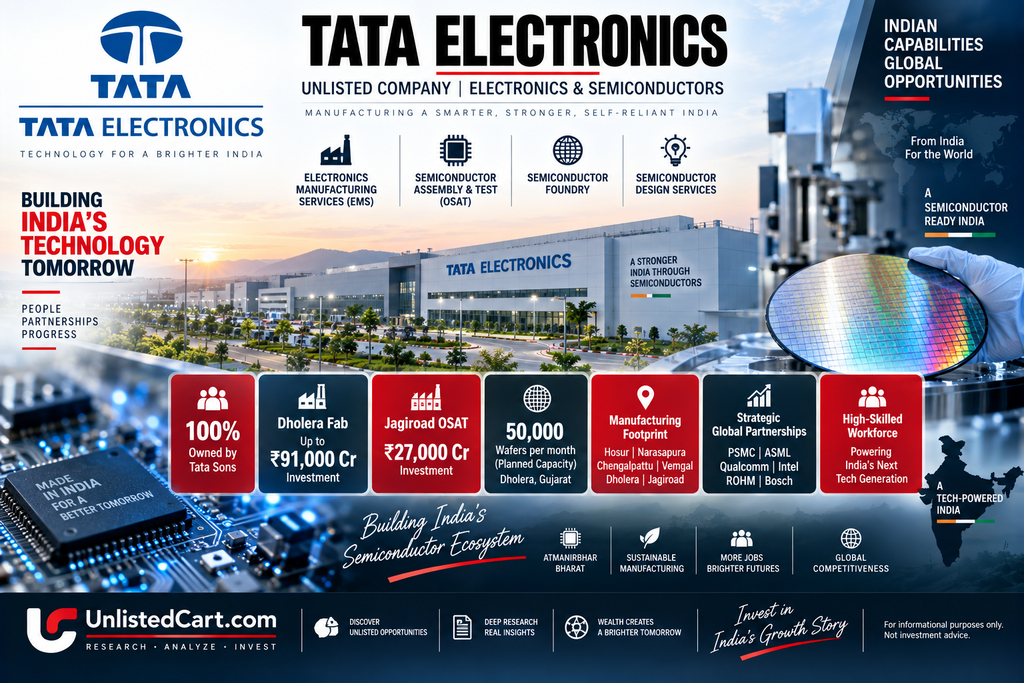
Tata Electronics is one of the Tata Group’s major new-generation manufacturing businesses, established in 2020 with a focus on building an integrated electronics and semiconductor ecosystem in India.
The company operates across four broad areas:
- Electronics Manufacturing Services (EMS)
- Semiconductor Assembly & Testing (OSAT)
- Semiconductor Foundry
- Semiconductor Design Services
Tata Electronics has expanded rapidly through organic investment as well as acquisitions, including the acquisition of Wistron’s India operations and a controlling stake in Pegatron Technology India.
The Tata Sons FY25 Annual Report reported Tata Electronics revenue of ₹66,601 Cr and 65,647 employees for FY25, describing it as a global electronics manufacturing player with capabilities spanning EMS, semiconductor assembly/testing, semiconductor foundry and design services.
However, the standalone legal entity Tata Electronics Private Limited reported FY25 sales of approximately ₹1,196.6 Cr and a net loss of approximately ₹997.9 Cr in the financial data available from MCA-linked databases. This difference is important because Tata Electronics’ wider business ecosystem includes subsidiaries such as Tata Electronics Systems Solutions and Tata Semiconductor Assembly & Test.
Company Overview
Tata Electronics was established as a greenfield Tata Group initiative in 2020.
The company initially focused on high-precision electronics components and subsequently expanded into electronics manufacturing, smartphone assembly, semiconductor assembly/testing and semiconductor fabrication.
Its journey accelerated substantially after the acquisition of Wistron’s India operations in 2024 and the acquisition of a majority stake in Pegatron Technology India in 2025.
The company’s stated ambition is to build an integrated electronics and semiconductor manufacturing ecosystem in India serving both domestic and global customers.
Official company journey: Tata Electronics – Our Journey
Ownership & Shareholding
Tata Electronics is not an independently promoter-owned Indian company.
The ownership chain is:
Tata Sons Private Limited → 100% → Tata Electronics Private Limited
Tata Sons’ FY25 Annual Report identifies Tata Electronics Private Limited as a 100% subsidiary.
Tata Sons is the principal investment holding company and promoter of Tata Group companies. The Tata Group states that 66% of Tata Sons’ equity is held by philanthropic Tata trusts.
Therefore, an investment in Tata Electronics would effectively provide exposure to a privately held Tata Group manufacturing business rather than to a separately listed Tata company.
Business Model
Tata Electronics is building an end-to-end electronics and semiconductor manufacturing platform.
1. Electronics Manufacturing Services
The EMS business includes precision components and final assembly, testing and packaging of electronic products.
The company currently identifies facilities around:
- Hosur, Tamil Nadu
- Narasapura, Karnataka
- Chengalpattu, Tamil Nadu
Tata Electronics says its EMS operations include both precision components and final assembly/testing/packaging activities.
EMS: Tata Electronics EMS Business
2. Smartphone / Consumer Electronics Manufacturing
The acquisition of Wistron’s India operations created Tata Electronics Systems Solutions, giving Tata Electronics a significant presence in high-volume electronics manufacturing.
In January 2025, Tata Electronics announced the acquisition of a controlling 60% stake in Pegatron Technology India, further strengthening its electronics manufacturing footprint.
The Competition Commission of India also described Tata Electronics as a wholly owned subsidiary of Tata Sons and noted its electronics manufacturing operations, including smartphone enclosures and electronics manufacturing services.
3. Semiconductor Assembly & Testing
Tata Electronics is developing semiconductor assembly and test capabilities at:
Vemgal, Karnataka
and
Jagiroad, Assam
The Vemgal facility has been operational since December 2023, while the large greenfield Assam facility is under development.
The Assam facility is being developed with an investment outlay of approximately US$3 billion / ₹27,000 Cr, with capacity planned at billions of chips per year.
OSAT: Tata Electronics Semiconductor Assembly & Test
Semiconductor Fab – Dholera, Gujarat
The Dholera semiconductor fab is arguably the most strategically important part of Tata Electronics’ expansion.
Tata Electronics is developing a 300mm / 12-inch semiconductor fabrication facility in Dholera, Gujarat, in partnership with Taiwan’s Powerchip Semiconductor Manufacturing Corporation (PSMC).
The planned facility is expected to have capacity of approximately 50,000 wafers per month and will target technologies from 28nm to 110nm.
Applications are expected to include:
- Automotive
- Power management ICs
- Display drivers
- Microcontrollers
- High-performance computing
- Communications
- AI
- Data storage
Semiconductor Foundry: Tata Electronics Semiconductor Foundry
Dholera Investment
The Tata Group announced an investment of up to approximately ₹91,000 Cr / US$11 billion for the Dholera semiconductor fab.
The Government of India approved the project in February 2024, with PSMC providing technology and execution support.
The project is therefore significantly more capital-intensive than Tata Electronics’ original electronics-component business.
Assam OSAT Facility
Tata Electronics is also developing a major semiconductor assembly and test facility at Jagiroad, Assam.
The announced investment is approximately ₹27,000 Cr, with the facility expected to create more than 27,000 direct and indirect jobs.
The facility is intended to use technologies including:
- Wire Bond
- Flip Chip
- Integrated Systems Packaging
The facility is designed to serve applications including automotive, mobile devices, AI and other semiconductor markets.
Manufacturing Footprint
Tata Electronics’ manufacturing ecosystem now spans:
Tamil Nadu
- Hosur
- Chengalpattu
Karnataka
- Narasapura
- Vemgal
Gujarat
- Dholera semiconductor fab
Assam
- Jagiroad OSAT facility
The company has also expanded its international customer and technology ecosystem through partnerships with global semiconductor and electronics companies.
Major Strategic Partnerships
PSMC – Taiwan
PSMC is providing technology transfer and engineering support for the Dholera fab.
The partnership covers technologies ranging from 28nm to 110nm.
ASML – Netherlands
In May 2026, Tata Electronics and ASML announced a strategic partnership to support the development and ramp-up of the Dholera fab.
ASML will provide lithography tools and solutions, while the companies will work on local talent development and R&D infrastructure.
Qualcomm
In February 2026, Tata Electronics announced a collaboration with Qualcomm Technologies to manufacture Qualcomm automotive modules in India at the upcoming Assam OSAT facility.
Intel
In December 2025, Tata and Intel announced a strategic alliance exploring semiconductor and systems manufacturing, packaging and AI-compute opportunities in India.
ROHM
Tata Electronics and Japanese semiconductor company ROHM announced a strategic partnership focused initially on power semiconductor manufacturing and assembly/testing in India.
Bosch
Tata Electronics and Robert Bosch announced collaboration around chip packaging and manufacturing at the Assam OSAT and Gujarat foundry, as well as possible vehicle-electronics EMS opportunities.
Financial Performance
Tata Electronics Business – FY25
According to the Tata Sons FY25 Annual Report:
| Metric | FY25 |
|---|---|
| Reported Tata Electronics revenue | ₹66,601 Cr |
| Employees | 65,647 |
| Ownership by Tata Sons | 100% |
| Business | Electronics manufacturing & semiconductor ecosystem |
Tata Sons describes this ₹66,601 Cr figure at the Tata Electronics business level, alongside the broader subsidiaries and operating ecosystem.
Standalone Tata Electronics Private Limited
The standalone legal entity’s FY25 financial data is materially different:
| ₹ Crore | FY24 | FY25 |
|---|---|---|
| Sales | 1,191.5 | 1,196.6 |
| Total Revenue | ~1,335 | ~2,787 |
| Operating Profit | -128.8 | -1,238.1 |
| PAT | -1,022.6 | -997.9 |
| Net Worth | 2,316.1 | 4,320.7 |
| Borrowings | 5,908.0 | 6,858.1 |
| Assets | 9,321.5 | 13,346.8 |
These figures come from MCA-linked financial data for Tata Electronics Private Limited itself.
Why is there such a large difference?
This is an important due-diligence point.
Tata Electronics operates through multiple subsidiaries and acquired businesses. Tata Sons’ FY25 report separately identifies entities including:
- Tata Electronics Private Limited
- Tata Electronics Systems Solutions Private Limited
- Tata Semiconductor Assembly and Test Private Limited
- TEL Components Private Limited
- Tata Semiconductor Manufacturing Private Limited
For example, Tata Electronics Systems Solutions reported FY25 turnover of approximately ₹55,235.88 Cr in Tata Sons’ subsidiary disclosures.
Therefore, ₹66,601 Cr should not be presented as the standalone revenue of Tata Electronics Private Limited without qualification.
For an UnlistedCart report, I would use:
Tata Electronics business revenue: ₹66,601 Cr FY25
and separately disclose:
Standalone Tata Electronics Private Limited revenue: ~₹1,197 Cr FY25; standalone PAT: ~₹998 Cr loss.
This distinction is critical for investors.
Balance Sheet & Capital Requirements
The standalone Tata Electronics entity had FY25:
- Net worth: ~₹4,321 Cr
- Borrowings: ~₹6,858 Cr
- Total assets: ~₹13,347 Cr
The debt/equity ratio was approximately 1.6x based on the reported figures.
This reflects the capital-intensive nature of the company’s expansion.
Large semiconductor fabs and OSAT facilities require substantial upfront investment before reaching mature utilisation and profitability.
Employee Base
Tata Sons reported 65,647 employees for Tata Electronics in FY25, with approximately 70% women mentioned in the Tata Sons Chairman’s letter.
This represents a dramatic scale-up from the company’s early years and reflects the labour-intensive nature of electronics manufacturing alongside increasing automation.
Competitive Advantages
1. Tata Group Ecosystem
Tata Electronics benefits from access to the wider Tata ecosystem, including:
- Tata Consultancy Services
- Tata Motors
- Tata AutoComp
- Tata Communications
- Tata Advanced Systems
- Tata Power
- Tata Chemicals
- Tata Digital
This can create opportunities for technology, automotive, infrastructure and supply-chain integration.
2. Large Capital Commitment
The planned Dholera and Assam investments represent a very large commitment to semiconductor manufacturing.
3. Global Technology Partnerships
Partnerships with PSMC, ASML, Qualcomm, Intel, ROHM and Bosch provide access to global technology, customers and semiconductor expertise.
4. India’s Semiconductor Policy Support
The company is building its semiconductor operations within India’s broader effort to establish domestic semiconductor manufacturing and reduce dependence on overseas supply chains.
5. Manufacturing Scale
The combination of EMS, smartphone manufacturing, OSAT, foundry and design services provides a potentially integrated electronics value chain.
Growth Drivers
Semiconductor Manufacturing
The Dholera fab provides Tata Electronics with a potential entry into semiconductor wafer manufacturing.
Semiconductor Packaging
The Assam OSAT facility can provide packaging and testing capabilities to domestic and global semiconductor companies.
Smartphone Manufacturing
The acquisition of Wistron’s Indian operations and majority ownership of Pegatron India strengthens Tata Electronics’ position in high-volume electronics manufacturing.
Supply-Chain Diversification
Global electronics companies are increasingly looking to diversify manufacturing locations. Tata Electronics is positioning India as an alternative manufacturing hub.
Automotive Electronics
The Qualcomm partnership and Bosch collaboration create opportunities in automotive electronics and semiconductor modules.
AI & Data-Centre Demand
The company’s semiconductor roadmap includes high-performance computing and AI-related applications, while its wider Tata ecosystem is also investing in AI infrastructure.
Key Risks
1. Very High Capital Intensity
Semiconductor fabs require enormous upfront investment and long ramp-up periods.
The Dholera project alone has a planned investment of up to approximately ₹91,000 Cr.
2. Execution Risk
Building and ramping a semiconductor fab is substantially more complex than conventional electronics assembly.
The Tata Sons Chairman’s FY25 report itself acknowledges that the semiconductor journey will require several years of serious work and that the company is beginning at the 28nm node before progressing toward more advanced technologies.
3. Current Standalone Losses
The standalone Tata Electronics Private Limited entity reported a FY25 loss of approximately ₹998 Cr, highlighting that the business is still in a heavy investment phase.
4. Debt
Standalone borrowings of approximately ₹6,858 Cr make balance-sheet monitoring important.
5. Semiconductor Technology Risk
Semiconductor technology changes rapidly. Maintaining competitive manufacturing economics requires continuous investment in equipment, process technology and talent.
6. Customer Concentration
Electronics manufacturing businesses can become dependent on a limited number of large global customers.
7. Parent-Company Structure
Investors purchasing shares of the private entity need to understand exactly which Tata Electronics entity they are acquiring and whether the investment provides exposure to the wider Tata Electronics ecosystem.
Current Unlisted Share Price
There is no official NSE/BSE market price for Tata Electronics.
The company remains an unlisted private company.
I have not included an OTC price because I could not verify a reliable current executable market quote.
Any privately quoted Tata Electronics share price should be checked against:
- Seller identity
- Share certificate/demat details
- Latest shareholding
- ISIN
- Number of shares outstanding
- Transfer restrictions
- Independent valuation
- Latest transaction price
- Exact Tata Electronics entity
A random online “Tata Electronics share price” should not automatically be treated as a genuine market price.
IPO / Listing Status
Tata Electronics is currently unlisted.
I found no confirmed public IPO/DRHP that would justify treating an IPO as a current base-case event.
The company’s expansion is currently focused on building its electronics and semiconductor manufacturing ecosystem.
Valuation
A reliable market-cap calculation cannot be made without a verified current transaction price for Tata Electronics shares.
The capital structure is also evolving rapidly as Tata Sons continues to fund the company’s expansion.
As of FY25, Tata Sons’ Annual Report showed its 100% ownership and an investment/capital base in Tata Electronics that was being increased as the business expanded.
Important valuation consideration
Investors should not simply apply a P/E multiple to the ₹66,601 Cr revenue figure.
The company is still investing heavily in semiconductor manufacturing and its standalone entity remains loss-making.
A more appropriate private-market valuation exercise would consider:
- EMS revenue and EBITDA
- Semiconductor OSAT economics
- Future fab utilisation
- Government support/subsidies
- Capex already deployed
- Debt
- Parent funding
- Subsidiary ownership
- Future cash burn
- Semiconductor technology partnerships
- Long-term customer contracts
- Potential IPO/listing structure
Investment Due-Diligence View
Tata Electronics is fundamentally different from mature Tata Group listed companies such as TCS, Tata Motors or Tata Steel.
It is a high-growth, capital-intensive manufacturing platform being built around electronics and semiconductors.
Key positives
- 100% Tata Sons ownership
- ₹66,601 Cr FY25 Tata Electronics business revenue reported by Tata Sons
- 65,647 employees
- Large electronics manufacturing footprint
- Smartphone manufacturing capabilities
- Wistron India acquisition
- 60% Pegatron India acquisition
- ₹91,000 Cr planned Dholera semiconductor fab
- ₹27,000 Cr Assam OSAT project
- Partnerships with PSMC, ASML, Qualcomm, Intel, ROHM and Bosch
- Strategic importance of semiconductors to India’s electronics ecosystem
- Large Tata Group ecosystem
Key concerns
- Standalone Tata Electronics entity reported ~₹998 Cr FY25 loss
- Standalone borrowings ~₹6,858 Cr
- Extremely high semiconductor capex
- Long gestation period
- Execution and technology risks
- No public-market price discovery
- No confirmed IPO
- Complex subsidiary structure
- Private-market liquidity risk
Overall Assessment
Tata Electronics is emerging as one of the Tata Group’s most important new-age manufacturing businesses, with ambitions extending well beyond conventional electronics assembly into semiconductor packaging, testing, design and wafer fabrication.
The strategic opportunity is significant, but the financial profile needs to be interpreted carefully.
The ₹66,601 Cr FY25 revenue figure represents the Tata Electronics business as reported by Tata Sons, while the standalone Tata Electronics Private Limited financial statements show approximately ₹1,197 Cr sales and a ₹998 Cr loss. The difference arises from the wider group/subsidiary structure and should be clearly disclosed in any investor presentation.
For an unlisted investor, the biggest due-diligence questions are therefore not simply revenue growth, but what exact entity the shares represent, what subsidiaries are included, how much capital is still required, how quickly the semiconductor facilities can reach commercial utilisation, and at what valuation the shares are being offered.
Important Links
Official Tata Electronics: Tata Electronics Official Website
Company Journey: Tata Electronics – Our Journey
Electronics Manufacturing Services: Tata Electronics EMS
Semiconductor Assembly & Test: Tata Electronics OSAT
Semiconductor Foundry: Tata Electronics Semiconductor Foundry
Tata Electronics Leadership: Tata Electronics Leadership
Tata Sons Annual Report FY25: Tata Sons FY25 Annual Report
Dholera Semiconductor Fab: Tata Electronics Dholera Fab Information
Assam OSAT Facility: Tata Electronics Assam OSAT Information
Disclaimer
This report is prepared for educational and research purposes only and should not be considered investment advice, a recommendation to buy or sell securities, or a guarantee of future returns. Tata Electronics is an unlisted private company and private-market transactions can involve substantial valuation, liquidity, transfer and information risks. Financial figures have been clearly distinguished between Tata Sons-reported Tata Electronics business figures and standalone Tata Electronics Private Limited figures wherever applicable. Investors should independently verify the latest audited financial statements, shareholding, exact legal entity, valuation, transaction price, ISIN and transferability before making any investment decision.
For more such unlisted stocks visit https://unlistedcart.com/unlisted-shares/