Value Retail & Fashion-Lifestyle Platform | Tier-II & Tier-III Focus | High-Risk Unlisted Growth Opportunity
Company: Mayasheel Retail India Limited
Brand: Bazar India
CIN: U52599DL2018PLC333450
ISIN: INE03NO01017
Incorporated: 4 May 2018
Registered Office: New Delhi, Delhi
Face Value: ₹10/share
Status: Active & Unlisted
Industry: Value Retail / Fashion & Lifestyle
Promoter Holding: ~82.73% according to available unlisted-market disclosures
Indicative Unlisted Price: ~₹24/share
Indicative Equity Value: ~₹72 Cr
NSE/BSE Listing: No
DRHP: No verified DRHP identified
1. About the Company
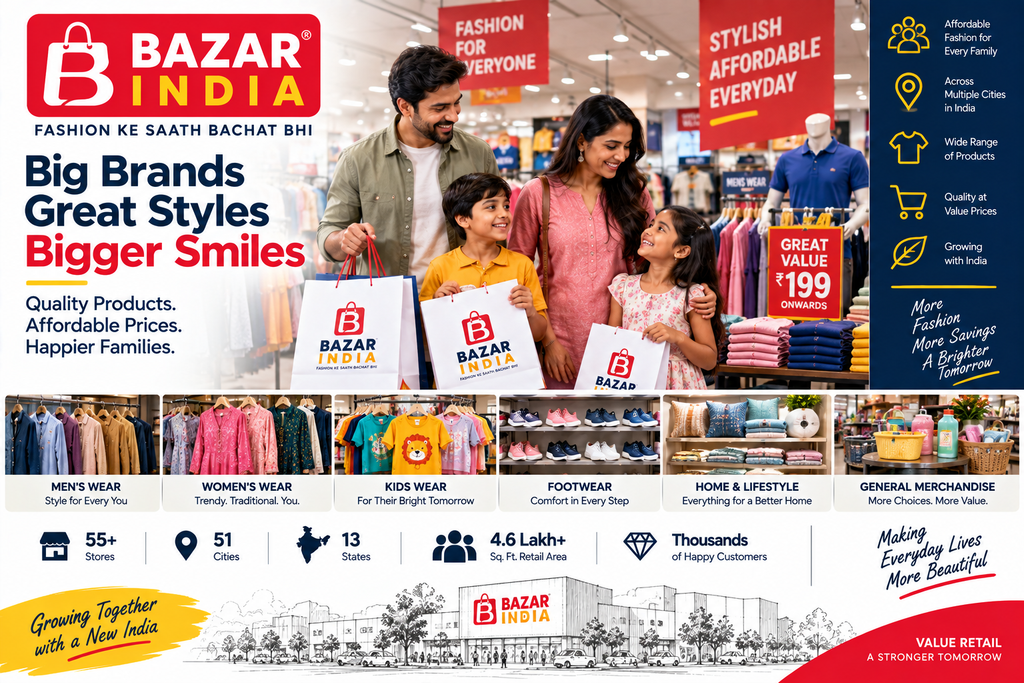
Bazar India, operated by Mayasheel Retail India Limited, is an Indian value-retail chain focused primarily on affordable fashion, apparel, footwear and general merchandise.
The company targets middle-income and value-conscious consumers, particularly in Tier-II and Tier-III cities, where organised retail penetration remains relatively low.
Its core proposition is captured by the brand’s tagline:
“Fashion Ke Saath Bachat Bhi”
Bazar India follows a one-stop-shop model, allowing customers to purchase apparel and everyday lifestyle products under one roof. https://bazaarindia.in/
The company was founded by Atul Garg and Sushil Kumar Karwa and has historically focused strongly on eastern India and the North-East. Its LinkedIn company profile currently describes operations across 55 stores in 51 cities, 13 states and approximately 4.6 lakh sq. ft. of retail area.
2. Investment Snapshot
| Particular | Current Position |
|---|---|
| Legal Entity | Mayasheel Retail India Limited |
| Brand | Bazar India |
| CIN | U52599DL2018PLC333450 |
| ISIN | INE03NO01017 |
| Face Value | ₹10 |
| Paid-up Capital | ₹30 Cr |
| Shares Outstanding | ~3 Cr |
| Indicative Price | ~₹24 |
| Indicative Market Cap | ~₹72 Cr |
| Listing | Unlisted |
| Promoter Holding | ~82.73% |
| FY23 Revenue from Operations | ₹152.59 Cr |
| FY23 PAT | ₹0.96 Cr |
| FY23 EPS | ₹0.32 |
| FY23 Debt/Equity | ~0.54x |
| IPO / DRHP | No verified filing |
The current unlisted-market price is not uniform. Recent references range approximately from ₹19 to ₹25, with Planify showing ₹23.92 on September 11, 2026. These are indicative OTC/private-market prices and should not be treated as exchange prices.
3. Business Model
Bazar India’s model is built around affordable retailing with a broad product assortment.
Key Categories
Apparel
- Men’s wear
- Women’s wear
- Kidswear
- Ethnic and casual clothing
Footwear & Accessories
- Everyday footwear
- Sports footwear
- Fashion accessories
General Merchandise
- Household products
- Home furnishing
- Lifestyle products
- Daily-use merchandise
This broad assortment is designed to increase the average customer basket and encourage repeat visits.
4. Target Market
Bazar India’s key customer segment is the middle and lower-middle-income consumer.
The company specifically targets markets where:
- Organised retail penetration is still developing
- Consumers are highly price-sensitive
- Family shopping is important
- Large-format value retail can replace multiple small purchases
- Branded fashion remains relatively underpenetrated
This gives Bazar India exposure to the structural shift from unorganised retail → organised value retail.
5. Store Network
Historically, Bazar India expanded rapidly across smaller Indian cities.
The company’s current LinkedIn profile states:
- 55 stores
- 51 cities
- 13 states
- Approximately 4.6 lakh sq. ft. retail area
- Strong presence in Eastern India and the North-East
Older company disclosures had also highlighted the ambition to expand the store network significantly.
The important investment question is whether the company can expand stores without sacrificing store-level profitability and cash flow.
6. Competitive Positioning
Bazar India operates in the highly competitive Indian value-retail market.
Its proposition sits between:
Local / unorganised retailers
and
Large organised value retailers
The competitive advantage is intended to come from:
- Affordable pricing
- Large product assortment
- Private-label opportunities
- Smaller-city penetration
- Centralised sourcing
- One-stop family shopping
- Promotional formats
The company’s “Fashion Ke Saath Bachat Bhi” positioning is particularly relevant to price-conscious consumers.
7. Special Retail Formats
Bazar India has explored formats such as:
99 Stores
A low-price format focused on merchandise priced around the ₹99 proposition.
Som Bazar
Promotional initiatives designed to generate additional customer traffic through recurring discounts and offers.
These formats can increase footfall but need to be evaluated carefully for gross margin and inventory economics, rather than simply revenue growth.
8. Historical Financial Performance
The latest clearly available audited financial information is FY23.
Profit & Loss
| ₹ Cr | FY20 | FY21 | FY22 | FY23 |
|---|---|---|---|---|
| Revenue from Operations | 359.0 | 187.0 | 165.0 | 152.6 |
| EBITDA | 4.0 | 10.0 | 18.0 | 1.03 |
| PBT | -16.0 | 1.2 | 12.0 | 1.46 |
| PAT | -17.6 | 1.88 | 9.58 | 0.96 |
| EPS | -7.04 | 0.75 | 3.25 | 0.32 |
FY23 revenue from operations was ₹152.59 Cr and PAT was ₹0.96 Cr. EBITDA fell sharply to approximately ₹1.03 Cr.
Important Observation
The financial trend shows that Bazar India has experienced significant volatility in revenue and profitability.
The FY20–FY22 period saw the impact of COVID and retail disruptions, followed by a sharp deterioration in profitability in FY23.
Therefore, investors should not assume that the historical store expansion automatically translates into high earnings growth.
9. Balance Sheet
FY23 balance-sheet data shows:
| Particular | FY23 |
|---|---|
| Share Capital | ₹30.0 Cr |
| Reserves & Surplus | ~₹0.01 Cr |
| Net Worth | ~₹30 Cr |
| Long-Term Borrowings | ~₹4.29 Cr |
| Short-Term Borrowings | ~₹24.14 Cr |
| Total Borrowings | ~₹28.43 Cr |
| Inventory | ~₹106.36 Cr |
| Trade Receivables | ~₹0.09 Cr |
| Cash & Equivalents | ~₹0.40 Cr |
| Total Assets | ~₹147.97 Cr |
Inventory is by far the largest current asset.
This is normal for a retail business, but it makes inventory turnover, markdowns and working-capital management extremely important.
10. Working Capital
The business has historically carried substantial inventory.
FY23:
Inventory: ~₹106 Cr
Revenue from operations: ~₹153 Cr
This means inventory represented a very large proportion of annual sales.
For a value retailer, inventory management is critical because:
- Fashion inventory can become obsolete
- Discounts can destroy margins
- Slow-moving stock locks up capital
- New stores require additional inventory
- Seasonal merchandise creates additional working-capital requirements
Therefore, inventory turnover should be one of the most important KPIs to monitor.
11. Credit Rating — Important Risk Signal
This is one of the most important updates for investors.
In April 2026, CRISIL Ratings classified Mayasheel Retail India Limited as “Issuer Not Cooperating.”
The available rating was:
CRISIL B / Stable — Issuer Not Cooperating
CRISIL stated that despite repeated attempts to obtain information regarding financial performance and strategic intent, the company did not provide the requested information.
CRISIL specifically cautioned that the rating was based on limited or dated information and therefore lacks a forward-looking component.
This should be treated as a major due-diligence concern.
It does not automatically mean the business is failing, but it significantly reduces confidence in making forward-looking financial assumptions.
12. Recent Financial Data — Important Caution
Some unlisted-share platforms publish FY24/FY25 figures such as:
- FY24 revenue ~₹971.6 Cr
- FY24 PAT ~₹22 Cr
- FY25 revenue ~₹1,343.6 Cr
- FY25 PAT ~₹14.7 Cr
However, these figures are not sufficiently corroborated by the latest accessible audited filings.
The latest MCA-linked financial information available through several databases continues to show FY23 as the last clearly filed financial year, while CRISIL’s 2026 report explicitly says it could not obtain updated financial information from the company.
Therefore:
These FY24/FY25 numbers should not be presented as confirmed audited results without obtaining the underlying annual reports/financial statements.
This is particularly important for an investor-facing UnlistedCart report.
13. Investment Positives
1. Value Retail Opportunity
India’s shift toward organised retail provides a long-term opportunity for value-focused retailers.
2. Tier-II & Tier-III Focus
Bazar India is positioned in markets that remain relatively underpenetrated by large organised retailers.
3. Affordable Positioning
The company focuses on consumers where price and value are key purchase drivers.
4. Multi-Category Model
The one-stop-shop format can increase customer frequency and basket size.
5. Store Expansion Potential
The existing network provides a platform for further geographic expansion if store economics remain attractive.
6. Strong Promoter Ownership
Available disclosures indicate promoter ownership of approximately 82.73%, providing substantial promoter control and alignment.
7. Low Absolute Valuation
At an indicative market capitalisation of approximately ₹72 Cr, the company is small relative to the potential scale of India’s organised value-retail market.
However, this low valuation must be considered alongside the company’s limited financial transparency and profitability history.
14. Investment Concerns
| Positive | Concern |
|---|---|
| Value-retail opportunity | Highly competitive industry |
| Tier-II/Tier-III presence | Low historical profitability |
| Strong promoter ownership | High inventory requirements |
| Multi-category assortment | Working-capital intensive |
| Store expansion potential | Store-level economics need monitoring |
| Low absolute market cap | Limited liquidity |
| Affordable pricing proposition | Margin pressure |
| Established retail network | Limited recent audited disclosure |
| Potential operating leverage | CRISIL “Issuer Not Cooperating” |
| Future IPO optionality | No verified DRHP |
15. Valuation
Using an indicative price of approximately ₹24/share:
Shares outstanding: ~3 Cr
Implied Equity Value
₹24 × 3 Cr = ~₹72 Cr
This is broadly consistent with recent unlisted-market references.
Valuation Snapshot
| Metric | Approx. |
|---|---|
| Indicative Price | ₹24 |
| Shares | ~3 Cr |
| Market Cap | ~₹72 Cr |
| Face Value | ₹10 |
| Book Value | ~₹13.34–₹10 depending on data source/year |
| P/B | ~1.8x |
| FY23 EPS | ₹0.32 |
| FY23 P/E | ~75x |
| Debt/Equity | ~0.95x in recent unlisted-market data |
The valuation appears inexpensive on absolute market capitalisation, but not necessarily on historical earnings.
At ₹24, the stock is approximately 75x FY23 EPS of ₹0.32.
Therefore:
Bazar India should not be considered a conventional value stock based on current/historical earnings.
The investment case requires a substantial recovery in profitability.
16. What Could Create Value?
Store Expansion
Increasing the store network could significantly increase revenue if new stores achieve attractive sales per square foot.
Same-Store Sales Growth
Existing-store growth is arguably more important than simply adding stores.
Private Labels
Higher private-label penetration could potentially improve gross margins and differentiation.
Inventory Efficiency
Better inventory turnover can release working capital and improve cash generation.
Operating Leverage
Retail has significant fixed costs.
Once stores achieve sufficient revenue density, incremental sales can potentially produce stronger EBITDA growth.
Organised Retail Penetration
The continued shift from unorganised to organised retail creates a long-term structural opportunity.
17. IPO / Listing Status
Currently Unlisted
Mayasheel Retail India Limited is not listed on NSE or BSE.
The security trades in the unlisted/private market under:
ISIN: INE03NO01017
No verified DRHP has been identified as of the latest review. Recent unlisted-market sources also indicate no confirmed IPO date.
Therefore:
Bazar India should not currently be marketed as a confirmed pre-IPO opportunity.
A future IPO may provide an exit catalyst, but it should be treated as optionality rather than part of the base-case valuation.
18. Management
The company was founded by:
Atul Garg — Chairman / Managing Director
Sushil Kumar Karwa — Director
The company’s current public profile also identifies Neha Garg among its directors.
Management execution will be particularly important because the value-retail model depends heavily on:
- Store selection
- Procurement
- Pricing
- Inventory management
- Merchandise mix
- Private labels
- Cost control
19. Key KPIs Investors Should Track
For Bazar India, investors should focus on:
1. Same-Store Sales Growth
More important than simply opening new stores.
2. Revenue per Square Foot
Measures store productivity.
3. Gross Margin
Determines whether growth is translating into profitability.
4. Inventory Turnover
One of the most important metrics for the company.
5. EBITDA Margin
The FY23 EBITDA margin was only about 0.7%, leaving substantial room for improvement.
6. Store-Level EBITDA
Shows whether individual stores are economically viable.
7. Debt
Borrowings and interest costs need to remain controlled.
8. Operating Cash Flow
Revenue growth without cash generation would be a warning sign.
20. Key Risks
Financial Disclosure Risk
The biggest current concern is the lack of sufficiently recent, independently verifiable financial information.
CRISIL Issuer-Not-Cooperating Status
This significantly increases information-availability risk.
Low Historical Profitability
FY23 PAT was only ₹0.96 Cr on ₹152.6 Cr revenue.
Inventory Risk
More than ₹100 Cr of inventory historically means substantial capital is tied up in merchandise.
Competition
The company competes with organised value retailers, regional chains, e-commerce platforms and local retailers.
Margin Risk
Affordable pricing can produce high volumes but relatively thin margins.
Liquidity Risk
There is no NSE/BSE market, and OTC liquidity may be limited.
Expansion Risk
Opening stores rapidly without achieving sufficient sales density can destroy shareholder returns.
IPO Uncertainty
There is no confirmed IPO/DRHP catalyst currently.
21. Investment View
Bazar India — Affordable Retail Story With High Execution & Information Risk
Bazar India provides exposure to India’s expanding value-retail segment, particularly in Tier-II and Tier-III cities.
The long-term industry opportunity is attractive.
India’s organised retail penetration remains significantly below mature markets, while rising disposable income, urbanisation and formalisation of retail provide structural tailwinds.
Bazar India’s positioning around affordable fashion and family shopping is also relevant to India’s mass-market consumer.
However, the investment case needs to be approached cautiously.
The company has historically demonstrated volatile revenue and very thin profitability, while inventory requirements are substantial.
More importantly, the latest CRISIL action classifying the company as “Issuer Not Cooperating” creates a significant information-quality concern.
Therefore, the investment thesis should not be:
“Bazar India is a fast-growing retailer and future IPO.”
Instead:
“Bazar India is a small-cap unlisted value-retail platform with a potentially attractive market opportunity, but the investment case depends on verified recent financial performance, sustainable store-level profitability and improved financial transparency.”
Overall Positioning
Indian Value Retail Opportunity — Attractive Market, But High Execution & Information Risk
Investment Character: High Risk / Growth & Turnaround
Key Opportunity: Store expansion + same-store sales + private labels
Key Concern: Profitability + inventory + information transparency
Key Catalyst: Sustained improvement in EBITDA and operating cash flow
IPO Catalyst: Unconfirmed
22. Share Details
| Particular | Details |
|---|---|
| Company | Mayasheel Retail India Limited |
| Brand | Bazar India |
| CIN | U52599DL2018PLC333450 |
| ISIN | INE03NO01017 |
| Face Value | ₹10 |
| Paid-up Capital | ₹30 Cr |
| Shares Outstanding | ~3 Cr |
| Indicative Price | ~₹24 |
| Indicative Market Cap | ~₹72 Cr |
| Listing | Unlisted |
| NSE/BSE Code | None |
| DRHP | Not verified |
| Demat | NSDL/CDSL |
| Promoter Holding | ~82.73% |
Indicative unlisted prices vary considerably between intermediaries. Recent references range from approximately ₹19 to ₹25, so investors should obtain a live transaction quote before relying on any valuation.
23. Conclusion
Bazar India is an interesting small-scale organised value-retail story, but it is currently better suited to investors who understand the risks of unlisted companies and are willing to wait for greater financial visibility.
The company has several attractive characteristics:
Value-focused positioning + Tier-II/Tier-III opportunity + established store network + high promoter ownership + potential operating leverage.
But the key negatives cannot be ignored:
Thin historical margins + high inventory + limited liquidity + lack of recent independently verifiable financials + CRISIL issuer-not-cooperating status.
Consequently, the company should be analysed primarily on store productivity, EBITDA margin, inventory turnover and operating cash flow, rather than headline revenue growth.
Bottom Line
Bazar India offers exposure to India’s value-retail expansion, but at this stage it remains a high-risk execution story where financial transparency and sustainable profitability need to improve before a stronger investment thesis can be established.
Disclaimer
This report is prepared for informational and research purposes only and does not constitute investment advice, a recommendation, solicitation or an offer to buy or sell securities.
Mayasheel Retail India Limited is an unlisted company. Unlisted share prices are indicative OTC/private-market references and may vary significantly based on liquidity, lot size and counterparty availability.
Recent financial figures circulating on third-party unlisted-share platforms have not all been independently verified against the company’s latest audited filings and should therefore not be treated as confirmed financial results without further due diligence.
Investors should independently verify the latest financial statements, corporate filings, shareholding, valuation and transaction terms and consult a SEBI-registered investment adviser before making an investment decision.
For more such unlisted stocks visit https://unlistedcart.com/unlisted-shares/