About the company
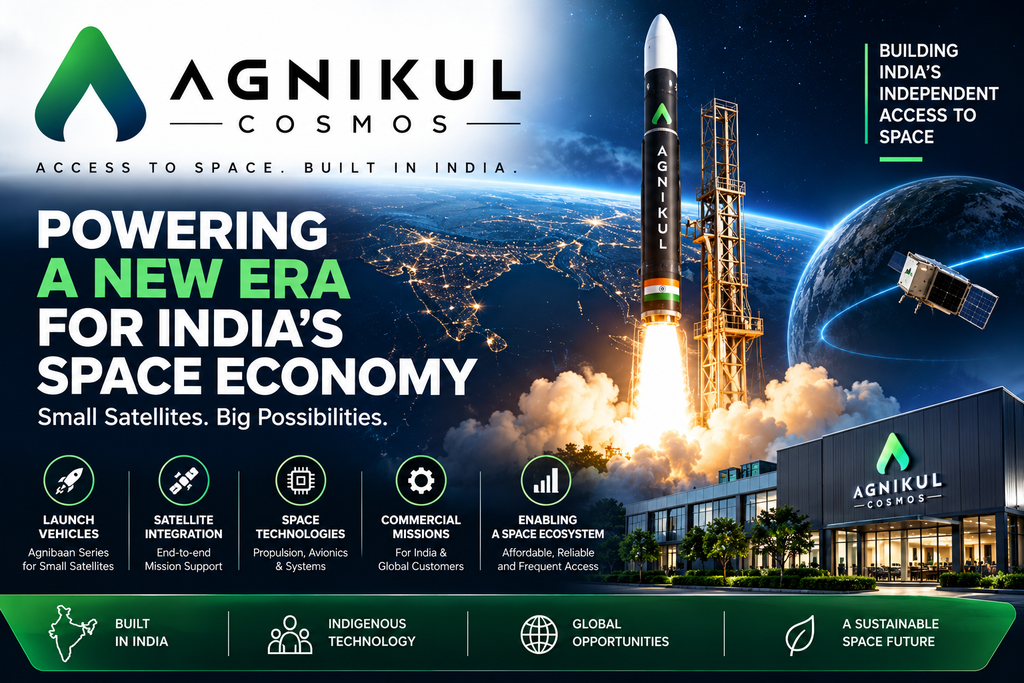
Agnikul Cosmos is a Chennai-based space-tech company founded in 2017 by Srinath Ravichandran and Moin SPM.
The company is developing a new generation of small satellite launch vehicles designed to provide dedicated and flexible access to low Earth orbit (LEO).
Its flagship vehicle is Agnibaan, a modular launch vehicle designed for payloads of up to approximately 300 kg to LEO, depending on configuration.
Agnikul’s major technological differentiation is its semi-cryogenic propulsion system and 3D-printed rocket engines.
The company has also established a private launch facility at Sriharikota with support from India’s space ecosystem
Key highlights
- Founded in 2017
- Incubated at IIT Madras
- Flagship launch vehicle: Agnibaan
- Target payload capacity: up to ~300 kg to LEO
- Proprietary semi-cryogenic rocket engines
- Significant use of 3D-printing/additive manufacturing
- Successfully demonstrated Agnibaan SOrTeD in May 2024
- First Indian private company to launch from its own private launchpad
- Strong association/support from ISRO and IN-SPACe
- Backed by several institutional venture-capital investors
- Latest major reported funding valuation: ~$500 million
- Upcoming orbital missions targeted for 2027
- Exposure to India’s rapidly developing private space sector
The May 2024 SOrTeD mission demonstrated Agnikul’s 3D-printed semi-cryogenic propulsion technology and launch capabilities. https://agnikul.in/
business model
Agnikul Cosmos operates primarily in the commercial space-launch and space transportation segment.
Its business model is based on providing launch services to customers that need to place small satellites and other payloads into orbit.
Core business areas
1. Small Satellite Launches
Agnibaan is being developed to launch small satellites into LEO.
Potential customers include:
- Satellite companies
- Space-tech startups
- Research organisations
- Universities
- Defence and government organisations
- Earth-observation companies
- Communication companies
2. Agnibaan Launch Vehicle
Agnibaan is a modular launch vehicle designed for different payload requirements.
The company is targeting payloads ranging from smaller payloads to approximately 300 kg to LEO, depending on configuration.
This modular approach is intended to allow customers to select a launch configuration according to their requirements.
3. SOrTeD
SOrTeD is Agnikul’s sub-orbital technology demonstrator.
The May 2024 mission was particularly important because it demonstrated the company’s indigenous propulsion, avionics and launch infrastructure.
The successful flight significantly reduced the technology risk associated with the company’s development programme.
4. Rocket Engine Technology
One of Agnikul’s biggest technological advantages is its proprietary rocket-engine technology.
The company has developed Agnilet/Agnite engines using additive manufacturing.
3D printing can potentially reduce:
- Number of components
- Manufacturing complexity
- Assembly requirements
- Production time
- Development cycles
This technology could eventually provide Agnikul with a cost and manufacturing advantage if successfully scaled.
financial snapshot
Agnikul is currently a technology-development and commercialisation-stage company, rather than a mature profitable business.
| Particular | FY25 |
|---|---|
| Revenue | ~₹7.8 crore |
| Net Loss | ~₹54.8 crore |
| Expenses | ~₹52.9 crore |
| Assets | ~₹197.7 crore |
The company therefore remains heavily investment-driven and has not yet reached commercial profitability.
The low current revenue should be viewed in the context of Agnikul being in the pre-commercial orbital launch phase rather than as a mature operating company.
Valuation & market position
Agnikul’s most important publicly reported valuation benchmark is its November 2025 funding round.
The company raised approximately:
$17 million
at a reported valuation of approximately:
$500 million
This translates to roughly ₹4,400–4,500 crore, depending on the exchange rate.
In 2026, reports indicated that the company was exploring another $50–75 million fundraising round around the same valuation.
Valuation perspective
The valuation is high compared with current revenue.
At approximately ₹4,500 crore valuation and FY25 revenue of approximately ₹7.8 crore:
Valuation / Revenue ≈ 577×
Therefore, investors buying the company today are essentially paying for future commercialisation and growth, rather than current earnings.
The valuation could become more reasonable if Agnikul successfully moves from technology demonstration to regular commercial orbital launches.
Market position
Agnikul operates in India’s emerging private space-launch industry.
Its primary Indian peer is Skyroot Aerospace, while globally it competes indirectly with companies involved in small-launch and satellite-launch services.
Agnikul’s key differentiator is its combination of:
Semi-cryogenic propulsion + 3D printing + modular launch vehicle + dedicated launch infrastructure.
The Indian government’s increasing participation of private companies in space activities provides a favourable regulatory and industry environment.
India has also set ambitious targets for expanding its space economy, creating a significant long-term opportunity for companies such as Agnikul.
Investment Rationale
1. India’s space sector is entering a new phase
India is increasingly opening the space sector to private companies.
This creates opportunities across:
- Launch vehicles
- Satellites
- Space manufacturing
- Ground infrastructure
- Earth observation
- Communication
- Space-based services
2. Proven technology demonstration
Agnikul is no longer only a technology concept.
Its SOrTeD mission successfully flew in May 2024.
This is one of the strongest positives for the investment thesis.
3. Proprietary 3D-printed engine technology
Agnikul’s 3D-printing capability could potentially reduce manufacturing complexity and enable faster development and production.
If successfully commercialised at scale, this could become an important competitive advantage.
4. Large potential market
The global demand for small satellites continues to grow.
More satellites mean greater demand for:
- Launch services
- Dedicated launches
- Satellite deployment
- Orbital transportation
Agnikul is positioned specifically around this emerging segment.
5. ISRO ecosystem
Agnikul has benefited from India’s established space ecosystem, including technical and infrastructure support from ISRO.
This is a significant advantage because rocket development has extremely high technological and regulatory barriers.
6. Strong institutional backing
Agnikul has attracted funding from several recognised venture-capital investors.
This provides:
- Capital
- Industry expertise
- Strategic networks
- Credibility
- Access to future funding
7. 2027 can be a major inflection point
Agnikul’s current mission roadmap targets orbital launches in 2027.
The company lists:
Q1 2027: launch targeting up to ~100 kg to LEO
Q2 2027: launch targeting up to ~300 kg to LEO
Successful orbital missions could materially change the company’s commercial prospects.
Risk factors
1. Technology risk
Rocket development is inherently high-risk.
A successful test flight does not guarantee successful orbital launches.
2. Commercialisation risk
The company has yet to demonstrate sustained commercial orbital launch operations.
3. High valuation
The current reported valuation is significantly higher than what current revenue would justify using traditional valuation metrics.
4. Continued losses
Agnikul remains loss-making and will likely require additional capital before achieving sustainable profitability.
5. Dilution risk
Future fundraising can dilute existing shareholders.
6. Competition
Agnikul faces competition from Indian and international launch companies, particularly Skyroot Aerospace and other small-launch providers.
7. Execution risk
The company needs to successfully execute several stages:
Engine development → orbital launch → commercial launch → repeat launches → scale → profitability
Failure or delays at any stage could affect valuation.
8. Unlisted-share liquidity
Agnikul shares are not publicly traded on NSE/BSE.
Therefore:
- Buying/selling can take time
- Price discovery is limited
- There may be a significant bid-ask spread
- Exit is not guaranteed
Share Details
Company: Agnikul Cosmos Limited
Status: Private / Unlisted
Industry: Space Technology / Aerospace
Headquarters: Chennai, Tamil Nadu
Depository: NSDL / CDSL, subject to the specific shareholding and transfer structure
Minimum Investment: Depends on the availability and prevailing secondary-market quotation
Liquidity: Limited
Listing: No current NSE/BSE listing
How to Invest
For an unlisted transaction, the general process is:
1. Check availability
Confirm whether Agnikul shares are actually available from the seller.
2. Verify the current price
Do not rely solely on an old quoted price.
Ask for:
- Current per-share price
- Number of shares available
- Latest transaction/reference valuation
- ISIN
- Share class
- Seller details
3. Calculate implied valuation
Share Price × Fully Diluted Shares = Implied Company Valuation
This is particularly important for Agnikul because the institutional valuation is a much more useful benchmark than simply comparing the per-share price.
4. Complete KYC and payment
Complete the intermediary’s required documentation and payment process.
5. Demat transfer
Once the transaction is completed, the shares are transferred to the investor’s demat account, subject to the applicable transfer process.
Investment View
Agnikul Cosmos = High Growth + High Risk
Agnikul is an interesting opportunity for investors who want exposure to India’s emerging private space economy.
| Positives | Key Concerns |
|---|---|
| Strong Technology – Proprietary 3D-printed semi-cryogenic engine technology | Very Low Current Revenue – Business is still at an early commercialization stage |
| ISRO Ecosystem – Strong technical and institutional support | Large Losses – Significant R&D and development expenditure |
| Government Support – Beneficiary of India’s growing private-space ecosystem | High Valuation – Current valuation is high relative to present revenue |
| Large Potential Market – Growing demand for small-satellite launches | No Commercial Orbital Track Record Yet – Orbital launch capability still needs to be demonstrated |
| Successful Technology Demonstration – SOrTeD mission successfully demonstrated key technology in 2024 | Future Capital Requirement – Additional fundraising may be required before profitability |
| Institutional Investors – Backed by established VC and strategic investors | Execution Risk – Delays or launch failures could materially impact valuation |
Key Investment Trigger
The most important milestone for Agnikul is:
Successful commercial orbital launch
The 2024 SOrTeD mission demonstrated that Agnikul can build and fly its technology.
The next stage is to demonstrate that it can:
Launch → reach orbit → deploy payload → repeat → commercialise → generate meaningful revenue → become profitable.
If that happens, the company’s current valuation could potentially look inexpensive in hindsight.
If orbital launches are delayed or unsuccessful, the current valuation could prove difficult to justify.
Disclaimer
Financial information and valuation figures are based on publicly available disclosures and reported funding information and may change as new financial statements, funding rounds and company disclosures become available.
Unlisted shares carry significant risks, including limited liquidity, price volatility, valuation uncertainty, transfer restrictions, dilution and the possibility of partial or complete loss of capital.
Investors should conduct independent due diligence before investing.
Explore more such amazing unlisted opportunities https://unlistedcart.com/unlisted-shares/