
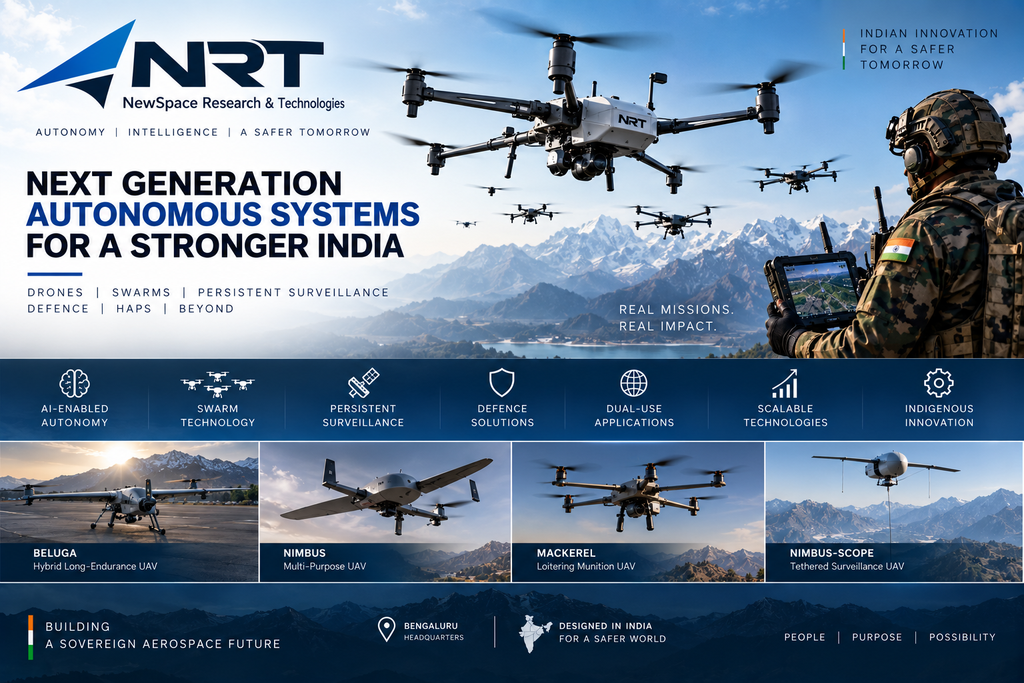
Defence Drones • Swarm Intelligence • Autonomous Systems • HAPS
1. Company Overview
NewSpace Research & Technologies Private Limited (NRT) is an Indian private/unlisted aerospace and defence technology company focused on autonomous unmanned aerial systems, swarm technology, persistent surveillance and next-generation military systems.
The company was incorporated on 25 April 2017 under CIN U74999UP2017PTC092586 and is currently an active private limited company. Corporate records identify the registered office in Greater Noida, Uttar Pradesh, while the company’s operational headquarters and public-facing presence are in Bengaluru, Karnataka.
NRT’s own website describes the company as an aerospace and defence R&D company developing next-generation intelligent cyber-physical uncrewed systems for military and civilian applications. Its programmes involve the Ministry of Defence, DRDO and other government organisations.
Legal Name: NewSpace Research & Technologies Private Limited
CIN: U74999UP2017PTC092586
Incorporated: 25 April 2017
Status: Active Private Limited Company
Listing Status: Unlisted
Primary Business: Aerospace & Defence Technology
Core Areas: UAVs, Swarms, Autonomous Systems, HAPS, Surveillance & Defence
Operational Base: Bengaluru
Registered Office: Greater Noida, Uttar Pradesh
Founders / Leadership: Sameer Joshi and Julius Somojit Amrit
Website: NewSpace Research & Technologies
2. What Does NewSpace Do?
NRT is not simply an agricultural or commercial drone manufacturer.
Its focus is on military-grade autonomous systems capable of operating collaboratively and performing multiple missions.
The company’s technology platform combines:
- Artificial intelligence
- Autonomous navigation
- Swarm intelligence
- Mesh networking
- Distributed computing
- Mission planning
- Robotics
- UAV hardware
- High-altitude platforms
- Persistent surveillance
- Human-machine teaming
NRT describes its systems as capable of dynamic retasking, heterogeneous UAV operations and self-healing swarms. Its public materials also cite systems capable of operating at approximately 50 km radius and up to 20,000 feet, depending on platform.
3. Core Product Portfolio
BELUGA
BELUGA is a hybrid multi-rotor long-endurance UAV.
It is designed for missions requiring longer endurance and autonomous operations.
Potential applications include:
- Intelligence
- Surveillance
- Reconnaissance
- Communications relay
- Tactical operations
NIMBUS
NIMBUS is a multi-purpose electric UAV designed to operate as part of NRT’s heterogeneous autonomous systems.
It can work alongside other UAV types in coordinated missions.
MACKEREL
MACKEREL is NRT’s loitering-munition-oriented multi-rotor UAV platform.
This moves the company beyond conventional surveillance drones toward more advanced defence applications.
NIMBUS-SCOPE
A tethered electric UAV designed for persistent surveillance and observation.
The tethered architecture allows the platform to remain airborne for extended periods while maintaining a connection to the ground system.
4. Swarm Drone Technology
This is arguably the company’s most distinctive technology area.
Instead of operating a single UAV controlled by a human operator, swarm technology allows multiple UAVs to:
- Communicate with each other
- Share information
- Coordinate missions
- Divide tasks
- Reassign tasks dynamically
- Operate as a heterogeneous fleet
NRT has developed autonomous swarm systems for military applications.
The Indian Army’s first major acquisition of swarm UAVs from NRT involved a contract reportedly worth approximately US$15 million, covering around 100 UAVs. Janes reported that the system comprised the company’s BELUGA and NIMBUS platforms.
This is significant because it demonstrates that NRT’s swarm technology has progressed beyond laboratory research into an operational defence procurement.
5. Indian Army Swarm Contract
NRT won an Indian Army contract in September 2021 for an autonomous surveillance and armed drone swarm system.
According to Janes, the company completed delivery by 2 March 2023.
The system was reported to include approximately:
- 100 UAVs
- Up to 50 km operating radius
- Approximately 3-hour endurance
- Up to 20,000 ft service ceiling
The systems can perform ISR, communications-relay and kinetic-attack-related missions.
This provides an important reference point when assessing NRT as a private defence-tech company: it has already moved from prototype → defence contract → delivered system.
6. High-Altitude Pseudo-Satellite — HAPS
Another major technology programme is NRT’s High-Altitude Pseudo-Satellite (HAPS) platform.
HAPS systems operate at very high altitudes and are designed to provide persistent coverage for long durations.
Potential applications include:
- Border surveillance
- Communications
- Intelligence
- Disaster monitoring
- Earth observation
- Communications relay
- Defence networking
NRT says its HAPS programme targets endurance of more than three months, with platforms operating roughly in the 5–20 km altitude range, according to its public company profile.
This is a much more technically demanding segment than conventional commercial drones.
7. Solar-Powered Persistent Surveillance
NRT has also developed solar-powered persistent UAV systems.
In January 2026, Janes reported that NRT secured an approximately ₹168 crore contract from the Indian Ministry of Defence to supply its Medium Altitude Persistent Surveillance System (MAPSS) to the Indian Army.
The MAPSS platform is designed for:
- Intelligence
- Surveillance
- Reconnaissance
- Electronic intelligence
- Communications relay
The reported design target includes:
- Multi-day endurance
- Approximately 28,000–30,000 ft operating altitude
- Solar-powered architecture
- EO/IR and mission-specific sensors
This is potentially one of the most important commercial developments for NRT because it demonstrates demand for a higher-value persistent surveillance platform.
8. Defence & Government Relationships
NRT’s customer and development ecosystem includes India’s defence establishment and government agencies.
The company’s own website says it is developing programmes for organisations including:
- Ministry of Defence
- National Disaster Response Force
- Ministry of Home Affairs
- Department of Telecommunications
The company has also worked with DRDO and has entered international technology relationships.
9. BAE Systems Partnership
In February 2023, BAE Systems announced an MoU with NRT to explore collaboration in next-generation uncrewed systems and related technologies.
The collaboration covers potential work across:
- Networking
- Software
- Hardware
- Piloting
- Autonomous platforms
- Defence applications
BAE Systems said NRT had more than 200 specialists at the time and had delivered more than 10 projects since its inception.
This partnership provides an important external validation of NRT’s engineering capabilities, although an MoU should not be treated as equivalent to a confirmed commercial order.
10. Funding History
NRT has attracted substantial private and institutional capital.
2022 – First Major Funding
NRT raised approximately US$21 million in its first major funding round.
Pavestone Capital was reported as the lead investor. The funding supported expansion and deliveries to the armed forces.
2022 – Pre-Series B
In December 2022, the company raised approximately ₹26.6 crore / US$3.21 million from investors including:
- QRG Investments & Holdings
- Ahmed Ali Husain Nalwala
- DS Group
2024 – $52 Million Bridge Round
In March 2024, NRT raised a US$52 million mixed funding round.
The round consisted of:
Equity: approximately US$33 million
Debt: approximately US$19 million
The equity investors included:
- Cornerstone Venture Partners
- 360 ONE Asset
- Volrado Venture Partners
- Existing investors
The debt component involved:
- SBI’s startup-focused platform
- SIDBI
The funding was described by Economic Times as one of the largest equity raises for an Indian defence startup at that time.
2025 – ₹115 Crore Debt / Convertible Funding
In August 2025, NRT reportedly approved issuance of 115 compulsory convertible debentures of ₹1 crore each, targeting approximately ₹115 crore.
Reported participants included:
- Lend Lease Company India
- Ahmed Nalwala
- ARA Investment
- NK Trust
- Weil Investments
- Gauri Khan Family Trust
- Additional investors
Funding Summary
Publicly tracked databases show more than US$73 million of funding through the March 2024 round, before accounting for the later 2025 ₹115 crore debt/CCD transaction.
If the 2025 transaction is included, total disclosed/identified capital raised or committed is higher, but the exact consolidated figure should not be presented as pure equity funding because the transactions include debt and convertible instruments.
11. Latest Series C Opportunity
This is particularly relevant for a private investor.
In September 2026, Mint reported that NRT was in discussions to raise approximately:
US$35–40 million
for a potential Series C round.
The proposed transaction was reported to contain a combination of:
- Equity
- Debt
Potential investors mentioned in the report included 360 ONE Asset and Avendus, while existing debt investors include Trifecta Capital and Stride Ventures.
Important
This round should NOT be treated as completed.
As of 23 September 2026, the reported Series C was still under discussion and the company had not publicly confirmed a completed round with final valuation and terms.
This could, however, become an important future valuation reference if completed.
12. Valuation
There is no reliable publicly disclosed current post-money valuation that should be used as the company’s definitive valuation.
Some startup databases show historical estimates, but these are not suitable as a current transaction benchmark. Inc42, for example, reports an old valuation figure from 2019 rather than a current valuation.
The 2024 $52 million round was reported as being completed at an undisclosed valuation.
Therefore, for any current unlisted transaction, the following must be obtained directly:
- Latest share price
- Latest funding price
- Fully diluted share capital
- CCPS/CCD terms
- ESOP pool
- Conversion ratios
- Liquidation preference
- Latest investor rights
- Current valuation
13. Financial Performance
The financial history is particularly important because NRT has experienced substantial revenue volatility.
FY2024
Corporate-data sources indicate FY2024 revenue was approximately ₹5.2 crore, while the company reported a substantial loss of approximately ₹60–62 crore.
This was a difficult period for the company from a recognised-revenue perspective, despite its technology development and defence contracts.
FY2025
Corporate filing aggregators based on MCA filings report approximately:
₹102.99 crore revenue in FY2025
representing a very large increase over FY2024.
The sharp change illustrates an important characteristic of defence startups:
Order execution and revenue recognition can be highly lumpy.
Therefore, one year’s revenue should not be extrapolated mechanically into the next year.
14. Why Revenue Can Be Volatile
Defence companies often face:
- Long procurement cycles
- Trials
- Acceptance testing
- Government approvals
- Budget timing
- Contract negotiations
- Delivery milestones
- Payment delays
Mint’s September 2026 report specifically highlighted uneven revenue growth and delayed government contract payments as issues being considered by investors in the latest fundraising discussions.
This is an important risk for any investor evaluating NRT.
15. Technology Portfolio
NRT’s technology can broadly be divided into six layers:
1. UAV Platforms
BELUGA, NIMBUS and other UAV systems.
2. Swarm Intelligence
Multiple autonomous platforms coordinating missions.
3. Autonomous Navigation
Systems designed to operate with reduced human intervention.
4. Persistent Platforms
HAPS and solar-powered UAVs capable of extended operations.
5. Mission Systems
AI, communications, mesh networking and mission planning.
6. Manned-Unmanned Teaming
Technology designed to integrate autonomous systems with human operators and manned platforms.
The company has also publicly discussed work involving AI, edge computing, combat-cloud architectures, human-machine interfaces and cooperative robotics.
16. Intellectual Property
NRT has publicly highlighted intellectual property covering areas such as:
- Human-machine interfaces
- AI
- Autonomy
- Edge computing
- Combat-cloud workflows
- Cooperative robotics
- Mesh networking
For a deep-tech defence company, proprietary IP can become a significant strategic asset because it can create differentiation beyond the physical drone platform.
However, investors should distinguish between:
patent filed
and
commercially deployed proprietary technology.
Both have different economic significance.
17. Key Growth Drivers
1. Defence Drone Adoption
India is increasing its focus on indigenous unmanned systems.
2. Swarm Warfare
The shift toward large numbers of autonomous systems could create demand for NRT’s core swarm technology.
3. Persistent Surveillance
Border surveillance requires systems capable of remaining operational for long durations.
4. HAPS
High-altitude pseudo-satellites could potentially create applications beyond traditional defence drones.
5. Heavy-Lift Autonomous Systems
Autonomous logistics is an emerging defence requirement.
6. Export Opportunities
NRT has indicated ambitions to build systems for the global market.
7. International Partnerships
The BAE Systems relationship provides a potential channel for technology and market collaboration.
18. Key Strengths
Defence-proven technology
NRT has delivered operational swarm UAV systems to the Indian Army.
High technology depth
Its technology spans UAV hardware, AI, autonomy, communications and swarm networking.
Government customer exposure
The company has worked with Indian defence and government organisations.
Significant institutional funding
The company has attracted capital from investors including 360 ONE Asset, Cornerstone, Volrado, QRG, Pavestone and institutional debt providers.
Large recent defence order
The reported ₹168 crore MAPSS contract provides evidence of commercial demand for persistent surveillance technology.
19. Key Risks
1. Revenue volatility
FY2024 revenue was reported at only around ₹5.2 crore before FY2025 increased sharply to approximately ₹102.99 crore.
2. Loss-making history
The company reported a large FY2024 loss, highlighting the capital-intensive nature of its R&D and defence business.
3. Government payment cycles
Delayed government payments can create working-capital pressure.
4. Capital requirements
Advanced aerospace and defence systems require continuous investment in:
- R&D
- Manufacturing
- Testing
- Certification
- Engineering talent
5. Technology risk
A technically successful prototype does not guarantee large-scale procurement.
6. Contract concentration
A meaningful proportion of revenue can depend on a relatively small number of large government contracts.
7. Funding dependence
The company has raised substantial external capital and may require additional financing as it scales.
8. Unlisted liquidity
There is no NSE/BSE trading liquidity for the company’s shares.
20. Unlisted Share Opportunity
NRT is particularly relevant to an unlisted investor because it is:
Private + Defence + DeepTech + Operational Product + Government Customer + Institutional Funding
However, this does not mean that any available secondary shares automatically represent an attractive transaction.
For a genuine private-market opportunity, the most important question is:
At what valuation are the shares available?
The same company can represent very different investment propositions at:
₹X valuation
versus
2X valuation
versus
5X valuation.
Therefore, an NRT secondary transaction should be evaluated against the latest institutional funding round, current revenue, order book, cash burn, debt, future dilution and potential exit routes.
21. What to Verify Before Buying NRT Shares
Corporate
- CIN
- Latest MCA filings
- Current directors
- Current shareholders
- Fully diluted cap table
- Subsidiaries
- Related-party transactions
Financial
- FY2025 audited financials
- FY2026 financials
- Revenue
- EBITDA
- PAT
- Operating cash flow
- Debt
- Receivables
- Cash balance
Funding
- Latest equity round
- Latest CCD/CCPS issuance
- Conversion terms
- Investor rights
- Liquidation preference
- ESOP dilution
- Proposed Series C terms
Defence
- Current MoD contracts
- Indian Army orders
- MAPSS contract
- HAPS programme
- Swarm contracts
- Export contracts
- iDEX/DRDO programmes
Transaction
- Seller
- Number of shares
- Security type
- Face value
- Sale price
- Fully diluted ownership
- Transfer restrictions
- ROFR/ROFO
- Tag-along rights
- Exit mechanism
- Tax implications
22. IPO / Listing Potential
NRT is currently private and unlisted.
There is no confirmed IPO date or public IPO filing that I could verify as of 23 September 2026.
The company has instead continued raising private capital.
The reported potential Series C fundraising in September 2026 suggests that the company remains in the private-capital-growth phase rather than having formally moved into a public-listing process.
An eventual IPO could provide a potential liquidity event, but an IPO should not be assumed for valuation purposes.
23. Investment Thesis in One Framework
The NRT story can be understood as:
Swarm Drones
↓
Operational Defence Deployment
↓
Persistent Surveillance
↓
HAPS / High-Altitude Systems
↓
Autonomous Logistics
↓
AI + Mesh Networks + Human-Machine Teaming
↓
Potential Global Defence Technology Platform
The investment risk is equally clear:
High technology potential
but
high R&D + high working capital + government procurement cycles + funding requirements + execution risk.
24. Company Snapshot
| Particular | Details |
|---|---|
| Company | NewSpace Research & Technologies Pvt Ltd |
| CIN | U74999UP2017PTC092586 |
| Incorporated | 25 April 2017 |
| Status | Private / Unlisted |
| Operational Base | Bengaluru |
| Registered Office | Greater Noida, Uttar Pradesh |
| Sector | Aerospace & Defence |
| Core Business | Autonomous UAVs & Defence Systems |
| Founders / Key Leadership | Sameer Joshi, Julius Somojit Amrit |
| FY2025 Revenue | ~₹102.99 Cr |
| FY2024 Revenue | ~₹5.2 Cr |
| FY2024 PAT | ~₹-60 Cr |
| 2024 Bridge Round | US$52 Mn |
| 2024 Equity Component | ~US$33 Mn |
| 2024 Debt Component | ~US$19 Mn |
| 2025 Debt/CCD | ~₹115 Cr |
| Reported 2026 Series C Discussions | US$35–40 Mn |
| MAPSS Defence Order | ~₹168 Cr |
| Major Technology | Swarm UAVs / HAPS / Autonomous Systems |
| Current IPO | Not announced |
| Current Listing | Unlisted |
25. Important Links
Official Company Website:
NewSpace Research & Technologies
Official Company Profile & Technology:
NewSpace – Next Generation Missions & Technologies
Corporate Information:
NewSpace Corporate Records
2024 Funding Round:
Economic Times – NewSpace $52 Million Funding
Latest Series C Funding Discussion:
Mint – NewSpace Series C Funding Discussion
BAE Systems Partnership:
BAE Systems – NewSpace Collaboration
Indian Army Swarm UAV Contract:
Janes – Indian Army Swarming UAVs
MAPSS / Solar-Powered UAV Contract:
Janes – Indian Army MAPSS UAV Contract
FY2025 Corporate Financial Information:
The Company Check – NewSpace Research & Technologies
Disclaimer
This report is prepared strictly for informational and educational purposes and should not be considered an offer, solicitation or recommendation to buy or sell securities or participate in any private transaction.
NewSpace Research & Technologies Private Limited is an unlisted private company. Unlisted investments can involve significant liquidity, valuation, transfer, regulatory, technology, execution and capital-loss risks.
Financial figures from corporate-data platforms are based on available MCA filings and may differ depending on standalone/consolidated presentation and subsequent restatements. Investors should obtain and verify the latest audited financial statements directly before making an investment decision.
The reported US$35–40 million Series C as of September 2026 is a reported fundraising discussion and not a completed financing round. The company’s current valuation has not been publicly established through a verified completed 2026 equity round.
Similarly, defence contracts, MoUs, technology demonstrations and government programmes should not automatically be interpreted as guaranteed future revenue.
Before purchasing any NRT secondary shares, investors should verify the exact security type, seller ownership, latest cap table, issue price, valuation, conversion rights, transfer restrictions, investor rights and taxation.
For more such unlisted stocks visit