SpaceTech | Hyperspectral Imaging | Earth Intelligence | Satellite Infrastructure
Company / Brand: Pixxel
Indian Operating Entity: PixxelSpace India Private Limited
Parent / Investment Entity: Pixxel Space Technologies, Inc.
Sector: Space Technology / DeepTech
Industry: Earth Observation, Satellite Imaging, Geospatial Intelligence & Space Infrastructure
Founded: 2019
Headquarters: Bengaluru, India / United States operations
Founders: Awais Ahmed & Kshitij Khandelwal
Status: Privately Held / Unlisted
Business Model: B2B / Government / Data-as-a-Service / Space Infrastructure
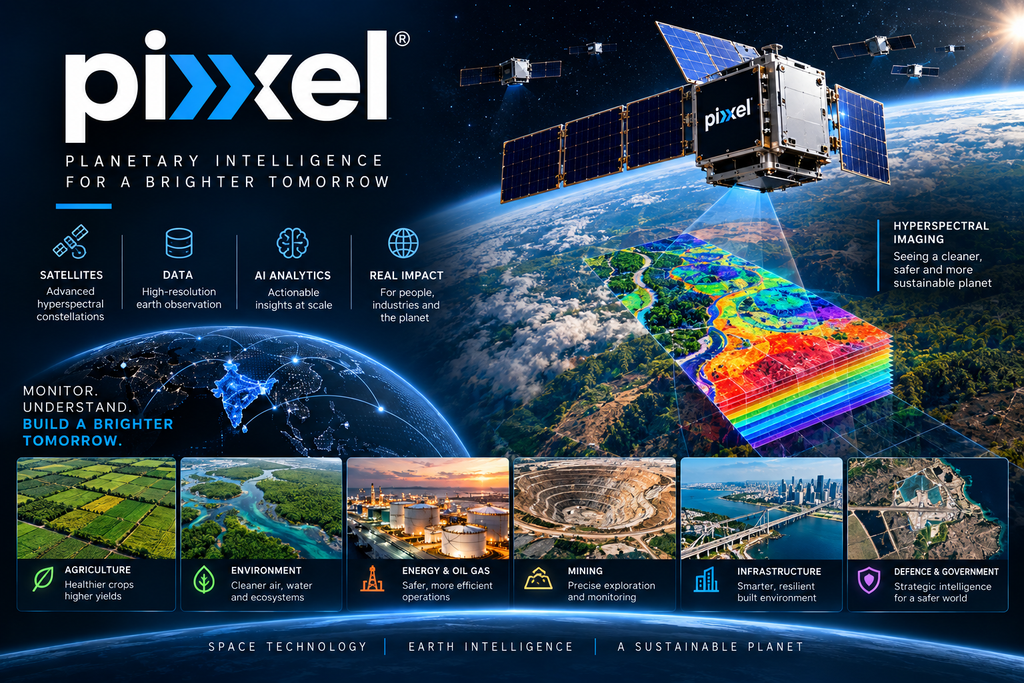
Pixxel is an Indian-origin space technology company building a planetary intelligence platform around satellites, hyperspectral imaging, Earth-observation data, AI analytics and space infrastructure.
The company initially focused on hyperspectral satellite imaging but has expanded its ambition into a broader platform combining advanced sensing satellites, Earth-intelligence software, sovereign space systems and satellite manufacturing.
Its latest $100 million Series C, announced on 7 September 2026 and co-led by Temasek and Seraphim, brought Pixxel’s disclosed total funding to approximately $195 million.
1. Company Background
Pixxel was founded by Awais Ahmed and Kshitij Khandelwal with the objective of building advanced Earth-observation satellites capable of collecting information that conventional optical satellite imagery cannot capture.
The company launched its first hyperspectral demonstration satellite, Shakuntala, in April 2022 and subsequently launched additional demonstration satellites. Pixxel later moved toward commercial satellite deployment with its Firefly constellation.
Pixxel has its roots in Bengaluru but operates internationally, with a US presence supporting its global customer and government business.
The company’s US parent, Pixxel Space Technologies, Inc., is incorporated in Delaware, according to US SEC filings.
2. What Does Pixxel Do?
Pixxel operates at the intersection of:
Space + Satellites + Hyperspectral Imaging + AI + Geospatial Intelligence
Its business can broadly be divided into four layers:
A. Satellite Systems
Pixxel designs and operates Earth-observation satellites.
B. Hyperspectral Imaging
Its satellites capture hundreds of spectral bands, allowing customers to identify materials and changes that may not be visible in conventional imagery.
C. Aurora Earth-Intelligence Platform
Aurora is Pixxel’s software platform that combines satellite imagery, AI-powered analytics and geospatial workflows to convert raw Earth-observation data into usable intelligence.
D. Space Infrastructure
Pixxel is now expanding into satellite manufacturing, sovereign space systems and orbital computing.
This broader strategy is what the company now describes as “planetary infrastructure.”
3. Understanding Hyperspectral Imaging
Traditional satellite imagery generally captures a limited number of spectral bands.
Hyperspectral satellites capture information across a much larger number of narrow spectral bands.
This enables identification of subtle differences in:
- Vegetation health
- Soil composition
- Water contamination
- Mineral composition
- Chemical signatures
- Crop stress
- Methane and other environmental indicators
- Industrial activity
- Infrastructure changes
Pixxel’s Firefly platform provides hyperspectral imagery across 135 bands with approximately 5-metre resolution in the VNIR range, according to its May 2026 product specification.
This capability is central to Pixxel’s differentiation.
4. Firefly Constellation
The Firefly constellation represents Pixxel’s transition from demonstration satellites to commercial-scale Earth observation.
Pixxel states that all six Firefly satellites were successfully launched during 2025 and are now operating in orbit. Together, they are designed to provide high-frequency hyperspectral coverage globally.
The Firefly platform is designed to provide:
- High-resolution hyperspectral imagery
- Frequent revisit capability
- Global Earth observation
- Environmental monitoring
- Agriculture intelligence
- Mining intelligence
- Energy-sector monitoring
- Defence and intelligence applications
The company’s product documentation lists Firefly at approximately 5.4-metre ground sampling distance and 472–890 nm VNIR coverage.
5. Next-Generation Honeybee Constellation
Pixxel is also developing the Honeybee constellation.
According to its May 2026 product specifications:
| Satellite | Spectral Range | Resolution | Status |
|---|---|---|---|
| Firefly | 472–890 nm | 5.4 m | Operational |
| Honeybee Zero | 400–2500 nm | 8 m | Planned Q4 2026 |
| Honeybees | 470–2500 nm | 5 m | Planned Q3/Q4 2027 |
The Honeybee programme is expected to significantly expand Pixxel’s spectral coverage beyond the VNIR range.
6. Aurora – Earth Intelligence Platform
Pixxel is attempting to move beyond being a satellite-imagery provider.
Its Aurora platform combines:
- Satellite imagery
- Hyperspectral data
- AI analytics
- Geospatial workflows
- Data visualisation
- Earth intelligence
- Decision-support tools
This is strategically important because software and analytics can potentially generate higher-value recurring revenue compared with simply selling raw satellite imagery.
Pixxel describes Aurora as an in-house Earth-intelligence software platform designed to turn observation data into operational information.
7. Industry Applications
Pixxel’s technology can be applied across multiple industries.
| Industry | Potential Application |
|---|---|
| Agriculture | Crop health, yield estimation, nutrient deficiency |
| Mining | Mineral exploration and monitoring |
| Oil & Gas | Infrastructure and environmental monitoring |
| Energy | Asset monitoring and environmental intelligence |
| Defence | Geospatial intelligence |
| Government | National Earth observation |
| Environment | Forest, water and climate monitoring |
| Infrastructure | Construction and asset monitoring |
| Maritime | Coastal and maritime intelligence |
| Insurance | Risk and environmental assessment |
Pixxel has previously highlighted applications such as emissions monitoring, water pollution, gas leaks, oil spills, soil composition, forest biodiversity and crop health.
8. Government & Defence Opportunity
Government and sovereign customers are becoming an important part of Pixxel’s business.
NRO Contract
In May 2026, Pixxel announced that it had been awarded a contract by the US National Reconnaissance Office (NRO) Commercial Systems Program Office under its Strategic Commercial Enhancements programme.
The contract involves demonstrating advanced commercial hyperspectral remote-sensing capabilities using Pixxel’s Firefly constellation.
This gives Pixxel exposure to the US national-security and intelligence ecosystem.
9. India’s National Earth Observation Constellation
One of Pixxel’s most significant recent developments came in January 2026.
Pixxel-led consortium signed an agreement with IN-SPACe to build India’s national Earth Observation constellation under a public-private partnership framework.
The consortium includes:
- Pixxel
- Dhruva Space
- PierSight
- SatSure
The programme envisages investment of more than ₹1,200 crore over five years to deploy 12 satellites covering optical, multispectral, SAR and hyperspectral imaging.
The project is intended to serve Indian government users while also supporting commercialisation of Earth-observation data globally.
10. Orbital Data Centre – Pathfinder
Pixxel is also moving into a completely new area: orbital computing.
In May 2026, Pixxel announced a partnership with Indian AI company Sarvam to develop India’s first orbital data-centre demonstration satellite.
The Pathfinder satellite is planned as a roughly 200 kg-class spacecraft, designed to combine:
- Hyperspectral imaging
- High-performance computing
- AI inference
- Satellite-based data processing
The satellite is targeted for launch as early as Q4 2026.
The concept is to process data in orbit instead of sending all raw data to Earth first.
If successfully demonstrated and commercialised, this could create a new business category around space-based computing and edge intelligence.
11. Gigapixxel – Satellite Manufacturing
Pixxel is also expanding its manufacturing capabilities.
The company is developing Gigapixxel, a high-rate satellite production facility designed to support production of up to 100 satellites.
The facility is intended to support Pixxel’s own constellation as well as future commercial and sovereign missions.
This is an important strategic development because the company is gradually moving from:
Satellite developer → Satellite operator → Data company → Space infrastructure company
12. Customer Base
Pixxel’s technology has applications across agriculture, mining, energy, environmental monitoring and government.
Earlier company profiles cited customers including:
- Rio Tinto
- DataFarming
IN-SPACe’s company profile previously described Pixxel as having more than 50 customers and 90+ resellers across major geographies.
The company has subsequently expanded its government and institutional relationships, including the NRO and India’s national Earth Observation programme.
13. Funding History
Pixxel has raised capital from a group of international and Indian venture investors.
Major Funding Rounds
| Round | Approx. Amount |
|---|---|
| Seed / Early Funding | ~$13M+ |
| Series A | ~$27M |
| Series B | $36M |
| Series B Extension | $24M |
| Series B Total | $60M |
| Series C – 2026 | $100M |
| Total Disclosed Funding | ~$195M |
The company’s December 2024 announcement stated that the additional $24 million brought total Series B funding to $60 million and cumulative funding to $95 million at that point.
The September 2026 Series C subsequently increased disclosed cumulative funding to approximately $195 million.
14. Series C – September 2026
This is the most important recent financing event.
Pixxel raised $100 million in Series C funding on 7 September 2026.
Lead Investors
- Temasek
- Seraphim
Other investors
- 360 ONE Asset
- IMM Investment
- Radical Ventures
- growX ventures
- M&G Catalyst
- Other existing investors
The round is described by Pixxel and multiple financial publications as the largest funding round raised by an Indian space-technology company to date.
The funding will support:
- Satellite constellation expansion
- Earth-intelligence software
- Sovereign space systems
- Satellite manufacturing
- New sensing capabilities
- Broader planetary infrastructure
15. Valuation
The final valuation following the September 2026 Series C has not been publicly disclosed by Pixxel.
Before the round closed, media reports had indicated a possible valuation in the $350–400 million range, but that should not be treated as the confirmed post-money valuation.
Third-party databases provide estimates, but these are not equivalent to an officially disclosed transaction valuation.
For an unlisted-share investor, the actual transaction price and fully diluted share count are therefore critical before comparing any secondary-market price with the latest institutional round.
16. FY2025 Financial Performance
Publicly available MCA-derived data for PixxelSpace India Private Limited indicates:
| Particular | FY2025 | FY2024 |
|---|---|---|
| Revenue | ₹39.3 Cr | ₹30.6 Cr |
| Revenue Growth | ~28.4% | — |
| Total Expenses | ₹67.1 Cr | — |
| PAT | ₹(30.8) Cr | — |
| Total Assets | ₹321.8 Cr | — |
The Indian entity therefore remained loss-making in FY2025, with revenue growing approximately 28.4% year-on-year.
Important: These numbers relate to the Indian operating entity and should not automatically be treated as consolidated financials for the entire Pixxel group, whose parent is a US corporation. The group-level financial picture can therefore differ materially.
17. Business Economics
Pixxel’s business has several potential revenue streams:
1. Satellite Data
Selling hyperspectral and other Earth-observation datasets.
2. Data Subscriptions
Recurring access to imagery and datasets.
3. Aurora Platform
Software and analytics revenue.
4. Government Contracts
Large institutional and sovereign programmes.
5. Satellite Manufacturing
Potential revenue from manufacturing satellites for customers and government missions.
6. Space Systems
Future revenue from spacecraft platforms and orbital computing infrastructure.
This creates the possibility of transitioning from a hardware-heavy business toward a combination of hardware + data + software + infrastructure.
18. Competitive Position
Pixxel operates in a rapidly expanding global Earth-observation market.
Its differentiation comes primarily from:
Hyperspectral Capability
Rather than relying solely on conventional optical imagery, Pixxel focuses on spectral information that can reveal the chemical/material characteristics of objects.
Full-Stack Approach
The company is increasingly building:
Satellite → Data → AI → Analytics → Intelligence
rather than simply selling satellite hardware.
Indian Space Ecosystem
Pixxel benefits from India’s expanding private-space ecosystem and government initiatives encouraging private participation.
Global Investor Base
Investors such as Temasek, Seraphim, Google and Radical Ventures provide international capital and ecosystem exposure.
19. Key Strengths
Large Institutional Funding
The latest $100 million Series C substantially strengthens the company’s capital base and expansion capacity.
First-Mover Position in Indian Hyperspectral Imaging
Pixxel has established an early position in commercial hyperspectral satellite imaging.
Six-Satellite Firefly Constellation
The company says all six Firefly satellites were launched during 2025 and are operating in orbit.
Government & Defence Opportunities
The NRO contract and India’s national Earth Observation constellation provide exposure to institutional demand.
Proprietary Data Platform
Aurora creates a software layer on top of the satellite infrastructure.
Manufacturing Capability
Gigapixxel is intended to enable higher-volume satellite production.
Multiple Growth Markets
Pixxel can potentially serve:
Agriculture + Mining + Energy + Climate + Defence + Government + Infrastructure
20. Key Risks
Still Loss-Making
The Indian operating entity reported a net loss of approximately ₹30.8 crore in FY2025.
Capital Intensive
Satellite development, launch, insurance, ground infrastructure and manufacturing require substantial capital.
Execution Risk
The company’s strategy has expanded considerably—from hyperspectral satellites into AI, software, sovereign systems and orbital computing. Successful execution across all these areas is uncertain.
Technology Risk
Satellite failures, launch delays, sensor performance issues and orbital problems can materially affect operations.
Long Revenue Cycles
Government and enterprise contracts can involve lengthy procurement and deployment cycles.
Customer Concentration
Large government or institutional contracts can create concentration risk if a major contract is delayed or not renewed.
Valuation Risk
The company remains privately held and has no continuously quoted market price. Venture funding valuations may differ substantially from the price at which secondary-market shares are offered.
Parent-Entity Structure
Investors need to verify whether the shares being offered represent equity in Pixxel Space Technologies, Inc., PixxelSpace India Private Limited or another group entity.
This is particularly important because the US parent and Indian operating subsidiary are separate legal entities.
21. Unlisted Investment Perspective
Pixxel is fundamentally different from a traditional mature unlisted company.
It is a venture-backed deep-tech company, where valuation is influenced by:
- Technology
- Satellite assets
- Intellectual property
- Government contracts
- Customer pipeline
- Funding rounds
- Future constellation scale
- Data monetisation
- Software revenue
- Manufacturing capacity
Key Things to Check Before Buying Unlisted Shares
1. Exact legal entity
Confirm the company whose shares are being transferred.
2. Latest Series C valuation
The $100 million Series C is the latest institutional financing event, but Pixxel has not publicly disclosed the final post-money valuation.
3. Fully diluted share count
Check ESOPs, preferred shares, convertibles and other instruments.
4. Share class
Confirm whether the shares being offered carry the same economic and voting rights as the institutional investors’ securities.
5. Secondary transaction price
Compare the proposed unlisted-market price with the latest institutional transaction, after adjusting for share class, dilution and currency.
6. Liquidity
There is currently no NSE/BSE listing providing continuous liquidity.
7. Future IPO
Investors should not assume an IPO timeline unless formally announced by the company.
22. IPO / Listing Status
As of 23 September 2026, Pixxel remains a privately held, unlisted company.
The company has recently raised a large institutional Series C round and is expanding its operations, but no confirmed IPO date has been announced in the latest official company announcements reviewed.
Therefore, any claim that Pixxel is definitely approaching an IPO should be treated as speculation unless supported by a formal company or regulatory announcement.
23. Why Pixxel Is Interesting for Unlisted Investors
Pixxel provides exposure to several major long-term technology themes:
🚀 India’s private space economy
🛰️ Satellite infrastructure
🌍 Earth observation
🔬 Hyperspectral imaging
🤖 AI & geospatial intelligence
🌾 Precision agriculture
⛏️ Mining intelligence
🛡️ Defence & national security
☁️ Space-based computing
💻 Data & software
The company’s evolution from a hyperspectral satellite startup into a broader planetary-infrastructure platform is the central strategic development to monitor.
24. Company Snapshot
| Parameter | Details |
|---|---|
| Company | Pixxel |
| Indian Entity | PixxelSpace India Private Limited |
| Parent | Pixxel Space Technologies, Inc. |
| Sector | SpaceTech / DeepTech |
| Industry | Earth Observation & Satellite Technology |
| Founded | 2019 |
| Founders | Awais Ahmed & Kshitij Khandelwal |
| Headquarters | Bengaluru / US |
| Status | Private & Unlisted |
| FY2025 Indian Entity Revenue | ₹39.3 Cr |
| FY2025 Indian Entity PAT | ₹(30.8) Cr |
| FY2025 Revenue Growth | ~28.4% |
| Latest Funding | Series C |
| Series C | $100M |
| Series C Date | September 2026 |
| Total Disclosed Funding | ~US$195M |
| Series C Lead Investors | Temasek & Seraphim |
| Firefly Satellites | 6 |
| Firefly Resolution | ~5.4 m |
| Firefly Spectral Bands | 135 |
| National EO Consortium | Pixxel-led |
| National EO Programme | ₹1,200 Cr+ planned investment |
| Planned National EO Satellites | 12 |
| NRO Contract | Yes |
| Aurora Platform | Yes |
| Orbital Data Centre | Pathfinder |
| Manufacturing Expansion | Gigapixxel |
| Exchange Listing | Unlisted |
25. Important Links
Pixxel – Official Website:
Pixxel
Pixxel – About Us:
Pixxel About Us
Pixxel – Newsroom:
Pixxel Newsroom
Pixxel – Series C Announcement:
$100M Series C Announcement
Pixxel – National Earth Observation Constellation:
National EO Constellation Announcement
Pixxel – Orbital Data Centre:
Orbital Data Centre / Pathfinder
Pixxel – NRO Contract:
NRO Hyperspectral Contract
US SEC – Pixxel Space Technologies, Inc.:
SEC Filing – Pixxel Space Technologies
Disclaimer
This report is prepared for educational and informational purposes only and should not be considered investment advice, a recommendation, solicitation, or an offer to buy or sell securities.
Pixxel is a privately held, unlisted deep-tech company and is still in a growth and investment phase. The financial figures cited for FY2025 relate to the Indian operating entity and should not automatically be treated as consolidated financials for the entire Pixxel group.
The latest Series C funding of $100 million was announced in September 2026 and takes disclosed total funding to approximately $195 million. The company has not publicly disclosed a final post-money valuation for this round.
Investors should carefully verify the exact legal entity, share class, fully diluted capitalisation, latest institutional transaction price, shareholder rights, transfer restrictions and valuation before purchasing any purported Pixxel unlisted shares.
Space technology involves substantial technology, execution, regulatory, launch, capital and commercialisation risks. Future satellite launches, contracts, revenue growth, profitability or an IPO should not be assumed unless formally confirmed.
For more such unlisted stocks visit
UnlistedCart – Unlisted Shares