Unlisted Telecom Tower Infrastructure | 5G & Digital Infrastructure
Company: Ascend Telecom Infrastructure Private Limited
CIN: U70102TG2002PTC038713
Incorporated: 28 March 2002
Registered Office: Secunderabad, Telangana
Corporate Office: Bengaluru, Karnataka
Business: Passive telecom infrastructure / tower leasing
Status: Unlisted equity company
IP-I Status: Category-I Infrastructure Provider
Parent: Funds managed by Global Infrastructure Partners (GIP), now part of BlackRock
FY26 Consolidated Revenue: ₹2,391 Cr
FY26 PAT: ₹100 Cr
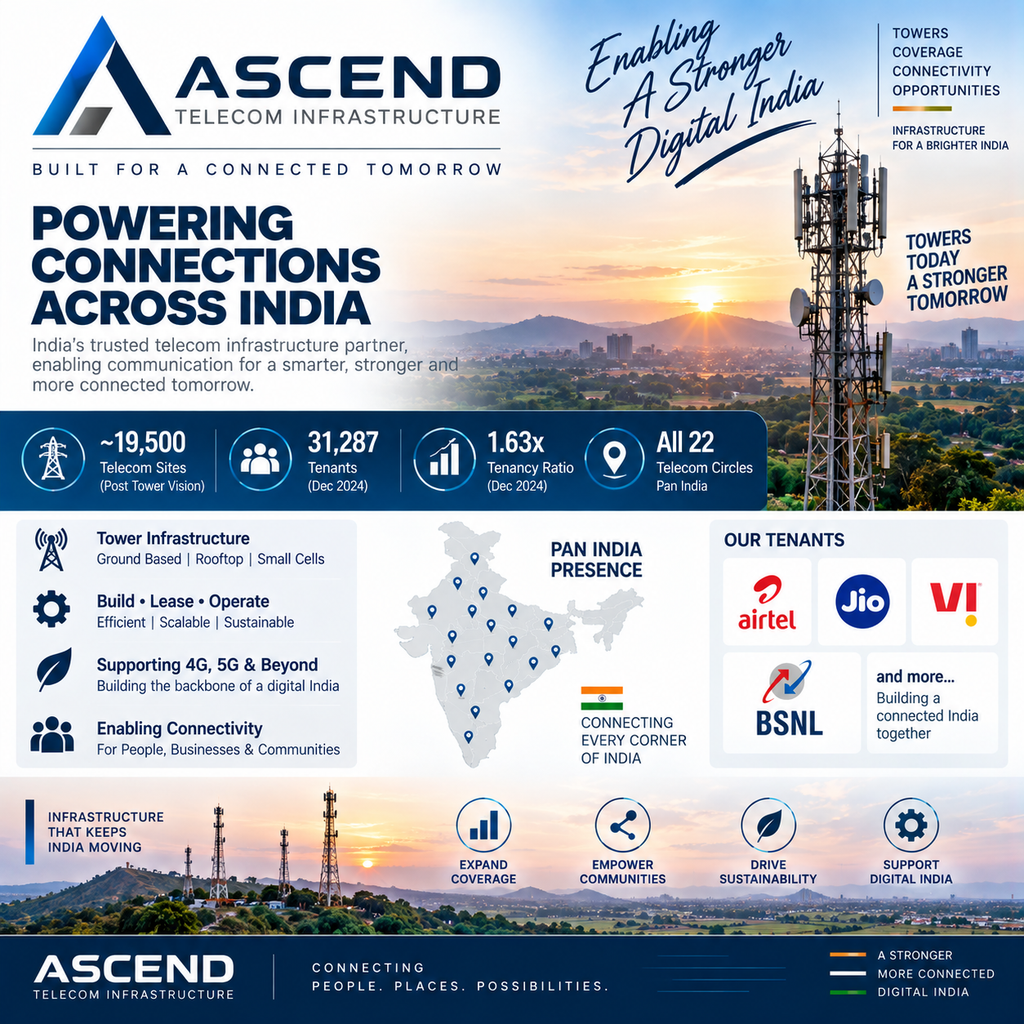
Tower Sites: ~19,500 post-acquisition
Tenants: 31,287 as of Dec. 2024

1. Company Overview
Ascend Telecom Infrastructure is an independent Indian telecom tower infrastructure company established in 2002. It provides passive telecom infrastructure on a Build–Lease–Operate model, allowing telecom operators to use tower sites without having to own and operate the underlying passive infrastructure themselves.
The company operates as a Category-I Infrastructure Provider (IP-I) and has a pan-India presence. Its infrastructure includes ground-based towers, rooftop towers, small-cell sites and related telecom infrastructure services. (Ascend Telecom Infrastructure)
Ascend Telecom – Official Website
2. What Does Ascend Telecom Do?
Ascend essentially owns/operates telecom infrastructure and earns recurring rental/service income from telecom operators.
Major offerings
- Ground-based towers
- Rooftop towers
- Small-cell infrastructure
- Telecom infrastructure sharing
- Build-to-suit tower deployment
- Operations & maintenance
- Site acquisition and deployment
- Power and allied infrastructure
- Network-support infrastructure
Its model is based on multi-tenancy — one tower can host equipment from multiple telecom operators, improving asset utilisation.
The company’s official website describes its infrastructure solutions as future-ready and deployable across India, including Jammu & Kashmir and the North-East. (Ascend Telecom Infrastructure)
3. Why Telecom Towers Are Important
The telecom tower business is an infrastructure business rather than a conventional telecom-operator business.
Operators such as Airtel, Jio, Vodafone Idea and BSNL need thousands of physical sites to provide mobile coverage.
Instead of each operator independently constructing infrastructure, tower companies can provide shared infrastructure.
This creates a model with:
Long-term contracts → recurring rentals → multiple tenants → operating leverage
CARE Ratings notes that Ascend’s agreements with telecom service providers include lock-ins, escalation clauses and early-termination provisions, providing medium-term revenue visibility.
4. Scale of Business
Following the acquisition and amalgamation of Tower Vision India, Ascend became a much larger telecom tower platform.
CARE Ratings reported:
| Metric | Data |
|---|---|
| Telecom towers | 19,249 |
| Tenants | 31,287 |
| Tenancy ratio | 1.63x |
| Telecom circles | All 22 circles |
| Industry position | 4th-largest passive infrastructure player, per CARE |
These figures were reported as of 31 December 2024.
Ascend’s FY2024-25 sustainability report subsequently reported approximately 19,500 telecom infrastructure sites, reflecting the post-acquisition portfolio. (Ascend Telecom Infrastructure)
Important distinction
The company has reported different site numbers depending on reporting date and definition. Therefore, it is better to describe the current portfolio as ~19,000–19,500 sites rather than treating one number as a live September 2026 figure.
5. Tower Vision Acquisition
One of the biggest strategic developments for Ascend was the acquisition of Tower Vision India Private Limited.
In June 2023, Ascend and GIP EM Ascend 2 Pte. Ltd. acquired 100% of Tower Vision India. The Competition Commission of India approved the transaction in May 2023. (Press Information Bureau)
The transaction significantly expanded Ascend’s:
- Tower portfolio
- Geographic footprint
- Tenant base
- Revenue base
- Market position
The Tower Vision business was subsequently amalgamated into Ascend. NCLT Hyderabad approved the amalgamation in January 2025.
6. FY26 Financial Performance
The latest audited consolidated financial statements provide FY26 numbers.
₹ Crore
| Particular | FY25 | FY26 |
|---|---|---|
| Revenue from operations | 2,515.1 | 2,391.1 |
| Other income | 65.1 | 77.4 |
| Total income | 2,580.2 | 2,468.5 |
| EBITDA / operating profit before D&A & interest | 1,555.8 | 1,289.3 |
| Depreciation & amortisation | 686.2 | 656.1 |
| Finance costs | 491.7 | 507.9 |
| Profit before tax | 377.9 | 125.3 |
| Profit after tax | 537.1 | 99.9 |
Source: audited consolidated FY26 financial statements of Ascend Telecom.
Important point about FY25 PAT
The FY25 PAT of approximately ₹537 crore needs to be interpreted carefully.
FY25 benefited materially from a deferred-tax credit, meaning the reported PAT was not entirely representative of recurring operating earnings.
Therefore, comparing FY26 PAT of ~₹100 crore directly with FY25 PAT of ~₹537 crore can give a misleading impression of the underlying operational change.
This is an important point for valuation.
7. Balance Sheet
As of 31 March 2026:
| Particular | FY26 |
|---|---|
| Total assets | ₹7,812 Cr |
| Equity / net worth | ₹2,030 Cr |
| Interest-bearing debt capital | ₹2,596 Cr |
| Cash & cash equivalents | ~₹195 Cr |
| Trade receivables | ~₹555 Cr |
The business remains capital intensive, as expected from a telecom infrastructure owner.
The large fixed-asset and right-of-use asset base reflects the infrastructure-heavy nature of the business.
8. Cash Flow
FY26 consolidated operating cash flow was approximately ₹110 Cr, compared with around ₹149 Cr in FY25.
The company also incurred significant investment in property, plant and equipment, while financing cash flow was negative because of debt servicing, interest and other financing activities.
For a tower company, cash flow after interest and maintenance capex is particularly important because accounting EBITDA can be high while actual free cash generation can be lower.
9. Ownership
As of 31 March 2025, the disclosed shareholding was:
| Shareholder | Holding |
|---|---|
| GIP EM Ascend Pte Ltd | 43.19% |
| GIP EM Ascend 2 Pte Ltd | 35.66% |
| India Infrastructure Fund II | 21.15% |
| Total | 100% |
The company disclosed these holdings in its FY24-25 annual report. (Ascend Telecom Infrastructure)
Funds managed by GIP ultimately own the platform. BlackRock completed its acquisition of GIP on 1 October 2024, with GIP continuing as BlackRock’s infrastructure platform. (BlackRock)
BlackRock – GIP Acquisition Announcement
10. Share Capital
FY25:
- Equity shares outstanding: 4.55 crore
- Face value: ₹10
- FY25 paid-up equity capital: approximately ₹45.5 crore
After the Tower Vision amalgamation, Ascend allotted additional shares, taking paid-up equity capital to approximately ₹48.24 crore. (Ascend Telecom Infrastructure)
This share-count change is important when calculating per-share valuation.
11. IPO – Very Important Development
There is currently no filed DRHP or confirmed IPO timetable identified for Ascend Telecom.
However, this is an important company to watch because Mint reported in May 2026 that BlackRock-backed GIP was exploring an IPO of Ascend Telecom, with a reported potential valuation of approximately $500 million / around ₹5,000 crore.
The report specifically stated that discussions were at an early stage and could change depending on market conditions. (mint)
Therefore:
IPO status: Early-stage reported consideration — NOT a confirmed IPO.
This distinction is particularly important when discussing Ascend in the unlisted market.
12. Potential Valuation Reference
The reported potential IPO valuation of around ₹5,000 crore can be used only as a media-reported valuation reference, not as an official company valuation or current market price. (mint)
With approximately 4.82 crore shares after the amalgamation-related allotment, ₹5,000 crore would mathematically correspond to roughly:
₹1,037 per equity share
But this is not an official Ascend share price.
It should not be presented as a current OTC quote.
13. Is Ascend Telecom Listed?
Equity
No.
Ascend’s equity shares are not listed on NSE or BSE. The company itself confirms that it is a private limited company and its equity is not listed. (Ascend Telecom Infrastructure)
Debt
Ascend has listed Non-Convertible Debentures (NCDs) on BSE.
So:
Equity = Unlisted
NCDs = Listed on BSE
This distinction is important when preparing an UnlistedCart report. (Ascend Telecom Infrastructure)
14. Credit Rating
CARE Ratings reaffirmed:
- Long-term bank facilities: CARE AA-; Stable
- Short-term bank facilities: CARE A1+
- NCDs: CARE A+; Stable
In March 2025, CARE had rated ₹2,280 crore of long-term bank facilities and ₹1,169 crore of NCDs.
The rating agency highlighted the company’s strong parentage, established operating track record, long-term contracts, liquidity and improving operational metrics.
15. Key Growth Drivers
1. 5G rollout
5G requires network densification and additional infrastructure in many locations.
CARE Ratings specifically identified 4G/5G rollout and rising data consumption as structural drivers for tower companies.
2. Increasing data consumption
As smartphone penetration, video consumption, cloud applications and digital services increase, telecom operators need greater network capacity.
This can increase demand for:
More sites + more equipment + more tenancy
3. Multi-tenancy
A tower hosting multiple operators can generate significantly better asset utilisation than a single-tenant site.
Ascend’s reported tenancy ratio of around 1.63x provides an indication of this operating model.
4. Tower Vision integration
The acquisition increased the scale of the platform and expanded its presence to all 22 telecom circles.
5. Long-term contracts
Master Service Agreements contain lock-ins, escalation clauses and termination provisions, supporting revenue visibility.
6. Digital infrastructure growth
Telecom towers are becoming an essential part of India’s broader digital infrastructure ecosystem.
16. Key Risks
High leverage
The company has a significant infrastructure debt burden. FY26 debt capital was around ₹2,596 crore.
Interest cost
Finance costs increased to around ₹508 crore in FY26, making interest coverage and refinancing important monitorables.
Telecom operator concentration
Tower companies ultimately depend on telecom operators for tenancy and collections.
Weakness in a major tenant can affect receivables and cash flows.
Tower tenancy
A decline in tenancy ratio would reduce revenue generation from the existing tower portfolio.
CARE identifies a sustained tenancy ratio below 1.50x as a negative credit-rating sensitivity.
Capital expenditure
Tower infrastructure requires ongoing maintenance and growth capex.
Regulatory / permission risk
Tower deployment requires permissions from relevant authorities. Industry associations have previously highlighted delays in infrastructure deployment permissions in certain states. (Business Standard)
Unlisted liquidity
There is no regular NSE/BSE equity market for Ascend shares. Exit opportunities therefore depend on private transactions, corporate actions or a future listing.
17. Investment Framework
For Ascend, investors should focus on:
| Metric | Why it matters |
|---|---|
| Tower count | Determines infrastructure scale |
| Tenancy ratio | Key revenue driver |
| Revenue/site | Asset productivity |
| New tower additions | Growth |
| Tenant mix | Customer concentration |
| Collection efficiency | Cash-flow quality |
| EBITDA margin | Operating leverage |
| Debt/EBITDA | Financial risk |
| Interest coverage | Debt servicing |
| Maintenance capex | Free cash flow |
| 5G rollout | Demand driver |
| IPO plans | Potential liquidity event |
18. Ascend vs Traditional Telecom Companies
Ascend is not a telecom operator.
It does not primarily earn money from selling mobile data or voice services to consumers.
Instead:
Telecom operators → rent infrastructure → Ascend
This makes Ascend closer to an infrastructure/real-estate-like annuity business than to Airtel, Jio or Vodafone Idea.
Its key assets are:
Towers + sites + leases + tenants + long-term contracts
19. Quick Snapshot
| Parameter | Ascend Telecom |
|---|---|
| Incorporated | 2002 |
| Business | Telecom Tower Infrastructure |
| IP-I Provider | Yes |
| Equity listed | No |
| BSE NCDs | Yes |
| Tower portfolio | ~19,000–19,500 |
| Tenants | 31,287* |
| Tenancy ratio | 1.63x* |
| FY26 Revenue | ₹2,391 Cr |
| FY26 EBITDA | ₹1,289 Cr |
| FY26 PBT | ₹125 Cr |
| FY26 PAT | ₹100 Cr |
| FY26 Net worth | ₹2,030 Cr |
| FY26 Debt capital | ₹2,596 Cr |
| Promoter / sponsor | GIP / BlackRock infrastructure platform |
| IPO | Early-stage reported exploration |
| Reported potential valuation | ~₹5,000 Cr** |
* CARE figures as of 31 December 2024.
** Media-reported potential IPO valuation, not an official valuation or current share price.
20. UnlistedCart Takeaway
Ascend Telecom is essentially a play on India’s growing digital infrastructure.
The company has substantially increased its scale through the Tower Vision acquisition and now operates a large multi-tenant tower portfolio across India. Its long-term contracts, 5G/4G rollout opportunity and infrastructure-heavy business model provide the core growth framework.
At the same time, the FY26 numbers show why debt, finance costs and cash generation need close attention. FY25 PAT was also boosted by a significant tax-related benefit, making recurring earnings a more useful basis for valuation than headline FY25 PAT.
The potential IPO story adds an interesting future liquidity angle, but the reported ₹5,000 crore valuation should be treated only as an early-stage media report, not as a confirmed IPO valuation. (mint)
Key Theme
5G + Data Growth + Tower Sharing + Long-Term Contracts + Digital Infrastructure
Official & Research Links
Ascend Telecom – Official Website
Ascend Telecom – Financial Information
Ascend Telecom – FY26 Consolidated Financial Statements
Ascend Telecom – FY25 Annual Report / Shareholding Disclosure
CCI – Tower Vision Acquisition Approval
Mint – Report on Potential Ascend Telecom IPO
Disclaimer: This report is for informational and research purposes only and is not investment advice. Ascend’s equity shares are unlisted and therefore have limited liquidity and less transparent price discovery than listed securities. Any private-market valuation or potential IPO valuation should be independently verified against the latest company documents and transaction terms before making an investment decision.
For more such unlisted stocks visit UnlistedCart – Unlisted Shares