Unlisted Power Distribution Company | Delhi Power Distribution
Company: BSES Yamuna Power Limited
CIN: U40109DL2001PLC111525
Registered Office: Shakti Kiran Building, Karkardooma, Delhi – 110032
Incorporated: 4 July 2001
Business: Electricity Distribution
Status: Unlisted company
Promoter/Strategic Shareholder: Reliance Infrastructure Limited
Government Partner: Government of NCT of Delhi
Ownership: 51% Reliance Infrastructure / 49% Government of NCT Delhi
1. Company Overview
BSES Yamuna Power Limited (BYPL) is one of Delhi’s private electricity distribution companies. It commenced operations on 1 July 2002 following the unbundling of the erstwhile Delhi Vidyut Board.
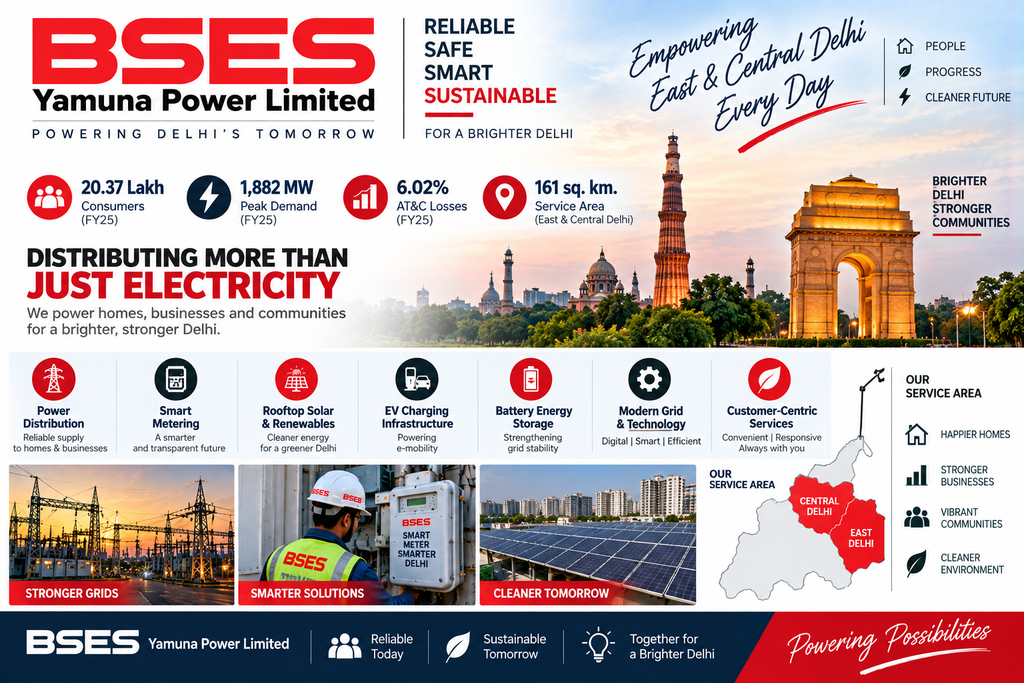
The company distributes electricity across approximately 161 sq. km. of Central and East Delhi, serving residential, commercial, industrial and other consumers.
Its service network covers areas through 3 circles and 14 divisions, including Yamuna Vihar, Krishna Nagar, Laxmi Nagar, Mayur Vihar, Vasundhara Enclave, Nand Nagri, Dilshad Garden, Karawal Nagar, Chandni Chowk, Darya Ganj, Paharganj, Patel Nagar and other areas.
Official BYPL – Company Overview
2. What Does BYPL Do?
BYPL operates a regulated electricity distribution business.
Its key activities include:
- Procurement of electricity
- Distribution of power to consumers
- Operation and maintenance of distribution infrastructure
- Substations and electrical networks
- Smart metering and digital consumer services
- Grid automation
- Renewable-energy integration
- Rooftop solar/net-metering facilitation
- Battery energy storage and grid-modernisation initiatives
The company’s economics are therefore different from a normal manufacturing or consumer business. Tariffs, power-purchase costs, regulatory approvals and allowed returns have a major impact on profitability.
3. Geographic Footprint
| Particular | BYPL |
|---|---|
| Licensed area | ~161 sq. km. |
| Region | East & Central Delhi |
| Consumers FY25 | 20.37 lakh |
| Peak demand FY25 | 1,882 MW |
| AT&C losses FY25 | 6.02% |
| Circles | 3 |
| Divisions | 14 |
One of BYPL’s biggest operational improvements has been the reduction in AT&C losses from 63.16% in FY03 to 6.02% in FY25. Consumer numbers increased from 7.43 lakh to 20.37 lakh over the same period.
4. Financial Performance
FY25 vs FY26
| ₹ Crore | FY25 | FY26 | Change |
|---|---|---|---|
| Revenue | 8,936.04 | 7,407.96 | -17.1% |
| Profit After Tax | 2,174.25 | 948.69 | -56.4% |
| Operating Cash Flow | 1,375.25 | 618.79 | -55.0% |
| Investing Cash Flow | -399.48 | -303.48 | — |
| Financing Cash Flow | -519.47 | -551.91 | — |
| Net assets | 12,970.02 | 14,342.71 | +10.6% |
FY26 saw a significant decline in both revenue and profitability compared with FY25. Revenue fell to ₹7,407.96 crore and PAT declined to ₹948.69 crore. Operating cash flow also reduced to ₹618.79 crore from ₹1,375.25 crore.
The financial figures are reported in Reliance Infrastructure’s FY2025-26 annual report, where BYPL is classified as a material subsidiary.
Reliance Infrastructure FY2025-26 Annual Report – BYPL disclosures
5. Ownership & Share Capital
BYPL is a joint venture between:
| Shareholder | Holding |
|---|---|
| Reliance Infrastructure Limited | 51% |
| Government of NCT of Delhi | 49% |
Reliance Infrastructure’s FY26 annual report confirms its 51% holding in BYPL. The report also discloses approximately 28.36 crore BYPL shares held by Reliance Infrastructure.
BYPL’s paid-up share capital is approximately ₹556 crore, implying around 55.6 crore equity shares of ₹10 each.
BSES BYPL – Companies Act & Annual Reports
6. Operational Performance
The biggest long-term operational story is the dramatic reduction in distribution losses.
AT&C Loss Reduction
FY03: 63.16%
↓
FY25: 6.02%
This represents a major improvement in distribution efficiency. The company also increased its consumer base substantially while handling much higher peak demand.
Other areas of focus include:
- Smart meters
- Digital billing
- Grid automation
- SCADA
- Network strengthening
- Renewable integration
- Rooftop solar
- Battery Energy Storage Systems
7. Regulatory Asset – Important Development
One of the most important factors for analysing BYPL is its regulatory asset position.
Following regulatory and judicial developments involving the Delhi distribution companies, BYPL disclosed a regulatory-asset liquidation plan.
As per BYPL’s June 2026 submission to DERC, the regulatory asset amount attributable to BYPL was approximately ₹12,333 crore as of 31 March 2026, with recovery planned through a structured process beginning in FY27 and extending through FY31 under the applicable regulatory/judicial framework.
This is important because regulatory assets can materially influence:
- Future cash flows
- Tariff recovery
- Consumer surcharges
- Reported profitability
- Regulatory return calculations
- Balance-sheet strength
Investors should therefore analyse BYPL differently from a conventional company where reported PAT alone provides a straightforward picture.
8. Power Purchase Cost & FPPAS
Power purchase is one of the largest cost components of a distribution utility.
BYPL currently publishes Fuel & Power Purchase Adjustment Surcharge (FPPAS) information on its website. The company’s current page shows a 17.43%+ FPPAS and also provides FY26-27 orders and calculations.
This mechanism is important because changes in power procurement costs can eventually flow through the regulatory/tariff mechanism.
BYPL – FPPAS / Power Purchase Adjustment Charges
9. Renewable Energy & Grid Modernisation
BYPL is increasingly involved in the transition towards smarter and cleaner electricity distribution.
Key areas include:
- Renewable energy procurement
- Renewable Purchase Obligation compliance
- Rooftop solar/net metering
- Battery storage
- Smart meters
- Digital distribution infrastructure
- Grid automation
BYPL continues to publish its Renewable Purchase Obligation and renewable-energy/REC information for FY26-27.
BYPL – Renewable Purchase Obligation Status
10. Regulatory Environment
BYPL is a licensed distribution utility under the regulatory framework of the Delhi Electricity Regulatory Commission (DERC).
DERC regulates areas such as:
- Tariffs
- Aggregate Revenue Requirement
- True-up
- Power purchase costs
- Capital expenditure
- Regulatory assets
- Consumer charges
- Performance standards
DERC – Licences Issued to Utilities
DERC also publishes BYPL’s regulatory proceedings and tariff-related orders.
DERC – BYPL Regulatory Information
11. Unlisted Share Price
BYPL is not listed on NSE or BSE, so there is no transparent exchange-traded market price.
A third-party private-market platform reported an indicative price of approximately ₹492/share as of 15 July 2026. This should be treated as an indicative OTC/private-market quote, not an official exchange price.
At ₹492/share:
- Approx. shares: 55.6 crore
- Indicative equity value: ~₹27,350 crore
- FY26 PAT: ₹948.69 crore
- Indicative P/E: ~28.8x
Because the shares are unlisted, actual transaction prices can differ materially depending on buyer/seller availability, lot size, liquidity and negotiation.
Indicative BYPL Unlisted Share Research – Planify
12. IPO / Listing Status
As of the latest information reviewed, no confirmed NSE/BSE IPO timetable or DRHP for BYPL was identified.
Therefore, investors should not treat the current OTC market as a pre-IPO price unless an official offer document is subsequently filed.
13. Key Growth Drivers
1. Extremely low AT&C losses
Losses have fallen from 63.16% in FY03 to 6.02% in FY25, improving the efficiency of the distribution network.
2. Growing electricity demand
Delhi’s rising urbanisation, commercial activity, data consumption, EV adoption and cooling demand can support long-term electricity consumption.
3. Smart-grid investments
Smart meters, automation and digital systems can improve collection, reliability and network management.
4. Renewable integration
Solar, storage and renewable procurement can become increasingly important as Delhi’s power ecosystem transitions towards cleaner energy.
5. Regulatory-asset recovery
The structured recovery of regulatory assets could have a meaningful impact on future cash-flow visibility, although the exact timing and regulatory treatment remain important variables.
6. Strategic ownership
The 51% ownership by Reliance Infrastructure provides a strategic parent with an established presence in India’s infrastructure and power sectors.
14. Key Risks
Regulatory Risk
Profitability and cash flows depend heavily on DERC decisions regarding tariffs, true-up, power purchase costs and regulatory assets.
Regulatory Asset Risk
The large regulatory-asset balance makes recovery timing an important investment variable.
Power Purchase Cost
Higher procurement costs can create pressure until they are appropriately recovered through regulatory mechanisms.
Unlisted Liquidity
There is no NSE/BSE trading liquidity, meaning investors may face difficulty finding buyers or sellers.
FY26 Earnings Decline
PAT declined from ₹2,174 crore to ₹949 crore in FY26, while operating cash flow fell from ₹1,375 crore to ₹619 crore.
Valuation Risk
At an indicative ₹492/share, the implied valuation is significantly higher than what the FY26 earnings alone might suggest. The regulatory-asset and future cash-flow framework therefore becomes particularly important in valuation.
15. What Investors Should Track
For BYPL, investors should monitor these metrics rather than relying only on P/E:
| Metric | Why it matters |
|---|---|
| AT&C losses | Distribution efficiency |
| Consumer growth | Demand expansion |
| Peak demand | Network utilisation |
| Power purchase cost | Major cost driver |
| Regulatory assets | Future cash-flow recovery |
| Tariff orders | Revenue visibility |
| Operating cash flow | Quality of earnings |
| Capex | Network modernisation |
| Smart-meter rollout | Collection & efficiency |
| Renewable procurement | Energy transition |
| FPPAS/PPAC | Cost recovery |
| Unlisted price | Valuation/liquidity |
16. Investment Snapshot
| Parameter | BYPL |
|---|---|
| Business | Power Distribution |
| Geography | East & Central Delhi |
| Consumers | 20.37 lakh |
| Licensed area | ~161 sq. km. |
| FY26 Revenue | ₹7,407.96 Cr |
| FY26 PAT | ₹948.69 Cr |
| FY26 Operating Cash Flow | ₹618.79 Cr |
| FY25 AT&C losses | 6.02% |
| Ownership | 51% Reliance Infra / 49% GNCTD |
| Paid-up capital | ~₹556 Cr |
| Indicative OTC price | ~₹492* |
| Indicative equity value | ~₹27,350 Cr* |
| NSE/BSE listed | No |
| IPO/DRHP | No confirmed IPO identified |
*Indicative private-market reference price reported for 15 July 2026; not an exchange-traded price.
17. Overall Business Framework
BSES Yamuna Power is essentially a regulated infrastructure and cash-flow business rather than a conventional high-growth company.
The long-term thesis revolves around:
Low distribution losses + growing electricity demand + regulated returns + network modernisation + renewable integration + potential regulatory-asset recovery.
At the same time, the sharp FY26 decline in PAT and operating cash flow and the large regulatory-asset balance mean that regulatory developments and cash-flow recovery deserve close monitoring.
The most important question for an unlisted investor is therefore not simply “What is the P/E?” but:
How much sustainable cash flow can the distribution business generate after power procurement costs, regulatory adjustments, capex and recovery of regulatory assets?
Disclaimer
This report is prepared for informational and research purposes only and should not be considered investment advice, an offer to buy/sell securities, or a guarantee of future returns. Unlisted shares carry higher liquidity, valuation and price-discovery risks than listed securities. Private-market prices are indicative and may vary by transaction size, availability and negotiation. Investors should independently verify the latest financial statements, regulatory orders, shareholding and transaction price before making any investment decision.
Official & Research Sources
BSES Yamuna Power – Official Website
BYPL – Companies Act Compliance & Annual Reports
Reliance Infrastructure FY2025-26 Annual Report
BYPL – Indicative Unlisted Share Research
For more such unlisted stocks visit UnlistedCart – Unlisted Shares