
Sector: Oil Refining / Fuel Retail / Petrochemicals
Status: Unlisted / Delisted
Former Name: Essar Oil Limited
Headquarters: Mumbai, Maharashtra
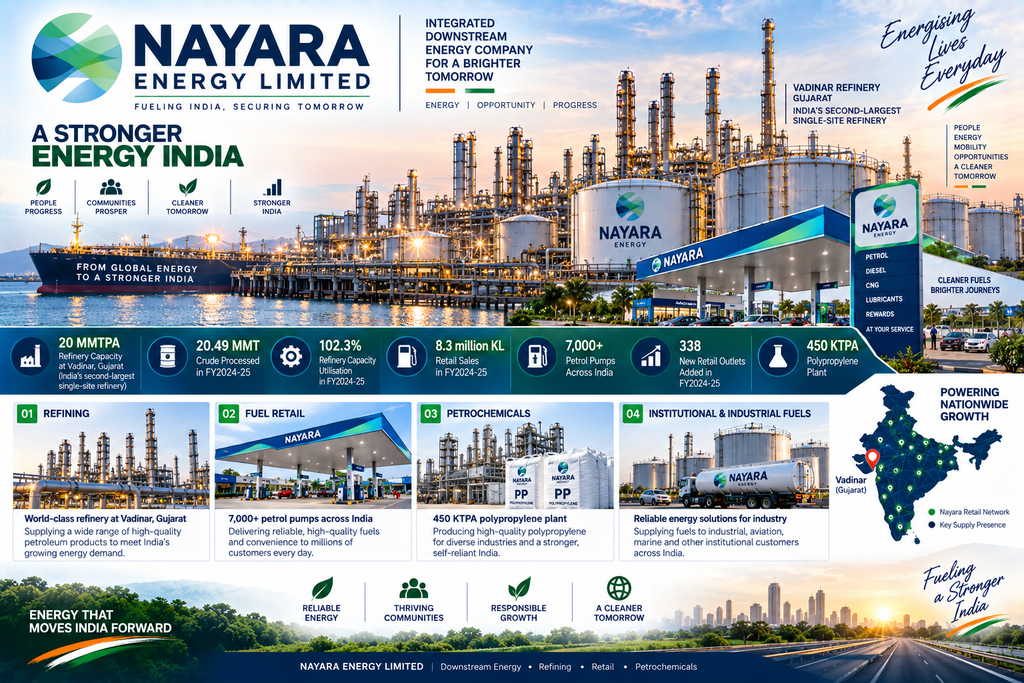
Refinery: Vadinar, Gujarat
Refinery Capacity: 20 MMTPA (~400,000 barrels per day)
Retail Network: 6,600+ fuel stations
ISIN: INE011A01019
CIN: U11100GJ1989PLC032116
1. Company Overview
Nayara Energy Limited is one of India’s largest privately owned integrated downstream energy companies.
The company was formerly known as Essar Oil Limited and changed its name to Nayara Energy in May 2018. Its principal assets are:
- The 20 MMTPA Vadinar refinery in Gujarat
- A nationwide fuel-retail network
- Crude-oil import and product-export infrastructure
- A deep-water port and oil terminal
- Petrochemical manufacturing
- Institutional and industrial fuel sales
The Vadinar refinery has a current capacity of 20 million tonnes per annum, equivalent to roughly 400,000 barrels per day. PPAC’s April 2026 data confirms the 20 MMTPA capacity.
The company’s integrated configuration gives it exposure to refining margins, domestic fuel demand, international product markets and petrochemicals.
2. Ownership Structure
Nayara Energy has a distinctive ownership structure.
Rosneft Singapore Pte. Ltd.: ~49.13%
Kesani Enterprises Company Limited: ~49.13%
The remaining shares are largely held by minority shareholders.
Rosneft acquired its stake as part of the 2017 transaction that valued the company at approximately US$12.9 billion. Kesani is linked to an investment consortium involving Mareterra Group and United Capital Partners.
Trafigura previously had an indirect interest through the consortium but sold its interest in January 2023 to Hara Capital, a subsidiary of Mareterra Group.
3. Business Model
Nayara operates across four major areas.
A. Refining
The Vadinar refinery is the core earnings engine.
It is designed to process a wide range of crude grades, including heavy and ultra-heavy crude.
The refinery has a high complexity configuration, allowing Nayara to convert relatively lower-cost crude into higher-value refined products.
During FY25, the refinery processed approximately:
20.49 MMT of crude
and operated at:
102.3% capacity utilisation
The refinery also achieved 99.63% operational availability for major process units.
B. Fuel Retail
Nayara has built one of India’s largest private fuel-retail networks.
The company currently reports more than 6,600 retail outlets.
The network primarily sells:
- Petrol
- Diesel
- Lubricants
- Other automotive products
The retail business provides a domestic distribution channel for the refinery.
C. Petrochemicals
Nayara has moved beyond pure refining into petrochemicals.
The company commissioned its polypropylene facility, with production commencing during FY25.
FY25 polypropylene production was approximately:
0.21 MMT
This creates an additional source of value from refinery feedstocks and supports Nayara’s strategy of increasing petrochemical exposure.
D. Institutional & Industrial Business
Nayara also supplies petroleum products to:
- Industrial customers
- Commercial customers
- Large institutions
- Other bulk consumers
This provides an additional distribution channel beyond retail stations.
4. Vadinar Refinery – Key Competitive Asset
The Vadinar refinery is the company’s most important asset.
Its key advantages include:
High complexity
The refinery can process heavy and ultra-heavy crude grades that may be purchased at discounts to lighter crude.
Deep-water port
The refinery is integrated with a deep-water port capable of handling large crude tankers.
This reduces dependence on external logistics infrastructure.
Integrated storage
The Vadinar complex has substantial crude and product storage facilities.
Export capability
The location on India’s western coast gives Nayara access to international product markets.
High utilisation
The refinery has consistently operated at high utilisation levels.
These characteristics are particularly valuable during periods when complex-refinery margins are attractive.
5. FY25 Refinery Performance
During FY24-25:
| Parameter | FY25 |
|---|---|
| Crude Processed | 20.49 MMT |
| Capacity Utilisation | 102.3% |
| Major-unit availability | 99.63% |
| Heavy + ultra-heavy crude | 96.1% |
| Light & middle distillates | 87% |
The company reported its highest-ever production of motor spirit and high-speed diesel during FY25.
The refinery also introduced new grades of ethanol-blended motor spirit, including E15 and E20.
6. FY25 Financial Performance
Consolidated Financials
| ₹ Crore | FY23 | FY24 | FY25 |
|---|---|---|---|
| Revenue | 1,38,866 | 1,56,031 | 1,50,324 |
| EBITDA | 18,313 | 20,670 | 12,295 |
| PBT | 12,535 | 16,430 | 8,458 |
| PAT | 9,426 | 12,321 | 6,080 |
| EBITDA Margin | 13.2% | 13.3% | 8.2% |
| PAT Margin | 6.8% | 7.9% | 4.0% |
FY25 revenue declined moderately from FY24, while EBITDA and PAT fell more sharply.
The consolidated annual report reported FY25 revenue from operations of approximately ₹1.492 lakh crore, total income of ₹1.503 lakh crore and profit of ₹6,079.5 crore.
Why did profit fall?
The key issue for a refinery is not simply revenue growth.
Profitability depends heavily on:
- Gross refining margins
- Crude procurement costs
- Product cracks
- Inventory gains/losses
- Fuel demand
- Petrochemical margins
- Export economics
Therefore, Nayara’s FY25 profit decline should primarily be viewed in the context of refining-cycle economics rather than simply weaker sales.
7. FY26 Financial Performance
Secondary financial data indicates a significant improvement in profitability during FY26.
| ₹ Crore | FY25 | FY26 |
|---|---|---|
| Revenue | 1,50,324 | 1,47,774 |
| EBITDA | 12,295 | 15,970 |
| PBT | 8,458 | 12,192 |
| PAT | 6,080 | 9,027 |
| EBITDA Margin | 8.18% | 10.81% |
| PAT Margin | 4.04% | 6.11% |
Revenue declined approximately 1.7%, but EBITDA increased approximately 30% and PAT increased approximately 48%.
This illustrates the operating leverage of a refinery: relatively small changes in refining economics can produce large changes in earnings.
The company’s FY25-26 annual report is available through its investor portal, although the company currently provides access to the report through a shareholder-password mechanism.
8. Cash Flow
Nayara has historically generated significant operating cash flows.
Consolidated Cash Flow
| ₹ Crore | FY24 | FY25 | FY26 |
|---|---|---|---|
| Operating Cash Flow | 3,455 | 3,048 | 6,921 |
| Investing Cash Flow | -6,383 | -1,456 | -4,060 |
| Financing Cash Flow | -2,556 | -1,159 | -4,030 |
| Net Change in Cash | -5,483 | +433 | -1,169 |
FY26 operating cash flow increased substantially to approximately ₹6,921 crore, according to the latest secondary financial compilation.
This is an important improvement because refinery businesses require substantial working capital.
The company also continued to deploy capital toward its refinery, petrochemical and other assets.
9. Balance Sheet
Secondary FY26 financial data indicates:
| Parameter | FY26 |
|---|---|
| Net Worth | ₹59,129 Cr |
| Total Assets | ₹1,07,559 Cr |
| Total Liabilities | ₹48,429 Cr |
| Debt/Financial obligations | Moderate relative to asset base |
| ROE | 15.27% |
| ROCE | 20.13% |
The balance sheet has strengthened materially compared with FY22.
Net worth increased from approximately ₹21,642 crore in FY22 to more than ₹59,000 crore in FY26.
10. Refining Margin Economics
Nayara’s earnings should not be evaluated like those of a normal consumer company.
A major driver is:
Gross Refining Margin (GRM)
Simplified:
GRM = Value of refined products – Cost of crude/feedstock
If product prices rise faster than crude prices:
GRM ↑ → EBITDA ↑ → PAT ↑
If crude prices rise while product cracks weaken:
GRM ↓ → EBITDA ↓ → PAT ↓
This explains why Nayara’s revenue can remain relatively stable while profit changes substantially.
The FY24-to-FY25 decline in profitability and FY26 recovery demonstrate this operating leverage.
11. Petrochemical Expansion
The polypropylene business is strategically important.
During FY25, Nayara introduced polypropylene production as part of its diversification beyond fuels.
The company produced approximately 0.21 million tonnes of polypropylene during FY25.
Petrochemicals can potentially:
- Increase refinery integration
- Improve value extraction from feedstocks
- Diversify earnings
- Reduce dependence on transportation fuels
- Provide exposure to India’s growing polymer demand
The success of the petrochemical segment will therefore be an important long-term valuation driver.
12. Fuel Retail Expansion
Nayara’s retail network has grown substantially.
The company had crossed approximately 6,000 stations by 2023 and currently reports more than 6,600 outlets.
A large retail network provides:
- Domestic market access
- Brand visibility
- Distribution scale
- Refinery-product offtake
- Potential non-fuel retail opportunities
The dealer-owned/dealer-operated model can also limit the amount of capital required from the parent compared with a company-owned network.
13. Current Unlisted Share Price
Nayara Energy is not listed on NSE or BSE.
The company explicitly states that its shares were delisted and that transactions can currently take place only through off-market demat transfers.
A current unlisted-market indication from Moneycontrol is:
₹1,110 per share
with:
Indicative market capitalisation: ~₹1.65 lakh crore
Shares outstanding: ~148.84 crore
FY26 EPS: ~₹60.65
Indicative P/E: ~17.3x
Indicative P/B: ~2.64x
These are OTC/unlisted indications rather than exchange prices.
Other intermediaries displayed nearby but different indications, so investors should not treat ₹1,110 as a firm executable exchange price.
14. Indicative Valuation
Using the current indicative price of ₹1,110:
P/E
FY26 EPS ≈ ₹60.65
P/E ≈ 18.3x
Moneycontrol’s displayed P/E is approximately 17.3x, reflecting differences in the underlying financial/share-count calculation.
P/B
Book value ≈ ₹397 per share
P/B ≈ 2.8x
Moneycontrol displays approximately 2.64x.
Market Capitalisation
At approximately 148.84 crore shares:
₹1,110 × 148.84 crore ≈ ₹1.65 lakh crore
This is the approximate equity value implied by the current OTC indication.
15. 2025 Share Buyback / Exit Opportunity
Nayara conducted a buyback offer for minority shareholders in 2025.
The company offered approximately:
₹731 per share
The total buyback value was approximately:
₹1,894 crore
for eligible minority shareholders who had not participated in previous exit offers.
The buyback programme concluded on 29 May 2025, according to Nayara’s investor information page.
This ₹731 price is useful historical context, but it should not be treated as the current fair value.
16. Delisting History
Nayara was previously listed under the name Essar Oil.
Its shares were delisted from BSE and NSE in 2016. The company subsequently changed its name from Essar Oil Limited to Nayara Energy Limited in May 2018.
This means current shareholders do not have the liquidity associated with a normal NSE/BSE-listed security.
17. Current Regulatory & Geopolitical Risk
This is arguably the most important non-financial factor for Nayara.
Rosneft owns approximately 49.13% of Nayara Energy.
The company became directly exposed to international sanctions-related complications after the EU’s July 2025 sanctions package included Nayara and restrictions relating to petroleum products made from Russian crude. ICRA noted that Nayara’s direct exports to the EU were minimal but said it would continue monitoring the impact.
During 2025, sanctions-related issues affected shipping, payments and refinery operations, according to Reuters reporting.
The issue remains relevant in 2026. Reuters reported in July 2026 that Nayara’s refinery had been relying entirely on Russian crude after other suppliers withdrew, while refined-product exports were being handled through traders.
More recently, international scrutiny of Russian oil trade remains active, including continuing EU sanctions and new U.S. legislative proposals affecting countries buying Russian oil.
For Nayara, this creates potential exposure to:
- Crude procurement restrictions
- Shipping availability
- Insurance
- Banking/payment channels
- Product exports
- Counterparty restrictions
- Financing costs
- Sanctions compliance
This is a genuine business risk and should be incorporated into any valuation.
18. Russian Crude Advantage vs Sanctions Risk
Nayara’s refinery configuration gives it an ability to process heavy and discounted crude.
Russian crude can potentially provide attractive feedstock economics when available at discounts.
However, there is a trade-off:
Cheaper crude → potentially higher refining margin
but
Greater Russian crude dependence → greater sanctions/logistics/payment risk
The economic benefit therefore has to be assessed alongside the cost and availability of shipping, financing and alternative crude supplies.
This is particularly important for Nayara because the Vadinar refinery is a very large single-site asset.
19. Key Growth Drivers
1. Indian Fuel Demand
India remains one of the world’s fastest-growing major energy markets.
Increasing mobility, industrial activity and freight movement support long-term petroleum-product demand.
2. Refinery Utilisation
Maintaining high utilisation of the 20 MMTPA Vadinar refinery can support strong fixed-cost absorption and operating leverage.
3. Refining Margin Recovery
Because Nayara has a large complex refinery, higher GRMs can translate into substantial changes in EBITDA and PAT.
4. Petrochemical Integration
Polypropylene production provides a new earnings stream and increases the value extracted from refinery feedstocks.
5. Retail Expansion
The 6,600+ station network gives Nayara a large domestic distribution footprint.
6. Export Capability
The Vadinar location and port infrastructure provide access to international markets.
7. Energy Transition
Over the longer term, Nayara can potentially diversify into:
- Renewable energy
- EV charging
- Biofuels
- Lower-carbon fuels
- Energy-efficiency initiatives
- Other low-carbon technologies
The company has already highlighted decarbonisation and energy-efficiency initiatives in its sustainability programme.
20. Key Risks
1. Sanctions / Geopolitical Risk
This is the most distinctive risk compared with other Indian refiners.
The company’s ownership and crude-sourcing relationships create exposure to international sanctions and financial restrictions.
2. Refining Margin Volatility
Refining is cyclical.
A strong year can be followed by a weak year even if refinery throughput remains high.
3. Crude Price Risk
Inventory gains and losses can materially affect reported profitability.
4. Export Restrictions
If certain markets become unavailable, Nayara may need to redirect products toward domestic or alternative international markets.
5. Petrochemical Execution
The polypropylene expansion adds diversification but also exposes the company to polymer-market cycles.
6. Capital Intensity
Refineries and petrochemical facilities require significant maintenance and expansion capex.
7. Unlisted Liquidity
There is no NSE/BSE trading.
Investors may have difficulty finding buyers or sellers at their preferred price.
8. OTC Price Transparency
Different intermediaries may quote substantially different prices.
9. Regulatory Risk
Fuel pricing, ethanol blending, emissions rules, environmental requirements and petroleum regulations can affect profitability.
21. Key Metrics to Track
| Metric | Why It Matters |
|---|---|
| Refinery utilisation | Asset efficiency |
| GRM | Core refinery profitability |
| Crude discount | Feedstock advantage |
| Product cracks | Refined-product profitability |
| EBITDA | Operating performance |
| PAT | Earnings |
| Operating cash flow | Cash generation |
| Net debt | Balance-sheet risk |
| Petrochemical volumes | Diversification |
| Retail outlets | Distribution scale |
| Retail sales volume | Domestic demand |
| Export volumes | International market access |
| Russian crude share | Geopolitical exposure |
| Sanctions developments | Business continuity |
| ROCE | Capital efficiency |
22. Peer Comparison
Nayara’s closest economic comparisons are large refining and downstream companies rather than pure-play fuel retailers.
| Company | Business |
|---|---|
| Nayara Energy | Refining + Retail + Petrochemicals |
| Reliance Industries | Refining + Petrochemicals + Multiple Businesses |
| Indian Oil Corporation | Refining + Marketing + Petrochemicals |
| Bharat Petroleum | Refining + Marketing + Petrochemicals |
| Hindustan Petroleum | Refining + Marketing |
| MRPL | Refining + Petrochemicals |
Nayara is distinctive because it combines a very large refinery with a nationwide private retail network while remaining unlisted.
23. Investment Perspective
Nayara Energy is fundamentally different from the smaller unlisted renewable-energy companies typically evaluated in this report series.
This is a large-scale, mature operating business with:
- 20 MMTPA refinery
- 6,600+ fuel stations
- Significant operating cash flow
- Large asset base
- Petrochemical integration
- Established domestic distribution
- International trading/export capability
FY26 secondary financial data indicates approximately:
Revenue: ₹1.48 lakh crore
EBITDA: ₹15,970 crore
PAT: ₹9,027 crore
Operating Cash Flow: ₹6,921 crore
The valuation at approximately ₹1,110 per share implies roughly ₹1.65 lakh crore of equity value and a mid-to-high-teens earnings multiple based on FY26 earnings.
The principal issue is therefore not whether the company has an established business.
It clearly does.
The important questions are:
1. What refining margins can Nayara sustainably earn?
2. Can the company maintain high refinery utilisation?
3. How successfully can it diversify into petrochemicals?
4. How much does Russian crude dependence reduce feedstock costs?
5. What is the long-term economic impact of sanctions and geopolitical restrictions?
6. Is the current OTC valuation adequately compensating investors for the lack of exchange liquidity?
24. What Makes Nayara Different
The company effectively offers exposure to three businesses inside one integrated platform:
Refining
The primary earnings engine.
Retail
A large domestic distribution network.
Petrochemicals
A newer growth and diversification engine.
This creates a different risk profile from a pure refinery because the company can capture value at multiple points in the downstream chain.
25. Overall Company Snapshot
| Parameter | Nayara Energy |
|---|---|
| Company | Nayara Energy Limited |
| Former Name | Essar Oil Limited |
| Sector | Oil Refining / Retail / Petrochemicals |
| Status | Unlisted / Delisted |
| Refinery | Vadinar, Gujarat |
| Refinery Capacity | 20 MMTPA |
| FY25 Revenue | ~₹1.50 lakh Cr |
| FY25 PAT | ~₹6,080 Cr |
| FY26 Revenue | ~₹1.48 lakh Cr |
| FY26 PAT | ~₹9,027 Cr |
| FY26 EBITDA | ~₹15,970 Cr |
| FY26 CFO | ~₹6,921 Cr |
| Retail Network | 6,600+ outlets |
| Rosneft Stake | 49.13% |
| Current Indicative Price | ~₹1,110 |
| Indicative Market Cap | ~₹1.65 lakh Cr |
| Indicative P/E | ~17–18x |
| Indicative P/B | ~2.6–2.8x |
| ISIN | INE011A01019 |
26. Corporate Details
Company: Nayara Energy Limited
Formerly: Essar Oil Limited
CIN: U11100GJ1989PLC032116
ISIN: INE011A01019
Registered Office & Refinery: Khambhalia Post, P.O. Box 24, District Devbhumi Dwarka, Gujarat – 361305
Corporate Office: 5th Floor, Godrej BKC, Bandra East, Mumbai – 400051
Website: Nayara Energy – Official Website
Investor Information: Nayara Energy Investor Information
Annual Reports: Nayara Energy Annual Reports
27. Conclusion
Nayara Energy is one of the more substantial businesses available in India’s unlisted market.
Its investment profile is built around a 20 MMTPA high-complexity refinery, a 6,600+ outlet retail network, growing petrochemical operations and substantial operating cash generation.
FY26 appears to have been materially stronger than FY25 on profitability, with secondary financial data indicating PAT of approximately ₹9,027 crore and EBITDA of approximately ₹15,970 crore.
The biggest factor separating Nayara from other Indian refining businesses is its ownership and crude-sourcing exposure to Russia.
That creates both an economic opportunity through potentially competitive crude procurement and a material geopolitical/sanctions risk.
At an indicative unlisted price around ₹1,110, the company is being valued at approximately ₹1.65 lakh crore, or roughly 17–18x FY26 earnings.
For an unlisted investor, the decision therefore comes down to balancing strong underlying operating assets and cash generation against refining-cycle volatility, sanctions/geopolitical exposure and the lower liquidity of an unlisted security.
Disclaimer
This report is for educational and informational purposes only. It is not investment advice or a recommendation to buy, sell or hold Nayara Energy Limited shares.
Nayara Energy is unlisted and its shares do not trade on NSE or BSE. The quoted price in this report is an indicative OTC-market quotation and may differ materially between intermediaries. The company itself cautions investors about unsolicited communications concerning transactions in its unlisted shares.
Financial figures should be verified against the latest audited annual report and official company filings before making an investment decision.
For more such unlisted stocks visit UnlistedCart – Unlisted Shares