Report Date: September 2026
Industry: Natural Gas, City Gas Distribution & Green Hydrogen
Status: Unlisted / Under CIRP
CIN: U74999GJ2018PLC101075
Face Value: ₹10 per Equity Share
Registered Office: Ahmedabad, Gujarat
Company Overview
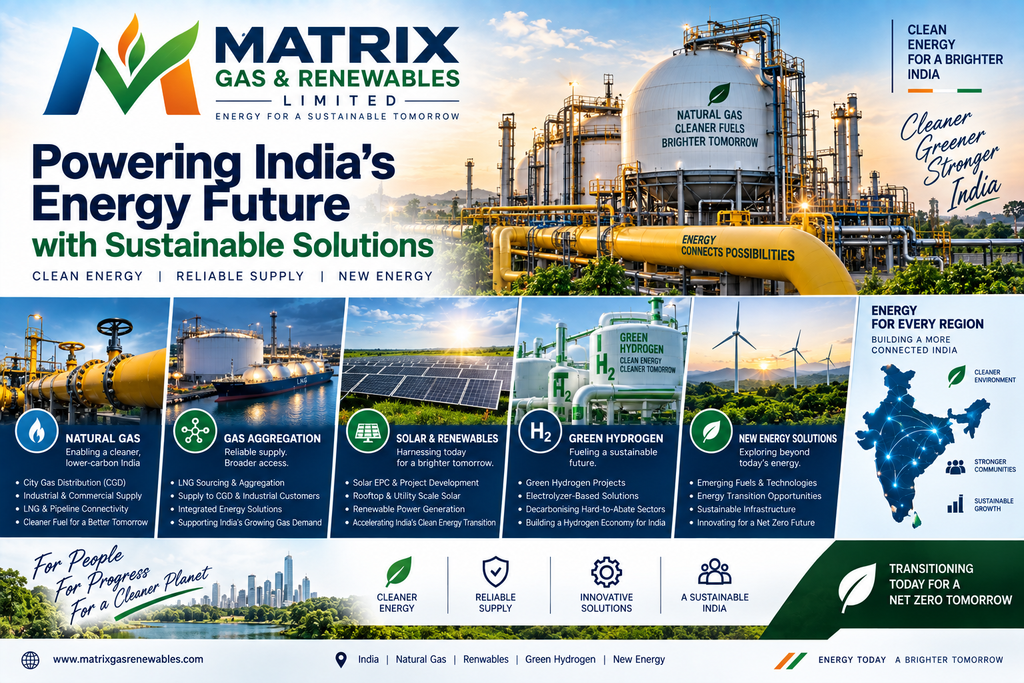
Matrix Gas & Renewables Limited is an energy company operating across natural-gas aggregation, gas distribution and emerging green-hydrogen infrastructure.
The company was incorporated in 2018 and was originally known as Gensol Renewables Private Limited before becoming Matrix Gas & Renewables Limited. Its registered office is in Ahmedabad, Gujarat.
The company has historically operated primarily as a natural-gas aggregation and trading business while simultaneously developing a strategic presence in green hydrogen, electrolyser manufacturing and related energy-transition infrastructure.
Matrix describes its business as covering:
- Natural gas aggregation
- Natural gas supply
- City Gas Distribution
- Green hydrogen
- Electrolyser manufacturing
- Green-hydrogen EPC
- Build-Own-Operate projects
- Renewable-energy integration
The company’s website states that it has handled more than 200 million metric standard cubic metres of natural gas, has a 300 MW per annum electrolyser manufacturing initiative, more than 20 clients and more than 25 hydrogen projects in its pipeline.
Matrix Gas & Renewables – Official Website
Important Current Development – CIRP
The most important issue for any investor considering Matrix Gas & Renewables today is that the company is currently undergoing the Corporate Insolvency Resolution Process (CIRP).
The company’s official CIRP page states that the CIRP process is ongoing and that a fresh Form G / Expression of Interest process was re-issued on July 31, 2026, inviting eligible prospective resolution applicants to submit resolution plans. The process remains subject to approval of the National Company Law Tribunal (NCLT).
The company entered CIRP following an NCLT order dated February 11, 2026.
This substantially changes the investment analysis.
Historical financial performance and the company’s green-hydrogen opportunity should therefore not be interpreted as evidence of current equity value. In an insolvency process, the treatment of existing shareholders depends on the approved resolution plan and the value available to different classes of creditors and stakeholders.
Historical Business Model
Before the current insolvency process, Matrix operated through several energy-related activities.
1. Natural Gas Aggregation
Natural gas has historically been the company’s core business.
Matrix aggregates gas from different sources and supplies it to customers through contractual arrangements.
The company states that it has experience in handling natural gas volumes exceeding 200 million MMSCMD-equivalent cumulative volumes, according to its current corporate presentation.
The natural-gas business provides exposure to:
- Industrial customers
- Commercial consumers
- City gas distribution
- Gas-based energy demand
- Long-term gas contracts
2. City Gas Distribution
Matrix has also positioned itself in the City Gas Distribution (CGD) segment.
The CGD business aims to supply natural gas to:
- Households
- Commercial establishments
- Industries
- Transport customers
Natural gas can play a transitional role in India’s energy system as industries move toward lower-carbon fuels.
3. Green Hydrogen
Green hydrogen represents the company’s principal energy-transition opportunity.
The company has positioned itself as a developer of green-hydrogen projects for applications such as:
- Green steel
- Green ammonia
- Industrial decarbonisation
- Renewable-energy utilisation
- Hydrogen mobility
- Energy storage
The company says it has more than 25 hydrogen projects in its pipeline.
4. Electrolyser Manufacturing
Matrix has also announced plans for electrolyser manufacturing in Gujarat.
Its website currently highlights a 300 MW electrolyser manufacturing capacity initiative.
Electrolysers are critical equipment for producing green hydrogen from water using electricity.
Green Hydrogen Business Model
The green-hydrogen business can potentially operate across multiple stages of the value chain.
Renewable Power
Renewable electricity provides the energy required for electrolysis.
Electrolyser
The electrolyser uses electricity to split water into hydrogen and oxygen.
Hydrogen Production
The hydrogen can then be compressed, stored and supplied to industrial customers.
Downstream Applications
Potential applications include:
- Green ammonia
- Green methanol
- Green steel
- Refining
- Heavy transportation
- Industrial heating
This creates the possibility of Matrix participating in several stages of the hydrogen ecosystem rather than simply selling hydrogen.
India’s Green Hydrogen Opportunity
India has identified green hydrogen as an important part of its long-term decarbonisation strategy.
The National Green Hydrogen Mission seeks to establish India as a major producer and supplier of green hydrogen and its derivatives.
The opportunity comes from India’s large existing demand for hydrogen in sectors such as:
- Refineries
- Fertilisers
- Chemicals
The next stage of demand could come from:
- Steel
- Shipping
- Heavy mobility
- Green ammonia
- Synthetic fuels
For companies such as Matrix, the opportunity therefore depends on converting announced projects and pipelines into commercially viable projects.
Historical Financial Performance
The most recent financial statements publicly available before the current CIRP show that Matrix had significant revenue growth between FY2023 and FY2024.
₹ Crore
| Particular | FY23 | FY24 |
|---|---|---|
| Revenue | ~489.81 | ~614.34 |
| Profit Before Tax | ~42.35 | ~50.08 |
| PAT | ~31.69 | ~37.19 |
| EPS | ~₹21.11 | ~₹20.76 |
FY24 revenue increased by approximately 25.5% compared with FY23, while PAT increased by approximately 17.4%.
These figures represent the company’s historical financial position and should not be treated as current post-CIRP earnings.
Revenue Composition
FY24 revenue was approximately ₹614 crore.
The company’s historical business was predominantly driven by the sale of products rather than services.
The FY24 financial statements show:
- Revenue from sale of products: approximately ₹606.79 crore
- Revenue from services: approximately ₹2.65 crore
- Other income: approximately ₹4.89 crore
This indicates that the historical revenue base was overwhelmingly linked to product/gas-related operations rather than green-hydrogen project revenue.
This distinction is important because much of the company’s future investment narrative was linked to green hydrogen, while its historical financial statements were primarily driven by the existing gas business.
Profitability
FY24 PAT was approximately ₹37.19 crore, compared with ₹31.69 crore in FY23.
The corresponding net margin was approximately 6.1% in FY24.
The business therefore generated profits historically, but margins were relatively modest because gas aggregation/trading is generally a higher-volume, lower-margin activity than a pure technology or asset-light platform.
Cash Flow
One of the major weaknesses visible in the historical financial statements was working-capital intensity.
FY24 operating cash flow was approximately:
₹(127.72) crore
despite PAT of approximately ₹37.19 crore.
By comparison, operating cash flow in FY23 was approximately ₹62.70 crore.
This divergence indicates that accounting profitability did not translate directly into operating cash generation.
For an energy trading/aggregation business, working capital can be substantial because of:
- Inventory
- Trade receivables
- Customer credit
- Supplier payments
- Gas procurement cycles
Therefore, cash conversion was an important factor even before the current CIRP.
Balance Sheet
FY24 balance-sheet data indicates a substantial increase in working-capital assets.
₹ Crore
| Particular | FY23 | FY24 |
|---|---|---|
| Trade Receivables | ~₹17.1 Cr | ~₹203.42 Cr |
| Trade Payables | ~₹11.44 Cr | ~₹69.84 Cr |
| Cash & Cash Equivalents | ~₹1.46 Cr | ~₹22.36 Cr |
| Fixed Assets | ~₹0.49 Cr | ~₹0.49 Cr |
The sharp increase in trade receivables is particularly important.
Revenue growth therefore required additional working capital, contributing to the negative operating cash flow in FY24.
Debt and Financing
The FY24 cash-flow statement shows substantial borrowing activity.
During FY24:
- Borrowings raised: approximately ₹171.69 crore
- Borrowings repaid: approximately ₹176.34 crore
- Interest paid: approximately ₹2.96 crore
The company also reported significant financing cash flows during the year.
The subsequent initiation of CIRP indicates that historical profitability alone was insufficient to prevent financial stress.
The precise current creditor position should be taken from the latest CIRP documents rather than relying on FY24 accounts.
Shareholding
Historical public-market information indicates that the promoter group included:
| Shareholder | Approx. Holding |
|---|---|
| Anmol Singh Jaggi | ~24.5% |
| Puneet Singh Jaggi | ~23.94% |
| Chirag Nareshbhai Kotecha | ~22.0% |
| Disha Chirag Kotecha | ~22.0% |
| Others / Public | ~7.56% |
These figures are historical and should not be assumed to represent the current post-CIRP economic ownership.
The resolution process can potentially alter the capital structure and rights of existing shareholders.
IPO History
Matrix Gas & Renewables had previously been associated with plans for an IPO.
In October 2024, Reuters reported that the company was targeting an IPO that could raise approximately ₹1,000–1,200 crore, with the proceeds intended partly to fund green-hydrogen projects. At that time, the company was targeting approximately 1 GW of green-hydrogen capacity over three years and expected capital expenditure of approximately ₹3,500 crore.
However, the current CIRP fundamentally changes the relevance of those earlier IPO plans.
The historical IPO proposal should therefore not be treated as an active IPO unless a new regulatory filing confirms it.
Current Corporate Insolvency Process
The current situation should be divided into three stages.
Stage 1 – Historical Business
The company built a natural-gas aggregation business and generated approximately ₹614 crore of revenue and ₹37 crore of PAT in FY24.
Stage 2 – Energy-Transition Expansion
The company attempted to expand into:
- Green hydrogen
- Electrolysers
- Hydrogen infrastructure
- CGD
- Renewable-energy projects
Stage 3 – CIRP
The company entered CIRP in February 2026.
As of July 2026, the Resolution Professional had re-issued Form G and invited fresh Expressions of Interest from prospective resolution applicants.
This means the company’s future ownership and capital structure remain subject to the resolution process.
What CIRP Means for Existing Shareholders
This is the most important section for an investor.
When a company enters insolvency resolution, the value attributable to existing equity shareholders depends on the resolution plan ultimately approved.
Potential outcomes can include:
- Existing shareholders retaining some equity
- Significant dilution
- Restructuring of share capital
- New investors receiving substantial equity
- Existing equity receiving little or no economic value
Therefore, an historical unlisted-share price cannot automatically be used to determine the current intrinsic value of Matrix Gas & Renewables.
Until the resolution plan and resulting capital structure are known, a conventional equity valuation has limited reliability.
Business Strengths
Natural Gas Experience
The company has established experience in gas aggregation and supply.
Existing Customer Base
The company has historically served multiple customers and developed relationships across the energy ecosystem.
Green Hydrogen Positioning
Matrix entered green hydrogen relatively early and developed a pipeline of projects.
Electrolyser Opportunity
Domestic electrolyser manufacturing could provide exposure to India’s hydrogen ecosystem.
Energy-Transition Theme
The company’s business sits at the intersection of:
- Natural gas
- Renewable energy
- Hydrogen
- Industrial decarbonisation
Key Risks
1. CIRP / Insolvency Risk
This is currently the largest risk.
The future economic value of existing equity depends on the outcome of the resolution process.
2. Equity Dilution
A successful resolution plan may involve substantial changes to the existing share capital.
3. Working-Capital Risk
Historical FY24 operating cash flow was negative despite positive accounting earnings.
4. Green-Hydrogen Execution Risk
Many announced hydrogen projects are development-stage opportunities rather than operating assets.
Project economics depend on:
- Electrolyser costs
- Renewable power prices
- Financing
- Government incentives
- Hydrogen offtake agreements
- Infrastructure costs
5. Commodity / Gas Price Risk
Natural-gas aggregation margins can be affected by changes in gas prices and procurement terms.
6. Financing Risk
Green-hydrogen projects require substantial capital.
The company’s earlier plans contemplated approximately ₹3,500 crore of capital expenditure for hydrogen projects.
7. Regulatory Risk
Both natural gas and green hydrogen are subject to evolving government policies and regulations.
8. Unlisted Liquidity
Even without CIRP, unlisted shares have limited liquidity.
During CIRP, liquidity and price discovery become substantially more uncertain.
Valuation
A conventional P/E valuation should not be presented as a reliable current valuation for Matrix Gas & Renewables.
Historical FY24 earnings would imply an EPS of approximately ₹20.76 based on the reported financial statements.
However, applying a current unlisted-market price to this historical EPS would ignore the company’s present CIRP status.
A more appropriate valuation framework would require:
Enterprise value of viable operating businesses
Value of viable green-hydrogen projects
Cash and other assets
−
Financial and operational liabilities
−
CIRP-related claims
−
Resolution-plan adjustments
=
Value attributable to equity
Only after the resolution process establishes the revised capital structure can a meaningful per-share valuation be calculated.
What Investors Should Monitor
For Matrix Gas & Renewables, the following developments are substantially more important than historical EPS:
- Final resolution applicant
- Resolution plan submitted
- Creditor recovery percentage
- NCLT approval
- Treatment of existing equity
- New capital infusion
- Revised debt structure
- Post-CIRP shareholding
- Green-hydrogen project status
- Electrolyser manufacturing plans
- Natural-gas business performance
- Working-capital requirements
- Cash-flow generation
- Any new IPO / listing filing
Industry Outlook
The long-term industry opportunity remains significant even though the company’s current corporate situation is challenging.
India’s energy transition requires investment across:
- Natural gas
- Renewable energy
- Green hydrogen
- Electrolysers
- Energy storage
- Transmission
- Industrial decarbonisation
Green hydrogen is particularly relevant for sectors where direct electrification is difficult.
Potential long-term demand can come from:
- Steel
- Fertilisers
- Refineries
- Shipping
- Chemicals
- Heavy transport
Matrix’s current corporate website continues to position the company around this broader energy-transition opportunity.
Investment Framework
For a normal unlisted company, the investment framework would be:
Business quality → financial growth → cash flow → valuation → liquidity.
For Matrix Gas & Renewables, the order needs to be changed:
CIRP outcome → creditor resolution → treatment of existing equity → revised capital structure → viability of operating businesses → green-hydrogen project economics → valuation.
This is because the resolution process can materially change the ownership economics before the underlying growth opportunity becomes relevant to existing shareholders.
Corporate Information
Company: Matrix Gas & Renewables Limited
Former Names: Gensol Renewables Private Limited / Matrix Gas & Renewables Private Limited
CIN: U74999GJ2018PLC101075
Incorporated: March 6, 2018
Registered Office: Westgate Business Bay, S.G. Highway, Ahmedabad, Gujarat – 380051
Industry: Energy / Natural Gas / Green Hydrogen
Status: Unlisted Public Company / Under CIRP
The company is currently classified as being under CIRP.
Important Links
Official Company Website:
Matrix Gas & Renewables
CIRP / Resolution Process:
Matrix Gas & Renewables – CIRP
FY2023-24 Financial Information:
Matrix Gas & Renewables Financials
Company Registry Information:
Matrix Gas & Renewables – Corporate Information
Reuters – Historical IPO Plans:
Reuters – Matrix Gas & Renewables IPO Plans
Conclusion
Matrix Gas & Renewables is an interesting example of an energy-transition company whose business opportunity and current equity situation are very different things.
Historically, the company built a meaningful natural-gas business and reported FY24 revenue of approximately ₹614 crore and PAT of approximately ₹37 crore. It subsequently expanded its ambitions into green hydrogen, electrolyser manufacturing and energy-transition infrastructure.
The green-hydrogen opportunity remains strategically relevant, particularly as India develops domestic electrolyser manufacturing and hydrogen production capacity.
However, the company’s current situation is dominated by the CIRP initiated in February 2026. The Resolution Professional re-issued the Expression of Interest process in July 2026, meaning the future ownership and capital structure are still subject to the resolution process.
Therefore, historical EPS, historical unlisted-share prices or the company’s earlier IPO plans should not be used in isolation to determine what existing equity is worth today.
The key investment question is now:
What value, if any, will remain for existing shareholders after the insolvency-resolution process?
Only after the resolution plan, creditor recoveries, new capital structure and treatment of existing equity are known can a meaningful post-CIRP valuation be constructed.
Disclaimer
This report is prepared solely for informational and research purposes and does not constitute investment advice.
Matrix Gas & Renewables Limited is currently undergoing the Corporate Insolvency Resolution Process. The ultimate treatment and value of existing equity shares are subject to the resolution process and applicable approvals.
Historical financial information should not be interpreted as representing the company’s current financial position.
Any historical or indicative unlisted-share price should not be considered a guaranteed exit price or exchange-traded market price.
Investors should independently verify the latest CIRP documents, creditor claims, resolution plan, NCLT orders, shareholding, liabilities, taxation, transfer restrictions and treatment of existing equity before considering any transaction.
The author of this report is not a SEBI-registered Research Analyst unless separately stated.