Report Date: September 2026
Industry: Power Transmission Infrastructure
Status: Unlisted
ISIN: INE03QT01027
Face Value: ₹2 per Equity Share
Company Overview
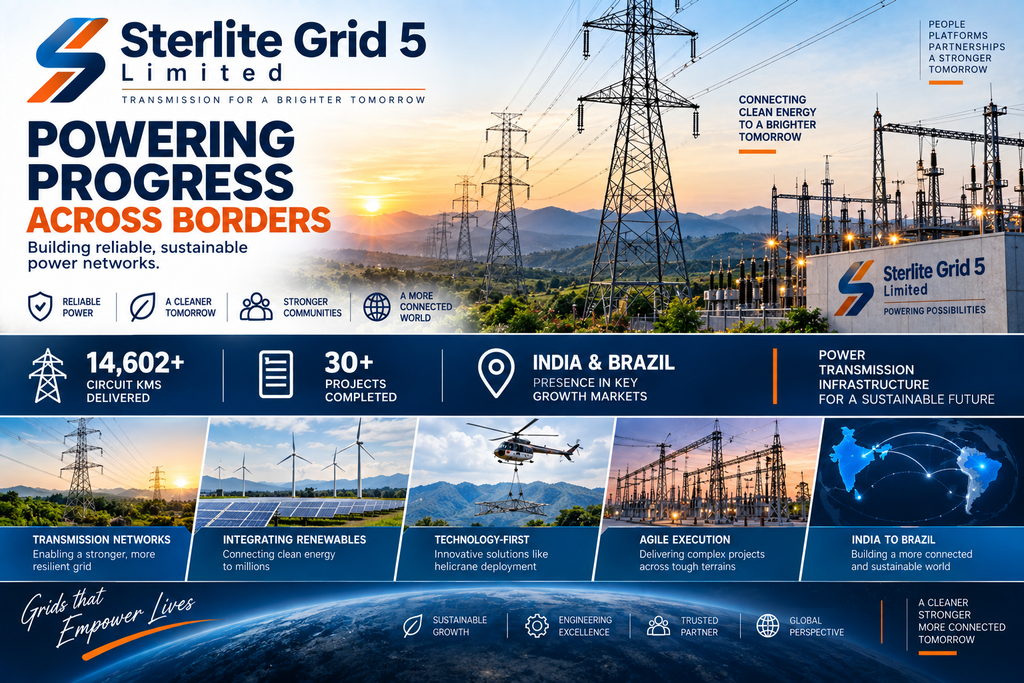
Sterlite Grid 5 Limited (SGL 5) is a power transmission infrastructure platform focused on bidding for, developing, owning and operating electricity transmission assets in India. The company operates directly and through subsidiaries, joint ventures and project-specific entities.
SGL 5 became the resulting company of the demerger of the Infrastructure Business of Sterlite Power Transmission Limited, now known as Sterlite Electric Limited. The National Company Law Tribunal, Mumbai Bench approved the Scheme of Arrangement on September 5, 2024, and the scheme became effective on October 8, 2024.
The demerger transferred the infrastructure business, including investments in transmission subsidiaries and project companies, into SGL 5. Existing shareholders of Sterlite Power Transmission Limited received one SGL 5 equity share for every one share held as part of the demerger.
Sterlite Grid 5 – Official Website
Business Model
SGL 5 operates primarily through long-term power transmission infrastructure projects.
Its activities include:
- Identification and bidding for transmission projects
- Tariff-Based Competitive Bidding (TBCB)
- Engineering and project development
- Financing and construction
- Build-Own-Operate-Maintain (BOOM)
- Build-Own-Operate-Transfer (BOOT)
- Long-term operation and maintenance
- Engineering, Procurement and Construction (EPC)
- Monetisation or “flipping” of operational assets where appropriate
The company’s project structure allows individual transmission assets to be developed through dedicated Special Purpose Vehicles (SPVs), providing ring-fenced project financing and long-term contracted cash flows.
Scale of Operations
According to the FY2024-25 Annual Report, SGL 5 had:
| Particular | FY2024-25 |
|---|---|
| Total portfolio | 24 projects |
| Transmission network | ~13,671 ckm |
| Estimated Indian transmission market share | ~15% |
| Cumulative CAPEX across portfolio | ₹52,844 Cr |
| Renewable integration capacity | ~4.5 GW |
| Operational & under-construction projects | 12 |
| Safe work hours | 40 million+ |
The company’s portfolio covers operational, flipped, developed and under-construction projects across India.
Key Transmission Projects
The company’s portfolio includes several strategically important transmission projects:
- Lakadia–Vadodara Transmission Project Limited
- Mumbai Urja Marg Limited
- Nangalbibra–Bongaigaon Transmission Limited
- Udupi Kasargode Transmission Limited
- Goa Tamnar Transmission Project Limited
- Kishtwar Transmission Limited
- Fatehgarh III Beawar Transmission Project
- Beawar Transmission Limited
- Neemrana II Kotputli Transmission Limited
- Khavda IV C Power Transmission Limited
- Ananthapur-II REZ – Phase I
- NERES-XXV
These projects cover important power evacuation corridors and renewable-energy integration zones.
Major Project Wins and Developments
Ananthapur-II Renewable Energy Zone – Phase I
In 2025, SGL 5 secured the transmission system for integration of Ananthapur-II Renewable Energy Zone Phase I through the TBCB mechanism.
The project is being implemented under a 35-year BOOT framework and is designed to evacuate approximately 4.5 GW of renewable energy.
The project includes:
- 765/400 kV and 400/220 kV pooling infrastructure
- Approximately 150 km of 765 kV double-circuit transmission lines
- Approximately 200 km of additional 765 kV double-circuit lines
- ±300 MVAR STATCOM installation
The project expands SGL 5’s presence in southern India and supports renewable-energy evacuation.
Khavda Phase-IV – Part C
SGL 5 also secured the Khavda Phase-IV (7 GW) Part C transmission project in Gujarat.
Khavda is one of India’s major renewable-energy development zones, making transmission infrastructure in the region important for evacuating large volumes of renewable electricity to the national grid.
Projects Commissioned During FY25
During FY2024-25, the company reported commissioning:
- Nangalbibra–Bongaigaon Transmission Project
- Mumbai Urja Marg Limited
- Goa Tamnar Transmission Project Limited
The commissioning of these projects increases the company’s operational asset base and creates additional long-term transmission revenue streams.
Financial Performance
Consolidated Financials
₹ Crore
| Particular | FY24 | FY25 | Change |
|---|---|---|---|
| Revenue from Operations | 1,245.8 | 1,160.6 | -6.8% |
| EBITDA | 168.8 | 302.8 | +79.5% |
| PBT – Continuing Operations | -64.8 | 42.9 | Improved |
| PAT – Continuing Operations | -79.3 | 26.6 | Improved |
| PAT – Total | -441.7 | -425.5 | Improved |
FY25 consolidated revenue declined because the business was affected by the restructuring/deconsolidation associated with the demerger. At the same time, EBITDA from continuing operations increased significantly.
However, consolidated PAT remained negative because the financial statements include substantial losses associated with discontinued operations and the company’s share of losses from joint ventures. Therefore, consolidated P/E is currently not a meaningful valuation measure.
Standalone Financial Performance
₹ Crore
| Particular | FY24 | FY25 |
|---|---|---|
| Revenue from Operations | 1,375.8 | 1,000.9 |
| EBITDA | 233.6 | 269.2 |
| PBT | -187.2 | 43.2 |
| PAT | -201.6 | 28.1 |
Standalone performance improved materially in FY25, with the company moving from a loss to a profit at the PAT level.
However, FY25 standalone results also contain a significant exceptional item, meaning headline PAT should not be treated as a clean measure of recurring earnings.
Why Consolidated PAT Is Negative
This is one of the most important points for investors analysing SGL 5.
FY25 consolidated financial statements show:
- PAT from continuing operations: ₹266.35 million
- Loss after tax from discontinued operations: ₹4,521.61 million
- Consolidated PAT: ₹(4,255.26) million
The discontinued-operation loss is associated with the restructuring and accounting treatment surrounding the demerger.
Therefore, simply looking at the consolidated PAT of approximately -₹426 crore without understanding the demerger can give a misleading picture of the underlying transmission platform.
Balance Sheet and Capital Structure
Following the demerger, SGL 5’s capital structure changed substantially.
As of March 31, 2025:
- Authorised share capital: ₹300 crore
- Paid-up equity share capital: ₹24.51 crore
- Equity shares outstanding: approximately 12.256 crore
- Face value: ₹2 per share
The increase in share capital occurred as part of the demerger and business combination.
Asset Portfolio and Capital Deployment
SGL 5’s FY25 Annual Report states that the cumulative CAPEX across commissioned, under-execution and operationally flipped projects stood at approximately ₹52,844 crore.
This is important because transmission infrastructure is highly capital intensive. The company’s long-term value depends not simply on current revenue but on:
- Project awards
- Construction progress
- Commissioning
- Long-term transmission contracts
- Financing costs
- Asset monetisation
- Recycling capital into new projects
Resonia and GIC Partnership
A major part of understanding SGL 5 is its relationship with Resonia Limited.
Resonia was established as a transmission development platform involving:
- Sterlite Grid 5 Limited – 51%
- GIC-affiliated entity – 49%
GIC has committed US$500 million of equity toward the platform, with approximately ₹1,800 crore drawn as of the latest ICRA rating report.
As of December 2025, Resonia had a portfolio of 14 transmission projects, of which:
- 5 were operational
- 9 were under construction
The platform also had a standalone order book of approximately ₹13,451 crore, excluding recently won projects.
This partnership provides SGL 5 with access to institutional capital and supports the development of large transmission assets.
Revenue Visibility
Transmission infrastructure differs from conventional EPC businesses because commissioned transmission assets can generate relatively predictable long-term revenue under transmission service agreements.
ICRA notes that Resonia’s transmission assets benefit from long-term transmission service agreements with availability-linked payment mechanisms. Thirteen of the 14 projects in its portfolio formed part of the inter-state transmission system, with the Central Transmission Utility’s pooling mechanism providing additional payment-security support.
This structure can provide greater revenue visibility after projects become operational.
Industry Outlook
India’s electricity system is undergoing a major expansion in transmission infrastructure because of:
- Renewable-energy additions
- Growth in electricity demand
- Solar and wind concentration in specific regions
- Development of green-energy corridors
- Increasing inter-regional power transfers
- Higher-voltage transmission requirements
- Grid modernisation
- Energy-storage integration
SGL 5’s Annual Report notes that India had approximately 817,972 ckm of total transmission lines in FY2024, while transmission lines of 220 kV and above had increased to approximately 488,423 ckm. It also cites significant future transmission investment requirements.
Growth Drivers
1. Renewable Energy Transmission
India’s renewable-energy capacity is increasingly concentrated in areas such as Gujarat, Rajasthan, Andhra Pradesh and other resource-rich regions.
This creates a structural need for long-distance transmission infrastructure.
2. Green Energy Corridors
Large renewable-energy projects require dedicated evacuation systems. Projects such as Khavda and Ananthapur-II directly align with this requirement.
3. TBCB Opportunities
Tariff-Based Competitive Bidding has increased private-sector participation in India’s transmission sector.
SGL 5 reported that 45 ISTS transmission schemes were awarded through TBCB in FY2024-25, compared with 23 in FY2023-24.
4. Institutional Capital
The GIC partnership provides a source of institutional equity for transmission infrastructure development through Resonia.
5. Capital Recycling
The company’s business model allows completed transmission assets to potentially be monetised and capital recycled into new projects.
Competitive Landscape
SGL 5 operates in India’s private transmission infrastructure ecosystem.
Relevant companies and platforms include:
- Power Grid Corporation of India
- Adani Energy Solutions
- Sterlite Electric Limited
- Kalpataru Projects International
- KEC International
The key difference is that SGL 5 is primarily an asset-development and transmission-infrastructure platform, rather than a pure transmission-equipment manufacturer.
Unlisted Share Price
As of September 2026, publicly available unlisted-market platforms are indicating a price of approximately ₹328–₹332 per share.
For example, one unlisted-market reference reported ₹332 per share as of September 14, 2026, while another reported ₹332 around September 13, 2026. These are OTC indicative prices and not NSE/BSE market quotes.
Therefore, the price should be treated as an indicative private-market reference rather than a continuously traded market price.
Indicative Valuation
Using an indicative price of ₹332 per share:
| Valuation Metric | Approximate Value |
|---|---|
| Indicative Share Price | ₹332 |
| Shares Outstanding | 12.256 Cr |
| Implied Market Capitalisation | ~₹4,069 Cr |
| Face Value | ₹2 |
| Indicative P/B | ~8.8x |
| P/E | Not meaningful |
The implied market capitalisation is approximately ₹4,069 crore based on the indicative unlisted price and approximately 12.256 crore shares outstanding.
P/E is not meaningful because consolidated FY25 PAT was negative.
The high P/B multiple also needs to be interpreted carefully because SGL 5 is a capital-intensive infrastructure platform whose value is influenced by the economics of its project portfolio, future transmission awards, project financing, contracted cash flows and potential monetisation—not only its reported book equity.
Key Risks
1. High Capital Intensity
Transmission projects require substantial upfront investment. Delays in financing, construction or commissioning can increase project costs.
2. Execution Risk
Large transmission projects often involve difficult terrain, land acquisition, regulatory approvals and complex construction requirements.
3. Interest Rate and Financing Risk
Because transmission projects require significant project financing, changes in interest rates can affect project economics and returns.
4. Regulatory Risk
Transmission projects operate under electricity-sector regulations and approvals from multiple authorities.
5. Project Concentration
A limited number of large projects can materially affect financial performance.
6. Negative Consolidated Earnings
Despite positive continuing-operation performance, FY25 consolidated PAT remained negative due to discontinued-operation losses and joint-venture losses. This makes conventional earnings-based valuation more difficult.
7. Unlisted-Security Liquidity
Unlike listed shares, SGL 5 does not have continuous exchange trading. Investors may face:
- Limited buyers
- Wider bid/ask spreads
- Delayed exits
- Limited price discovery
- Greater dependence on private-market intermediaries
Key Investment Metrics to Monitor
For SGL 5, investors should focus on the following metrics rather than only headline PAT:
- New transmission project awards
- Order book
- Projects under construction
- Projects commissioned
- Transmission availability
- Project-level IRRs
- Debt/equity at project SPVs
- Interest costs
- Cash-flow generation
- Asset monetisation
- GIC/Resonia capital deployment
- Future TBCB wins
- Renewable-energy evacuation projects
- Potential IPO/listing plans
Corporate Information
Company: Sterlite Grid 5 Limited
CIN: U29190PN2016PLC209044
Incorporated: September 27, 2016
Registered Office: Pune, Maharashtra
Business: Power transmission infrastructure
Face Value: ₹2 per share
ISIN: INE03QT01027
Status: Unlisted Public Company
The company was incorporated in 2016 and became the resulting company for the infrastructure-business demerger from Sterlite Power Transmission Limited.
Important Links
Company Website:
Sterlite Grid 5 / SGL 5 Official Website
FY2024-25 Annual Report:
Sterlite Grid 5 Annual Report FY2024-25
Resonia Official Website:
Resonia
Resonia / Sterlite Group Demerger Announcement:
Sterlite Group – Demerger and Resonia
ICRA Rating Report – Resonia, May 2026:
ICRA Rating Rationale
Overall Business Assessment
SGL 5 should be viewed primarily as a power-transmission infrastructure and asset-development platform, rather than as a conventional EPC company.
The central investment thesis is linked to India’s long-term requirement for transmission infrastructure to connect renewable-energy generation centres with demand centres.
The company has a sizeable project portfolio, approximately 13,671 ckm of transmission infrastructure, a reported 15% estimated market share, and exposure to major renewable-energy evacuation projects. The GIC partnership through Resonia also provides institutional capital for expanding the transmission platform.
At the same time, the company has substantial capital requirements, project-execution risks and a complex corporate structure. FY25 consolidated earnings are also distorted by discontinued-operation losses following the demerger.
Consequently, book value and current PAT alone do not provide a complete picture of SGL 5’s value. A more appropriate valuation would involve project-level cash-flow analysis, the value of operational transmission assets, under-construction projects, future project awards, project debt and potential asset monetisation.
Disclaimer
This report is prepared for informational and research purposes only and is not investment advice.
Sterlite Grid 5 Limited is an unlisted company. Indicative unlisted-market prices can vary between intermediaries and transactions and should not be treated as NSE/BSE market prices.
Financial information is based primarily on the company’s FY2024-25 Annual Report and other publicly available information. Current unlisted-market price information is indicative and may change without notice.
Investors should independently verify the latest financial statements, shareholding, valuation, transfer restrictions, taxation, liquidity, corporate actions and regulatory information before undertaking any transaction.
The author of this report is not a SEBI-registered Research Analyst unless separately stated.