Unlisted Share Research Report
Business: Jewelry Retail | Gold & Diamonds | Manufacturing | Wholesale | International Retail
Status: Unlisted Public Company
CIN: U52393KL2001PLC014804
Incorporated: 19 June 2001
Registered Office: 16/501 M Montana Estate, Paingottupuram, Peringolam, Kozhikode, Kerala – 673571
Paid-up Capital: ~₹1,014 crore
Authorised Capital: ₹2,000 crore
Latest Financial Year: FY2024-25
FY25 Revenue: ~₹66,749 crore
FY25 EBITDA: ~₹945 crore
FY25 PAT: ~₹801 crore
FY25 Net Worth: ~₹5,045 crore
Listing Status: Unlisted
Industry: Consumer / Jewelry Retail
Executive Summary
Malabar Gold & Diamonds is one of India’s largest unlisted consumer businesses and the flagship company of the Malabar Group.
Established in 1993, the group has built a large jewellery retail, manufacturing, wholesale and international distribution network. The company has expanded from its origins in Kerala into a global jewellery business spanning India, the Middle East, Southeast Asia, North America, Europe and other international markets.
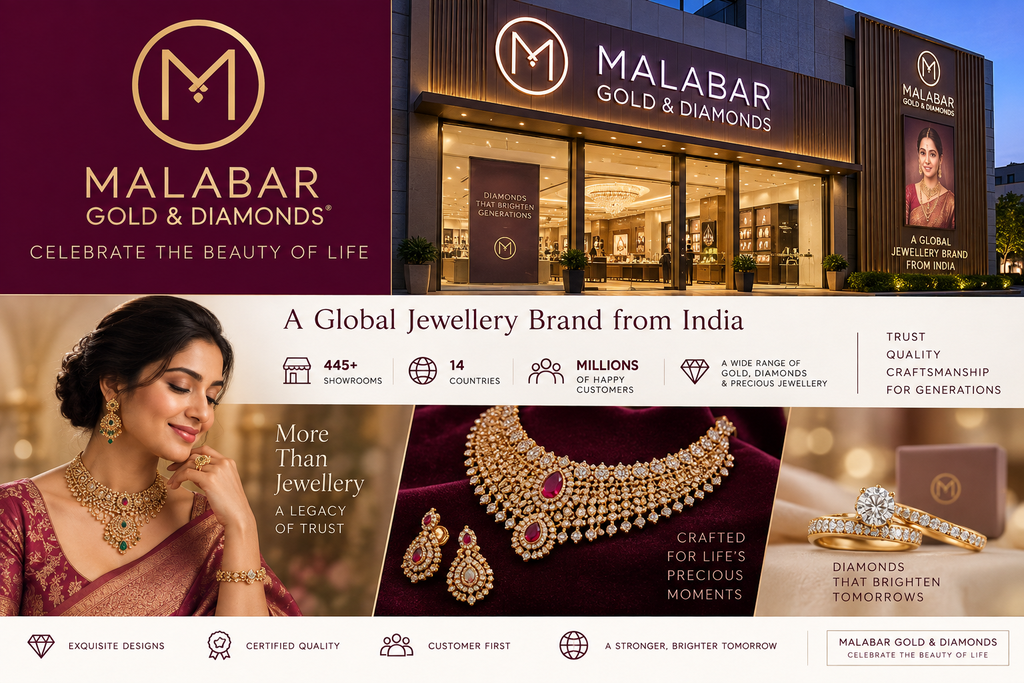
The company’s official website currently states that Malabar Gold & Diamonds has more than 445 showrooms across 14 countries, alongside offices, design centres, wholesale operations and manufacturing facilities.
Malabar Gold & Diamonds – Official Website
Financially, the company has grown at a substantial pace. FY2024-25 revenue was approximately ₹66,749 crore, compared with ₹47,449 crore in FY2023-24, while PAT increased to approximately ₹801 crore.
The company is particularly interesting from an unlisted-equity perspective because it combines:
- A well-established consumer brand
- Large domestic and international retail presence
- Strong revenue growth
- Increasing organised jewellery penetration
- Significant expansion plans
- Vertically integrated operations
- Large shareholder base
- Potential future capital-market optionality
However, the business also has characteristics that investors need to understand carefully. Jewelry retail is a high working-capital and inventory-intensive business, margins are relatively thin, borrowings have increased along with growth, and the company’s future valuation will depend heavily on profitability rather than revenue alone.
A further important development came in July 2026, when the Competition Commission of India approved the proposed merger of 51 Malabar Group companies into Malabar Gold & Diamonds Limited, most of which are engaged in jewellery businesses.
This could make the corporate structure more consolidated and potentially more relevant for future capital-market activity, although it should not be interpreted as confirmation of an IPO.
Company Overview
Company: Malabar Gold and Diamonds Limited
Former Name: Malabar Gold Limited
Earlier Structure: Malabar Gold Private Limited
CIN: U52393KL2001PLC014804
Incorporation: 19 June 2001
ROC: Ernakulam
Company Type: Public Limited Company
Status: Active and Unlisted
Authorised Capital: ₹2,000 crore
Paid-up Capital: ~₹1,014 crore
Public corporate databases identify the company as an active unlisted public company with its registered office in Kozhikode, Kerala.
The official company page identifies Malabar Gold & Diamonds Limited as the parent company of the group’s jewellery operations.
Malabar Gold & Diamonds – Corporate Information
History and Evolution
Malabar Gold & Diamonds was established in 1993 and began with its first showroom in Calicut, Kerala.
Over the following three decades, the business expanded from a regional jewellery retailer into an international jewellery group.
According to India Ratings, the business started as a partnership firm promoted by M. P. Ahammed and his entrepreneurial team. Malabar Gold was subsequently converted into a private limited company in 2001 and then into a closely held public limited company in 2023.
The company’s expansion has been driven by:
- New showroom additions
- International expansion
- Manufacturing capabilities
- Franchise operations
- Wholesale distribution
- Product diversification
- Strong brand positioning
- Expansion into new Indian markets
Business Model
Malabar Gold operates across multiple layers of the jewellery value chain.
1. Jewelry Retail
Retail is the core business.
The company sells:
- Gold jewellery
- Diamond jewellery
- Bridal jewellery
- Platinum jewellery
- Precious stones
- Gold coins
- Solitaires
- Contemporary jewellery
- Traditional jewellery
The business serves both everyday jewellery demand and high-value occasions such as weddings and festivals.
2. Manufacturing
Malabar operates manufacturing and production facilities supporting its retail and wholesale operations.
Vertical integration allows the group greater control over:
- Product design
- Manufacturing
- Quality
- Inventory
- Product availability
- Supply chain
- Customer experience
3. Wholesale
The company also participates in wholesale and distribution activities, supplying jewellery through different channels.
4. International Business
International operations are particularly important to Malabar’s strategy.
The company has a significant presence across the Middle East and other overseas markets, where the Indian diaspora provides a large customer base.
The group currently has a presence across 14 countries and more than 445 showrooms according to its official website.
5. Franchise Model
Malabar also uses franchise arrangements for showroom expansion.
India Ratings notes that the group operates through multiple legal entities and franchisee structures, with external investors participating in certain new showroom entities.
This can help accelerate store expansion while reducing the capital requirement borne directly by the flagship entity for every outlet.
Why the Jewelry Industry is Attractive
India has one of the world’s largest jewellery markets, supported by:
- Weddings
- Festivals
- Cultural traditions
- Gold savings
- Rising disposable income
- Premiumisation
- Increasing organised retail penetration
Historically, a large portion of India’s jewellery market was controlled by family-owned and regional jewellers.
The industry is gradually becoming more organised, with national chains gaining market share.
Companies such as Titan’s Tanishq, Kalyan Jewellers, Senco Gold and Malabar Gold are competing for this organised market.
For Malabar, the opportunity is particularly significant because the company combines a strong regional heritage with national and international expansion.
Organised Jewelry Retail Opportunity
The structural shift from unorganised to organised jewellery retail is one of the biggest long-term opportunities for Malabar.
Organised retailers generally provide:
- Better transparency
- Hallmarked jewellery
- Standardised pricing
- Wider product selection
- Formal exchange policies
- Brand assurance
- Digital purchasing
- Better after-sales service
This increases customer trust and allows established brands to capture market share.
Malabar’s large showroom network gives it significant distribution reach.
Retail Expansion
Expansion remains a major growth strategy.
In March 2026, Malabar announced an expansion involving 20 new showrooms in 20 days, with an investment of approximately ₹1,580 crore.
The expansion was expected to take the company’s global showroom count to approximately 445 across 14 countries and create more than 725 employment opportunities.
This is important because showroom additions are one of the primary drivers of revenue growth in organised jewellery retail.
However, expansion also requires significant working capital because new stores need inventory before they begin generating sales.
Financial Performance
FY2024-25 was a strong year for Malabar Gold & Diamonds in terms of revenue growth.
Public financial databases report the following five-year standalone trend:
| Particulars | FY21 | FY22 | FY23 | FY24 | FY25 |
|---|---|---|---|---|---|
| Sales | ₹23,445 Cr | ₹31,096 Cr | ₹38,569 Cr | ₹47,449 Cr | ₹66,231 Cr |
| Operating Profit | ₹572 Cr | ₹679 Cr | ₹634 Cr | ₹845 Cr | ₹945 Cr |
| Net Profit | ₹465 Cr | ₹639 Cr | ₹626 Cr | ₹741 Cr | ₹801 Cr |
| Net Worth | ₹1,731 Cr | ₹2,383 Cr | ₹3,004 Cr | ₹3,901 Cr | ₹5,045 Cr |
Revenue increased approximately 39.3% in FY2025 based on the reported total-revenue figure of ₹66,749 crore. EBITDA increased approximately 11.8%, while net profit increased approximately 8.1%.
This shows an important characteristic of the jewellery business:
Revenue can grow very rapidly without profit growing at the same pace.
The reason is that gold is a high-value, relatively low-margin product, meaning margins are generally much thinner than those of conventional consumer businesses.
Profitability Analysis
FY2025 operating profit was approximately ₹945 crore against revenue of more than ₹66,000 crore.
This represents an operating margin of only around 1.4%.
Net profit was approximately ₹801 crore, representing a net margin of around 1.2%.
This is not necessarily a weakness by itself.
Jewelry retailers operate with:
- High inventory values
- Large transaction volumes
- Significant gold costs
- Working-capital requirements
- Financing requirements
Therefore, the more important parameters are:
- Inventory turnover
- Return on equity
- Store productivity
- Same-store sales growth
- EBITDA growth
- Working-capital efficiency
- Debt management
Balance Sheet
Malabar’s balance sheet has expanded significantly along with its business.
FY2025 standalone figures indicate:
Net Worth: ~₹5,045 crore
Borrowings: ~₹2,910 crore
Total Assets: ~₹12,487 crore
Debt/Equity: ~0.6x
Current Ratio: ~1.2x
The company is therefore not debt-free.
However, a debt-to-equity ratio of around 0.6x is not exceptionally high for a rapidly expanding jewellery business, particularly considering the substantial inventory base.
Inventory
Inventory is the most important balance-sheet item to monitor.
FY2025 standalone inventory was approximately ₹6,195 crore, representing nearly half of total assets.
This is a normal characteristic of the jewellery industry but creates important risks.
If gold prices decline sharply, the value of inventory can fall.
At the same time, if gold prices rise rapidly, the amount of capital required to maintain the same physical inventory increases.
Therefore, Malabar’s ability to manage inventory efficiently is critical.
International Presence
International expansion is one of Malabar’s strongest differentiators.
The group has operations across:
- India
- UAE
- Saudi Arabia
- Qatar
- Kuwait
- Bahrain
- Oman
- Singapore
- Malaysia
- USA
- UK
- Canada
- Australia
- New Zealand
The official company website states that Malabar has more than 445 showrooms across 14 countries.
The international footprint also provides geographical diversification.
However, it introduces additional exposure to:
- Currency movements
- Geopolitical risks
- Regional regulations
- Gold import/export rules
- Middle East economic conditions
FY26 Operating Update
India Ratings’ latest assessment provides an important update beyond FY2025.
For 9M FY2026, standalone revenue was reported at approximately ₹66,960 crore, with EBITDA of around ₹1,040 crore.
Standalone EBITDA margin was approximately 1.6%, while net leverage was around 2.0x.
The data is provisional and should not be directly compared with FY2025 consolidated figures without considering the different reporting basis.
Nevertheless, it indicates that the business continued to operate at a very large scale during FY2026.
Corporate Restructuring: Merger of 51 Companies
One of the most significant recent developments is the proposed merger of 51 Malabar Group companies into Malabar Gold and Diamonds Limited.
The Competition Commission of India approved the combination in July 2026.
Most of the transferor companies are engaged in jewellery businesses, while Malabar Gold & Diamonds is the flagship company responsible for manufacturing, trading, retailing, wholesaling, distribution, import, export and franchising of jewellery products.
CCI – Official Merger Approval
Why This Matters
The consolidation could potentially:
- Simplify the group structure
- Bring more jewellery operations under the flagship company
- Improve transparency of the consolidated business
- Reduce structural complexity
- Potentially improve future capital-market readiness
However, the merger should not automatically be interpreted as an IPO announcement.
Investors should wait for the final scheme, shareholder approvals, court/NCLT process and resulting capital structure before assessing the exact impact on existing shareholders.
Share Capital and Ownership
As of FY2025, paid-up capital was approximately ₹1,014 crore compared with ₹250 crore in the preceding years in the financial database.
The company has an authorised capital of approximately ₹2,000 crore.
The increase in equity capital means historical per-share calculations need to be adjusted carefully.
Investors should therefore avoid using older unlisted-market reports that calculate valuation using an outdated number of shares.
Current Unlisted Share Price
Unlike listed companies, Malabar Gold & Diamonds does not have a continuously quoted NSE/BSE market price.
Unlisted-market prices can vary based on:
- Seller availability
- Buyer demand
- Transaction size
- Shareholder liquidity
- Corporate actions
- Valuation expectations
- Expected future listing
- Broker margins
Several unlisted-share platforms currently track Malabar Gold, but publicly visible sources do not provide a sufficiently reliable single live executable price to treat as the company’s official market price. One comparison platform specifically notes that prices can differ between private-market sources.
Therefore, investors should obtain a fresh buy/sell quote before using any unlisted price for valuation.
Indicative Valuation Framework
Because there is no transparent exchange price, valuation is better assessed through earnings and EBITDA multiples.
FY2025 standalone:
PAT: ~₹801 crore
EBITDA: ~₹945 crore
Net Worth: ~₹5,045 crore
P/E Approach
If the company were valued at:
15x FY25 PAT:
₹801 Cr × 15 = ₹12,015 Cr
20x FY25 PAT:
₹801 Cr × 20 = ₹16,020 Cr
25x FY25 PAT:
₹801 Cr × 25 = ₹20,025 Cr
These should be treated as illustrative valuation scenarios, not fair-value estimates.
EV/EBITDA Approach
At approximately 10x FY25 EBITDA:
₹945 Cr × 10 = ₹9,450 Cr Enterprise Value
At 12x:
₹945 Cr × 12 = ₹11,340 Cr Enterprise Value
At 15x:
₹945 Cr × 15 = ₹14,175 Cr Enterprise Value
The final equity value would need to account for debt and cash.
This method is particularly useful because jewellery retailers can have significant differences in capital structure.
Valuation Perspective
Malabar deserves a premium compared with smaller regional jewellery companies because of:
- Brand strength
- Global presence
- Scale
- Store network
- Manufacturing capabilities
- International diversification
- Established management
- Revenue growth
However, the company should not automatically receive the same valuation multiple as the highest-quality listed consumer companies.
The key reason is the relatively low operating margin and high working-capital requirement.
Therefore, the purchase price of the unlisted share becomes extremely important.
A great business can still be a poor investment if purchased at an excessive valuation.
Competitive Advantages
1. Strong Brand
Malabar has developed significant brand recognition in India and international markets.
2. Large Retail Network
More than 445 global showrooms provide substantial distribution reach.
3. International Presence
The business is diversified across multiple geographies.
4. Manufacturing Integration
In-house and group manufacturing capabilities provide greater control over design, quality and supply.
5. Strong Customer Base
Jewelry purchases are heavily influenced by trust, especially for high-value purchases.
6. Scale
Revenue exceeding ₹66,000 crore places Malabar among India’s largest unlisted businesses.
Malabar ranked third in the JM Financial–Hurun India 2026 list of high-potential unlisted companies by revenue, behind Reliance Retail and Flipkart.
Key Growth Drivers
Organised Jewelry Market
The shift from unorganised to organised jewellery retail can continue to drive market-share gains.
Store Expansion
New showrooms provide direct revenue growth opportunities.
Tier-2 and Tier-3 Cities
Smaller cities remain underpenetrated by national jewellery chains.
International Expansion
The Indian diaspora provides a strong customer base across international markets.
Premiumisation
Increasing demand for diamond, platinum and premium jewellery can improve the product mix.
Digital Jewelry Retail
Online discovery and digital customer engagement can complement the physical showroom network.
Corporate Consolidation
The proposed merger of 51 group companies could create a more consolidated flagship structure.
Key Risks
1. Gold Price Volatility
Large movements in gold prices can affect consumer demand and working-capital requirements.
2. Low Operating Margins
The company operates with a relatively low operating margin of around 1.4% based on FY2025 standalone figures.
3. High Inventory
Inventory was approximately ₹6,195 crore in FY2025.
4. Debt
Borrowings increased to approximately ₹2,910 crore, making interest costs and leverage important factors to monitor.
5. Competition
The company competes with:
- Tanishq
- Kalyan Jewellers
- Senco Gold
- Joyalukkas
- Regional jewellery chains
- Independent jewellers
6. International Risk
International operations expose the company to currency, geopolitical and regulatory risks.
7. Liquidity Risk
Unlisted shares can be difficult to sell compared with listed shares.
8. IPO Uncertainty
Investors should not purchase the shares solely on the assumption that an IPO will happen within a specific timeframe.
9. Corporate Restructuring
The 51-company merger could materially change the group’s capital structure and ownership economics. Investors should assess the final post-merger shareholding and swap ratio before making a valuation decision.
IPO / Listing Outlook
Malabar Gold & Diamonds is frequently discussed in the unlisted market as a potential future capital-market candidate.
However, there is no confirmed IPO date that should be treated as a base-case assumption in this report.
The recent merger of 51 group companies into Malabar Gold & Diamonds is strategically significant, but CCI approval itself does not mean that the company has announced an IPO.
Therefore, investors should view any future IPO as optionality rather than certainty.
Re-rating Triggers
Potential valuation triggers could include:
- Continued high revenue growth
- Improvement in EBITDA margins
- Higher store productivity
- Successful international expansion
- Stronger free cash flow
- Reduction in leverage
- Improved inventory turnover
- Successful completion of the group merger
- Greater corporate transparency
- Formal IPO/listing announcement
- Improved minority-shareholder liquidity
Key KPIs to Monitor
For Malabar Gold, investors should focus on:
Revenue growth
EBITDA growth
EBITDA margin
PAT growth
Same-store sales growth
Number of showrooms
Revenue per showroom
Inventory turnover
Inventory days
Debt/equity
Net leverage
Interest coverage
International revenue contribution
Diamond/studded jewellery mix
Operating cash flow
Investment Positives
Strong consumer brand: Malabar has built substantial trust in the jewellery market.
Large scale: FY2025 revenue exceeded ₹66,000 crore.
Strong growth: Revenue has increased substantially over the last five years.
Global footprint: More than 445 showrooms across 14 countries according to the company’s current website.
Expansion opportunity: The company continues to add stores aggressively.
International diversification: The business is not dependent entirely on one geography.
Organised retail opportunity: Formalisation of India’s jewellery sector provides a long-term tailwind.
Potential corporate simplification: The proposed merger of 51 group companies could make the flagship entity more consolidated.
Investment Concerns
Thin margins: Despite enormous revenue, operating margin remains relatively low.
High inventory: Jewelry requires substantial capital to maintain inventory.
Increasing borrowings: Debt has risen along with expansion.
Unlisted liquidity: Exit can be significantly more difficult than in listed companies.
Valuation uncertainty: Different brokers can quote substantially different prices.
IPO uncertainty: No confirmed listing timeline should be assumed.
Investment View
Malabar Gold & Diamonds is arguably one of the most interesting large-scale consumer businesses in India’s unlisted market.
The company’s biggest strength is not simply its revenue size.
It is the combination of:
Brand + scale + global presence + retail network + manufacturing + international diversification + continued expansion.
The financial trajectory is also impressive.
Revenue increased from approximately ₹23,445 crore in FY2021 to approximately ₹66,231 crore in FY2025, while net worth increased from approximately ₹1,731 crore to ₹5,045 crore.
However, the business operates on relatively thin margins and requires substantial inventory and financing.
Therefore, the most important question for an investor is not whether Malabar is a good company—it clearly has many characteristics of a high-quality large consumer franchise—but at what valuation the unlisted shares are being purchased.
At a reasonable valuation, Malabar can offer exposure to the continued formalisation and growth of India’s jewellery industry.
At an aggressive valuation, the margin of safety can become limited.
Overall Assessment
| Parameter | Assessment |
|---|---|
| Brand Strength | ⭐⭐⭐⭐⭐ |
| Business Scale | ⭐⭐⭐⭐⭐ |
| Retail Network | ⭐⭐⭐⭐⭐ |
| International Presence | ⭐⭐⭐⭐⭐ |
| Revenue Growth | ⭐⭐⭐⭐⭐ |
| Profitability | ⭐⭐⭐⭐ |
| Balance Sheet | ⭐⭐⭐ |
| Working Capital | ⭐⭐⭐ |
| Management/Execution | ⭐⭐⭐⭐ |
| Industry Opportunity | ⭐⭐⭐⭐⭐ |
| Growth Potential | ⭐⭐⭐⭐⭐ |
| Valuation Visibility | ⭐⭐⭐ |
| Unlisted Liquidity | ⭐⭐ |
| IPO Visibility | ⭐⭐⭐ |
| Overall Risk | Medium–High |
Conclusion
Malabar Gold & Diamonds has evolved from a Kerala-based jewellery business into a large international jewellery retailer with more than 445 showrooms across 14 countries and a substantial manufacturing, wholesale and retail ecosystem.
FY2025 financial performance demonstrates the scale of the business, with revenue of approximately ₹66,749 crore, EBITDA of approximately ₹945 crore and PAT of approximately ₹801 crore.
The company’s aggressive store expansion, strong brand, international footprint and exposure to the organised jewellery market provide a compelling long-term growth opportunity.
The proposed consolidation of 51 Malabar Group companies into Malabar Gold & Diamonds is another important corporate development that investors should monitor closely.
The major risks remain the low-margin nature of jewellery retail, high inventory requirements, leverage, gold-price volatility, intense competition and limited liquidity of unlisted shares.
Our view: Malabar Gold & Diamonds is a high-quality unlisted business worth tracking closely, but the investment attractiveness depends heavily on the actual acquisition price and the post-merger capital structure. Investors should avoid treating an eventual IPO as guaranteed and should focus primarily on earnings growth, margins, cash generation, leverage and valuation.
Disclaimer: This report is for educational and informational purposes only and should not be considered investment advice or a recommendation to buy or sell securities. Unlisted share prices can vary materially between buyers, sellers and intermediaries. Investors should independently verify the latest audited financial statements, shareholding, corporate actions, valuation, merger terms and transaction availability before making any investment decision.
For more such unlisted stocks visit https://unlistedcart.com/unlisted-shares/