
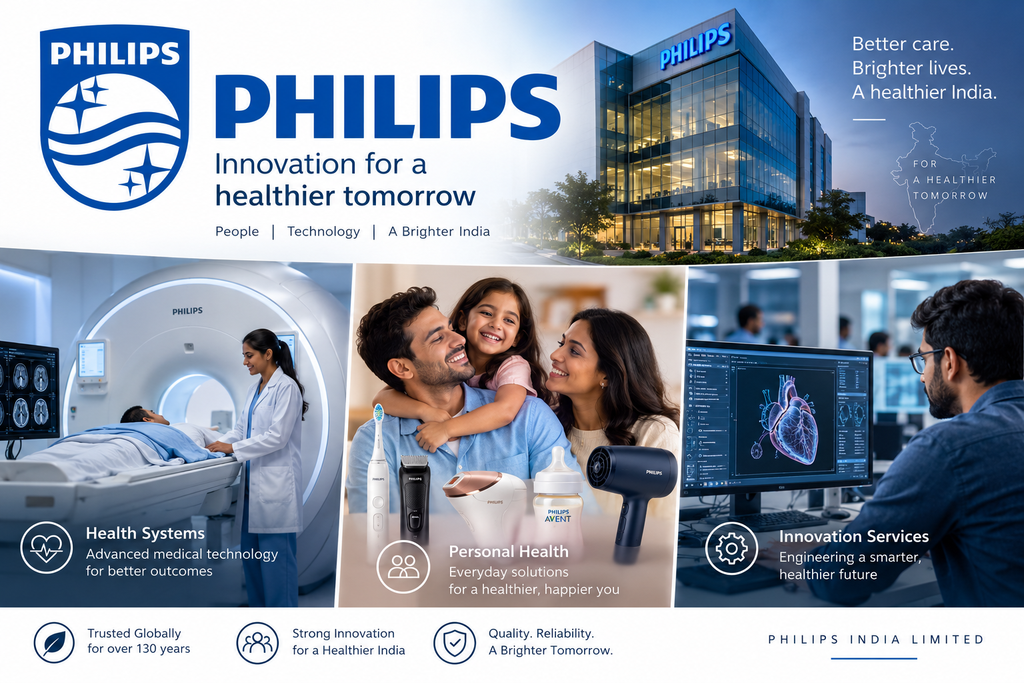
Business: Healthcare Technology | Personal Health | Innovation Services
Status: Unlisted Public Company
Promoter: Koninklijke Philips N.V.
Indicative Unlisted Price: ~₹1,154/share
Latest Full-Year Audited Financials: FY2024-25
Executive Summary
Philips India Limited is the Indian operating company of the global Philips group and has been present in India for several decades. The company operates across healthcare technology, personal health and innovation services, giving it exposure to India’s expanding healthcare infrastructure, medical technology and consumer-health markets.
Philips India – Official Corporate Page
The company has a strong parent in Koninklijke Philips N.V., a globally established healthcare-technology company. Philips India’s FY2024-25 performance showed improvement in revenue and profitability, with PBT increasing significantly and PAT reaching approximately ₹309 crore.
However, investors should distinguish Philips India from a conventional pre-IPO opportunity. The company was delisted from Indian stock exchanges in 2004 and its official disclosures state that it currently has no plans to relist its equity shares in India.
The investment case therefore depends primarily on business quality, profitability, balance-sheet strength and the price at which the unlisted shares can be acquired—not on an assumed IPO or relisting event.
Company Overview
Company Name: Philips India Limited
CIN: U31902WB1930PLC006663
Incorporation: 31 January 1930
Status: Active, Unlisted Public Company
Registered Office: Rajarhat, 4A, 5th Floor, Ecospace Business Park, AA II, Newtown, Chakpachuria, Kolkata, West Bengal – 700156
Corporate Office: 402, 4th Floor, Worldmark, Sector 65, Gurugram, Haryana – 122018
Paid-up Equity Capital: ~₹57.52 crore
Equity Shares: 5,75,17,242 shares of ₹10 each
Promoter Holding: ~96.13%
The company is a subsidiary of Koninklijke Philips N.V., giving it access to Philips’ global technology, products, intellectual property, research capabilities and healthcare ecosystem.
Business Model
Philips India operates across several important businesses.
1. Health Systems
Health Systems is the company’s largest business segment and includes medical technologies used by hospitals and healthcare providers.
The business covers areas such as:
- Diagnostic imaging
- MRI and CT solutions
- Ultrasound
- Patient monitoring
- Healthcare informatics
- Image-guided therapy
- Hospital and clinical solutions
This segment benefits from increasing healthcare expenditure, hospital expansion and demand for advanced diagnostic and treatment technologies.
2. Personal Health
Personal Health focuses on consumer-oriented healthcare and wellness products.
The portfolio includes areas such as:
- Grooming
- Oral healthcare
- Mother and child care
- Personal wellness
- Consumer healthcare products
Philips has significant brand recognition in this category, providing a competitive advantage in the Indian consumer market.
3. Innovation Services
Philips India also has a significant innovation and engineering-services operation.
This provides exposure to:
- Product development
- Software engineering
- Digital healthcare
- Research and development
- Technology development
- Global Philips innovation programs
The segment makes India strategically important to the global Philips organization.
Why the Industry Opportunity is Attractive
India’s healthcare sector is undergoing structural growth driven by:
- Rising healthcare expenditure
- Increasing hospital capacity
- Growing private healthcare infrastructure
- Greater adoption of advanced diagnostics
- Increasing health awareness
- Digitalization of healthcare
- Growth in chronic diseases
- Demand for AI-enabled medical technologies
Medical technology is particularly attractive because hospitals increasingly require advanced equipment rather than only traditional healthcare infrastructure.
Philips’ global positioning in imaging, monitoring, connected care and healthcare technology gives Philips India exposure to these long-term trends.
Parent Company Advantage
Philips India benefits from its relationship with Koninklijke Philips N.V.
Philips – Official Global Website
The parent provides access to:
- Global technology
- Research and development
- International product portfolio
- Brand strength
- Technical expertise
- Global healthcare relationships
- Software and AI capabilities
This is one of the company’s strongest structural advantages compared with smaller standalone Indian medical-technology businesses.
Financial Performance
The latest complete audited annual report available for analysis is FY2024-25.
Philips India FY2024-25 Annual Report
Key Financials
| Particulars | FY2023-24 | FY2024-25 |
|---|---|---|
| Gross Income | ₹6,061.3 Cr | ₹6,630.6 Cr |
| PBT | ₹326.9 Cr | ₹448.0 Cr |
| PAT | ₹257.5 Cr | ₹309.3 Cr |
| EPS | ₹44.78 | ₹53.78 |
| Net Worth | ~₹1,800 Cr | ~₹1,803.6 Cr |
| Cash | ~₹272.8 Cr | ~₹247.3 Cr |
Gross income increased by approximately 9.4%, while PBT increased by roughly 37%.
PAT increased by approximately 20%, demonstrating an improvement in profitability.
EPS increased from approximately ₹44.78 to ₹53.78.
Segment Performance – FY2024-25
| Segment | FY2024-25 Sales |
|---|---|
| Personal Health | ~₹806.6 Cr |
| Health Systems | ~₹3,264.0 Cr |
| Innovation Services | ~₹2,327.5 Cr |
| Services – Others | ~₹69.3 Cr |
| Total | ~₹6,467.4 Cr |
Health Systems remains the dominant business, while Innovation Services provides an important technology and engineering component to the company.
Profitability
FY2024-25 showed a meaningful improvement in profitability.
PBT: ~₹448 crore
PAT: ~₹309 crore
EPS: ₹53.78
Third-party financial compilations put FY2024-25 EBITDA at approximately ₹680 crore compared with approximately ₹508 crore in FY2023-24.
The improvement in operating profitability is an important positive factor for the investment case.
Cash Flow and Balance Sheet
Philips India has a relatively strong balance sheet.
As of March 2025:
- Net worth was approximately ₹1,804 crore.
- Cash and cash equivalents were approximately ₹247 crore.
- Debt levels were relatively low.
- Total assets were approximately ₹4,073 crore.
One area that deserves attention is operating cash flow.
Operating cash flow was approximately ₹128 crore in FY2024-25 compared with approximately ₹736 crore in FY2023-24.
Therefore, although accounting profitability improved, investors should monitor whether earnings continue to convert into operating cash flow.
The company also increased capital expenditure substantially during FY2024-25, with capex of approximately ₹153 crore.
Delisting History
Philips India was delisted from Indian stock exchanges on 16 February 2004.
The delisting was voluntary and followed increased control by Koninklijke Philips Electronics N.V.
An exit offer was made historically to shareholders around the time of delisting.
Importantly, Philips India should not be presented as a company where investors are buying purely for an expected IPO.
The company has subsequently stated in its corporate disclosures that its equity shares remain unlisted and that it does not currently have plans to list its equity shares on Indian stock exchanges.
This makes liquidity and exit visibility important considerations for an unlisted investor.
Minority Shareholder Capital Reduction
Philips India had proposed a capital reduction involving the cancellation of approximately 22.27 lakh shares, representing around 3.87% of the company’s equity held by non-promoter shareholders.
The historical proposal involved consideration of approximately ₹915 per share, consisting of a fair value of ₹740 plus a ₹175 premium.
However, this should not be interpreted as the current value or a guaranteed buyback price.
The NCLT Kolkata rejected the capital-reduction petition in September 2024, taking the view that the proposed transaction effectively amounted to acquisition/buyout of minority shares rather than a capital reduction permissible in that structure.
NCLT Order – Philips India Capital Reduction Matter
The company’s shareholder disclosure provides additional details regarding the proposal.
Philips India – Official Shareholder Disclosure
Current Unlisted Share Price
A current market reference indicates Philips India shares around:
₹1,154 per share
The indicated 52-week range was approximately ₹1,032.50–₹1,165.25.
Because the shares are unlisted, prices can vary substantially between transactions and different unlisted-share intermediaries.
Moneycontrol – Philips India Unlisted Share Price
Indicative Valuation
Using approximately ₹1,154/share and 5,75,17,242 outstanding equity shares:
Indicative equity value = ~₹664 crore
Using FY2024-25 audited EPS of ₹53.78:
Indicative P/E = ~21.5x
Using estimated FY2024-25 book value per share of approximately ₹314:
Indicative P/B = ~3.7x
This valuation is not extremely cheap on traditional book-value parameters. However, the company deserves some premium because of:
- Strong global parentage
- Healthcare exposure
- Established brand
- Large revenue base
- Improving profitability
- Low leverage
- Technology capabilities
- Strong market positioning
The key question for investors is therefore whether the business quality justifies the premium valuation while considering the severe liquidity limitations of the unlisted shares.
Competitive Advantages
Strong Global Brand
Philips is one of the most recognized healthcare and technology brands globally.
Parent Support
The backing of Koninklijke Philips N.V. provides significant technological and strategic advantages.
Healthcare Technology Exposure
Healthcare Systems provides exposure to a structurally growing medical-technology market.
Established Indian Presence
Philips has been operating in India for decades, giving it established relationships and market knowledge.
Technology and Innovation
The company’s Innovation Services operations increase India’s strategic importance within the Philips global ecosystem.
Low Financial Leverage
The balance sheet provides greater resilience compared with highly leveraged businesses.
Investment Positives
1. Strong global parentage
Backed by one of the world’s major healthcare-technology companies.
2. Healthcare sector exposure
The business participates in long-term healthcare infrastructure and technology adoption.
3. Improving profitability
FY2024-25 showed strong PBT and PAT growth.
4. Established brand
Philips enjoys substantial brand recognition among Indian consumers and healthcare institutions.
5. Low leverage
The balance sheet is comparatively strong.
6. Technology capabilities
Innovation Services provides exposure to digital healthcare, engineering and technology.
7. Large operating scale
The company generates thousands of crores in annual income.
Key Concerns and Risks
1. Unlisted Liquidity
This is the biggest practical risk.
There is no continuously traded exchange market, so investors may face difficulty finding buyers when they want to exit.
2. No Current Relisting Plan
Investors should not assume that Philips India will return to the stock exchanges.
3. Valuation Risk
At around ₹1,154 per share, the stock trades at a meaningful premium to book value.
4. Cash Flow Volatility
The significant decline in operating cash flow in FY2024-25 deserves monitoring.
5. Technology Competition
Healthcare technology is highly competitive and requires continuous innovation.
6. Parent-Company Dependence
The business is strategically connected with the global Philips group, which can create both advantages and dependency.
7. Limited Free Float
With approximately 96.13% promoter ownership, the number of shares available to minority investors is very limited.
Key Growth Drivers
Healthcare Infrastructure Expansion
India continues to expand hospital capacity and healthcare infrastructure.
Medical Technology Adoption
Hospitals are increasingly adopting sophisticated diagnostic, monitoring and treatment technologies.
Digital Healthcare
AI, connected care, software and digital healthcare can create additional opportunities.
Consumer Health
Increasing health awareness and consumer spending can support personal-health businesses.
Innovation Services
India’s engineering and technology talent base can continue to make the country important for Philips’ global innovation operations.
Re-rating Triggers
Potential positive triggers could include:
- Sustained double-digit revenue growth
- Continued margin expansion
- Strong operating cash-flow generation
- Higher healthcare technology demand
- Increased contribution from digital/AI healthcare
- Greater capital allocation to high-return businesses
- Improvement in minority shareholder liquidity
- Any future change in listing strategy
However, relisting should not be considered a base-case assumption based on current company disclosures.
Key KPIs to Monitor
Investors should track:
- Revenue growth
- EBITDA margin
- PBT margin
- PAT growth
- EPS
- Operating cash flow
- Working-capital intensity
- Capital expenditure
- Health Systems growth
- Innovation Services growth
- Personal Health growth
- Debt and cash position
- Minority shareholder liquidity
Investment View
Philips India represents an interesting business-quality-driven unlisted investment, rather than a typical pre-IPO opportunity.
The strongest part of the thesis is the combination of:
Global parent + healthcare technology + established Indian presence + strong brand + improving profitability + relatively strong balance sheet.
The biggest drawback is equally clear:
Unlisted liquidity + no current relisting plan + premium valuation.
At around ₹1,154/share, the valuation appears reasonable only if investors are willing to pay a premium for the quality of the underlying business and hold the investment for a longer period.
Investors should therefore evaluate Philips India based on business fundamentals, earnings growth, cash-flow generation and purchase price, rather than relying on a future IPO narrative.
Overall Assessment
| Parameter | Assessment |
|---|---|
| Business Quality | ⭐⭐⭐⭐⭐ |
| Brand Strength | ⭐⭐⭐⭐⭐ |
| Healthcare Opportunity | ⭐⭐⭐⭐⭐ |
| Financial Performance | ⭐⭐⭐⭐ |
| Profitability | ⭐⭐⭐⭐ |
| Balance Sheet | ⭐⭐⭐⭐⭐ |
| Parent Support | ⭐⭐⭐⭐⭐ |
| Growth Potential | ⭐⭐⭐⭐ |
| Cash Flow Quality | ⭐⭐⭐ |
| Valuation | ⭐⭐⭐⭐ |
| Liquidity | ⭐⭐ |
| IPO/Relisting Visibility | ⭐ |
| Overall Risk | Medium–High |
Conclusion
Philips India Limited is a fundamentally strong Indian operating company with the backing of a global healthcare-technology leader.
FY2024-25 demonstrated healthy improvement in profitability, with PBT increasing to approximately ₹448 crore and PAT reaching approximately ₹309 crore.
The company’s exposure to healthcare technology, diagnostics, personal health and innovation services provides multiple long-term growth opportunities.
However, investors must be realistic about the nature of the investment. Philips India is an unlisted company with limited liquidity, and the company has stated that it currently has no plans to list its equity shares on Indian stock exchanges.
Therefore, Philips India can be considered by investors who understand the risks of unlisted securities, have a long investment horizon and are comfortable with limited exit liquidity.
Disclaimer: This report is for educational and informational purposes only and should not be considered investment advice or a recommendation to buy or sell securities. Unlisted share prices and transaction availability can change materially. Investors should independently verify the latest audited financial statements, shareholding, valuation, legal status and transaction terms before making any investment decision.
For more such unlisted stocks visit https://unlistedcart.com/unlisted-shares/