Premium Beer Leader in India | Global Brands, Strong Parentage & High-Growth Premiumisation Opportunity
Company: Anheuser Busch InBev India Limited
Formerly: SABMiller India Limited
CIN: U65990MH1988PLC049687
ISIN: INE038G01019
Incorporated: 18 November 1988
Registered Office: Mumbai, Maharashtra
Corporate Office: Bengaluru, Karnataka
Sector: Alcoholic Beverages / Breweries
Status: Active & Unlisted Public Company
Ultimate Parent: Anheuser-Busch InBev (AB InBev)
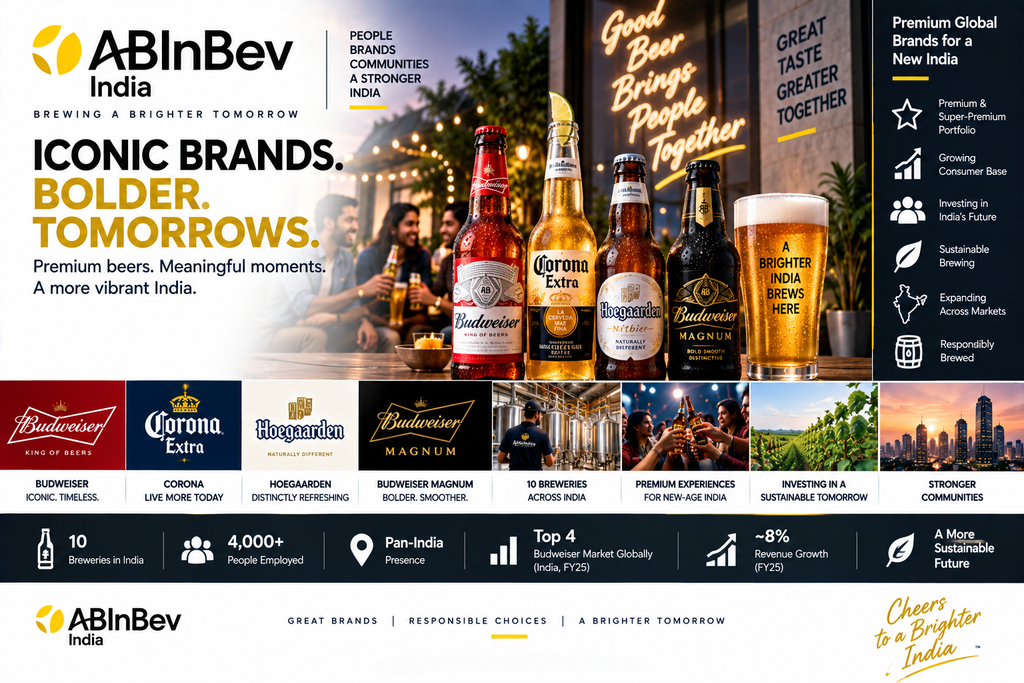
Key Brands: Budweiser, Budweiser Magnum, Corona, Hoegaarden and other premium brands
About the Company
Anheuser Busch InBev India Limited is the Indian operating company of Anheuser-Busch InBev, one of the world’s largest brewing groups.
The Indian business was formerly known as SABMiller India Limited and became part of AB InBev following AB InBev’s global acquisition of SABMiller.
The company manufactures, markets, distributes and sells beer and other malt beverages in India.
AB InBev has built a particularly strong position in India’s premium and super-premium beer segments, with flagship brands including Budweiser, Budweiser Magnum, Corona and Hoegaarden. AB InBev says India was one of Budweiser’s top-four markets globally in FY25.
Key Highlights
| Particular | Details |
|---|---|
| Company Status | Active & Unlisted |
| Parent | Anheuser-Busch InBev |
| Indian Presence | Established beer business with 10 breweries |
| FY25 Revenue | ₹7,891 Cr |
| FY25 Revenue Growth | ~8.1% |
| FY25 Loss Before Tax | ₹356 Cr |
| FY25 Loss | ₹356 Cr |
| Total Assets | ₹3,693 Cr |
| Borrowings | ₹1,665 Cr |
| Cash & Equivalents | ₹117 Cr |
| Equity | ₹241 Cr |
| Promoter Group Holding | ~99.67% |
| Indicative OTC Price | ~₹525–₹590/share |
| IPO | No confirmed DRHP |
| Investment Character | Premium consumer brand + turnaround/profitability story |
FY25 financial figures are from the company’s audited annual report.
Business Model
AB InBev India’s business revolves around the complete beer value chain:
Brewing → Packaging → Distribution → Retail / On-Premise → Consumer
The company sells through state beverage corporations, distributors, retailers, restaurants, bars and other channels.
The company also uses contract bottling arrangements, allowing certain products to be manufactured through Contract Bottler Units.
Core Portfolio
Budweiser
The flagship global lager and the most important brand for AB InBev’s premium strategy in India.
Budweiser Magnum
A stronger, premium extension of the Budweiser franchise.
Corona
A globally recognised premium Mexican beer brand with strong lifestyle positioning.
Hoegaarden
Belgian-style wheat beer positioned toward premium/craft-oriented consumers.
The broader AB InBev portfolio includes more than 50 iconic brands globally.
India — A Strategic Growth Market
One of the most important developments is that AB InBev increasingly views India as a major future growth engine.
According to Budweiser Brewing Company APAC’s FY25 annual report:
- India gained total beer market share in FY25.
- Budweiser grew ahead of the industry.
- Premium and Super Premium products accounted for more than two-thirds of India’s revenue.
- The Premium and Super Premium portfolio delivered more than 20% revenue growth.
- India was one of Budweiser’s top-four markets globally.
This is important because AB InBev is not primarily trying to compete for the lowest-priced beer consumer.
Its strategy is centred around premiumisation.
Manufacturing Footprint
AB InBev has historically operated approximately 10 breweries in India and employs more than 4,000 people, according to the company’s global materials.
The company is also continuing to invest in Indian capacity.
In September 2026, AB InBev announced an investment of approximately ₹200 crore in a new manufacturing facility in Neemrana, Rajasthan, aimed at increasing capacity to meet growing beer demand in North and Central India.
This is a particularly positive signal because the parent company is committing fresh capital to expand its Indian operating footprint rather than treating India merely as a mature market.
FY25 Financial Performance
Financial Snapshot
| ₹ Crore | FY25 | FY24 |
|---|---|---|
| Revenue from Operations | 7,890.9 | 7,301.6 |
| Total Income | 7,896.9 | 7,324.8 |
| Total Expenses | 8,252.9 | 7,915.7 |
| Loss Before Tax | (356.0) | (590.9) |
| Loss for the Year | (356.0) | (590.9) |
| EPS | ₹(3.64) | ₹(6.36) |
| Total Assets | 3,693.2 | 3,378.4 |
| Equity | 240.9 | 149.1 |
The company therefore delivered ~8.1% revenue growth while reducing its loss materially from FY24.
FY25 revenue was ₹7,890.9 crore and loss narrowed to ₹356 crore from ₹590.9 crore in FY24.
Important Interpretation
The headline revenue number needs some context.
Of the FY25 revenue from operations:
- Beer revenue: ~₹3,443 Cr
- Excise duty collected: ~₹4,383 Cr
- Other beverages: ~₹14 Cr
- Other operating revenue: ~₹50 Cr
Therefore, a substantial portion of reported revenue represents excise duty collected from customers, rather than pure beer economics.
For valuation analysis, investors should therefore focus on underlying net sales, volumes, gross margins, EBITDA and cash generation, rather than simply applying a sales multiple to the ₹7,891 crore reported figure.
Cash Flow
Cash generation remains a major concern.
FY25
Cash used in operations: ~₹66 Cr
versus:
Cash used in operations FY24: ~₹311 Cr
There was therefore a significant improvement in operating cash flow, but it remained negative.
At the same time, the company invested approximately ₹237 Cr in investing activities, including property, plant and equipment and intangible assets.
This means the company has not yet reached the point where the Indian entity can comfortably fund its own expansion through internal cash generation.
Balance Sheet
The balance sheet requires careful attention.
FY25
| Particular | Amount |
|---|---|
| Total Assets | ₹3,693 Cr |
| Current Assets | ₹2,175 Cr |
| Cash & Cash Equivalents | ₹117 Cr |
| Total Equity | ₹241 Cr |
| Borrowings | ₹1,665 Cr |
| Lease Liabilities | ₹194 Cr |
| Trade Payables | ₹910 Cr |
| Current Liabilities | ₹3,289 Cr |
The company had current assets of ₹2,175 crore against current liabilities of ₹3,289 crore, giving a current ratio of only 0.66x.
Debt
Borrowings stood at approximately ₹1,665 crore at March 2025.
The reported debt-equity ratio was:
7.72x
Although this improved from 12.20x in FY24 following a capital infusion, leverage remains high relative to the company’s accounting equity.
Parent Support — A Critical Positive
One of the most important differences between AB InBev India and a typical financially stressed unlisted company is its parent.
The FY25 annual report states that Anheuser Busch InBev Asia BV, the holding company, has confirmed financial and other support to enable the Indian company to settle obligations as they arise and continue operations.
This support allowed the company to prepare its accounts on a going-concern basis despite accumulated losses and negative working-capital conditions.
This does not eliminate the financial risk, but it materially changes the risk profile compared with a standalone distressed brewer.
Shareholding Pattern
As of 31 March 2025:
| Shareholder | Shares | Holding |
|---|---|---|
| Anheuser Busch InBev Asia B.V. | 86.53 Cr | 85.14% |
| Anheuser Busch InBev Breweries Pvt. Ltd. | 14.21 Cr | 13.98% |
| SABMiller India Holdings | 0.56 Cr | 0.55% |
| Others | Balance | ~0.33% |
The AB InBev group therefore controlled approximately 99.67% of the company.
FY25 Capital Infusion
In September 2024, the company issued approximately 8.80 crore equity shares to Anheuser Busch InBev Asia B.V. at ₹47.70 per share, raising approximately ₹420 crore.
This increased the paid-up capital from approximately ₹928 crore to ₹1,016 crore.
The transaction is important because it demonstrates the parent’s willingness to provide capital support to the Indian business.
Recent Strategic Development — Rajasthan
AB InBev’s approximately ₹200 crore investment in Neemrana, Rajasthan is an important growth signal.
The facility is intended to increase production capacity and support demand growth beyond India’s largest metros.
This fits with the broader Indian beer-market trend toward:
Premiumisation + rising disposable income + urbanisation + consumption beyond Tier-1 cities.
Industry Opportunity
India remains structurally attractive for beer companies.
The key long-term drivers include:
- Rising disposable income
- Younger consuming population
- Premiumisation
- Growth of organised retail
- Expansion of nightlife and hospitality
- Increasing acceptance of beer
- Growth beyond major metropolitan cities
- Introduction of low/no-alcohol products
- Greater consumer willingness to pay for premium brands
AB InBev is particularly well positioned for premiumisation because its portfolio contains some of the world’s strongest premium beer brands.
Investment Positives
| Positive | Investment Relevance |
|---|---|
| Global Parentage | Backed by one of the world’s largest brewers |
| Budweiser | Extremely strong global premium brand |
| Corona | High-value international premium brand |
| Premiumisation | More than two-thirds of India revenue from Premium/Super Premium portfolio |
| Market Share Gains | India gained share in FY25 |
| Revenue Growth | FY25 revenue increased ~8% |
| Loss Reduction | Loss narrowed substantially from FY24 |
| Parent Support | Strong financial backing from AB InBev group |
| Manufacturing Expansion | ₹200 Cr Neemrana investment |
| Scale | Large existing Indian manufacturing/distribution platform |
| Global Knowledge | Access to AB InBev technology, brands and brewing expertise |
Key Risks / Concerns
1. The company is still loss-making
FY25 loss remained approximately ₹356 crore.
2. Negative accumulated earnings
Accumulated losses were approximately ₹4,791 crore at March 2025.
3. High leverage
Debt-equity ratio was approximately 7.72x.
4. Weak liquidity
Current ratio was only 0.66x.
5. Negative operating cash flow
Operating cash flow remained negative at approximately ₹66 crore.
6. Regulatory risk
Alcohol remains one of India’s most heavily regulated consumer industries, with substantial state-level taxation and licensing requirements.
7. Parent-company dependence
The Indian entity’s financial sustainability partly depends on continued support from the AB InBev group.
8. Valuation risk
The OTC valuation is extremely high relative to the Indian company’s current accounting earnings and net worth.
9. Unlisted liquidity
There is no exchange liquidity, and OTC prices can vary substantially depending on lot size, seller availability and buyer demand.
Current Unlisted Share Price
As of 11 September 2026, publicly displayed OTC references vary significantly:
- Moneycontrol: around ₹526.63
- BuyUnlistedShares: around ₹555
- InCred Unlisted: around ₹590
- Planify: around ₹588.20
These are indicative OTC references and not exchange prices.
Important valuation discrepancy
The available platforms also show different outstanding-share figures and therefore materially different implied market capitalisations.
The audited FY25 annual report shows 101.64 crore shares outstanding after the September 2024 capital infusion.
At approximately ₹555:
₹555 × 101.64 Cr shares ≈ ₹56,400 Cr
At approximately ₹590:
₹590 × 101.64 Cr shares ≈ ₹59,970 Cr
Therefore, investors should not blindly rely on the market-cap figure displayed by any one OTC platform without reconciling the latest capital structure.
Valuation Perspective
This is where AB InBev India becomes particularly interesting — and potentially expensive.
At a ₹555 reference price:
Indicative Equity Value ≈ ₹56,400 Cr
Against:
- FY25 revenue: ₹7,891 Cr
- FY25 loss: ₹356 Cr
- FY25 book equity: ₹241 Cr
The company cannot currently be valued using conventional P/E, because earnings are negative.
The implied:
Price-to-Sales ≈ 7.1x
and
Price-to-Book ≈ 234x
using the audited FY25 standalone share count and equity.
This illustrates an important point:
The market is valuing AB InBev India primarily on brand strength, future profitability, strategic scarcity and parentage — not on current book value or earnings.
IPO Status
⚠️ No confirmed IPO
AB InBev India remains unlisted.
There is currently no verified active DRHP that should be treated as confirmation of an imminent IPO.
Therefore, investors should not buy the shares purely on the assumption that an IPO is coming soon.
The stronger thesis is the underlying Indian beer business and the possibility of future profitability/strategic corporate action.
What Could Unlock Value?
The biggest potential catalysts are:
1. Return to profitability
The single most important catalyst.
2. Positive operating cash flow
This would demonstrate that the Indian operation can fund growth internally.
3. Premium beer growth
Continued double-digit growth in Budweiser, Corona and other premium brands could materially improve economics.
4. Manufacturing expansion
The Rajasthan investment could increase volumes and improve regional supply economics.
5. Operating leverage
Higher utilisation of existing breweries could improve margins.
6. Further parent investment
Additional capital support could strengthen the balance sheet.
7. Potential IPO / strategic transaction
An eventual public listing or other strategic transaction could provide liquidity and price discovery — but this remains unconfirmed.
What Investors Should Monitor
| KPI | Why It Matters |
|---|---|
| Revenue Growth | Indicates market expansion |
| Beer Volumes | More important than headline revenue |
| Premium/Super Premium Mix | Key margin driver |
| Budweiser Growth | Flagship brand performance |
| EBITDA | First major profitability milestone |
| Operating Cash Flow | Quality of earnings |
| Debt | Balance-sheet improvement |
| Current Ratio | Liquidity |
| Parent Support | Funding requirement |
| Brewery Utilisation | Operating leverage |
| Rajasthan Plant | Capacity expansion execution |
| IPO Filing | Potential liquidity catalyst |
Investment View
Anheuser-Busch InBev India — Premium Brand Powerhouse with a Profitability Gap
AB InBev India presents an unusual unlisted investment proposition.
On one side:
Budweiser + Corona + Hoegaarden + global parentage + premiumisation + market-share gains + new capacity investment
On the other:
₹356 Cr annual loss + ₹4,791 Cr accumulated losses + ₹1,665 Cr borrowings + negative operating cash flow + 0.66x current ratio + very high implied valuation.
Therefore, the story is not a conventional value investment.
It is a future profitability and premiumisation investment.
The most encouraging factor is that the business is showing improvement: FY25 revenue increased approximately 8%, losses narrowed significantly, the parent injected approximately ₹420 crore, and AB InBev continues to invest in new Indian manufacturing capacity.
However, at OTC valuations around ₹525–₹590, the market appears to be pricing in substantial future improvement.
Our Investment Classification
Business Quality: ⭐⭐⭐⭐⭐
Brand Strength: ⭐⭐⭐⭐⭐
Parentage: ⭐⭐⭐⭐⭐
Growth Opportunity: ⭐⭐⭐⭐½
Current Profitability: ⭐⭐
Balance Sheet: ⭐⭐
Valuation: ⭐⭐
Liquidity: ⭐⭐
Overall Risk: 🔴 High
UnlistedCart View: WATCHLIST / LONG-TERM PREMIUM CONSUMER STORY
AB InBev India can become a much stronger investment proposition if the company converts its premium brand leadership into sustainable EBITDA, positive operating cash flow and lower leverage.
At current OTC valuations, however, investors should demand a clear margin-of-safety analysis rather than buying only because “Budweiser is a great brand.”
The brand is excellent.
The investment price is the question.
Disclaimer
This report is prepared for informational and research purposes only and does not constitute investment advice, an offer, solicitation or recommendation to buy or sell securities. Unlisted-share prices are indicative OTC/private-market references and may differ materially by transaction size, availability and counterparty. Investors should independently verify the latest audited financial statements, capital structure, shareholder records, transferability, taxation and applicable regulatory requirements before making any investment decision.
For more such unlisted stocks visit https://unlistedcart.com/unlisted-shares/