Sector: AI Surveillance, Security Technology & IT Infrastructure
Status: Active & Unlisted — IPO process underway
CIN: U72900DL2001PLC109496
ISIN: INE0OR401022
Incorporated: 2 February 2001
Registered & Corporate Office: New Delhi
Face Value: ₹2 per share
Chairman & Managing Director: Arun Gupta
Proposed Listing: NSE & BSE
1. About the Company
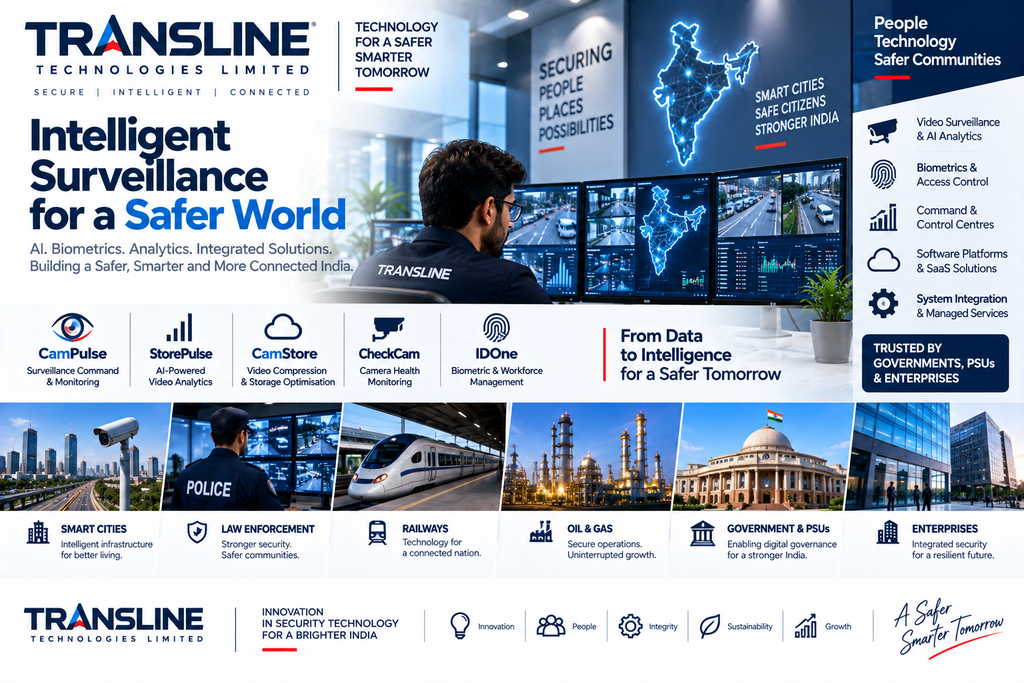
Transline Technologies Limited is a New Delhi-based technology company that has evolved from an IT infrastructure and systems-integration business into a more specialised AI-powered surveillance, biometrics and intelligent-security solutions provider.
The company provides an integrated offering covering hardware, software, installation, system integration, managed services and proprietary SaaS platforms.
Its current positioning is built around combining cameras + biometrics + AI + computer vision + analytics + command centres into end-to-end security infrastructure for governments, PSUs and enterprises.
Transline has more than 25 years of operating history and has worked with government departments, police, railways, banking, oil & gas, education, telecom and other institutional customers.
2. What Does Transline Technologies Do?
The business can broadly be divided into two categories:
| Segment | Key Activities |
|---|---|
| Solutions | Video surveillance, biometrics, IT infrastructure, security hardware, command centres |
| Services | Implementation, system integration, managed services, software/SaaS and support |
FY26 revenue was approximately ₹377.76 Cr from Solutions and ₹110.70 Cr from Services.
Major Product Platforms
- CamPulse — surveillance command and monitoring
- StorePulse — AI-powered video analytics
- CamStore — video compression and storage optimisation
- CheckCam — camera-health monitoring
- IDOne — biometric/workforce-management platform
- Video surveillance systems
- Facial recognition
- Access control
- Intelligent traffic/security systems
The company says it has developed 5+ proprietary software products, helping it move beyond pure hardware supply and system integration.
3. Target Markets
Transline serves a broad institutional customer base, including:
- Central and state government
- Police and law-enforcement agencies
- PSUs
- Railways
- Oil & gas
- Banking and financial services
- Education
- Healthcare
- Retail
- Industrial infrastructure
- Transportation
- Smart-city projects
The government/PSU segment remains particularly important. The DRHP disclosed that government and PSU customers contributed 66.03% of FY25 revenue from operations.
This gives Transline access to large projects, but also makes the company dependent on government tender cycles, project execution and payment collections.
4. Major Milestones
Transline has a long history of working on institutional technology projects.
| Year | Milestone |
|---|---|
| 2008 | Biometric attendance system for a state municipal department covering ~150,000 employees |
| 2011 | Aadhaar-kit contract; more than 5.8 million Aadhaar IDs generated as an enrolment agency |
| 2015 | ICT project covering 204 schools in Andhra Pradesh |
| 2017 | Biometric attendance system for a state judiciary |
| 2019 | Aadhaar enrolment kits supplied to banks, postal circles and education departments |
| 2023 | 20,000 CCTV cameras installed at a state public works department |
| 2024 | Multiple police, PSU, railway and biometric projects |
| 2025 | 1,720 CCTV cameras installed across 11 Delhi police stations |
These projects demonstrate that the company is not a newly created AI story; it has an established execution history in institutional security infrastructure.
5. FY26 Financial Performance
FY26 was another strong year operationally.
| ₹ Cr | FY24 | FY25 | FY26 | FY26 Growth |
|---|---|---|---|---|
| Revenue from Operations | 225.9 | 371.1 | 488.5 | +31.6% |
| EBITDA | ~53 | 79.4 | 109.2 | +37.6% |
| PBT | ~49 | 68.6 | 93.9 | +37.0% |
| PAT | 35.5 | 48.3 | 70.3 | +45.4% |
| EPS | ~3.96 | 5.44 | 7.84 | +44% |
FY25 itself had already recorded revenue growth of approximately 64%, making the FY23–FY26 revenue trajectory particularly strong.
Three-Year Revenue Growth
Revenue increased approximately:
₹114 Cr → ₹228 Cr → ₹371 Cr → ₹488 Cr
between FY23 and FY26.
That represents a substantial scale-up over a relatively short period.
6. Profitability
One of the strongest aspects of the business is the improvement in profitability.
FY26:
- EBITDA: ~₹109 Cr
- EBITDA margin: ~22.4%
- PAT: ~₹70 Cr
- PAT margin: ~14.4%
- ROE: ~32.9%
- ROCE: ~47.0%
Profit grew faster than revenue during FY26, indicating operating leverage and an improving business mix.
The increasing contribution of software, services and proprietary platforms could potentially support margins over time.
7. The Most Important Concern — Profit vs Cash Flow
This is the area investors should examine carefully.
Despite reporting approximately ₹70.28 Cr PAT in FY26, operating cash flow remained negative at approximately ₹72.13 Cr.
FY25 operating cash flow was also negative at approximately ₹79.93 Cr.
| ₹ Cr | FY25 | FY26 |
|---|---|---|
| PAT | 48.33 | 70.28 |
| Operating Cash Flow | -79.93 | -72.13 |
| Borrowings | 86.08 | 110.71 |
| Trade Receivables | 189.59 | 218.07 |
| Contract Assets | 90.64 | 145.51 |
| Inventory | 29.70 | 66.53 |
| Cash & Equivalents | ~0.13 | ~0.13 |
This does not automatically imply poor accounting quality. The business is heavily project-driven and government/PSU oriented, where receivables, retention money, unbilled revenue and inventory can absorb substantial working capital.
However, the trend needs to improve.
Key Question for FY27
Can Transline convert accounting profits into operating cash flow?
This is arguably more important than another year of headline revenue growth.
8. Working Capital
The company’s working-capital cycle increased materially over recent years.
According to the DRHP, the working-capital cycle increased from approximately:
74 days → 117 days → 165 days
between FY23 and FY25.
FY26 also saw:
- Receivables increase ~15%
- Contract assets increase ~61%
- Inventory increase more than 2x
The combination of receivables, unbilled contract assets, retention amounts and inventory means significant capital is tied up in the operating cycle.
Investment Interpretation
The company is growing rapidly, but growth is currently capital intensive.
If working-capital efficiency improves, free cash generation could improve significantly.
If working capital continues to expand faster than revenue, additional borrowing could remain necessary.
9. Debt Position
Total borrowings increased from approximately ₹86.1 Cr in FY25 to ₹110.7 Cr in FY26.
Debt-to-equity nevertheless remained relatively moderate at around 0.44x, because shareholders’ equity increased alongside the company’s profitability.
Therefore, the balance sheet is not currently overleveraged, but the combination of:
negative operating cash flow + rising borrowings
deserves monitoring.
10. Customer & Competitive Position
Transline states that it has served 500+ clients across government, banking, industry, education and other sectors.
The company has also highlighted:
- CMMI Level 5
- ISO 9001
- ISO 14001
- ISO 27001
- ISO/IEC 20000-1
- 25+ years of operating experience
- 11+ billing locations
- Proprietary software platforms
- AI/video analytics capabilities
The company says it has worked with organisations including Indian Oil, Indian Railways and police departments.
11. Government Exposure — Strength and Risk
Government exposure is one of Transline’s biggest competitive advantages.
Large surveillance and security projects require:
- technical capability
- certifications
- previous project experience
- tender eligibility
- execution capacity
- working capital
Transline’s long operating history can therefore create a meaningful entry barrier.
However, the same exposure introduces risks:
- Tender delays
- Budget-cycle dependency
- Payment delays
- Project concentration
- Policy changes
- Competitive bidding pressure
The DRHP states that government/PSU customers represented approximately 66% of FY25 revenue, while approximately 93.92% of the order book was attributable to government customers as of March 31, 2025.
12. Customer Concentration
Customer concentration remains another important risk.
The top 10 customers accounted for approximately 80.97% of FY25 revenue, although this had improved from approximately 92.53% in FY23.
The direction is positive, but concentration remains high.
This means the company should ideally continue diversifying toward:
- enterprise customers
- banking
- retail
- healthcare
- industrial customers
- recurring SaaS contracts
13. IPO Status — Important Update
Transline is not merely a company that is considering an IPO.
It has already taken formal steps.
IPO Timeline
7 August 2025: DRHP filed with SEBI.
January 2026: SEBI observation/approval received, according to the latest IPO disclosures.
Proposed IPO Structure
The proposed IPO is an Offer for Sale (OFS).
Up to:
1,61,91,500 equity shares
are proposed to be offered.
There is no fresh issue component in the disclosed structure.
Why This Matters
Because the IPO is entirely OFS:
Transline itself will not receive IPO proceeds.
The transaction primarily provides:
- public-market listing
- liquidity to existing shareholders
- greater visibility
- potential institutional ownership
- a transparent market valuation
This is an important distinction for investors.
The company is therefore IPO-approved / IPO-ready, but the actual price band, subscription dates and listing date have not yet been announced.
14. Proposed Promoters
The DRHP identifies the promoters as:
- Arun Gupta
- Amita Gupta
- Drishti Gupta
- RKG Enterprises Private Limited
The current management structure includes Arun Gupta as Chairman & Managing Director, with Drishti Gupta and other independent/non-executive directors on the board.
15. Current Unlisted Share Price
Current unlisted-market references are around:
₹164–₹165/share
as of September 10–11, 2026.
Examples:
- Planify: ₹164.50
- BuyUnlistedShares / UnlistedZone: ~₹165
- WWIPL: ₹164
These are OTC/private-market reference prices, not NSE/BSE prices.
Because unlisted prices can vary by seller, quantity and settlement terms, investors should obtain an executable quote before using the price for a transaction decision.
16. Indicative Valuation
Using approximately 8.9675 Cr shares and an indicative price of ₹165:
Indicative market capitalisation ≈ ₹1,480 Cr
At FY26 EPS of approximately ₹7.84:
Indicative FY26 P/E ≈ 21x
The latest unlisted-market sources report approximately 5.9x P/B.
Valuation Snapshot
| Parameter | Approx. |
|---|---|
| Indicative Price | ₹164–165 |
| Shares Outstanding | 8.97 Cr |
| Market Cap | ~₹1,475–1,480 Cr |
| FY26 EPS | ~₹7.84 |
| FY26 P/E | ~21x |
| Book Value | ~₹27.8 |
| P/B | ~5.9x |
| Debt/Equity | ~0.44x |
At ~21x FY26 earnings, the valuation is not extremely cheap, but it can be considered more reasonable if the company sustains 25–30% growth and improves cash conversion.
The key issue is therefore not simply the P/E; it is whether the current earnings quality and growth are sustainable.
17. Investment Positives
1. Strong Revenue Growth
Revenue has increased from approximately ₹114 Cr in FY23 to ₹488 Cr in FY26.
2. Faster Profit Growth
FY26 PAT grew approximately 45%, faster than the 32% revenue growth.
3. AI & Surveillance Tailwinds
Government digitisation, smart cities, public safety, AI video analytics, facial recognition and intelligent command centres provide structural demand opportunities.
4. Strong Government Credentials
More than two decades of institutional execution provides a meaningful competitive advantage in large government/PSU tenders.
5. Proprietary Software
StorePulse, CamStore, CheckCam, CamPulse and IDOne provide an opportunity to increase the recurring/software component of revenue.
6. IPO Catalyst
The company has already filed its DRHP and received regulatory observations/approval, providing a potential public-market liquidity event.
7. Improving Business Mix
The Services segment is growing rapidly and can potentially carry better margins than pure hardware distribution and project supply.
18. Key Risks
1. Negative Operating Cash Flow
Two consecutive years of negative operating cash flow are the biggest fundamental concern.
2. Working-Capital Intensity
Receivables, contract assets and inventory are consuming significant capital.
3. Government Concentration
A large portion of revenue and order book remains linked to government/PSU customers.
4. Customer Concentration
Top 10 customers represented ~81% of FY25 revenue.
5. Borrowing Requirement
Borrowings increased to ~₹111 Cr in FY26 as operating cash flow remained negative.
6. IPO Timing Uncertainty
Although the IPO has cleared an important regulatory stage, no final price band, subscription date or listing date has been announced.
7. OFS Structure
Because the proposed IPO is entirely OFS, the company itself does not receive new IPO capital.
8. Valuation
At approximately ₹165/share, the stock is already valued at around 21x FY26 earnings. A significant part of the future growth opportunity may therefore already be reflected in the OTC price.
19. What Can Drive Future Growth?
The long-term opportunity lies in moving from:
Hardware + Integration
toward:
Hardware + AI + SaaS + Analytics + Managed Security
This transition could improve:
- recurring revenue
- margins
- customer retention
- cross-selling
- revenue visibility
The company specifically highlights SaaS products such as StorePulse, CheckCam and CamStore as a source of recurring and predictable income.
20. Investment View
AI Surveillance & Security Infrastructure — High-Growth Pre-IPO Opportunity
Transline is an interesting company because the investment story is not dependent solely on the generic “IT services” theme.
It sits at the intersection of:
AI + Surveillance + Biometrics + Government Digitisation + Smart Infrastructure + Cyber/Physical Security.
FY26 numbers were strong, with revenue growing 31.6% and PAT growing 45.4%.
The IPO provides an additional potential catalyst.
However, investors should not overlook the other side of the story.
The company generated ₹70 Cr+ of accounting profit but remained cash-flow negative by ~₹72 Cr, while borrowings increased and working capital remained elevated.
Therefore, the next phase of the investment thesis should focus on cash conversion rather than revenue growth alone.
Our Research View
| Factor | Assessment |
|---|---|
| Business opportunity | ⭐⭐⭐⭐⭐ |
| Revenue growth | ⭐⭐⭐⭐⭐ |
| Profit growth | ⭐⭐⭐⭐⭐ |
| AI/SaaS potential | ⭐⭐⭐⭐ |
| Government positioning | ⭐⭐⭐⭐⭐ |
| Balance sheet | ⭐⭐⭐⭐ |
| Cash-flow quality | ⭐⭐ |
| Customer concentration | ⭐⭐ |
| IPO visibility | ⭐⭐⭐⭐⭐ |
| Valuation | ⭐⭐⭐ |
| Overall Risk | Medium–High |
21. Key Numbers to Track Going Forward
For FY27, investors should particularly monitor:
- Revenue growth
- Services revenue growth
- EBITDA margin
- Operating cash flow
- Trade receivables
- Contract assets
- Inventory
- Working-capital days
- Borrowings
- Government vs private-sector revenue mix
- SaaS/recurring revenue contribution
- IPO price band and listing timeline
The most important KPI:
Operating Cash Flow > PAT
If Transline reaches that stage while maintaining 20%+ EBITDA margins and strong revenue growth, the quality of the investment thesis could improve materially.
22. Final Assessment
Transline Technologies has evolved into a credible AI-led security and surveillance technology company with strong institutional credentials and impressive recent financial growth.
The combination of 25+ years of experience, government relationships, proprietary software, AI capabilities and an upcoming IPO makes it a compelling company to track in the Indian unlisted market.
At the same time, investors should not evaluate the company solely on its 30%+ revenue growth.
The biggest question is:
Can Transline convert its strong reported profits into sustainable free cash flow?
At around ₹164–165/share, the valuation already prices in a meaningful portion of the company’s growth potential. Therefore, the opportunity becomes considerably more attractive if the company can improve working-capital efficiency and cash generation while maintaining its growth trajectory.
Investment stance: Positive on the business trajectory, but valuation and cash conversion require close monitoring.
Disclaimer
This report is prepared for research and informational purposes only and does not constitute investment advice, an offer to buy or sell securities, or a guarantee of future returns. Unlisted-share prices are indicative OTC/private-market references and may differ materially from executable transaction prices. IPO approval does not guarantee that the IPO will launch on any particular date or at any particular valuation. Investors should independently verify the latest financial statements, DRHP/RHP, regulatory status, share availability, taxation, transfer restrictions and transaction terms before investing.
For more such unlisited stocks visit https://unlistedcart.com/unlisted-shares/