Company: Udaan / Hiveloop Group
Operating Entity: Hiveloop E-Commerce Private Limited
CIN: U74999KA2017PTC106742
Founded: 2016
Founders: Vaibhav Gupta, Sujeet Kumar & Amod Malviya
Headquarters: Bengaluru, Karnataka
Business: B2B E-commerce / Retail Distribution / Supply Chain / FinTech
Status: Active & Unlisted
CEO: Vaibhav Gupta
Latest Transaction Valuation: Approximately $1.9–2.0 Billion
FY25 Revenue: ₹4,561 Cr
FY25 Net Loss: ₹1,055 Cr
Latest Funding/Recapitalisation: ~$160 Million, July 2026
IPO: Planned; reverse-flip to India underway, but no DRHP filed
Udaan is one of India’s largest technology-enabled B2B commerce platforms, connecting manufacturers, brands and wholesalers with kirana stores and other small retailers.
The company has gone through a major restructuring over the last few years: it exited several low-margin/non-core categories, reduced its geographic footprint, moved toward a cluster-based operating model and focused more heavily on FMCG, staples, pharma, HoReCa and private labels.
Official website: Udaan
Key Highlights
| Particular | Latest Information |
|---|---|
| Founded | 2016 |
| Founders | Vaibhav Gupta, Sujeet Kumar, Amod Malviya |
| Current operating footprint | 16 cities |
| Warehouses | 25+ |
| Retail outlets served | 2,00,000+ |
| FY25 Revenue | ₹4,561 Cr |
| FY25 Revenue Growth | -20% |
| FY25 Net Loss | ₹1,055 Cr |
| FY25 Loss Reduction | ~37% |
| Revenue CAGR | ~25% over Q4 CY23–Q1 CY26 |
| EBITDA burn reduction | ~70% over same period |
| Latest financing | ~$160 Mn |
| Latest transaction valuation | ~$1.9–2.0 Bn |
| Total funding | $2.3 Bn+ |
| IPO status | Preparation stage |
| DRHP | Not filed |
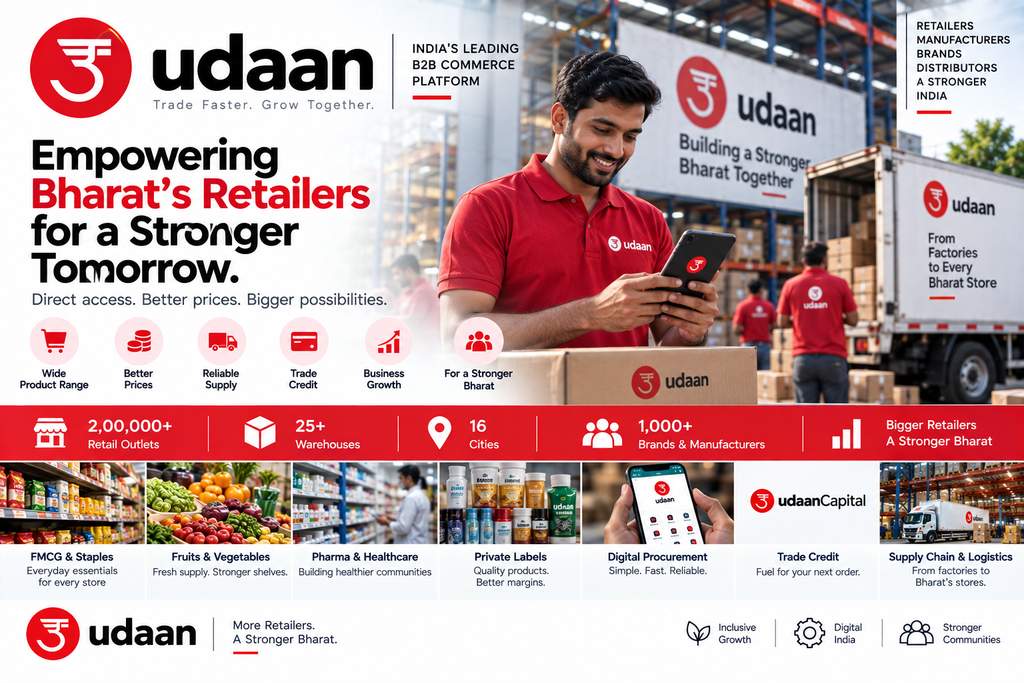
Udaan’s current operating footprint is much smaller than some of its older headline numbers. The company currently reports/has been reported at 16 cities, 25+ warehouses and 2 lakh+ retail outlets, following its restructuring.
About the Company
Udaan was founded by three former Flipkart executives — Vaibhav Gupta, Sujeet Kumar and Amod Malviya.
The company initially attempted to build a broad B2B marketplace across multiple categories. During the 2022–24 period, however, the business faced significant losses, funding pressure and a difficult operating environment.
Udaan subsequently shifted strategy toward a more focused model:
Manufacturers → Udaan → Retailers/Kirana Stores
The company now concentrates on categories where it believes it can build repeat purchasing, stronger margins and better supply-chain economics.
Its core categories include:
- FMCG
- Staples
- Fruits & vegetables
- Pharmaceuticals
- HoReCa
- Private-label products
- Retail distribution
- Trade credit
- Working-capital financing
Udaan also operates udaanCapital, its working-capital/credit business for small businesses.
Business Model
1. B2B Marketplace
Udaan allows retailers to procure products from brands, manufacturers and wholesalers through its digital platform.
The platform provides:
- Product discovery
- Wholesale pricing
- Digital ordering
- Credit
- Delivery
- Supply-chain services
The model is designed around repeat purchases rather than one-time consumer transactions.
2. FMCG & Staples
FMCG and staples have become the company’s primary focus after exiting several non-essential categories.
This is important because staples provide:
- High purchase frequency
- Predictable demand
- Large addressable market
- Strong retailer relationships
Udaan is also expanding its private-label portfolio.
Private labels currently contribute around 15–25% of staples sales across operating cities, according to the company.
3. Supply Chain & Distribution
Udaan manages procurement, warehousing and distribution between suppliers and retailers.
This creates a significant logistical moat if the company can achieve sufficient density within each geographic cluster.
4. Trade Credit / udaanCapital
Small retailers frequently face working-capital constraints.
Udaan uses transaction data and its retailer relationships to facilitate trade credit and working-capital financing.
This increases customer stickiness while providing an additional monetisation opportunity.
However, lending also introduces credit and regulatory risks.
Cluster Model — The Major Turnaround Strategy
One of the most important changes at Udaan is its move toward a cluster-led operating model.
Instead of attempting to operate across a very large geographic footprint, the company has concentrated resources in selected cities and clusters.
Management says this strategy has resulted in:
- ~25% revenue CAGR over 10 quarters
- ~500 bps improvement in contribution margin
- ~70% reduction in EBITDA burn
- EBITDA profitability in Bengaluru
- Improved operating efficiency
These are encouraging signs because Udaan’s historical problem was not simply lack of revenue — it was the cost required to generate that revenue.
FY25 Financial Performance
| ₹ Crore | FY24 | FY25 | Change |
|---|---|---|---|
| Revenue | 5,707 | 4,561 | -20% |
| Net Loss | 1,674 | 1,055 | +37% improvement |
| Staff Cost | ~641 | ~500 | ↓ ~22% |
| EBITDA Burn | Higher | Lower | Significant improvement |
Udaan’s FY25 revenue fell because the company deliberately exited non-core categories such as lifestyle, general merchandise, home and kitchen products.
At the same time, the net loss declined from approximately ₹1,674 Cr to ₹1,055 Cr, a reduction of about 37%.
The important point
Revenue decline is not automatically negative in Udaan’s case.
The company intentionally sacrificed scale to improve economics.
This means investors should track:
Contribution margin + EBITDA burn + cash flow + repeat buyers
rather than revenue growth alone.
FY26 Operating Progress
Udaan has not yet publicly filed its FY26 full-year financial statements, so investors should not treat FY26 revenue/profit numbers circulating in private-market reports as audited financials.
However, management has reported substantial operational improvement.
Over the 10 quarters from Q4 CY23 to Q1 CY26:
- Revenue CAGR: ~25%
- Contribution margin improvement: ~500 bps
- EBITDA burn reduction: ~70%
- Bengaluru became EBITDA positive
- Private labels reached 15–25% of staples sales
The company has also stated that it expects to move toward break-even around the middle of 2027, subject to execution.
Latest Major Development — LYNK Acquisition
This is currently one of the most important developments for Udaan.
In September 2026, Udaan agreed to acquire LYNK Logistics, Swiggy’s B2B retail-distribution platform, for approximately ₹500 Cr.
The transaction is primarily being settled through preference shares issued by Udaan’s parent, Trustroot Internet Private Limited.
Under the deal:
- Swiggy receives approximately 2.8% of Udaan
- Swiggy is additionally investing ₹75 Cr
- Total Swiggy ownership is expected to be approximately 3.2%
- LYNK serves 100,000+ retail stores
- Four major metros account for around 75% of LYNK revenue
Why LYNK matters
The acquisition gives Udaan:
More retailers + stronger distribution + established brand relationships + deeper metro presence
It also strengthens Udaan’s ability to compete with traditional distributors and other B2B commerce platforms.
The transaction is expected to close subject to customary conditions and approvals.
Latest Valuation
Udaan’s valuation has changed substantially over the years.
| Period | Approx. Valuation |
|---|---|
| 2021 peak | ~$3.2 Bn |
| 2023 | ~$1.8 Bn |
| June 2025 | ~$1.8 Bn |
| July 2026 recapitalisation | ~$1.6–1.7 Bn reported |
| September 2026 LYNK transaction | ~$1.9–2.0 Bn implied |
The latest LYNK transaction provides a fresh market-based valuation reference of roughly $1.9–2.0 Billion, although the exact implied value depends on the securities issued and transaction structure.
This is significantly below Udaan’s 2021 peak valuation.
Important valuation lesson
Udaan demonstrates why investors should not use historical unicorn valuations as a valuation benchmark.
The company was once valued at around $3.2B, but subsequent funding rounds occurred at substantially lower valuations.
Latest Financing — July 2026
In July 2026, Udaan announced a ~$160M recapitalisation.
The transaction included:
- Fresh equity from existing investors
- New debt
- Conversion of convertible bonds into equity
- Approximately $45M of new debt from BlackRock’s private-credit platform
- Existing investors including Lightspeed and M&G participating
The transaction was also designed to resolve a major issue involving Udaan’s Singapore holding company and creditors.
Why this matters
The financing was not simply a normal growth round.
It was also a balance-sheet restructuring.
Udaan had faced insolvency proceedings involving its Singapore holding entity after default-related issues around approximately $170M of convertible notes.
The recapitalisation settled that overhang and simplified the capital structure.
This is positive for the potential IPO story, but it also highlights the financial stress Udaan has experienced.
Total Funding
Udaan has raised more than $2.3B across its funding history according to current private-company databases.
Major investors/backers have included:
- Lightspeed
- M&G Investments
- DST Global
- Tencent
- Altimeter
- BlackRock
- Tiger Global
- EvolutionX
- Other institutional and venture investors
The very large amount of capital raised relative to historical profitability is an important risk consideration.
Shareholding / Investor Base
A complete current cap table is not publicly available in a simple, reliable format because Udaan has a complex private-company structure involving multiple preference-share classes, conversions and restructuring transactions.
Important institutional investors include:
| Investor | Status / Relevance |
|---|---|
| Lightspeed | Major long-term investor |
| M&G Investments | Major investor |
| DST Global | Earlier major investor |
| Tencent | Earlier strategic investor |
| BlackRock | New private-credit provider |
| Info Edge | Joined cap table through ShopKirana transaction |
| Swiggy | New strategic shareholder through LYNK deal |
Info Edge entered Udaan’s shareholder base following the 2025 ShopKirana acquisition, while Swiggy is expected to become a shareholder following the LYNK transaction.
ShopKirana Acquisition
In 2025, Udaan acquired ShopKirana in an all-stock transaction.
ShopKirana had built a network serving more than 50,000 kirana stores and had expertise in digital procurement and FMCG distribution.
The transaction brought ShopKirana’s investors, including Info Edge, onto Udaan’s cap table.
The acquisition fits Udaan’s strategy of consolidating India’s fragmented B2B retail-distribution ecosystem.
Competitive Advantage
Udaan’s potential moat comes from a combination of:
1. Retailer Network
The company already has relationships with a large number of small retailers.
2. Supply Chain
Its warehouses and distribution network can create geographic density.
3. Transaction Data
Repeated procurement transactions generate useful information about retailer demand and purchasing behaviour.
4. Credit
Trade credit can increase retailer retention and purchasing capacity.
5. Private Labels
Private labels can potentially provide significantly better margins than pure third-party distribution.
6. Consolidation Opportunity
India’s B2B retail-distribution market remains highly fragmented.
The acquisitions of ShopKirana and LYNK show that Udaan is attempting to consolidate this market rather than relying solely on organic growth.
Investment Rationale
1. Huge B2B Retail Market
India has millions of small retailers and kirana stores.
Digitising procurement, credit and logistics remains a very large opportunity.
2. Turnaround Is Becoming Visible
Udaan has materially reduced EBITDA burn and improved contribution margins.
The company also says Bengaluru has reached EBITDA profitability.
3. Strategic Acquisitions
ShopKirana followed by LYNK strengthens Udaan’s distribution capabilities.
4. Private Labels
Private labels representing 15–25% of staples sales could become an important margin driver.
5. IPO Optionality
The company is actively preparing for an Indian public listing.
6. New Institutional Validation
The LYNK transaction brings Swiggy onto the cap table and provides a fresh valuation reference around $1.9–2.0B.
IPO Status
Udaan is one of the more serious potential pre-IPO candidates in the Indian startup ecosystem.
The company has been preparing for an India listing and is undertaking a reverse flip from Singapore to India.
In March 2026, CEO Vaibhav Gupta said Udaan expected the IPO within approximately 9–18 months, while the company was preparing to shift its domicile to India.
Current status — September 2026
| IPO Parameter | Status |
|---|---|
| IPO intention | Yes |
| Reverse flip | Underway / preparation |
| NCLT consolidation | Approved |
| DRHP | Not filed |
| SEBI approval | No |
| Price band | Not announced |
| Issue size | Not announced |
| Listing date | Not announced |
| Target | Potentially 2027, subject to execution |
The absence of a DRHP means investors should not advertise Udaan as a confirmed IPO.
It is more accurate to describe it as:
IPO-bound / IPO preparation stage
Current Unlisted Share Price
A private-market platform currently quotes Udaan’s Hiveloop Technology shares at approximately ₹55,215/share as of September 9, 2026, with ISIN INE778U01029.
Important warning
Do not directly calculate Udaan’s valuation by multiplying ₹55,215 by the 4.1 million shares shown on that platform.
The quoted security relates to a specific Udaan-group entity/security and Udaan has a complicated multi-entity and preference-share structure.
That calculation would produce a value that does not reconcile with the latest $1.9–2.0B transaction valuation.
Therefore, for an UnlistedCart listing, I would present:
Indicative unlisted price: ₹55,215/share*
Latest transaction valuation: ~$1.9–2.0B*
ISIN: INE778U01029*
*Price/security-class reference should be independently verified before a transaction. Private-market prices can differ materially depending on the exact entity, share class, liquidity and seller quote.
Valuation Perspective
At approximately $1.9–2.0B, Udaan is being valued significantly below its historical peak of $3.2B.
This makes the story interesting — but cheap valuation alone is not enough.
Positives
- Large B2B market
- Strong retailer network
- Improving contribution margins
- EBITDA burn falling sharply
- Private-label expansion
- Bengaluru EBITDA positive
- LYNK acquisition
- Potential IPO
- Major institutional investors
Concerns
- Still loss-making
- FY25 revenue declined 20%
- Approximately ₹13,000 Cr cumulative losses estimated since inception
- Complex capital structure
- Historical funding/valuation reset
- Significant dependence on external capital
- Credit/lending exposure
- Reverse-flip execution risk
- IPO timing uncertainty
Major Risks
| Risk | Assessment |
|---|---|
| Profitability | 🔴 High |
| Cash Burn | 🟠 Improving but important |
| Valuation | 🟠 Needs IPO execution |
| Debt/Capital Structure | 🔴 Historically significant |
| Competition | 🟠 High |
| Credit Risk | 🟠 Moderate–High |
| IPO Risk | 🟠 Medium |
| Liquidity of Unlisted Shares | 🔴 High |
| Execution Risk | 🟠 Medium–High |
1. Profitability Risk
Udaan remains loss-making despite years of restructuring.
2. Revenue Decline
FY25 revenue fell approximately 20%.
Although strategically driven, the company must demonstrate that profitability can improve without sacrificing too much scale.
3. Capital Requirement
Udaan has raised more than $2B over its lifetime.
The business therefore has a history of significant capital consumption.
4. IPO Risk
An IPO could be delayed if profitability, corporate restructuring or market conditions are not favourable.
5. Credit Risk
udaanCapital and trade credit create additional exposure to retailer defaults and credit losses.
6. Competition
Udaan competes with:
- Traditional distributors
- Jumbotail
- Amazon Business
- Reliance
- Metro/wholesale players
- Other regional B2B platforms
- Direct distribution by FMCG companies
Investment View
Udaan — High-Risk Turnaround + Pre-IPO Opportunity
Udaan is an interesting case because the investment thesis has changed significantly.
Earlier:
Growth → aggressive expansion → high cash burn
Today:
Focused categories → cluster economics → lower burn → private labels → consolidation → IPO
That is a much healthier strategy.
The biggest positive is that the turnaround is increasingly visible in the operating metrics: contribution margins are improving, EBITDA burn has fallen sharply, and Bengaluru has reached EBITDA profitability.
The biggest concern remains the company’s long history of losses and capital consumption.
The LYNK transaction is strategically positive, but investors should monitor whether acquisitions improve profitability and cash generation, rather than simply increasing revenue.
Overall Assessment
| Factor | View |
|---|---|
| Business Opportunity | ⭐⭐⭐⭐⭐ |
| Market Size | ⭐⭐⭐⭐⭐ |
| Competitive Position | ⭐⭐⭐⭐ |
| Growth Potential | ⭐⭐⭐⭐ |
| Profitability | ⭐⭐ |
| Balance Sheet | ⭐⭐⭐ |
| IPO Potential | ⭐⭐⭐⭐½ |
| Valuation Comfort | ⭐⭐⭐ |
| Risk | 🔴 High |
Final Verdict: Positive Turnaround Story — High Risk
Udaan is potentially one of India’s more interesting B2B pre-IPO opportunities.
The company has moved from a growth-at-any-cost model toward a profitability-focused distribution platform.
The combination of:
200,000+ retail outlets + FMCG/staples focus + private labels + udaanCapital + ShopKirana + LYNK + improving unit economics + India IPO preparation
creates a compelling long-term story.
However, investors should remember that Udaan has already consumed substantial capital and accumulated large losses.
Therefore, the investment case depends heavily on one question:
Can Udaan convert its improving unit economics into sustainable company-wide profitability and cash flow before the IPO?
If the answer is yes, the current ~$1.9–2.0B valuation could eventually look attractive.
If profitability remains delayed, the valuation could continue to face pressure.
Investment Category: B2B Commerce / Retail-Tech / Pre-IPO
Risk Level: High
Business Outlook: Positive
Profitability: Improving, but not yet achieved at company-wide level
IPO Potential: High
Current IPO Status: Preparation / reverse-flip stage
Valuation: ~US$1.9–2.0B latest transaction reference
Overall View: High-risk turnaround opportunity with meaningful IPO optionality
How to Invest
Udaan shares are not listed on NSE or BSE.
Transactions in unlisted shares may be conducted through private-market intermediaries, subject to:
- Availability
- Exact entity
- Exact ISIN
- Share class
- Seller quote
- KYC
- Demat requirements
- Transfer restrictions
- Applicable taxes and transaction costs
Before purchasing, investors should verify that the security being offered is actually the intended Udaan-group security and not another company using the Udaan/Hiveloop name.
Disclaimer
This report is for informational and educational purposes only and does not constitute investment advice, an offer or solicitation to buy or sell securities. Unlisted shares carry substantial liquidity, valuation, regulatory, execution and capital-structure risks. Private-market prices are indicative and may vary significantly between transactions. Funding-round valuations are not guaranteed future IPO valuations. Investors should independently verify the latest audited financial statements, corporate structure, ISIN, share class, capitalization table, transaction documents, taxation and applicable transfer restrictions before investing.
For more such unlisited stocks visit https://unlistedcart.com/unlisted-shares/